Author: vitorcherulli

  • Top 5 AI Agent Performance Issues and Engineering Solutions for Production Systems

    Top 5 AI Agent Performance Issues and Engineering Solutions for Production Systems

    Many AI agent failures stem from system design rather than limitations of the underlying model. Runaway loops, context drift, and poor tool orchestration can reduce accuracy while increasing costs. Practical engineering safeguards help prevent these issues and create more dependable production systems.

    Overview

    • Most agent failures trace back to five root causes: runaway loops, tool misuse, memory rot, weak grounding, and uncoordinated multi-agent handoffs.
    • Each failure carries an operational signal worth tracking, such as tool-call fidelity, handoff latency, or hallucination rate, before damage compounds.
    • Fixing agents is a systems engineering problem rather than a prompting problem, and continuous evaluation has become standard practice across mature 2026 production stacks.

    The biggest risk to an AI agent is not a weak model. It is a system that looks reliable until real users, live data, and unpredictable situations expose its flaws. Most production failures come from engineering choices, not model capability. How an agent plans work, selects tools, manages context, and coordinates with other agents determines whether it performs reliably or fails under production pressure. Performance goes beyond accuracy. It includes latency, cost, task completion, and reliability. This is why engineering teams now rely on observability, catching regressions before they ever disrupt production.

    Runaway Loops and Unbounded Execution

    Repeated tool calls, where an AI agent uses external tools such as APIs or databases to complete a task, rarely signal a weak model. They usually point to missing execution constraints in the orchestration layer. Without a hard stop condition, an agent has no built-in reason to quit even after progress has clearly stalled, and every extra loop burns tokens and time.

    The fix starts with runtime limits: a maximum number of steps, a cap on tool calls, and a token budget set per task. Pairing these limits with a simple progress check that compares the latest output with the previous step helps detect stalled runs early. If no new information is produced, the run aborts instead of continuing. Deduplicating repeated tool arguments closes the most common variant of this failure, where an agent quietly retries the same query with identical inputs.

    Tool Misuse and Weak Orchestration

    Agents given too many tools tend to pick the wrong one, pass malformed arguments, or invoke a tool call that does not match anything registered in the system. Many engineering teams track tool-call fidelity, the ratio of attempted calls to clean, error-free results, as an operational signal. A sustained decline typically indicates a mismatch between the agent’s understanding of a tool and the tool’s actual schema.

    The exact threshold worth flagging varies by team and workload. Restriction and validation solve most of this: give the agent the smallest tool set the task actually needs, validate every argument against a predefined schema before execution, and route simple requests away from the agent entirely when a direct API call would do the job faster.

    Memory Rot and Context Drift

    Long-running agents do not simply forget details. Their working memory can actively corrupt itself over time. Engineers sometimes call this memory rot: small errors in an agent’s own reasoning trace accumulate across a long task, and each step continues to look locally coherent even as the overall state drifts from what is actually true. Multi-agent chains make this worse, since one agent can pass its already-degraded context downstream, and the next agent builds on that flawed foundation with full confidence.

    Treating context as a working surface rather than a permanent record fixes this at the root: summarize aggressively once a thread grows long, keep a single source of truth for any fact that matters, and separate durable memory from disposable conversation history.

    Weak Grounding and Unmeasured Hallucinations

    An ungrounded agent answers with confidence even when it is wrong, and this often surfaces only after a bad output has already triggered a downstream action. Grounding reduces this risk through retrieval from live or verified data, citations for high-risk claims, and human review before high-impact actions are executed.

    Mature engineering teams run golden-set evaluations after prompt, workflow, or model updates and monitor hallucination rates through automated pipelines instead of assuming quality holds steady between releases. Expanding an adversarial test set over time catches regressions before users ever notice them.

    Multi-Agent Coordination and Prompt Injection

    Multi-agent workflows raise a new challenge: coordination now rivals reasoning in importance. One common failure is the infinite handoff loop, where Agent A passes a task to B, B forwards it to C, and C sends it back to A, with no single agent owning the outcome. Every transfer raises the risk of context degradation and slows completion.

    Clear task ownership and well-defined handoff rules prevent these failures. Multi-agent systems also face prompt injection risks, where malicious instructions hidden in documents, emails, or tool outputs can alter an agent’s behavior. Marking external content untrusted by default, separating read and write permissions, and requiring approval for sensitive actions help contain these attacks.

    Tracking the right operational metrics helps teams verify that these engineering improvements continue to work as production workloads evolve.

    Final Thoughts

    An AI agent succeeds or fails less on model capability and more on system design. Production-ready agents carry clear guardrails, measurable performance, and well-defined ownership from the start. Engineering discipline, backed by steady monitoring and evaluation, is what lets these agents run reliably at scale.

    Frequently Asked Questions

    1. What are the most common AI agent performance problems?

    The most common AI agent performance problems include runaway execution loops, tool misuse, context drift, weak grounding, prompt injection, and poor coordination between multiple agents. These issues can reduce reliability, increase costs, and affect task completion in production environments.

    2. Why do AI agents fail in production even when they work in testing?

    AI agents often perform well in controlled environments but encounter unpredictable inputs, live data, and complex workflows in production. Weak orchestration, missing guardrails, poor context management, and inadequate monitoring are common causes of production failures.

    3. How can engineering teams improve AI agent reliability?

    Engineering teams can improve reliability by setting runtime limits, validating tool calls, maintaining accurate context, grounding outputs in trusted data, assigning clear task ownership, and continuously monitoring performance through operational metrics and evaluations.

    4. Which metrics should be tracked to evaluate AI agent performance?

    Important AI agent evaluation metrics include task completion rate, tool-call fidelity, latency, token consumption, hallucination rate, handoff latency, and security-related indicators. Monitoring these metrics helps identify performance regressions before they affect production systems.

    5. Why is observability important for AI agents?

    Observability provides visibility into how AI agents execute tasks by tracking execution traces, tool usage, latency, token consumption, and system behavior. It helps engineering teams detect failures early, troubleshoot issues faster, and maintain reliable performance as workloads evolve.

  • Croma Taps Onsitego’s Qdigi to Elevate After-Sales Service for Own-Label Appliances Across India

    Croma Taps Onsitego’s Qdigi to Elevate After-Sales Service for Own-Label Appliances Across India

    Mumbai, July 8, 2026 — Croma, India’s leading omni-channel electronics retailer under the Tata Group, has appointed Qdigi, a subsidiary of Onsitego, as its exclusive Authorized Service Partner nationwide. The strategic collaboration covers installation, repairs, maintenance, and spare parts management for Croma’s rapidly expanding Own Label product portfolio.

    Backed by deep technology integration and a pan-India service network, the partnership aims to deliver a best-in-class ownership experience for millions of Croma customers. Support spans categories including air conditioners, refrigerators, washing machines, televisions, and small domestic appliances.

    Following a successful operational transition over the past six months, Qdigi now oversees the entire after-sales service ecosystem for Croma’s Own Label products. The service framework is built on four key pillars:

    Expanded Nationwide Reach

    A service network spanning over 550 centers improves accessibility for customers across the country.

    Faster Turnaround Times

    Centralized spare parts warehousing, optimized logistics, and partnerships with leading spare-part distribution networks accelerate fulfillment, improve first-time resolution, and reduce repair turnaround times.

    Technology-Led Service Delivery

    Deep integration between Croma’s CRM platform and Onsitego’s proprietary technology enables intelligent service allocation, real-time tracking, and complete visibility throughout the service lifecycle.

    “Our commitment to our customers extends far beyond the point of sale; it encompasses the entire ownership journey,” said Shibashish Roy, CEO & Managing Director of Infiniti Retail Ltd. “As our Own Label portfolio continues to grow, investing in a robust service ecosystem is paramount. This partnership with Qdigi is a significant step in that direction. By combining their expansive network and technical expertise with our customer-first approach, we are creating a service experience that is not just reliable and accessible, but also transparent and efficient.”

    Kunal Mahipal, Founder and CEO of Onsitego, added, “At Onsitego, we believe after-sales service is a critical driver of customer trust and brand loyalty. We are delighted to partner with Croma to build one of India’s most advanced and customer-centric service ecosystems for private-label appliances.”

    The partnership reflects Croma’s broader strategy of treating after-sales service as a core part of its customer proposition, not an add-on. With over 560 stores across 200+ cities, Croma continues to invest in initiatives that enhance its overall customer experience.

  • Wordle Puzzle #1845 Solution for July 8, 2026: Hints and Expert Tips

    Wordle Puzzle #1845 Solution for July 8, 2026: Hints and Expert Tips

    Searching for today’s Wordle solution? Discover July 8 hints, subtle clues, and smart strategies to solve Puzzle #1845 while keeping the challenge intact.

    Today’s Wordle rewards players who carefully analyze letter placement instead of relying on common opening words. Eliminating unlikely letter combinations early can significantly improve your chances of solving the puzzle. A combination of logical deduction, vocabulary knowledge, and strategic guesses is the best way to crack Puzzle #1845.

    Midweek Wordle is where confidence often meets surprise. Some puzzles appear straightforward before taking an unexpected turn, forcing players to rethink their approach. It’s a reminder that patience matters just as much as vocabulary, making every successful solution feel like a well-earned victory.

    How to Play Wordle

    1. First Guess: Type any five-letter English word (like SLATE), then hit Enter.
    2. Color Feedback: After each guess, letters will change colors: Green = correct letter in correct location; Yellow = correct letter in incorrect location; Gray = letter not in the word at all.
    3. Apply Logic: Now, with mistakes in grays ruled out from the next guess, greens will be prioritized, and yellows will be tried in other locations based on their color.
    4. Guess Within Six Tries: Suppose you can find the word within six guesses. Congratulations! You have won for the day. Everyone gets the same puzzle each day.

    Yesterday’s Wordle: July 7, 2026

    The answer was SLING.

    Today’s NYT Wordle Hints

    If today’s Wordle feels challenging, these hints can help you move closer to the solution without giving it away too quickly:

    • Vowels: The word contains two vowels (E, O).
    • Starting Letter: It begins with the letter D.
    • Ending Letter: It ends with the letter N.
    • Definition: An evil spirit.

    NYT Wordle Answer Today

    The Wordle answer for July 8, 2026, is DEMON.

    Want More Wordle? Play Again and Again!

    Paid NYT Games members have access to a tool known as the Wordle Bot. This allows them to track their performance in each day’s game. Newcomers can look back and catch up on earlier editions. If you are an NYT subscriber with full access to the publication’s games, you don’t need to quit after a single round. You’ll have access to an archive of over 1,400 games. See you tomorrow for another round of Wordle.

  • How Crypto Derivatives Drove $20.57 Trillion in Trading Volume in Q1 2026

    How Crypto Derivatives Drove $20.57 Trillion in Trading Volume in Q1 2026

    Despite a 22.30% drop in the combined cryptocurrency market cap from $2.96 trillion to $2.3 trillion in the first quarter of 2026, trading activity surged to a staggering $20.57 trillion. This massive capital turnover was driven not by retail spot buying but by an institutional pivot toward derivatives, which now command nearly 90% of total volume. The market has shifted from simple accumulation to complex hedging, yield strategies, and professional risk management.

    The Institutional Pivot to Complex Instruments

    Capital behavior in early 2026 confirms that sophisticated counterparties dictate price discovery. Over-the-counter data from Wintermute shows options notional trading grew 3.8x, and trade counts expanded 2.1x compared to early 2025. These metrics point to a decisive move toward systematic yield generation and structured execution rather than simple directional spot bets. Demand for capital-efficient exposure also pushed the number of CFD underlying tokens from 15 to 46 over the past year, indicating institutions are diversifying beyond major assets into broader markets.

    Operating in this environment requires highly reliable infrastructure. Large-scale execution naturally filters out venues with thin order books, forcing market makers and asset managers to operate where execution certainty is guaranteed. “As trading activity normalized in Q1, market structure became clearer: derivatives continued to lead price discovery, while liquidity consolidated on platforms able to support scale,” notes Binance Co-CEO Richard Teng. “In a lower-volume environment, Binance’s consistent leadership across both spot and perpetual markets reflects the value users place on deep liquidity and reliable execution.”

    Absorbing the ETF and Treasury Inflows

    The influx of structured capital helps explain the persistent demand for derivative instruments. According to Grayscale, spot crypto exchange-traded products have recorded net inflows of $87 billion since January 2024. As traditional funds enter the digital asset space, authorized participants and market makers must immediately hedge their massive exposures to maintain delta-neutral positions. Spot markets simply cannot support this level of sustained institutional hedging. These entities rely heavily on deep perpetual futures markets to manage risk efficiently.

    CryptoQuant data demonstrates this imbalance clearly: perpetual futures generated $3.5 trillion in monthly volume by the end of Q1, entirely surpassing the $0.8 trillion processed in spot markets. Derivatives act as the primary sponge for these massive institutional flows. Market makers facilitating ETF transactions or managing corporate treasury allocations use perpetual swaps and options to lock in pricing and minimize volatility exposure. The underlying market structure has fundamentally adapted to support traditional financial mechanics, moving the core of crypto trading permanently into the derivatives sector.

    Centralization of the $4.5 Trillion Surge

    As overall activity pulled back, liquidity became distinctly concentrated. Total centralized exchange trading volume cooled 48% from its October 2025 peak, settling at $4.3 trillion in March 2026. Rather than fragmenting during this slowdown, institutional volume clustered on the most liquid venues to minimize counterparty risks. Reporting from CoinGlass confirms this structural consolidation: Binance captured 34.9% of the Top 10 derivatives volume, processing roughly $4.90 trillion for the quarter.

    Looking specifically at the perpetual futures sector, Binance leads with $1.4 trillion in monthly volume, effectively doubling the $0.7 trillion handled by OKX. This concentration culminated in Binance recording a cumulative 2026 perpetual volume of $4.5 trillion by the end of March. This market share distribution is a direct result of institutional demand for deep, slippage-free order books. High-frequency trading systems and advanced hedging strategies break down on platforms lacking sufficient depth. Asset managers and proprietary trading firms direct capital toward venues that can consistently support large-scale derivative execution without compromising entry and exit pricing.

    The Future of Market Mechanics

    The first quarter of 2026 indicates a paradigm shift. The historical four-year cycle driven by retail spot accumulation has been replaced by steady, derivative-heavy institutional volume. As exchange-traded funds, corporate treasuries, and hedge funds become prominent market participants, their operational requirements command how the entire industry functions daily. Trading volume now favors efficiency and depth over speculative retail momentum. Strict risk protocols demand robust platforms. As the ecosystem matures, venues offering the deepest liquidity across futures, options, and spot markets will command the space regardless of underlying price action. Liquidity naturally begets liquidity. The infrastructure that successfully absorbs this institutional complexity will remain the primary engine of cryptocurrency price discovery moving forward.

  • 2026’s Best Smart Vacuum Cleaners: Cordless, Upright, Canister, and Robot Options for Every Home and Budget

    2026’s Best Smart Vacuum Cleaners: Cordless, Upright, Canister, and Robot Options for Every Home and Budget

    Vacuum cleaners have evolved far beyond simple cleaning devices. Today’s models are smarter, more versatile, and designed to tackle the cleaning needs of every type of home. From lightweight cordless stick vacuums to advanced models with laser dust detection and self-emptying robot vacuums, there is an option for every lifestyle.

    Whether you live in a compact apartment, a spacious home, or a pet-friendly household, modern vacuum cleaners deliver powerful performance with minimal effort. Choosing the right vacuum cleaner is no longer just about suction power—it also involves durability, versatility, smart features, ease of use, and the ability to maintain a cleaner, more hygienic living environment.

    Dyson V15 Detect Plus

    The Dyson V15 Detect Plus is a powerful cordless stick vacuum built for apartments and multi-room homes. It features laser dust detection, a lightweight design, powerful suction, and a smart LCD screen that displays real-time dust counts. It is ranked among the best stick vacuums by experts, delivering superior performance on both floors and carpets.

    Shark Stratos Upright Vacuum

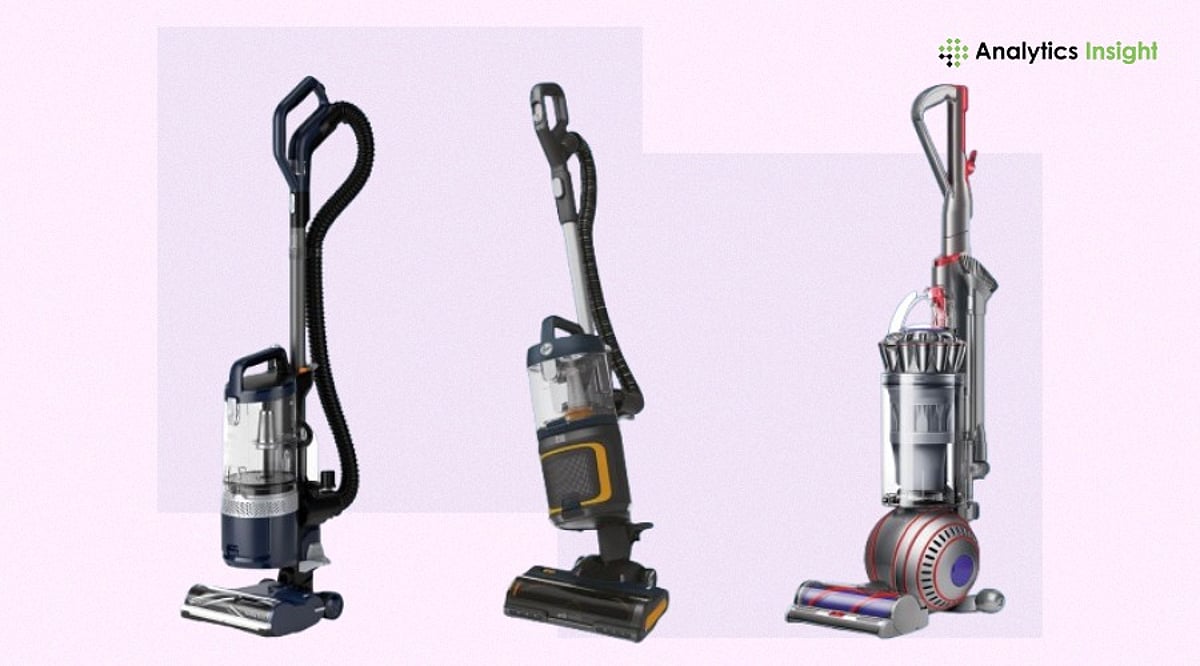
    The Shark Stratos Upright Vacuum handles large carpet areas and hard floors with ease, picking up more hair and dirt in one pass. It includes brush rolls that dig deep, a replaceable cartridge to prevent odors, and a detachable canister for cleaning stairs and furniture. A corded design ensures unlimited runtime.

    Bissell Cleanview Swivel Pet Vacuum

    Ideal for pet owners, the Bissell Cleanview Swivel Pet Vacuum offers triple-option brush rolls that loosen, lift, and remove stuck pet hair. It features scatter-free technology for wood and tile floors, swivel steering for tight spaces, and a TurboEraser tool for bedding and stairs.

    Miele Complete C3 Calima Canister Vacuum

    This German-engineered bagged vacuum excels on hard floors and low-pile rugs. It has a 1,200-watt vortex motor, six-stage rotary suction control, a genuine HEPA AirClean filter (capturing 99.95% of microscopic particles), and an AirTeq floorhead system with a foot-switch for surface transitions.

    iRobot Roomba Max 705 Robot

    The iRobot Roomba Max 705 is a premium robot vacuum with smart obstacle detection, advanced mapping, and self-emptying dust disposal. It avoids cables, shoes, and furniture in real time, and its high-lift suction combined with dual rubber brushes ensures thorough cleaning. It works with Alexa, Google Assistant, and Siri Shortcuts.

    Final Thoughts

    Dyson V15 is ideal for quick daily pickups; Shark Stratos is a corded workhorse for heavy-duty carpet cleaning; Bissell Cleanview is a budget-friendly champion for pet owners; Miele Complete C3 is a top choice for allergy sufferers; and iRobot Roomba Max 705 offers hands-free automated maintenance. Modern vacuum cleaners redefine home cleaning with smart features and robotic technology.

    FAQs

    1. Which vacuum cleaner is the best in 2026? The best depends on your needs. Dyson V15 Detect Plus excels in cordless power, while iRobot Roomba Max 705 offers full automation.
    2. Which is best for homes with pets? The Bissell Cleanview Swivel Pet Vacuum with specialized brush rolls and scatter-free technology effectively removes pet hair from floors and stairs.
    3. Are robot vacuums worth buying in 2026? Yes. Modern models like the iRobot Roomba Max 705 feature smart navigation, obstacle detection, automatic mapping, and voice assistant compatibility.
    4. What features should I look for? Consider suction power, filtration system, battery life, smart features, weight, floor compatibility, pet-hair performance, and maintenance requirements.
    5. Which vacuum is best for allergy sufferers? The Miele Complete C3 Calima Canister Vacuum with its HEPA AirClean filter and sealed bag system is a top choice.
  • Revolutionizing Visa Applications: How AI Streamlines the Process for Indian Travelers

    Revolutionizing Visa Applications: How AI Streamlines the Process for Indian Travelers

    The process of traveling abroad—whether for leisure, business, education, or visiting relatives—has never been simpler for Indian tourists. While booking flights and accommodations can take just minutes, the visa application process remains a time-consuming and stressful endeavor. Collecting required documents, understanding each country’s specific requirements, filling out forms correctly, and tracking application status can be daunting.

    Fortunately, artificial intelligence is radically changing that. By automating processes, validating documents, and providing step-by-step assistance, AI makes the visa application process faster and less intimidating.

    Challenges Faced by Indian Travelers

    Every nation has its own visa requirements and application procedures. A small mistake—such as uploading the wrong document or filling in a field incorrectly—can lead to delays or requests for additional information. Common challenges include:

    • Navigating country-specific document requirements
    • Organizing financial and supporting documents
    • Filling out lengthy application forms accurately
    • Tracking the status of submitted applications
    • Dealing with multiple document formats (PDF, scans, photos)

    For those juggling work, studies, or family obligations, these tasks can become overwhelming.

    The Role of AI in Streamlining Visa Applications

    Artificial intelligence simplifies the visa application process by reducing manual tasks. Advanced AI guides users through every step, from initial document preparation to final submission. Current systems can analyze uploaded documents, identify gaps, and flag potential errors before submission. AI also provides personalized checklists based on the traveler’s destination and visa type.

    Automated Document Validation

    Document preparation is often the most time-consuming part of visa applications. Travelers must ensure that passports, financial records, identification papers, photographs, and letters of invitation are correct and complete. AI-powered validation tools automatically check documents for errors, missing pages, or inconsistencies. Instead of receiving a rejection notice after submission, travelers get real-time feedback and can fix issues immediately.

    Enhancing Transparency Throughout the Process

    One of the biggest frustrations for applicants is the lack of clarity after submitting documents. Travelers often wonder if more information is needed and when a decision will be made. AI-based platforms solve this by offering centralized dashboards that track status, send notifications, and provide updates on any changes. This transparency helps travelers—especially business travelers and families with fixed trip dates—plan more effectively.

    Visarun AI: An Example in Action

    Visarun AI is a prime example of how artificial intelligence can make visa applications easier for travelers. This AI-enabled B2C platform simplifies the entire process, from preparing the application and organizing documents to tracking status and receiving updates. Rather than leaving travelers to navigate complex requirements alone, Visarun AI uses automation to guide them step by step.

    Advantages Beyond Faster Processing

    In addition to reduced processing time, AI offers several other benefits:

    • Less paperwork and manual effort
    • Greater accuracy in documentation
    • Tailored assistance based on the traveler’s profile
    • Shorter preparation time
    • Increased transparency about application progress
    • Reduced stress during the entire visa process

    These benefits are especially valuable for first-time international travelers.

    The Future of AI in Travel

    Artificial intelligence is expected to play an even larger role in international travel in the coming years. Future advancements may include multilingual assistance, better document recognition, predictive process improvements, and personalized travel recommendations. AI does not replace immigration officials but works alongside existing systems to produce better-prepared applications that are easier to evaluate. As governments worldwide continue digitizing their processes, AI travel assistants will become as common as booking flights, arranging accommodations, and purchasing insurance.

    Conclusion

    For Indian citizens, securing a visa has traditionally involved extensive paperwork, diligence, and uncertainty. Artificial intelligence is revolutionizing this process by automating checks, simplifying document preparation, and increasing transparency. With tools like Visarun AI, travelers can now streamline the visa application process, avoid common mistakes, and minimize stress.

  • AI Assistants Revolutionize the In-Car Experience: From Voice Commands to Natural Conversations

    AI Assistants Revolutionize the In-Car Experience: From Voice Commands to Natural Conversations

    The era of frustrating voice commands in cars is ending. Major automakers are replacing rigid rule-based systems with conversational AI assistants powered by large language models (LLMs). This shift promises to transform vehicles from mere transportation into intelligent digital companions.

    The in-car voice assistant market is projected to grow from $3.27 billion in 2026 to $5.49 billion by 2029, at a compound annual growth rate of 13.9%, according to The Business Research Company. This growth is fueled by new capabilities and fierce competition among automakers to secure the best AI partners.

    From Rigid Commands to Natural Conversation

    Traditional voice assistants required memorized phrases and often failed. Modern LLM-based systems understand context, prioritize results, and handle multi-step requests. For example, a driver can say, “Take me to the nearest coffee shop and text my mom I’ll be late,” then follow up with, “Actually, make it one with outdoor seating,” without repeating context.

    This capability depends on a pipeline of technologies: Automatic Speech Recognition (ASR), Natural Language Understanding (NLU), and real-time data from maps, weather, charging-station APIs, and vehicle sensors. For EV owners, this means asking about a nearby fast charger and receiving live availability, pricing, and operating hours in one exchange.

    Major Automaker-AI Partnerships Reshaping Dashboards

    Automakers are choosing different AI partners:

    • General Motors integrates Google’s Gemini into Buick, Chevrolet, Cadillac, and GMC vehicles with “Google built-in,” leveraging its OnStar network. Nearly four million cars in the US are affected.
    • Mercedes-Benz incorporates ChatGPT via Microsoft Azure OpenAI Service into its MBUX Voice Assistant, enabling open-ended question answering with Bing search.
    • BMW integrates Amazon’s Alexa+ into its Intelligent Personal Assistant, launching with the new iX3 at CES 2026 and expanding to 40 models by 2027.
    • Tesla uses xAI’s Grok.
    • Stellantis partners with French AI company Mistral.
    • Lucid teams up with SoundHound.

    Each approach is unique: GM uses its connectivity history to scale Gemini; BMW focuses on continuity across devices; Mercedes emphasizes knowledge depth. No single standard has emerged.

    What These Assistants Can Actually Do Behind the Wheel

    Beyond trivia, these systems perform context-aware tasks. BMW’s Alexa+ can adjust cabin temperature and find Italian restaurants along a route from a single sentence. Mercedes partners with Liquid AI to run parts of the assistant on-device for low-latency responses. GM envisions a future where drivers ask specific questions about vehicle parts and systems, answered by an assistant fine-tuned on proprietary data. Some automakers layer assistants over driver-assistance functions, allowing voice control of driving modes, diagnostics, and maintenance alerts.

    Real Challenges Behind the Conversational Upgrade

    LLMs can hallucinate, producing confident but incorrect answers—problematic for navigation or safety. Most systems rely on cloud connectivity, introducing latency and failure in poor signal areas (hence on-device processing experiments). Data privacy concerns have grown, prompting GM to commit to opt-in consent and no data selling. Driver reception is mixed; some worry about accidental activation or unwanted processing of everyday conversations. Automakers emphasize that microphones require explicit wake words or button presses, and core functions work without linking AI accounts.

    Where In-Car AI Goes From Here

    The current wave is a stepping stone. GM’s Gemini rollout is interim; a proprietary OnStar-trained assistant is planned. Automakers are linking conversational AI to advanced driver-assistance systems, predictive maintenance, and autonomous driving. As competition among Google, OpenAI, Amazon, xAI, and Mistral plays out across dashboards, cars become connected devices in a digital ecosystem. Over-the-air updates will allow continuous improvement, unlike traditional fixed infotainment systems. The next two to three years will reveal whether this leads to safer, more useful driving companions or more sophisticated distractions.

  • NYT Strands July 8, 2026: Hints, Spangram, and Answers for ‘Here Comes Trouble’

    NYT Strands July 8, 2026: Hints, Spangram, and Answers for ‘Here Comes Trouble’

    Welcome back to our daily NYT Strands guide. Today’s theme revolves around ‘playful troublemakers’. Think of playful troublemakers and cheeky characters as you work through today’s puzzle. The Spangram starts close to the left side of the grid. Hints and clues have been listed below, or you can head straight to the answer key.

    What is NYT Strands and How to Play It

    If you’re new to NYT Strands, here’s a quick overview of how the game works. The game combines elements of the NYT Crossword, Connections, and Spelling Bee. Players are given letters on a 6×8 board, along with a daily theme as a hint. NYT Strands is an engaging daily word puzzle that challenges players’ vocabulary and pattern-recognition skills.

    NYT Strands Hints for Today

    Here are some words that can serve as hints to find the answers:

    • Snap
    • Spit
    • Pits
    • Reel
    • Sale
    • Real
    • Scam

    Spangram Reveal and Explanation

    Today’s Spangram is LITTLEDEVIL. To find it, start with the L that is four letters down on the far-left row, and wind over. Is that a devil-horn shape it makes? Pretty clever! Calling someone a ‘little devil’ is just a playful way to describe a mischievous kid or a cheeky older guy. Obviously, the literal words sound pretty dark—like you are talking about an actual evil spirit—but in real life, it is always used affectionately. It is all about pointing out someone’s playful, troublesome side without meaning they have any actual malice or bad intent.

    Tips for Solving NYT Strands

    Here are a few simple tips that can help you solve NYT Strands more quickly. First, identify the theme. Start by thinking about words related to today’s theme, ‘Here comes trouble.’ Another helpful tip is to look for long words stretching across the edges of the grid, as they often form the Spangram.

    NYT Strands Answers for Today

    Here are all the non-Spangram answers for July 8:

    • Scamp
    • Hellion
    • Rapscallion
    • Whippersnapper

    Understanding the Theme for Today

    ‘Here comes trouble’ is a playful or warning phrase used to announce the arrival of someone known to cause mischief, minor problems, or bring excitement. The exact tone depends heavily on context, ranging from an affectionate, teasing greeting to a sarcastic caution.

    Check out the image below to learn how to solve today’s puzzle. Also read: NYT Wordle Hints and Answers for July 7, 2026: Strategy & Expert Walkthrough.

  • NYT Mini Crossword Solved: July 8, 2026 Answers and Hints

    NYT Mini Crossword Solved: July 8, 2026 Answers and Hints

    The New York Times Mini Crossword for Wednesday, July 8, 2026, offers a quick yet engaging mix of pop culture references, everyday vocabulary, and clever wordplay. Below you’ll find all across and down answers, along with brief explanations to help you understand each clue.

    Across Clues and Answers

    • 1 Across: Hairstyle for Jimi Hendrix — AFRO
    • 5 Across: Snow-clearing vehicle — PLOW
    • 6 Across: Headwear for a monarch — CROWN
    • 7 Across: Car part that can be ‘popped’ — HOOD
    • 8 Across: Iconic film character with a fedora, familiarly — INDY

    Down Clues and Answers

    • 1 Down: Chef’s garment — APRON
    • 2 Down: Biblical phenomenon caused by 40 days of rain — FLOOD
    • 3 Down: Obstreperous — ROWDY
    • 4 Down: “Mind your ____ beeswax!” — OWN
    • 6 Down: Invisible life force, in Chinese philosophy — CHI

    Puzzle Highlights

    Today’s grid balances straightforward clues with a few trickier entries. Music fans will spot the AFRO reference to Jimi Hendrix, while movie buffs will appreciate INDY for Indiana Jones. Words like ROWDY and CHI add a touch of challenge. The Mini remains a favorite daily brain teaser that pairs well with other NYT Games such as Wordle, Connections, Strands, and Spelling Bee.

    Whether you solved it in seconds or needed a few hints, every completed puzzle sharpens your vocabulary and mental agility. A new Mini Crossword arrives tomorrow, so stay tuned for another quick challenge.

  • Indian Stock Market Tumbles: Sensex Drops to 76,504, Nifty Falls Below 23,900 Amid US-Iran Tensions

    Indian Stock Market Tumbles: Sensex Drops to 76,504, Nifty Falls Below 23,900 Amid US-Iran Tensions

    Indian benchmark indices closed sharply lower on Wednesday as renewed US-Iran tensions triggered a broad market sell-off, pushing the Sensex down 1,677 points to 76,503.60 and the Nifty 50 down 516 points to 23,882.05. Rising crude oil prices, a stronger dollar, and weak global cues fueled risk aversion across sectors.

    Market Overview

    The trading session started cautiously with the Sensex slipping to around 77,650 and the Nifty falling below 24,250. However, a late-session sell-off deepened losses, with the Nifty crashing below 23,900. The India VIX surged nearly 28% to 14.88, signaling heightened investor nervousness.

    Sectoral Performance

    All major sectoral indices ended in the red. The Nifty PSU Bank index fell 2.7%, followed by Nifty Bank (-2.26%), Oil & Gas (-2.22%), Private Bank (-2.19%), and FMCG (-2.19%). Broader markets also suffered, with the Nifty Midcap 100 declining 1.5% and the Nifty Smallcap 100 dropping 2.2%. Market breadth was weak, with over 3,000 stocks declining.

    Stocks in Focus

    Gainers: ONGC gained 0.61%, Bajaj Auto advanced 0.33%, and Wipro added 0.25% — the only Nifty 50 stocks in positive territory. Unichem Laboratories surged 20% to lead broader market gainers.

    Losers: Shriram Finance slumped 4.51%, InterGlobe Aviation fell 4.48%, Maruti Suzuki dropped 3.48%, and Bajaj Finance declined 3.20%. Jio Financial Services fell over 5%.

    Currency and Commodity Impact

    The Indian rupee weakened 0.67% to 95.55 against the US dollar, pressured by rising crude oil prices and a stronger dollar. Crude oil surged 6.27% to $74.86 per barrel after US President Donald Trump declared the ceasefire with Iran over, intensifying supply concerns.

    Corporate Highlights

    Restaurant Brands Asia: Completed a Rs. 2,235 crore deal with Inspira Global, which now holds a 41.78% stake.

    Knack Packaging: Listed at an 11% premium over its IPO price.

    Cochin Shipyard: The government will exercise the oversubscription option for its OFS after strong investor demand.

    Inox India: Secured fresh orders worth Rs. 939 crore since May 21.

    SEPC: Approved acquisition of up to 90% stake in Abu Dhabi-based Avenir International for Rs. 1,530 crore.

    Uno Minda: Announced Rs. 320 crore investment in a new passenger vehicle seating plant.

    Marksans Pharma: To acquire 100% of Germany-based ABCnow GmbH for €0.9 million.

    Analyst Outlook

    Market experts noted that the Nifty’s sharp fall below key support levels has weakened the short-term technical outlook. Analysts recommend a sell-on-rallies approach until benchmark indices reclaim crucial resistance zones, while closely monitoring geopolitical developments and crude oil prices.

    Disclaimer: This article is for informational purposes only and does not constitute investment advice. Readers should conduct their own research before making any investment decisions.