
Category: Mechanical Engineering

  • Laser Cutting for Beginners: A Complete Guide to the Technology, Types, and Safety

    Laser Cutting for Beginners: A Complete Guide to the Technology, Types, and Safety

    What Is Laser Cutting?

    Laser cutting is a precision technology that employs a focused beam of light to cut, engrave, or etch materials with remarkable accuracy. Unlike traditional blades or routers, the laser never makes physical contact with the material—it melts, burns, or vaporizes it along a programmed path, producing clean edges and intricate details that manual tools cannot replicate.

    What once required a factory floor now fits on a desk. Today, a desktop laser cutter can transform a digital design into a finished object in minutes: custom wood signage, engraved leather wallets, or precision-cut acrylic parts. The technology is now accessible to hobbyists, small business owners, and educators alike.

    How Does Laser Cutting Work?

    The process is straightforward once you grasp the basics. A laser source generates a concentrated beam of light. A lens system focuses that beam down to a tiny point—often thinner than a human hair. A CNC motion system then guides the focused beam along the paths defined in your design file (typically an SVG or DXF). Where the beam meets the material, temperatures spike high enough to vaporize or melt it instantly, creating your cut or engraved line.

    Most machines also use air assist—a stream of compressed air aimed at the cutting zone. This prevents flare-ups, blows away debris, and keeps the lens clean for consistent results.

    Types of Laser Cutting Machines

    Not all lasers are created equal. The three main types serve very different purposes:

    • CO₂ lasers: The workhorse for most makers. They deliver clean cuts on the widest range of non-metal materials and are available in both industrial and desktop form factors.
    • Diode lasers: The most affordable entry point. They handle engraving and thin material cutting well but lack the power for thicker stock.
    • Fiber lasers: Built for metal. They cut significantly faster than CO₂ on steel and aluminum but at a much higher price.

    Across all three categories, the trend is clear: desktop laser cutting machines are getting more precise and easier to use. New entrants like the Bambu Lab R1 laser cutter exemplify this shift, bringing pro-level accuracy to a compact, beginner-friendly form factor.

    What Materials Can You Laser Cut?

    One of the biggest draws of laser cutting is the variety of materials you can work with:

    • Wood: Plywood, MDF, birch, basswood—maker favorites that cut cleanly and develop attractive charred edges.
    • Acrylic: Cast acrylic produces polished, crystal-clear edges straight off the machine.
    • Leather: Real vegetable-tanned leather cuts and engraves beautifully.
    • Fabric: Cotton, felt, denim—natural fibers cut without fraying.
    • Paper & cardboard: Ideal for prototyping and intricate paper art.

    For engraving only (not cutting through): glass, ceramic tile, anodized aluminum, and coated metals.

    ⚠️ Never laser cut PVC, vinyl, or ABS. These materials release toxic chlorine or cyanide gas that is hazardous to breathe and will corrode your machine.

    Laser Cutting vs. Laser Engraving

    Most laser cutters are actually two tools in one:

    • Cutting sends the beam all the way through the material, separating pieces along vector paths. You use higher power and slower speed.
    • Engraving removes only the surface layer, creating texture, contrast, or images through a raster scanning motion—similar to how an inkjet printer moves back and forth.

    A typical workflow: engrave first (while the piece is still flat and stable), then cut the outline to release the finished part.

    How to Use a Laser Cutter: From Design to Finished Piece

    Here is the step-by-step process most beginners follow:

    1. Design your project in vector software (Adobe Illustrator, Inkscape, or even Canva for simple shapes).
    2. Export your file as SVG or DXF—the two formats laser software reads.
    3. Import into your laser’s software and set parameters: power, speed, and number of passes.
    4. Test cut on a scrap piece of the same material to dial in settings.
    5. Run the full job and remove your finished piece.

    The key settings to learn: Power controls beam intensity, Speed controls how fast the head moves, and Passes means how many times the laser traces the same path. Two moderate passes often give cleaner edges than one aggressive cut.

    Safety Tips Every Beginner Should Know

    Laser cutting is safe when you follow basic precautions:

    • Ventilation is non-negotiable. Always use an exhaust system or operate near an open window. Cutting wood and acrylic produces smoke and fumes.
    • Wear laser safety glasses rated for your machine’s wavelength.
    • Never leave a running machine unattended. Materials can ignite, especially paper, cardboard, and thin fabrics.
    • Check your material before cutting. If you are unsure whether it contains PVC or chlorine-based coatings, do not cut it.

    Frequently Asked Questions

    What does laser cutting do?

    It uses a focused beam of light to cut through or engrave materials like wood, acrylic, leather, and fabric. The process is CNC-controlled, meaning a computer guides the laser along your exact design paths.

    What is the laser cutting process?

    A laser beam is generated, focused through a lens, and directed along programmed paths on the material. The intense heat vaporizes or melts the material, creating precise cuts or surface engravings.

    How much does it cost to get something laser cut?

    Professional laser cutting services typically charge per minute of machine time, or by material area. For frequent use, a desktop laser cutter pays for itself quickly—entry-level diode machines start around a few hundred dollars, while more capable desktop systems range from $1,000 to $5,000+.

    What should you not cut with a laser?

    Never cut PVC, vinyl, ABS, polystyrene foam, or fiberglass. These materials release toxic fumes that are dangerous to inhale and can damage your equipment.

  • 10 Revolutionary Capabilities of Liquid Robots Transforming Science and Medicine

    10 Revolutionary Capabilities of Liquid Robots Transforming Science and Medicine

    Imagine a robot that can squeeze through a crack under a door, reform itself after being cut in half, and deliver medicine precisely to a tumor inside your body. This isn’t science fiction—it’s the emerging field of liquid robotics. Using materials like ferrofluids, liquid metals, and hydrogels, researchers are creating flexible, adaptive machines that defy traditional mechanical limitations. Here are ten astonishing things these liquid robots can already do or are being developed to accomplish.

    1. Shape-Shifting for Confined Spaces

    Liquid robots can alter their shape to squeeze through tiny openings and navigate complex, cluttered environments. This ability makes them ideal for search-and-rescue operations, pipe inspections, and medical procedures requiring navigation through narrow blood vessels.

    2. Targeted Drug Delivery

    Scientists are designing liquid robots that carry therapeutic payloads directly to diseased organs or tumors. By controlling their movement with magnetic fields or chemical gradients, these robots could dramatically improve treatment precision while minimizing systemic side effects.

    3. Minimally Invasive Surgery

    Tiny liquid robots could assist surgeons in performing delicate procedures inside the human body with unprecedented flexibility. They might deliver tools, clear blockages, or even perform micro-suturing through natural openings, reducing the need for invasive incisions.

    4. Self-Healing Capabilities

    Unlike conventional machines that break when damaged, liquid robots can merge back together after being cut or separated. Their ability to re-form and continue functioning without manual intervention promises greater durability in harsh environments.

    5. Adaptive Obstacle Navigation

    The flexible, deformable nature of liquid robots allows them to flow around barriers, through narrow gaps, and along uneven surfaces. This gives them a mobility advantage over rigid robots in environments like disaster rubble or industrial piping.

    6. Safe Hazardous Inspections

    Liquid robots can be deployed into radioactive zones, chemical plants, or disaster areas where human presence is dangerous. They can sample toxic materials, measure radiation levels, or assess structural integrity without risking human lives.

    7. Environmental Cleanup

    Researchers envision liquid robots that absorb oil spills, heavy metals, or microplastics from water and soil. Their ability to navigate hard-to-reach ecosystems—such as marshes, coral reefs, or groundwater—makes them powerful tools for environmental restoration.

    8. Precision Micro Manufacturing

    Liquid robots can manipulate and assemble microscopic components with exceptional accuracy. This capability could revolutionize semiconductor fabrication, medical device production, and the assembly of next-generation electronics at scales impossible for human hands or traditional machines.

    9. Extreme Environment Adaptation

    Because liquid robots can operate in extreme temperatures, pressures, and corrosive conditions, they are being explored for use in deep-sea exploration and volcanic monitoring. Their resilience opens new frontiers for scientific discovery.

    10. Space Exploration

    Future planetary missions may deploy liquid robots that reconfigure themselves to navigate rocky terrain, enter caves, or withstand temperature swings on Mars or the Moon. Their versatility could make exploration safer and more efficient, gathering samples from places traditional rovers cannot reach.

    Liquid robots are still largely in the research phase, but their potential spans healthcare, manufacturing, environmental remediation, and space travel. As material science and control systems advance, these remarkable machines will likely become a staple of the technological landscape.

  • How Ceramic Heating Technology Is Transforming Vape Hardware Through Application-Specific Engineering

    How Ceramic Heating Technology Is Transforming Vape Hardware Through Application-Specific Engineering

    Key Takeaways

    • A ceramic vape coil is a system of porous material, electrical heating, liquid delivery and airflow—not a single interchangeable part.
    • Pore structure influences how quickly oil reaches the heating area, while thermal properties affect how evenly heat spreads.
    • Different oil profiles can require different inlet, ceramic, power and airflow parameters.
    • Postless designs change the internal architecture but still require complete-device testing.
    • B2B buyers should validate hardware with the exact formulation, filling process and storage conditions intended for launch.

    What Is Ceramic Heating Technology?

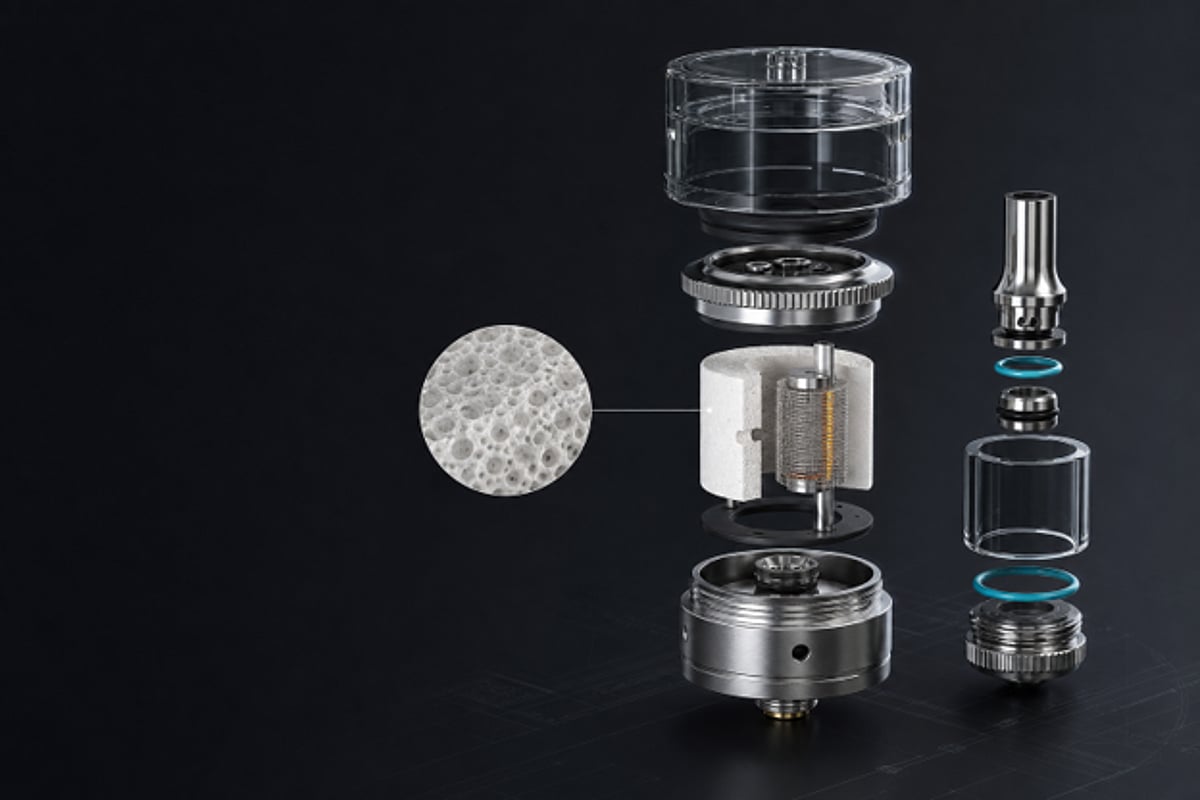
    A ceramic heating system usually combines a porous ceramic body with an embedded, wrapped or surface-mounted conductive element. When electrical power reaches the element, heat moves through the ceramic and into the oil held near its surface. The pores also support capillary movement, helping replenish oil at the heating area.

    This dual role—liquid transport and heat distribution—is why ceramic has become important in compact vaporizer hardware. Metal coils and cotton-based structures can also vaporize oil, but engineered ceramic creates additional options for controlling pore size, shape, heating area and material contact.

    The word “ceramic” still covers a broad range of constructions. Two cores may look similar while using different formulations, densities, coil materials or heating geometries. Buyers should therefore examine how a core is designed for its application rather than treating the material name as proof of a specific outcome.

    Why One-Size-Fits-All Heating Systems Have Limits

    Oil formulations differ in viscosity, composition and temperature sensitivity. A system that supplies a relatively fluid distillate at an appropriate rate may not feed a thicker rosin in the same way. Increasing power to compensate can create new problems if the oil cannot reach the heating area quickly enough.

    Capacity also matters. Hardware designed for a smaller reservoir may experience a different operating pattern from a high-capacity device used for longer sessions. Heat can accumulate, the oil level changes over time and the distance between the remaining material and the inlet may become more important.

    A universal core must compromise across these conditions. Application-specific hardware can instead tune several variables together:

    • pore size and distribution;
    • oil-inlet geometry;
    • coil material and shape;
    • active heating area;
    • voltage, resistance and power;
    • airflow and activation behavior; and
    • reservoir structure and capacity.

    The objective is not to maximize any one specification. It is to keep liquid delivery, heat generation and airflow in balance across the intended operating range.

    The Materials Science Behind Porous Ceramic

    The ceramic body performs more than one task, and three material characteristics are especially important.

    Pore Structure

    Interconnected pores allow oil to move through the ceramic toward the heated surface. If the structure supplies oil too slowly for the power and usage pattern, the heating area can become under-supplied. If liquid movement is too aggressive for the device architecture, the system may become more difficult to control during storage or between activations.

    Pore size is therefore not simply “larger is better.” Engineers consider the distribution and connectivity of pores as well as the target formulation. The ideal structure is application dependent.

    Thermal Behavior

    Thermal conductivity and heat capacity influence how quickly the core warms and how heat spreads. Localized hot spots can expose a small area to disproportionate thermal load, while a more controlled distribution can use the available surface more effectively.

    The surrounding hardware also affects thermal behavior. The center structure, tank, seals and enclosure can absorb or retain heat. A core cannot be evaluated independently from the complete device.

    Mechanical Strength

    Porosity creates liquid pathways, but it can also influence material strength. A core must tolerate manufacturing, assembly, shipping and normal operation without cracking. Ceramic formulation, firing conditions, geometry and handling procedures all contribute to mechanical reliability.

    This creates a classic materials-engineering tradeoff: the pore network must support the formulation while the structure remains suitable for repeatable production.

    How Coil Geometry Changes Heat Distribution

    The conductive element determines where electrical energy becomes heat. Traditional spiral patterns, mesh structures and multi-zone layouts produce different heat maps. The choice affects warm-up behavior, active surface area and the concentration of thermal energy.

    A larger heating area can spread energy, but it also changes power requirements. A fast-heating structure may improve response, yet it must remain synchronized with liquid supply. Multi-zone concepts can create areas that operate at different thermal intensities, helping engineers manage both vapor generation and temperature-sensitive components of a formulation.

    For buyers, the relevant question is not which geometry sounds most advanced. It is whether the supplier can explain why a particular geometry, resistance and power profile were selected for the intended oil and device capacity.

    The Future of Ceramic Heating Technology

    The next phase is likely to bring greater specialization rather than one dominant core. Engineers can tune pore structures for defined viscosity ranges, use more deliberate heating maps and connect the core more closely with airflow and power control. Digital simulation and manufacturing data may help narrow prototypes and identify production drift, but physical formulation testing will remain essential.

    Material efficiency will also matter. Designers will face pressure to reduce unnecessary parts, improve assembly consistency and communicate disposal responsibilities for devices that combine batteries, electronics and mixed materials.

    Ceramic heating is therefore becoming a platform discipline. Competitive advantage will come from understanding the relationship between material science and the complete product—not from placing the word “ceramic” on a specification sheet. CILICON continues to develop ceramic heating technology around formulation-specific requirements, device architecture and complete-system performance.

    Frequently Asked Questions

    What is a ceramic vape coil?

    It is a heating component that uses engineered ceramic—often porous—to support oil transport and distribute heat from an electrical element. Its behavior depends on the ceramic, coil, power, airflow and formulation.

    Are all ceramic heating systems the same?

    No. Ceramic composition, pore structure, coil geometry, resistance, active area and surrounding hardware can differ substantially.

    Why does oil viscosity matter?

    Viscosity affects how quickly oil moves through inlets and porous material. The supply rate must remain coordinated with the amount of heat and the device’s operating pattern.

    What is postless vape hardware?

    It is an architecture that removes the conventional center post from the reservoir area and redistributes its airflow, electrical or structural functions elsewhere in the device.

    Does higher wattage always improve performance?

    No. Additional power can create more heat, but the formulation, liquid supply, heating area, airflow and materials must support it. Balanced engineering is more important than a single maximum value.

    How should brands compare ceramic hardware samples?

    They should use the same formulation, filling procedure, conditioning period, storage conditions and documented evaluation criteria across multiple units.

  • MIT’s New Manufacturing Initiative Gains Traction with Industry, Workforce, and Startup Programs

    MIT’s New Manufacturing Initiative Gains Traction with Industry, Workforce, and Startup Programs

    In its first year, the Initiative for New Manufacturing (INM) at MIT has built significant momentum by bridging research, workforce development, and industry engagement to accelerate the deployment of advanced manufacturing technologies. The initiative marked its first anniversary with MIT Manufacturing Week in May 2026, attracting over 800 registrants—including students, faculty, industry leaders, investors, entrepreneurs, and government officials—for four days of workshops, symposia, and discussions on AI in factories, startup innovation, and workforce solutions.

    “INM launched a year ago with the premise that strengthening the industrial base needed a coordinated response, and MIT has a responsibility to lead it,” said Paula T. Hammond, dean of MIT’s School of Engineering and co-chair of INM’s Steering Committee. “The response and participation level has been huge. MIT Manufacturing Week proved that the appetite for change—from students to chief executives—is real and urgent.”

    Manufacturing Week Highlights

    Manufacturing Week opened with a cybersecurity workshop co-led by INM and Google Cloud for industry members. It continued with the MIT MIMO (Machine Intelligence for Manufacturing Operations) symposium on deploying AI on factory floors, alongside sessions on workforce development, emerging technologies, startups, and industrial transformation. The week closed with a regional research showcase and competition featuring more than 140 graduate students and postdocs from across New England.

    Over the past year, INM also hosted a distinguished speaker series with manufacturing leaders including Keith Flynn (Anduril), Roland Busch (Siemens), and Venky Alagirisamy (Nike).

    Fostering New Manufacturing Startups

    A central goal of INM is to help students see manufacturing as a frontier for scientific discovery, technological innovation, entrepreneurship, and societal impact. The initiative partnered with NSF I-Corps New England to host its first manufacturing research showcase. More than 140 teams from 17 universities applied; 40 finalist teams received mentorship, and eight teams shared $50,000 in prize funding.

    The top prize for “most transformative innovation” went to MIT PhD student Jake Read for “The End of G Code,” a project on modular machine control architectures. Vatsal Patel (MIT) and Joshua Grace (Yale) won the research excellence category for “VisFT,” scalable six-axis force-torque sensors. Project themes included AI tools for manufacturing, semiconductor process control, robotics, digital twins, new materials, additive manufacturing, next-generation shipbuilding, and biomanufacturing.

    “Entrepreneurship is a transformative pathway to take research to market, and to drive faster innovation and scale-up,” said John Hart, INM faculty co-director and head of MIT’s Department of Mechanical Engineering. “At INM’s inaugural research showcase, we had tremendous interest from universities across New England, along with enthusiastic participation from industry, investors, and experienced founders. We are excited to build on this success and work toward a nationwide program and platform for entrepreneurship and translation in manufacturing.”

    Growing Industry Consortium

    During Manufacturing Week, First Solar became INM’s eighth industry member, joining Amgen, Autodesk, GE Vernova, Flex, PTC, Sanofi, and Siemens. The consortium’s growth reflects a recognition that modern manufacturing challenges—supply chain resilience, workforce development, industrial competitiveness—require cross-sector collaboration. INM provides a platform to convene and develop solutions through workshops and working groups on cybersecurity, digital twins, AI agents in regulatory environments, and continuous innovation.

    “Our members see MIT as a partner that can help them both address today’s challenges and think far into the future,” said Rick Locke, dean of the MIT Sloan School of Management and co-chair of INM’s steering committee. “This kind of multi-industry engagement is unusual and powerful.”

    Research and Workforce Development

    INM issued a call for proposals on AI and automation, receiving an overwhelming response and funding eight seed research projects. The initiative plans to publish eight white papers in June as part of a broader study on the future of manufacturing. During MIT’s Independent Activities Period in January 2026, INM collaborated with NSF I-Corps to guide 13 early-stage teams through customer discovery via the I-Corps Spark program.

    Workforce development is a major focus. MIT launched the Technologist Advanced Manufacturing Program (TechAMP), led by Principal Research Scientist John Liu, to create a new generation of shop floor leaders at six sites across New England, including three community colleges. “INM has the potential to transform the national manufacturing workforce,” said Liu. “It will require deep engagement between how people learn and lead, and how firms adopt new technologies and transform. We’re just getting started.” INM is now exploring a national rollout of TechAMP and expansion into biomanufacturing and semiconductor manufacturing.

    On campus, INM supported student engagements including an AI and automation lunch series and a Factory Observatory program. This spring, students founded MIT’s first manufacturing club, holding its launch event during Manufacturing Week. “We’re thrilled students are taking the lead,” said Sloan associate professor and INM faculty co-director Karen Zheng. “It was really exciting to see a full room of 80-plus students across campus coming together for the kickoff event during the busiest final period of a semester. This speaks to the students’ enthusiasm.”

    Global Reach and Future Plans

    While focused on strengthening domestic manufacturing, INM aims for global impact. It is collaborating with NAMTECH in Ahmedabad, India, where students are now taking an adaptation of MIT’s “yo-yo course” (2.008: Design and Manufacturing II). Next year, INM plans to bring more manufacturing leaders to campus, offer additional programming for emerging entrepreneurs, graduate TechAMP’s first cohort, expand TechAMP to new states, grow the consortium, and deepen research into manufacturing productivity.

    “INM aims to be a catalyst for transforming manufacturing across the nation to drive innovation, economic growth, and new types of jobs,” said Chris Love, faculty co-director of INM. “MIT’s work on the PIE (Production in the Innovation Economy) study in 2013 highlighted the value of proximity between production and innovation. INM seeks to rekindle this relationship in manufacturing across the country.”

  • MIT Researchers Unveil New Method to Accurately Model Metal Alloy Behavior

    MIT Researchers Unveil New Method to Accurately Model Metal Alloy Behavior

    Companies working at the frontier of aerospace, energy, and computing are constantly searching for new materials to improve performance. However, understanding how these materials will behave inside rockets or on computer chips typically requires physically making and testing them first. This is because even the most powerful simulation techniques struggle to model the complex chemical arrangements found in most solid materials, adding significant costs and time to materials innovation.

    Now, a team of MIT researchers has developed a way to accurately model the behavior of metals, regardless of the complexity of their chemical arrangement. The core of the approach involves machine-learning models that accelerate and improve material simulations. The researchers enhanced these models by building training datasets that capture the diversity of atomic environments in chemically disordered materials.

    In a new paper published in Sciences Advances, the team demonstrated that their approach can accurately predict material properties for a diverse group of metal alloys under various conditions. They also showed how the method could be used to develop new materials, especially in scenarios where experimentation is expensive.

    “The focus of the paper is metallic alloys, but this could be adapted to other types of materials, like semiconductors,” says senior author Rodrigo Freitas, MIT’s TDK Career Development Professor in Materials Science and Engineering. “This is not specific to any one application — you could use this approach to create new sustainable steels, new materials for aerospace, and more. That’s what makes this exciting.”

    Modeling Metals

    Material properties are largely determined by the internal arrangement of their chemical elements. Even two materials with the same chemical composition can differ drastically — one might be brittle while the other deforms without breaking — depending on the atomic arrangement.

    Capturing that distinction requires simulating materials atom by atom. Researchers rely on models that describe how atoms interact. Over the last two decades, machine learning has become the most accurate way to build these models. Such models work well when chemical arrangements follow highly ordered patterns, but most solid materials are chemically disordered, with varying arrangements from one region to another.

    “The real challenge in our field is modelling these chemically disordered phases,” Freitas says. “Chemical disorder means there’s a huge variety of local chemical environments, which is hard for the machine-learning model to learn. This is a problem because every single metal we use in practice is chemically disordered.”

    The issue stems from a lack of representative training data for atom-by-atom simulations. The current leading approach uses brute force, often requiring over 100,000 hours of computation to create training data for a single material, and it does not transfer well when the material’s composition changes.

    Information Theory Approach

    In previous work, Freitas’ group developed a way to measure the chemical complexity of solid materials by analyzing the frequency and spacing of tiny groups of atoms. For this study, they used that capability to build better training datasets. They applied a mathematical approach known as information theory to generate datasets that capture a wider variety of local chemical environments inside disordered materials. The method works by swapping out atoms from samples to reduce repetition and expose the model to chemical environments it might otherwise miss.

    “We kept optimizing the training set so it captured as many different local environments as possible,” Freitas says. “If the same kind of environment showed up many times, we replaced redundant examples with ones the model hadn’t seen before. That makes the training set much more informative because each example adds something new.”

    When trained on the researchers’ datasets, the models predicted material properties more accurately than models trained using random sampling or another popular sampling method.

    “The starting point for all these atom-by-atom simulations is: Are you able to accurately describe the chemical bond between atoms?” Freitas explains. “If not, it can still teach you about materials in general, but it doesn’t tell you what will happen to specific materials in the real world. This approach makes the simulations high fidelity in terms of their chemistry, to better reflect what’s happening to materials.”

    The researchers applied their technique to create machine-learning training datasets for a group of chemically diverse metal alloys. Using a set of machine-learning models, they showed that models trained on their datasets are more accurate than much larger models created by companies like Google and Microsoft.

    From Lab to Industry

    The method works, in part, by capturing hidden patterns in the sample data — described as “subtle energetic biases toward certain local chemical configurations.” These small energetic differences determine which phases form in an alloy, how those phases change with temperature and composition, and ultimately what properties the material will have.

    As one test, simulations led by MIT PhD student Daniel Xiao showed that the team’s models could predict phase diagrams that closely matched experimental data. Phase diagrams map which phases are stable across different temperatures and chemical compositions, and they are a central tool for designing and processing alloys.

    “Phase diagrams are one of the main ways people connect materials modeling to real processing decisions,” Freitas says. “If you are welding, casting, or heat-treating an alloy, you need to know which phases are likely to form under different conditions. Our goal is to make these kinds of predictions accurate enough, and accessible enough, that they become part of how people design materials.”

    The researchers are now using the approach to study how changing an alloy’s composition affects mechanical properties and radiation tolerance, aiming to design materials that remain strong and damage-tolerant in harsh environments. They are also working to make the method easier to integrate with the tools and workflows materials engineers already rely on.

    “Industry isn’t going to change the way they do things if what you’re creating doesn’t fit into their existing operating procedures,” Freitas says. “The goal is to make these predictions useful in the places where materials decisions are actually made.”

    The research was supported by the U.S. Air Force Office of Scientific Research.

  • New Machine Learning Approach Accurately Predicts Metal Alloy Properties

    New Machine Learning Approach Accurately Predicts Metal Alloy Properties

    Companies in aerospace, energy, and computing constantly seek new materials to boost performance, but understanding how those materials will behave in real-world applications often requires costly and time-consuming physical testing. Traditional simulation techniques struggle to model the complex chemical arrangements found in most solid materials, particularly metal alloys. Now, MIT researchers have developed a method that accurately models the behavior of metals regardless of their chemical complexity.

    At the core of the approach are machine-learning models that simulate materials atom by atom. The researchers improved these models by building training datasets that capture the diversity of atomic environments in chemically disordered materials. Using information theory, they optimized the training sets to include a wider variety of local chemical configurations, replacing redundant examples with new ones to make the data more informative.

    In a paper published in Science Advances, the team demonstrated that their technique could accurately predict material properties for a diverse group of metal alloys under various conditions. The approach also showed promise for developing new materials, especially in scenarios where experimentation is expensive.

    “The focus is metallic alloys, but this could be adapted to other materials like semiconductors,” says senior author Rodrigo Freitas, MIT’s TDK Career Development Professor in Materials Science and Engineering. “You could use this approach to create new sustainable steels, new materials for aerospace, and more.”

    The researchers applied their technique to create machine-learning training datasets for several chemically diverse alloys. Models trained on these datasets outperformed larger models from companies like Google and Microsoft in accuracy. The team also validated their predictions against experimental data on atomic ordering in alloys.

    One key test involved predicting phase diagrams—maps showing which phases of an alloy are stable at different temperatures and compositions. The models closely matched experimental data, a crucial step for connecting materials modeling to real-world processing decisions like welding, casting, or heat-treating.

    The researchers are now using the method to study how changing an alloy’s composition affects mechanical properties and radiation tolerance, aiming to design materials that remain strong and damage-tolerant in harsh environments. They also plan to make the approach easier to integrate with existing tools used by materials engineers.

    “Industry isn’t going to change the way they do things if what you’re creating doesn’t fit into their existing operating procedures,” Freitas notes. “The goal is to make these predictions useful where materials decisions are actually made.”

    The research was supported by the U.S. Air Force Office of Scientific Research.

  • MIT Mechanical Engineering Department News: Pioneering Research, Rankings, and Innovations in 2026

    MIT Mechanical Engineering Department News: Pioneering Research, Rankings, and Innovations in 2026

    MIT Mechanical Engineering: A Hub of Innovation

    MIT’s Department of Mechanical Engineering continues to be a global leader in engineering education and research. In 2026, the Institute once again topped the QS World University Rankings as the No. 1 university, marking its 15th consecutive year at the pinnacle. The department itself advanced breakthroughs in biomedicine, manufacturing, climate technology, and student-led initiatives.

    Top Stories from MIT Mechanical Engineering

    QS Ranks MIT World’s No. 1 University for 2026-27

    For the 15th year in a row, MIT secured the top spot in the QS World University Rankings, also placing first in 12 subject areas. The ranking reflects the Institute’s sustained excellence across disciplines.

    MIT’s Initiative for New Manufacturing Builds Momentum

    In its first year, the Initiative for New Manufacturing (INM) has accelerated research, workforce development, and industry engagement to bring new manufacturing technologies to real-world deployment.

    The Tenured Engineers of 2026

    Ten faculty members across MIT’s School of Engineering received tenure in 2026, including several from the Department of Mechanical Engineering, highlighting the strength of the academic community.

    Ingestible Sensor Measures Temperature Inside the Body

    MIT engineers developed a tiny ingestible sensor that can continuously monitor body temperature from inside the gastrointestinal tract, offering a noninvasive way to track patients at risk of hypothermia.

    Drug Delivery Directly to the Esophagus

    A new gel-like drug formulation coats the esophageal lining, enabling targeted treatment for inflammatory conditions affecting the esophagus. This innovation could improve patient outcomes and reduce side effects.

    Hertz Foundation Fellowships Awarded to MIT Affiliates

    Several MIT affiliates received 2026 Hertz Foundation Fellowships, supporting doctoral students tackling pressing challenges in science and technology.

    Innovative Projects to Combat Extreme Heat

    With seed funding from MIT’s Climate Project, researchers are exploring low-cost personal cooling and emissions-free air conditioning as part of broader efforts to address extreme heat.

    Novel Carbon Capture Methods

    MIT researchers developed an efficient, flexible alternative to conventional carbon capture, offering a promising pathway to reduce atmospheric CO₂.

    Ambassadors of STEM: Promoting Hands-On Education

    A new student club for FIRST Robotics alumni aims to enhance K-12 STEM education through hands-on activities and mentorship.

    Ultrasound-Based Pacemaker Steadies the Heart Noninvasively

    Engineers designed a pacemaker that uses ultrasound to stimulate the heart without surgery, potentially replacing traditional implants.

    Eleven from MIT Accept 2026 Fulbright Awards

    Over half of MIT’s Fulbright applicants won awards this year, with students and alumni embarking on research and teaching projects abroad in 2026-27.

    Bridging Human Movement and Digital Technology

    MIT.nano’s Immersion Lab collaborated with Emerson College to advance virtual production, merging real human motion with digital tools.

    MIT Affiliates Elected to National Academy of Sciences for 2026

    Six MIT faculty and ten additional alumni were recognized by the National Academy of Sciences for their contributions to natural and social sciences.

    Building ‘Hardcore’ Advanced Machines

    In the course 2.72/2.270 (Elements of Mechanical Design), students learn that “if it doesn’t break the laws of physics, it’s possible; you just have to figure out how to engineer it.”

    Measuring the ‘Klein’ – A New Unit in Honor of an MIT Alumnus

    In a playful nod to the smoot, MIT researchers introduced the “klein” to honor Martin Klein ’62, renaming a section of the Charles River bridge the “Shortfellow Bridge.”

    For more details, visit the MIT Mechanical Engineering News page.