

Tag: 3D modeling

  • From Handlooms to High-Tech: The Digital Revolution Reshaping Textile Manufacturing

    From Handlooms to High-Tech: The Digital Revolution Reshaping Textile Manufacturing

    When most people think of technology, images of artificial intelligence, smartphones, and self-driving cars come to mind. Yet some of the most transformative technological breakthroughs are happening in industries with centuries-old roots. Textile and garment manufacturing, one of humanity’s oldest crafts, is undergoing a profound digital transformation. Computer-aided design (CAD), robotic automation, and advanced materials science are converging to bridge the gap between traditional craftsmanship and cutting-edge innovation, reshaping the global textile industry for the better.

    The Rise of Advanced Material Science

    Engineered fabrics represent a key frontier in modern textile manufacturing. By designing textiles at the molecular level, manufacturers can now produce “smart” fabrics capable of opening and closing air vents, changing color, adjusting insulation in cold weather, and repelling spills and stains in different environments. In formal wear, the trend leans toward lighter, more comfortable garments. Modern microfiber and high-performance synthetic fibers offer the structure of traditional fabrics while providing superior comfort and durability—lightweight yet strong enough for daily wear.

    Digitization Through CAD and 3D Modeling

    Creating clothing involves extensive pattern design and garment construction. High-end CAD software and 3D modeling now allow designers to create virtual prototypes before cutting a single piece of fabric. Special algorithms optimize fabric usage, significantly reducing waste and making textile manufacturing more sustainable. Digitization has also transformed labor-intensive hand-embroidery: computer-controlled embroidery machines can precisely replicate intricate vector-based patterns that once required hundreds of hours of manual work.

    Preserving Tradition with Modern Machinery

    The fusion of past and present is especially visible in highly specialized garments for weddings and formal occasions. Religious vestments, such as the chasuble—traditionally made using historical patterns, seasonal colors, and embroidered symbols—can now be produced with advanced digital looms, spectrophotometers for precise color matching, and laser-guided cutting machines. These technologies ensure that garments made from the finest materials remain colorfast, resist fraying, and retain their shape for decades.

    AI and the Future of Niche E-Commerce

    Advanced demand-prediction algorithms now enable better control of automated production facilities that operate around the clock. Manufacturers can forecast demand for various colors and styles of traditional clothing across seasons, including historical models. Augmented reality (AR) technology allows customers to visualize bespoke tailored clothing online before purchase, making custom garments more accessible than ever.

    Yet the push toward technology does not mean abandoning history. The textile industry boasts a rich heritage of styles and techniques. By combining cutting-edge tools with traditional garment-making, we can preserve the styles of the past for future generations to enjoy.
  • How Meshy AI Is Transforming 3D Design and Content Creation in 2026

    How Meshy AI Is Transforming 3D Design and Content Creation in 2026

    Artificial intelligence has revolutionized every creative profession, from writing and image creation to video composing. But one field remained difficult to automate for years: high-resolution 3D modeling. Creating assets for games, product prototypes, architectural objects, or models for printing has always required specialized software, expertise, and hours of manual labor.

    That reality has changed dramatically. In 2026, AI-generated 3D content has emerged as a top growth market for creative technology. Designers, developers, educators, marketers, and entrepreneurs can now move from concept to completion in minutes instead of days. One driving force behind this innovation is Meshy AI, a 3D production system that has become the industry exemplar for AI-driven 3D content creation.

    Why 3D Creation Needed Reinvention

    Traditional 3D workflows come with long learning curves. Professional software offers limitless creativity, but mastering modeling, UV mapping, texturing, rigging, topology optimization, and export prep can take years. Even experienced artists spend hours polishing simple objects. For companies producing hundreds or thousands of digital assets, those bottlenecks mean higher costs and slower turnaround.

    AI flips that dynamic. It handles repetitive manual work, leaving the creative part to the creator. The latest AI tools do not replace professional artists; they act as creative assistants, delivering substantial starting points that artists can refine.

    Turning Words into Production-Ready 3D Models

    The first standout feature of Meshy is Text to 3D. Users simply type natural language, and in about a minute they get a textured 3D model ready for immediate download and use in professional software. This removes the biggest barrier for newcomers and helps professionals quickly prototype ideas instead of spending hours blocking out loose designs.

    From Reference Images to Detailed Assets

    Many creative projects begin with images—photos, sketches, or concept art. Meshy’s Image to 3D workflow generates textured 3D content from a reference image. Applications include e-commerce product visualization, industrial design from concept sketches, gaming character creation, and immersive marketing campaigns—all at massive time savings.

    The Rise of Conversational 3D Creation

    Perhaps most ambitious is Meshy’s 3D Agents feature. Instead of a simple chatbot, it acts like a creative partner: users can start from text, sketches, images, or ideas. The agent guides multiple creative directions, generates variations, answers questions, and enables real-time refinement—making the interface feel more like talking with a talented human designer than traditional software.

    Eliminating Technical Bottlenecks

    Production-ready 3D assets need proper texture sets, optimal polygon counts, and game-engine-ready topology. Meshy provides a complete integrated workflow:

    • AI Texture Generation automatically creates PBR materials (normal, metallic, roughness, ambient occlusion) without manual UVs.
    • Auto-Rigging prepares characters for animation in under 30 seconds.
    • Remeshing and Retopology ensure compatibility with game engines, editing software, and 3D printing.

    Exports in GLB, FBX, OBJ, STL, 3MF, USDZ, and Blender formats mean seamless integration with Blender, Maya, Cinema 4D, Unity, and Unreal Engine.

    Beyond Digital Creation: From Screen to Physical Object

    Meshy’s Creative Lab bridges digital and physical worlds by letting users turn 3D models into physical objects via built-in manufacturing partners. A character sketch becomes a 3D-printed figurine; a logo becomes a badge; a digital drawing becomes a keychain. This opens prototyping, merchandise testing, and limited drops to creators with minimal technical know-how.

    Hardware Partnerships That Extend the Workflow

    Meshy has integrated with leading 3D printer manufacturers like FlashForge, Bambu Lab, and Formlabs, allowing users to send models directly to printers with texture-to-filament color conversion. These partnerships—along with earlier integrations with xTool and Snapmaker—show that AI-generated models are now part of broader creative ecosystems.

    Real Creators, Real Results

    Independent game developer Jlemarchand used Meshy to create characters for Navy Island Confidential, cutting a months-long process to a fraction of the time. EvilKris used the 3D Agent mode to rapidly prototype monsters for horror game Famished. Creator cyber_fox reduced a 300-hour Blender modeling task to 5 minutes using Meshy for an educational app. Teacher Noel piloted Meshy with 8th-grade students, who created Roblox-compatible assets after one lesson. And Annie, R&D Director for the “Colorful Woven World” exhibition, cut days per model to minutes.

    The Future of AI-Powered 3D Design

    The conversation has shifted from whether AI can produce creative works to which systems best fit into production pipelines. Meshy stands out because it not only fits but provides all steps: from text or image to production-ready assets, animation, topology optimization, and manufacturing integration. With demand for immersive media, digital twins, gaming, robotics, product visualization, and additive manufacturing surging in 2026, Meshy positions itself as a next-generation platform linking creativity to production.

  • Tripo Studio’s AI Tools Bring Data-Driven Precision to 3D Creation

    Tripo Studio’s AI Tools Bring Data-Driven Precision to 3D Creation

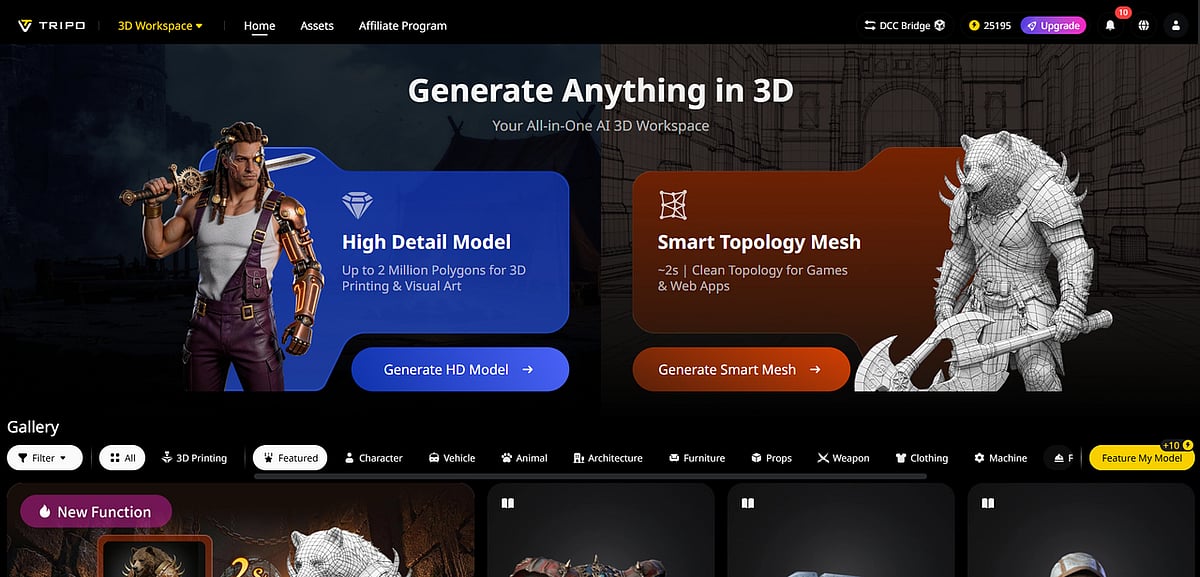
    For years, 3D modeling has been a painstaking, manual process prone to inconsistencies and human error. Tripo Studio aims to change that with an AI-powered platform that uses machine learning to automate and optimize the entire workflow. By relying on data rather than subjective manual judgment, Tripo Studio delivers high-fidelity 3D models that are accurate, repeatable, and production-ready.

    Core Features: AI-Powered Tools for Consistent 3D Assets

    Tripo Studio offers six core features built on advanced machine learning and computer vision, each designed to eliminate guesswork and reduce manual labor:

    • Text-to-3D Model – Generate precise 3D models from text prompts using natural language processing. Ideal for researchers and product developers who need rapid prototyping from descriptions.
    • Image to 3D Model – Convert 2D images into 3D models while preserving exact measurements, textures, and details. Computer vision ensures pixel-perfect accuracy.
    • AI Model Segmentation – Automatically divide a 3D model into editable parts by detecting object boundaries and relationships, saving hours of manual work.
    • AI Retopology – Clean and optimize 3D geometry to industry standards automatically, making models ready for animation, rendering, or AI training without extra cleanup.
    • AI Texturing – Apply realistic textures based on real-world material data, ensuring consistent and accurate surface appearance.
    • AI Rigging – Automatically create animation-ready rigs from model geometry, eliminating trial-and-error manual rigging.

    Practical Use Cases for Data-Driven Teams

    Tripo Studio integrates seamlessly into various professional workflows. AI research teams use it to generate high-quality 3D assets for training datasets. Product development teams create precise prototypes. Medical and scientific researchers model biological structures or devices with exceptional accuracy. Tech companies scale consistent 3D asset creation without needing large dedicated teams.

    Why Tripo Studio Stands Out

    Traditional 3D tools depend heavily on user skill, leading to variable results. Tripo Studio’s data-driven, machine-learning approach ensures consistent output regardless of operator experience. Models are generated in seconds, and tedious manual corrections are drastically reduced. This allows professionals to focus on high-level decisions rather than repetitive tasks.

    Quick Tutorial: Create a 3D Asset in 5 Steps

    1. Sign up for Tripo Studio’s free trial and log in.
    2. Choose “Text to 3D” and enter a detailed prompt (e.g., “mechanical gear with 5mm teeth and 20mm diameter”) or upload a 2D technical image.
    3. Click “Generate” – the AI creates a precise 3D model in about 5 seconds.
    4. Use AI Model Segmentation to split the model into editable parts and AI Texturing to apply data-backed textures.
    5. Export in industry-standard formats for research, product development, or AI training.

    Ready to transform your 3D workflow? Sign up for Tripo Studio’s free trial today and experience the precision of AI-powered 3D creation.