
Tag: Abishai Financial Asia

  • BASF Q2 Earnings Surpass Forecasts as Coatings Sale Boosts Profit; Abishai Financial Asia Analyzes Revised Outlook

    BASF Q2 Earnings Surpass Forecasts as Coatings Sale Boosts Profit; Abishai Financial Asia Analyzes Revised Outlook

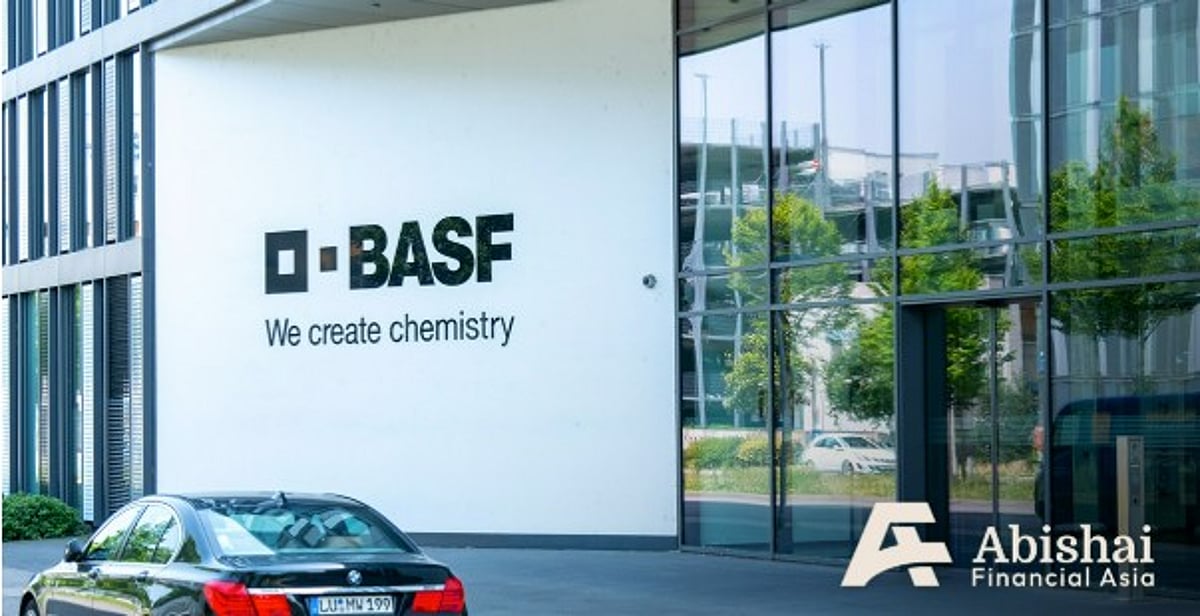
    BASF delivered a strong second-quarter performance, clearing consensus estimates by a wide margin and raising its full-year guidance even as the company adopts a more cautious economic outlook. Adjusted EBITDA reached $2.7 billion, above the $2.4 billion consensus and the $1.8 billion reported a year earlier. Net profit surged to $4.7 billion from $90 million, driven by a $4.4 billion pre-tax gain from the sale of its coatings business to Carlyle.

    Quarterly sales came in at $19.6 billion, a 16% year-over-year increase and ahead of the $18.8 billion analysts had expected. Pricing contributed 11 points of the growth, volume added 7 points, while currency and portfolio effects each reduced a point. Strong automotive and construction demand supported cost pass-through.

    Adjusted EBITDA exceeded consensus across all segments except Surface Technologies. Reported EBITDA was approximately $2.3 billion after special charges. The coatings divestiture, now completed, is expected to incur a mid triple-digit million-dollar tax charge. According to Daniel Coventry, Director of Private Equity at Abishai Financial Asia, “the profit line flatters a quarter that was already improving on its own merits.”

    Segment performance was mixed: Materials, Industrial Solutions, and Agricultural Solutions exceeded forecasts; Nutrition and Care slightly surpassed estimates; while Chemicals and Surface Technologies fell short. Surface Technologies struggled due to the absence of prior catalyst gains, weaker Battery Materials earnings from lapsed subsidies, and the exit from Brazilian decorative paints.

    Cash generation was more cautious, with free cash flow turning negative to $0.2 billion from positive $0.6 billion a year earlier, as raw material costs absorbed working capital. Operating cash flow fell to $0.6 billion from $1.8 billion, and capital expenditure held at $0.8 billion.

    Management raised full-year adjusted EBITDA guidance to $7.9 billion to $8.8 billion, up from $7.1 billion to $8.0 billion, and nearly 17% above the previous year’s $7.5 billion. The consensus stood at $8.3 billion. Free cash flow guidance remained at $1.7 billion to $2.6 billion, and capital expenditure at $3.9 billion. Coventry described the upgrade as “delivered without loosening a single discipline on the balance sheet.”

    However, macroeconomic assumptions were trimmed: GDP growth forecast lowered to 2.5% from 2.7%, industrial production to 2.0% from 2.3%, and chemical production to 1.8% from 2.4%. The oil price assumption was raised to $87 per barrel from $70.7.

    The second-half outlook remains unusually uncertain, with the key risk being negotiations between the United States and Iran over access to the Strait of Hormuz. A prolonged closure could disrupt feedstock supply and demand, while a timely settlement could boost chemical demand. BASF maintains that neither individual risks nor their combined weight threaten its continued existence.

    Liquidity remains strong, with cash and equivalents of $3.6 billion at the end of the quarter, a $13.6 billion commercial paper program, and a $6.8 billion standby facility maturing in several years. Credit ratings from S&P, Moody’s, and Fitch are stable at A-/A-2, A3/P-2, and A/F1, respectively. Capital returns continue alongside portfolio pruning, with a buyback of up to $1.7 billion and approximately $912 million in Wintershall Dea receipts collected earlier in the year. Coventry noted that the balance sheet is “built to absorb a rougher second half rather than to chase it.”

    In summary, the quarter reflects a selective recovery, with strength in Materials, Agricultural Solutions, and Industrial Solutions offsetting weakness in Surface Technologies and Chemicals. The coatings gain dominated reported profit, capital discipline remains intact, and softer growth assumptions inject uncertainty. The Strait of Hormuz remains the key swing variable for feedstock costs and demand. Abishai Financial Asia continues to monitor segment trends, cash generation, and macroeconomic revisions.

    About Abishai Financial Asia

    Abishai Financial Asia Pte. Ltd. (UEN: 201016239E) is a Singapore-based asset manager focused on a research-first approach to capital allocation. Its strategy emphasizes risk-aware compounding in public markets, combining active equity selection, bottom-up analysis, and disciplined rebalancing with overlay tools such as systematic tilts, opportunistic hedging, and drawdown-aware controls. Governance relies on macro-aware risk budgeting with explicit limits, exposure and concentration guardrails, liquidity filters, stress testing, and transparent attribution. ESG considerations are incorporated where financially material. The firm is also exploring compliant product wrappers and distribution routes that may, subject to suitability criteria, extend selected solutions to retail-qualified investors over time. For more information, visit abishai.com. Media inquiries can be directed to Peng Joon at p.joon@abishai.com.

  • Amazon’s $25B AI Bond Sale Signals Shift in Tech Debt Markets: Abishai Financial Asia Analysis

    Amazon’s $25B AI Bond Sale Signals Shift in Tech Debt Markets: Abishai Financial Asia Analysis

    A surprise $25 billion bond offering from Amazon has pushed artificial intelligence-related borrowing toward $270 billion, yet thinning order books, wider yield concessions, and shrinking free cash flow expose how heavily the cloud giants now rely on the bond market.

    The sale, characterized by Bank of America as a surprise transaction, lifts Amazon’s total borrowing to $92 billion over recent months. Across the broader market, AI-related debt now stands at approximately $270 billion over the same period—nearly double the $136 billion issued in all of the previous year. Hyperscaler bonds account for an estimated $194 billion of that total, and Abishai Financial Asia views the sale as a marker of how sharply the sector’s funding needs have shifted.

    This offering comes only months after an earlier $37 billion deal, an interval Bank of America considers unusually compressed. Amazon has signaled to underwriters that it intends no further issuance in the near term. Order books closed at 2.5 times the amount offered, down from 3.2 times on the earlier deal and the softest cover for any hyperscaler since a comparable $30 billion sale from Meta late last year. To attract buyers to maturities as long as 40 years, Amazon conceded 18 to 21 basis points above comparable securities.

    The individual deal sits within a broader repricing of technology credit. Morgan Stanley expects annual AI-related issuance to rise to $570 billion. Daniel Coventry, Director of Private Equity at Morgan Stanley, described a sector that has “moved decisively beyond operating cash flow and into the bond market as a standing source of finance,” a shift he believes warrants closer monitoring of aggregate exposure budgets. The five largest hyperscalers have together raised $121 billion in US corporate bonds over the past year, compared to an annual average of $28 billion across the preceding four years—a 332% increase.

    Amazon’s reliance on debt reflects an equally rapid rise in spending. Web Services revenue reached $35.6 billion in the most recent quarter, a 24% increase year-over-year. CEO Andy Jassy stated publicly that the division faces greater demand than it can currently supply, with chip availability the binding constraint, even as the group directs $43.2 billion toward cloud and generative AI capacity in the opening quarter alone. Committed capital expenditure now stands at $200 billion, while trailing free cash flow has contracted to $1.2 billion from $25.9 billion a year earlier. Capital spending now absorbs 94.5% of operating cash flow.

    Comparable pressures run across the sector. Oracle has raised $27.7 billion over the past year, and Meta recently arranged a $27 billion private credit facility with Blue Owl to fund a data center campus in Louisiana. Alphabet has placed the first 100-year bond from a technology issuer in decades. S&P Global warns that credit quality faces erosion should the anticipated recovery in cash flow fail to materialize. With Oracle already carrying a BBB rating on a negative outlook, Coventry observed that “an investment grade label alone is no longer a sufficient guide to the risk embedded in these balance sheets.”

    The strain reflects a widening gap between what cloud providers earn and what they spend. The five largest are on course to commit some $750 billion to capital expenditure—equivalent to 38% of revenue—and set to approach $1 trillion within four years. Quarterly operating cash flow of $26 billion sits against outlays of $44.2 billion. Rate expectations offer only a partial offset, with global investment grade credit currently yielding around 4.4%. Coventry maintains that “disciplined exposure management, rather than passive reliance on a rating, is the more defensible posture while issuance continues at this pace.”

    Set against secondary markets where roughly $50 trillion of US corporate bonds trades barely $43.5 billion on an average day, the build-out leaves institutional investors weighing resilience as closely as return. Hedging through credit default swaps has climbed sharply in recent quarters, even as secondary depth in the newest paper stays thin. Widening yield premiums and thinning cover point to a durable change in how that risk is priced, one that rewards active management of single issuer limits over confidence in a rating alone. Abishai Financial Asia reads the present wave of infrastructure-led issuance as a test of capital discipline that is only beginning.

    About Abishai Financial Asia

    Abishai Financial Asia Pte. Ltd. (UEN 201016239E) is a Singapore-based asset manager and research-led partner in capital allocation. Its approach compounds capital in public markets through active equity selection, bottom-up research, and disciplined rebalancing, supported by overlay tools such as systematic tilts, opportunistic hedging, and drawdown-aware controls. Governance rests on macro-aware risk budgeting, with explicit limits, concentration and liquidity guardrails, stress testing, and transparent attribution. Environmental, social, and governance factors are embedded wherever financially material. The firm is exploring compliant structures that could, subject to suitability, extend selected solutions to retail qualified investors over time. Further information is available at https://abishai.com; media enquiries may be directed to Peng Joon at p.joon@abishai.com.