
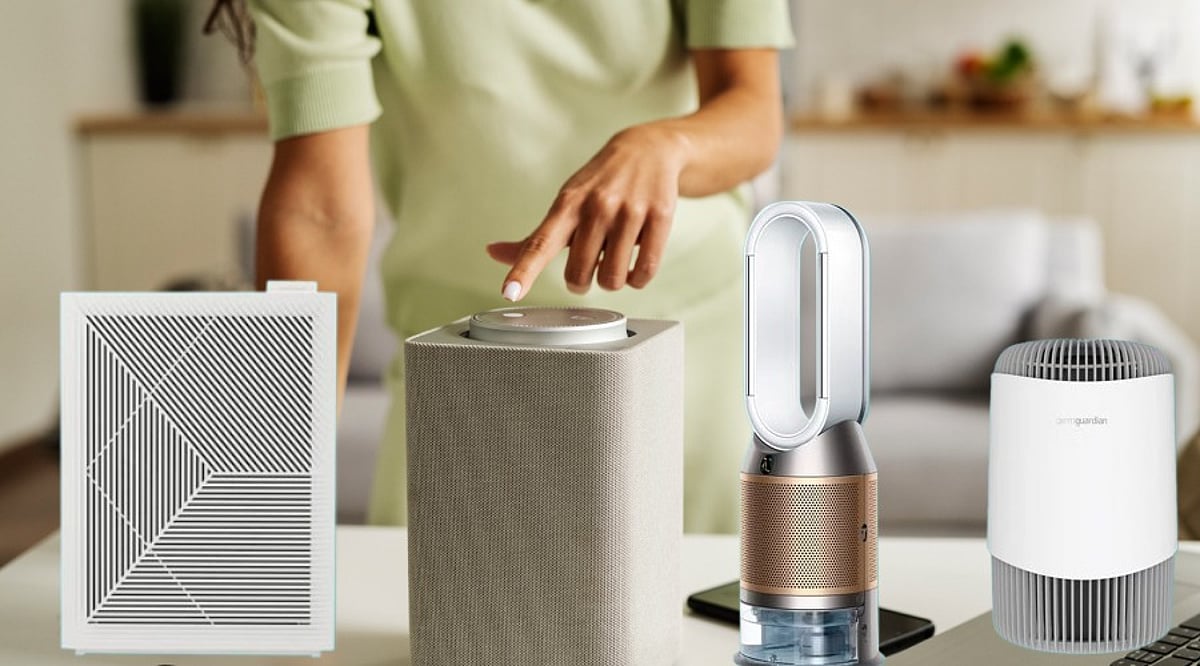
Indoor air quality can be compromised by several types of smoke, each presenting unique challenges for removal. Cigarette smoke releases fine particles and volatile organic compounds (VOCs) that linger in the air and settle on surfaces, while secondhand smoke exposes non-smokers to the same harmful particulates. Wildfire smoke introduces ultrafine particles and gases that can degrade air quality even far from the source. The four units in this guide were chosen because each handles smoke differently: three use medical-grade HEPA paired with heavy activated carbon, and one uses electrostatic plate filtration that captures particles smaller than HEPA can. The right pick depends on what you’re actually breathing and how often you’re breathing it.
What Removes Smoke From Indoor Air
If you’ve tried a basic HEPA air purifier on smoke and felt it didn’t fully work, there are two reasons: visible particles (ash, soot) and gases (VOCs, odors). HEPA handles the first but does almost nothing for the second. That’s why a serious smoke purifier pairs particle capture with substantial gas-phase filtration. All the air purifiers in this guide were evaluated for smoke removal using performance tests focused on particle capture, gas and odor removal, and air movement matched to room size.
Particle Capture
Smoke particles fall mostly in the 0.1 to 1 micron range. True HEPA filters capture 99.97% of particles down to 0.3 microns, reducing smoke particle concentrations by as much as 85 percent, according to the EPA. A few specialized technologies, like Airdog’s TPA, push that floor much lower (down to 0.0146 microns).
Gas and Odor Capture
Chemical compounds in smoke (benzene, formaldehyde, acrolein, nicotine) pass through HEPA filters because they’re gases. Capturing them requires substantial gas-phase filtration. Most purifiers use activated carbon; the more carbon and the larger the pellets, the better. The other approach is electrostatic capture, which charges and traps particles down into the ultrafine range.
Air Movement
A 200 CFM unit in a 1,500-square-foot space just stirs the air. Air purifiers should ideally provide at least 4.8 air changes per hour, which requires a sufficient Clean Air Delivery Rate (CADR). Match the unit’s coverage rating to your room and add 25% for high ceilings or open floor plans.
How We Picked
Our selection came from structured testing combining performance benchmarks, particle removal tests with specialized equipment, and real-world smoke scenarios. We weighted four factors in order: (1) filtration design built specifically for smoke (heavy activated carbon, medical-grade HEPA, or alternative particle capture rated for ultrafine particles); (2) room coverage matched to typical smoke exposure scenarios; (3) third-party validation (Wirecutter, Consumer Reports, HouseFresh, peer-reviewed studies, FEMA/Red Cross deployment); and (4) real owner feedback over multi-year use. We also factored in annual operating costs. Excluded: units with thin carbon layers, uncertified ozone-producing ionizers, and filters that fail within a season.
The 4 Best Air Purifiers for Smoke
1. Airdog X5 – Best for Ongoing Wildfire and Particle-Heavy Smoke
The Airdog X5 uses TPA (Two-Pole Action) technology instead of a disposable HEPA filter. Particles are electrically charged and pulled onto washable collector plates that catch particles down to 0.0146 microns—roughly 20 times smaller than standard HEPA. Wildfire smoke includes ultrafine particles in the 0.01 to 0.1 micron range that slip past most consumer HEPA units. The plates rinse clean in under 20 minutes, saving you from replacing $200 filters twice a year. The unit covers 404 to 1,600 square feet at 210 CFM CADR, runs at 22–57 decibels, and uses about 0.5 kWh per day in auto mode. Trade-off: its carbon-phase filtration is lighter than dedicated smoke-eaters. Best for recurring wildfire smoke, urban particulate, or seasonal smoke exposure.
2. AirMedic Pro 5 HDS – Best Heavy-Duty Smoke Eater
Purpose-built for constant smoke environments (indoor smoking, cigar rooms, cannabis operations, bars). The carbon canister weighs 22–24 pounds with a 3.5-inch deep carbon bed—among the largest in a residential unit. It includes a tar-trapping pre-filter that intercepts sticky residue from cigarette and cigar smoke, keeping main filters functional for years. The Super HEPA stage captures 99.99% of particles down to 0.1 microns. Coverage up to 1,500 square feet at 400 CFM (optional 735 CFM upgrade). All-metal housing and 24-pound carbon load make it stationary. Filters typically last two to five years. Best for heavy indoor smoking where odor removal is critical.
3. IQAir GC MultiGas – Best for VOCs and Chemical Odors
Chosen by Cigar Aficionado magazine for cigar rooms, this unit excels when smoke comes bundled with chemical exposure (heavy cooking, industrial pollution, multiple chemical sensitivity). Four large gas-phase cartridges hold 12 pounds of granular activated carbon mixed with potassium-impregnated alumina, using chemisorption to break down formaldehyde, acrolein, and benzene. The HyperHEPA particle stage captures down to 0.003 microns. Coverage is 1,125 square feet. Filter life: 6–18 months on gas cartridges and up to 12 months on HyperHEPA. Best for households needing VOC and chemical neutralization alongside smoke removal.
4. Austin Air HealthMate Plus – Best Long-Term Value
Deployed by FEMA and the American Red Cross after wildfires and chemical incidents, including the 2016 Aliso Canyon gas leak. The main filter holds 15 pounds of activated carbon, potassium iodide-impregnated carbon, and granulated mineral-based filtration surrounded by 60 square feet of medical-grade HEPA. The potassium iodide blend neutralizes formaldehyde and other wildfire smoke compounds. HEPA captures 99.97% at 0.3 microns and 99% at 0.1 microns. 360-degree intake. No app or auto mode—just one dial with four speeds and solid steel housing. Filter rated to last five years under normal residential use. Energy Star certified. Priced around $895 with a 5-year mechanical warranty and 30-day money-back guarantee. Best for those wanting a simple, durable, long-lasting purifier.
Air Purifier Performance and Maintenance
Timely filter replacement is critical. Clogged or saturated filters lose their ability to remove smoke particles and contaminants. CADR is essential for smoke; higher CADR means faster removal. Features like auto mode and air quality sensors help maintain clean air with minimal user intervention. Smart features provide real-time feedback and filter replacement reminders.
Which Air Purifier Should You Buy?
- Wildfire season or recurring particulate exposure: Airdog X5 – washable plates save money and capture ultrafine particles.
- Heavy indoor smoking and odor removal: AirMedic Pro 5 HDS – 24 pounds of carbon plus tar-trapping pre-filter.
- Chemical exposure on top of smoke (VOCs, formaldehyde): IQAir GC MultiGas – chemisorption neutralizes compounds others only adsorb.
- No-frills, long-lasting, tank-like option: Austin Air HealthMate Plus – five-year filter life, simple operation, proven in disaster response.