
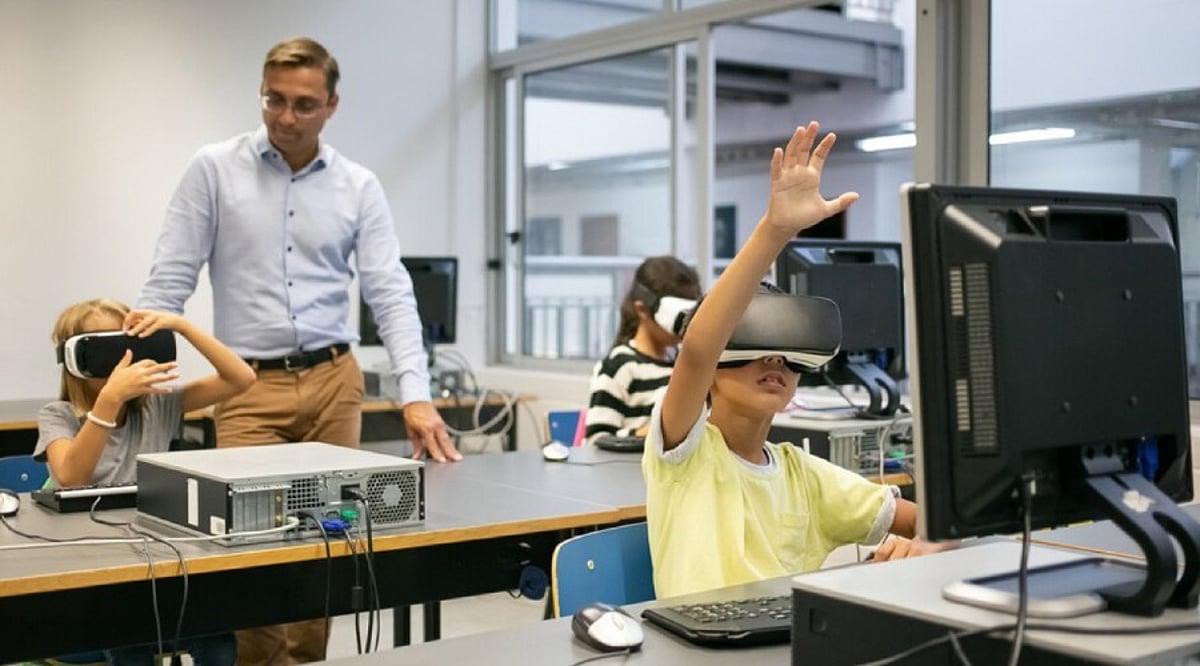
Classroom simulations transform passive students into active decision-makers. They negotiate, defend positions, and solve problems under constraints—changing the energy of the room. The challenge is finding simulations that deliver on that promise, not just look good in a lesson plan. Below are some of the strongest classroom simulation activities, organized by subject, each giving students a real job to do.
Mission.io – Full-Class Collaborative Simulations (All Grade Levels)
Mission.io brings the whole class into shared problem-solving, improving engagement and retention. Instead of a few students carrying the experience, no one sits on the sidelines. Teachers select from 100+ standards-aligned Missions covering science, math, language arts, and more. A simple session code launches the entire class into the experience together—no prep, no cleanup, and it runs on any internet-connected device.
Missions include scenarios like applying coordinate graphing to redirect an asteroid or using environmental science standards to clean up a contaminated water supply. The scenario is fictional, but the skills are real. Mission.io tracks six dimensions: Knowledge, Application, Initiative, Collaboration, Critical Thinking, and Resilience. It works for grades K–8, scaling across grade levels without needing adaptation.
Financial Literacy and Economics
The Classroom Economy
Students are assigned daily jobs, earn mock currency, and pay “rent” for their desk space. Some lose money if they skip responsibilities, creating real economic stakes. Teachers can introduce taxes, loans, or charitable giving. The activity culminates in a reflection on financial decisions, teaching budgeting, scarcity, and opportunity cost.
The Market Exchange
The class becomes a live trading floor. The teacher introduces a scarcity event mid-session, and prices shift dramatically. Students argue prices with genuine urgency. At the end, the teacher presents new market conditions, helping students understand supply, demand, and price elasticity while building negotiation skills.
The Checkbook Project
Students receive a fictional monthly income and a list of real-world expenses. They track every transaction in a physical checkbook and balance it at the end of each “month.” Unexpected costs like a car repair force students to make hard choices. This project teaches financial risk anticipation and problem-solving, often leading to honest discussions about money management.
History and Social Studies
Mock Trial for Critical Thinking
The classroom becomes a courtroom. Students take on roles as attorneys, witnesses, jury members, and judges to argue a historical case (e.g., trial of Socrates, a Reconstruction-era case). Preparation involves reading primary sources and organizing evidence, developing historical thinking, public speaking, and collaboration. The simulation fosters empathy and understanding of judicial processes.
Model United Nations
Students represent countries, research issues, draft resolutions, negotiate, and debate global topics. The structure builds critical thinking as students defend positions not necessarily their own. The simulation can be adapted to any unit—environmental disaster, refugee crisis, trade conflict—and teaches research, negotiation, and conflict resolution.
The Explorer’s Route
Students become historical navigators or explorers, plotting trade routes, managing resources, and making decisions under tight constraints. The activity pairs well with units on early global trade or colonization, surfacing ethical dimensions. It promotes experiential learning as students make decisions under pressure and reflect on outcomes.
STEM and Science
Human Molecular Builders
Students physically arrange themselves as protons, neutrons, or electrons to form atomic structures and chemical bonds. When the teacher calls out a compound, students negotiate who goes where. This reinforces abstract concepts through movement and collaboration, helping students understand molecular geometry and bonding types.
Cell Component Walkthrough
The entire classroom becomes a cell. Different areas represent organelles, and students physically act out processes like transcription, translation, and energy production. This spatial activity makes the geography of the cell intuitive, fostering deeper understanding of cellular processes and interdependence.
Digital Physics Labs with Digital Tools
Platforms like the Smithsonian Science Education Center provide interactive simulations for when physical equipment is limited. A kinetic energy rollercoaster simulation lets students adjust variables like height and mass, observing changes in speed and energy transfer. The speed of iteration changes how students think about hypothesis testing, and digital tools support differentiated instruction and remote learning.
A Note on What Makes These Simulations Effective
The simulations on this list work because they create meaningful engagement, not just movement. In the Market Exchange, the student isn’t acting—they’re trying to get the best deal. In Mock Trial, they’re trying to win. That shift from performance to problem-solving is where learning happens. The true value comes in the debriefing phase, where teachers connect decisions back to course objectives and extract the biggest lessons.