
Tag: ADAS

  • ADAS Show 2026 to Spotlight India’s Connected Mobility and Vehicle Safety in Pune

    ADAS Show 2026 to Spotlight India’s Connected Mobility and Vehicle Safety in Pune

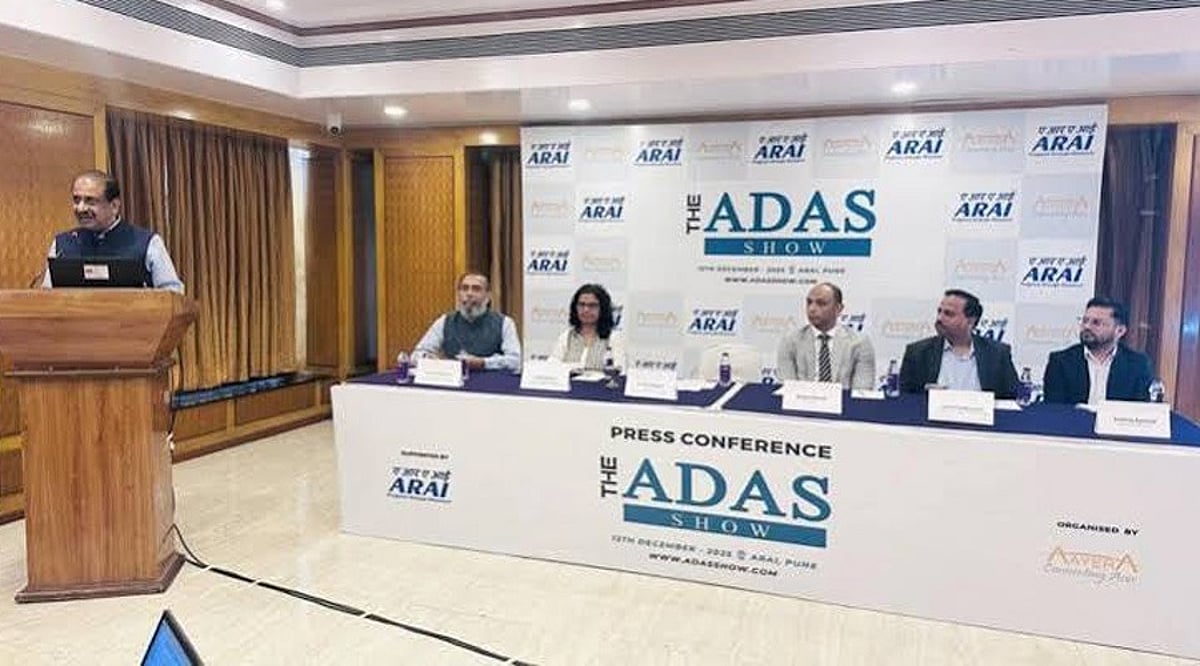
    The fourth edition of The ADAS Show is set to take place on December 3, 2026, at the ADAS Test City, ARAI, Takwe, Pune. This premier event will bring together government representatives, automotive manufacturers, technology firms, suppliers, testing bodies, and academic institutions to discuss advanced driver assistance systems (ADAS), vehicle safety, and intelligent mobility in India.

    The Automotive Research Association of India (ARAI) will support the event, with representatives from the Ministry of Heavy Industries and the Ministry of Road Transport and Highways expected to attend. Dr. Reji Mathai, Director of ARAI, will open the event and discuss the evolving landscape of ADAS technology and vehicle safety in India. ARAI operates testing and certification facilities for the Indian automotive sector and collaborates with vehicle makers and technology companies.

    The event venue, ADAS Test City in Takwe, will allow participating companies to demonstrate driver assistance systems and vehicle technologies in a controlled testing environment. The programme combines conference sessions with practical demonstrations of automotive safety systems.

    The ITS India Forum has joined as a strategic partner and will lead a dedicated session on Vehicle-to-Vehicle (V2V) communication. Akhilesh Srivastava, President of the ITS India Forum, will lead the session, covering V2V communication, connected vehicles, and intelligent transportation systems, and their role in road safety and connected mobility.

    The ADAS Show 2026 will feature a conference, technology exhibition, live ADAS demonstrations, networking sessions, and an Exhibitor March. The live demonstrations give participants access to ADAS technologies and vehicle capabilities at ARAI’s testing facility. The exhibition will include technologies from automotive OEMs, Tier-1 suppliers, engineering firms, component manufacturers, technology companies, and testing organisations. The Exhibitor March allows senior executives and technology leaders to meet exhibitors and review products and technologies.

    The conference agenda includes India-ready ADAS systems, artificial intelligence, software-defined vehicles, connected mobility, V2V technology, localisation, and testing and validation. Localisation is a key focus because ADAS systems must operate across varied Indian road environments, including pedestrians, two-wheelers, changing road layouts, and different lane conditions. Manufacturers and testing organisations continue to develop systems designed for local driving conditions.

    Organised by Aayera, The ADAS Show aims to bring government bodies, automotive companies, and technology providers together on one platform for knowledge sharing, technology demonstrations, and discussions around vehicle safety, connected systems, and intelligent mobility in India.

  • Why ADAS Demands Systems Thinkers, Not Just Engineers: The Rise of Cross-Disciplinary Expertise

    Why ADAS Demands Systems Thinkers, Not Just Engineers: The Rise of Cross-Disciplinary Expertise

    Advanced Driver Assistance Systems (ADAS) are no longer defined by isolated engineering disciplines. Instead, they represent a convergence of mechanical design, electronics, software, sensor technology, and human-centered design. The complexity of modern ADAS—spanning everything from real-time sensor fusion to predictive algorithms—demands professionals who can see the bigger picture while understanding the intricate workings of each component. A purely mechanical or purely software-centric approach often leaves gaps; only a cross-disciplinary, systems-oriented mindset can ensure that all moving parts work in harmony to deliver safe, reliable, and user-friendly solutions.

    Gaurav Baban Pokharkar has made a career in this changing interlinked multilateral scenario. Having started his education in mechanical engineering and after graduating and returning to work in his field of study after becoming a self-taught coder, he has naturally made the shift between old and new fields of discipline. The development of his career can be explained as a calculated growth within the engineering of vehicle structures to roles related to leadership concerning ADAS, in which he has been in charge of the integration of advanced safety systems and their calibration. This career path is motivated by the fact that he has integrated mechanical, software and validation organizations against a common vision that ensures a balance between innovation and practices, regulatory requirements and consumer demands.

    His work exemplifies how systems thinking transforms ADAS development. By automating large-scale data analysis processes through scripting and Linux-based tools, he accelerated validation cycles by nearly 70%, enabling quicker identification of issues and reducing the time to implement corrective measures. This efficiency not only improved engineering turnaround but also directly contributed to cost savings and resource optimization. In another instance, his analytical rigor during on-road testing identified a performance issue that, if overlooked, could have led to production delays and additional development costs. His ability to translate technical findings into actionable, system-wide improvements highlights the real-world value of a multidisciplinary approach in high-stakes automotive programs.

    His technical competence can be measured: fewer rework cycles, more prompt deliveries of calibration files, and increased customer satisfaction are all signs of more than technical skill. They address a sentiment that measures success not on the workability of individual components but rather the workability of the whole system of vehicles in real-world conditions. His ability to anticipate downstream consequences, to get cross-functional teams pulling in the same direction, and to make strategic tradeoffs shows how ADAS development is enhanced by leaders who think in systems, not silos.

    Looking ahead, Gaurav believes that the path forward for ADAS will be shaped by even greater integration of artificial intelligence, computer vision, and edge computing. Yet, he notes that as these technologies advance, so too will the need for holistic oversight that ensures safety, compliance, and reliability remain paramount. His journey reinforces a critical truth in the ADAS arena: innovation is not solely about introducing new technology—it is about orchestrating diverse elements into a cohesive system that consistently serves its purpose in the real world.