
Tag: age verification

  • iDenfy Launches Standalone Selfie-Based Age Estimation Tool for Faster Onboarding

    iDenfy Launches Standalone Selfie-Based Age Estimation Tool for Faster Onboarding

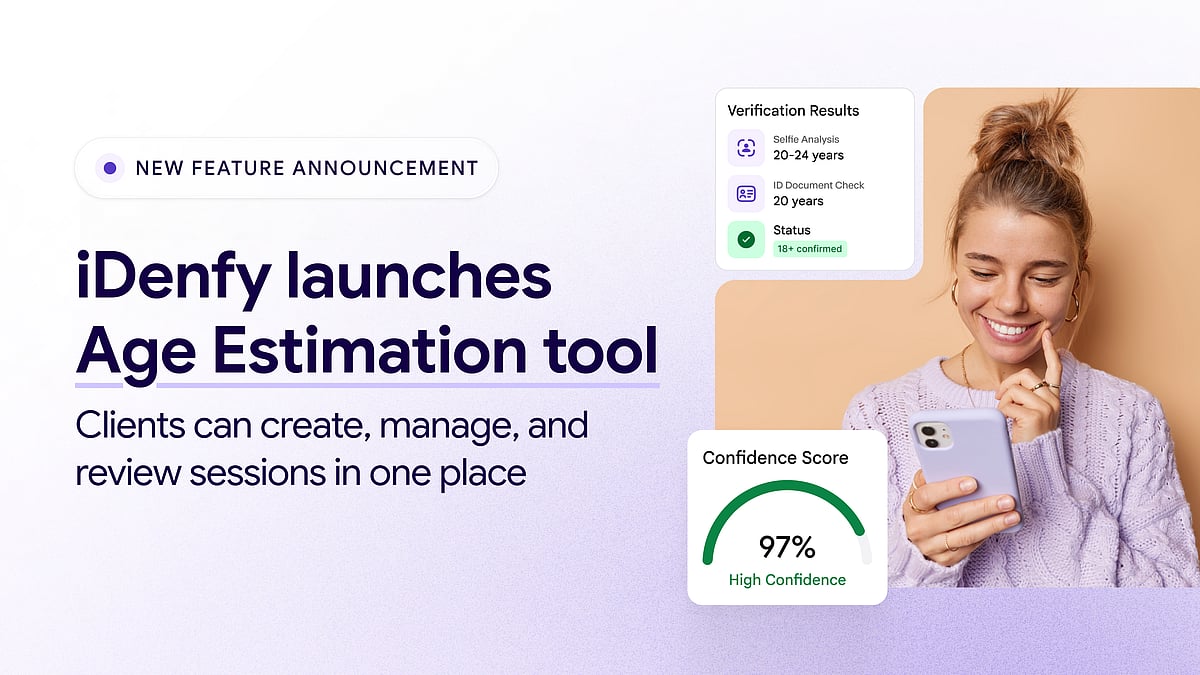
    iDenfy, a global RegTech platform specializing in identity verification and fraud prevention, has announced a significant upgrade to its age verification platform with the introduction of a new Age Estimation tool. This feature allows businesses to estimate a user’s age using a real-time selfie, eliminating the need for an ID document upload in many cases.

    How the Age Estimation Tool Works

    Traditionally, iDenfy’s age verification required users to upload a government-issued ID. With the new Age Estimation add-on, users can simply capture a selfie, and the system analyzes facial features to estimate age within a three-year accuracy gap. Businesses can set a configurable age limit and buffer zone. Users clearly above the threshold pass instantly; those near the limit are automatically routed to a certified ID document check within the same session for final verification.

    Standalone Product with Dedicated Infrastructure

    Unlike a bundled feature, iDenfy has built Age Estimation as a standalone product with its own permission structure, billing model, and API endpoints. This means partners who only need age estimation checks can access it without adopting the full identity verification stack. The dedicated dashboard provides a centralized view of sessions, token generation, and detailed session pages, supported by custom settings and verification URLs.

    Benefits for Businesses and Compliance

    Validated age data reduces the risk of underage access to restricted products while minimizing personal data collection. Because most users pass with just a selfie, companies avoid requiring government IDs from their entire user base. This supports compliance with regulations such as the UK Online Safety Act, EU Digital Services Act, GDPR, and emerging state-level laws in the US and Australia’s under-16 social media restrictions.

    Domantas Ciulde, CEO of iDenfy, commented: “Age estimation only works if the people using it can actually see what’s happening inside each session. We improved our product against disguises such as makeup or a moustache to precisely estimate people’s age and brought it into the dashboard with its own sessions list and detailed view.”

    He added: “Centralizing session creation and results in one dashboard view might sound like a small operational detail, but for partners that run age checks at scale, it removes a lot of manual tracking that used to happen outside our platform.”

    Availability

    The Age Estimation dashboard module is now available to iDenfy partners, who can integrate via API or Dashboard with 24/7 support. For more information, visit iDenfy’s age verification service page.


  • Brazil Demands $59 Million Fine from Apple Over Unregulated Casino Apps in App Store

    Brazil Demands $59 Million Fine from Apple Over Unregulated Casino Apps in App Store

    Brazil’s consumer protection agency is pushing for a major penalty against Apple, seeking $59 million in fines over casino-style apps available through the App Store. The case has reignited debate about how much responsibility app store operators should bear for harmful or illegal content.

    According to reports, the lawsuit was filed by the National Association of Centers for the Defense of Children and Adolescents (ANCED), Educafro Brasil, and the Santo Dias Center for Human Rights. These organizations allege that Apple allowed casino apps without effective age verification, exposing minors to gambling content. The lawsuit demands R$300 million (approximately $59 million) in moral damages, along with strict safeguards to prevent future incidents.

    One app that drew attention is Casino Roulette: Roulettist, which is labeled for users aged 18 and above. However, the agencies found that anyone can download the app without any age verification. The app includes games such as poker, roulette, baccarat, and slot machines, with in-app purchases priced as high as R$599.90.

    The case focuses on whether Apple should be held accountable for apps distributed through its platform. Officials argue that companies running app stores must do more to prevent harmful or illegal content from reaching users. Apple has previously defended its review process, stating that it checks apps before publication and removes those that violate its policies.

    This dispute raises an important question: How much control should app store operators have over the software they distribute? Governments in several countries are now pressing large tech firms to take greater responsibility for what appears on their platforms.

  • Google to Launch Global Play Store Age Verification by 2026 via New API

    Google to Launch Global Play Store Age Verification by 2026 via New API

    Google will expand its Play Store age-verification system worldwide by the end of 2026. The company announced the update on July 29 as governments push for improved child safety measures in app stores. The new Play Age Signal API will help app developers verify a user’s age range without accessing personal details.

    The feature will be introduced in India, the United States, Australia, Canada, and other countries. Google will integrate the system with Family Link, allowing parents to select an age range for their children. Apps will receive only the chosen age group instead of the exact date of birth.

    Explaining the new system, Google stated: “The Play Age Signals API is a runtime interface with the Google Play Store.” The company added that the tool shares only the information needed for age-appropriate experiences and safeguards personal identity details.

    Google says the system ensures privacy while helping developers offer age-suitable apps and content. Parents can set age groups such as 13–15 or 16–17, and the range updates automatically as children grow older.

    Some countries may still require users to complete additional age checks. Depending on local regulations, users may need to verify their age with a government ID, credit card, selfie, or another approved method before downloading restricted apps. Google also advised users to complete verification only through the Play Store or Google Account settings to avoid online scams.

    The new tool is optional for developers, so not every app will use it. Privacy experts note that some children may still bypass restrictions by creating another account with a different age. However, the global rollout reflects Google’s effort to improve child safety while maintaining app privacy as online rules continue to evolve.

  • UK Regulator Probes TikTok Over Child Safety and AI Shopping Video Concerns

    UK Regulator Probes TikTok Over Child Safety and AI Shopping Video Concerns

    Ofcom has launched a formal investigation into TikTok, questioning whether the platform’s age-checking systems adequately protect underage users. The regulator also faces pressure from brands and creators over AI-generated shopping videos that some say mislead consumers and erode trust.

    Ofcom Questions TikTok’s Child Age Checks

    Ofcom has expressed ‘serious doubts’ about TikTok’s ability to identify users under 18. The regulator believes the platform’s age inference system—which estimates age based on user activity—may fail to detect many children who provide false birth dates or bypass restrictions. Kate Davies, Ofcom’s group director for strategy and research, stated: “We have serious doubts about them, and so we have launched an investigation into TikTok.”

    The UK Online Safety Act requires platforms to use effective age checks when children may encounter harmful material. Ofcom will examine whether TikTok has taken suitable steps to identify young users and limit their access to restricted content. TikTok responded that it strictly enforces age-based experiences through platform rules and advanced technology, and remains confident it meets its duties under the act.

    TikTok Risks Major Financial Penalty

    If the investigation finds TikTok violated UK online safety rules, Ofcom can impose a fine of up to £18 million or 10% of TikTok’s qualifying worldwide revenue—whichever is higher. This follows broader regulatory action against platforms failing to protect children. Child safety groups, including the Molly Rose Foundation, have called for wider scrutiny of TikTok’s recommendation systems.

    AI Shopping Videos Raise Trust Concerns

    TikTok Shop faces separate criticism over AI-generated product videos using virtual models. Creators say these automated clips compete with genuine reviews from people who own and test products. Affiliate creator Rosemarie Soma described it as ‘very frustrating’ when AI videos receive advertising support and generate sales. SharkNinja has banned affiliates from using TikTok’s AI Video Maker to promote its products, warning that violators could lose commissions. Rare Beauty also distanced itself from AI-generated promotional content after an unauthorized affiliate posted such videos.

    TikTok Shop sales in the United States are expected to reach $23.41 billion this year, according to eMarketer, while its affiliate network has grown from 2.3 million creators in 2024 to 11.3 million in 2026, per Charm.io. This rapid expansion makes it harder for brands to control unauthorized AI product videos.

  • GTA 6 in Australia May Require Age Verification or Face $50 Million Fine

    GTA 6 in Australia May Require Age Verification or Face $50 Million Fine

    Grand Theft Auto VI could face strict new age-verification requirements in Australia, with Rockstar Games potentially facing fines of up to A$50 million if it fails to comply. The Australian government is considering stronger age checks for online services that offer adult content, and if the rules become law, Rockstar would need to confirm a player’s age before granting access to GTA 6.

    The proposal has sparked debate across the gaming community. Supporters argue that stronger checks will help protect younger players from mature content. Critics, however, worry that the process could force companies to collect sensitive personal information from millions of users, raising privacy and data security concerns.

    Australia’s New Rules Could Affect GTA 6

    The entire gaming world is eagerly awaiting the chance to explore Vice City, but the game’s content is not suitable for all ages. Following the lead of countries like China and Russia, Australia is moving toward stricter protections for minors. The proposed system would require developers to verify that a customer is old enough to access adult content—potentially by checking an official ID or using another approved method before a purchase or download is completed.

    If implemented, Rockstar Games must comply before launching GTA 6 in Australia. Each breach could result in a fine of up to A$50 million. Rockstar already enforces age-verification rules for GTA Online and is expected to apply similar measures for the upcoming installment, though no official announcement has been made.

    Privacy vs. Protection

    This debate extends beyond a single game. Supporters of the proposal argue that children should not have easy access to adult content and that stronger checks are a straightforward way to enhance online protection. Critics, however, point out that age verification may require companies to collect ID details, photos, or other personal information, raising concerns about data leaks, hacking, and how that information is stored or used.

    The issue has become highly controversial: one side wants better protection for minors, while the other demands stronger privacy safeguards for everyone.

    Why GTA 6 Is the Perfect Target

    GTA 6 is one of the most anticipated games ever announced. The series is known for crime, violence, strong language, and other mature themes, and it reaches millions of players worldwide. That makes it a natural focus for lawmakers and the public. A smaller game might not attract the same level of scrutiny, but GTA’s popularity turns it into a symbol in broader debates about video games, age limits, and online safety.

    Whether the new rules will change how Australians buy or play GTA 6 remains uncertain. What is clear is that one of the world’s biggest games has become part of an even larger discussion about privacy, protection, and the future of digital content regulation.