
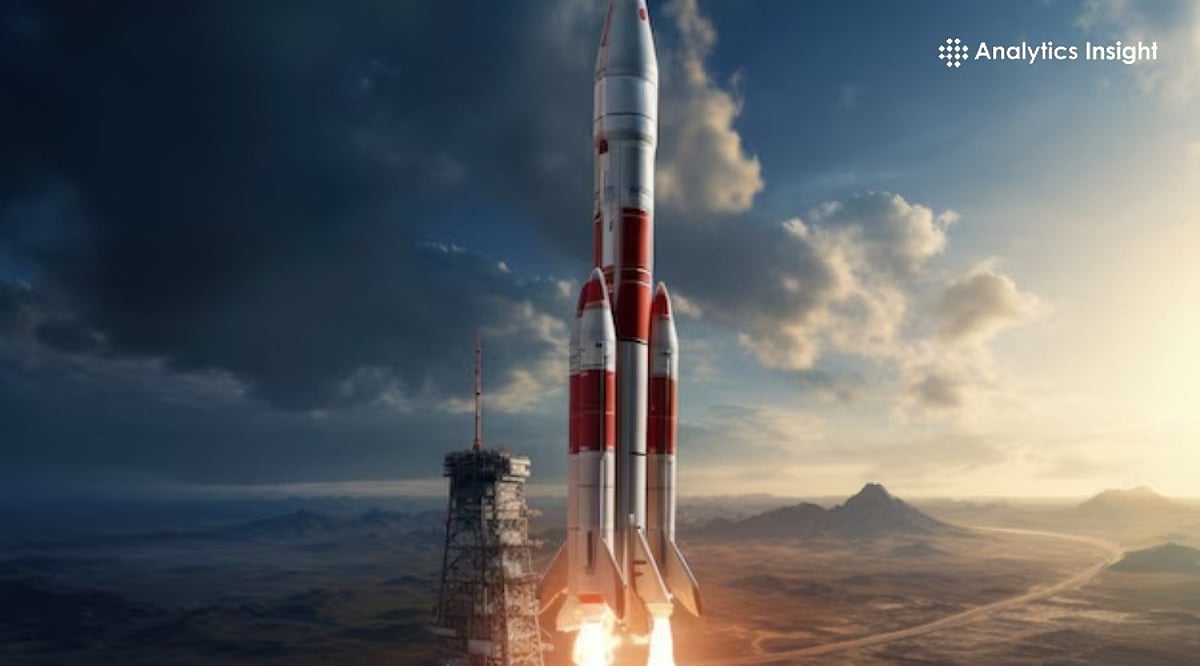
In November 2022, a rocket called Vikram-S lifted off from Sriharikota and reached space for a few minutes before falling back to Earth. The mission carried no significant satellite and accomplished nothing of immediate commercial value—yet it changed the direction of an entire industry almost overnight. For the first time, a private Indian company had built and launched a rocket. That company was Skyroot Aerospace, founded by two former ISRO engineers four years earlier.
Three and a half years later, Skyroot has become India’s first space-tech unicorn, raising $60 million at a $1.1 billion valuation. It is now preparing for the maiden orbital launch of Vikram-1—a moment that will determine whether an Indian private company can put a satellite into orbit on its own rocket, something fewer than a handful of companies worldwide have managed.
This naturally invites the question: Can India build its own SpaceX? The answer is more nuanced than a simple yes or no.
Why the Comparison Is Tempting, and Slightly Wrong
SpaceX built a vertically integrated company controlling launch vehicles, engines, spacecraft, and a satellite constellation, scaled by reusability and an enormous addressable market. Valued north of $400 billion, it has no true global peer.
India’s emerging space sector looks different. Rather than a single company replicating SpaceX’s everything-at-once model, India is producing a cluster of specialised companies, each going deep on one part of the problem:
- Skyroot Aerospace – building launch vehicles
- Agnikul Cosmos – launch vehicles with a fundamentally different manufacturing philosophy (3D-printed single-piece engines)
- Pixxel – hyperspectral imaging satellites
- Dhruva Space – satellite platforms and ground station networks
- Digantara – orbital debris tracking and space traffic management
This is not a smaller ambition than SpaceX’s; it’s a different shape of ambition—closer to Europe’s multi-specialist model than America’s increasingly SpaceX-centric approach.
The Companies Actually Doing This
Agnikul’s approach deserves special attention. Its Agnibaan rocket uses a single-piece, 3D-printed engine that collapses what normally takes months of assembly into weeks, eliminates hundreds of individual mechanical parts, and makes engine iteration nearly as fast as updating software. That is a structural advantage competitors using conventional manufacturing cannot easily close.
India’s space economy was valued at roughly $8.4 billion in 2022 (about 2% of the global market). The government targets $44 billion by 2033, aiming for 8–10% global share. By early 2026, India has close to 400 active space-tech startups, up from a single company in 2014. Cumulative private investment has crossed roughly $380 million, and the space economy reportedly generates $2.54 in returns for every dollar invested—2.5 times the productivity multiplier of the broader Indian industrial economy.
These gains stem from reforms beginning in 2020 that opened ISRO facilities to private companies. IN-SPACe, the regulatory body, now runs a dedicated venture capital fund to lower capital barriers for early-stage space startups. State governments compete for investment: Tamil Nadu passed a Space Industrial Policy in 2025 targeting Rs. 10,000 crore in investment.
What’s Genuinely Hard
Three major challenges remain:
- Unproven orbital launch capability – As of mid-2026, neither Skyroot’s Vikram-1 nor Agnikul’s Agnibaan has completed a successful commercial orbital mission. If Vikram-1’s maiden flight fails, the narrative shifts instantly from “India’s SpaceX moment” to “the sector needs more time.”
- Competitive pricing – SpaceX, Rocket Lab, and increasingly aggressive Chinese providers are pricing small-satellite launches hard in exactly the market Indian startups target. Lower Indian manufacturing costs help, but are not an automatic win against flight-proven reliability and reusable rocket economics.
- Talent pipeline – India’s startups have aggressively recruited former ISRO engineers, but the number of aerospace-trained graduates from Indian universities has not scaled to match ambition. IN-SPACe chairman Dr. Pawan Goenka has stressed that skilling is a precondition for reaching the $44 billion target, not an automatic byproduct of investment.
The Part of the Story That’s Easy to Miss
A meaningful share of the engineers building these rockets are in their mid-twenties, many leaving high-paying jobs at global tech companies. One Skyroot engineer, speaking after Prime Minister Modi inaugurated the company’s Hyderabad campus, put it simply: they grew up watching ISRO’s PSLV launches on Doordarshan, and now they are building the next chapter themselves.
That generational pipeline—engineers who watched India’s state space program as children and are now building its private successor—is cultural infrastructure as much as technical infrastructure, and it may end up mattering as much as any funding round.
So, Can India Build Its Own SpaceX?
Probably not in the literal sense. A single company achieving SpaceX’s scale, reusability, and vertical integration within a similar timeframe looks unlikely given where Indian launch technology stands today. But that may be the wrong question.
India appears to be building a distributed version of the same outcome: multiple specialised companies, each strong in one layer of the stack, collectively giving the country independent and increasingly commercial access to space without depending on a single company’s success or failure. If Vikram-1 reaches orbit successfully, it will be a genuine milestone. The more important test, over the next three to five years, is whether the cluster as a whole—rockets, satellites, propulsion, and debris-tracking—keeps growing fast enough to make the $44 billion target look conservative rather than fantastical.