
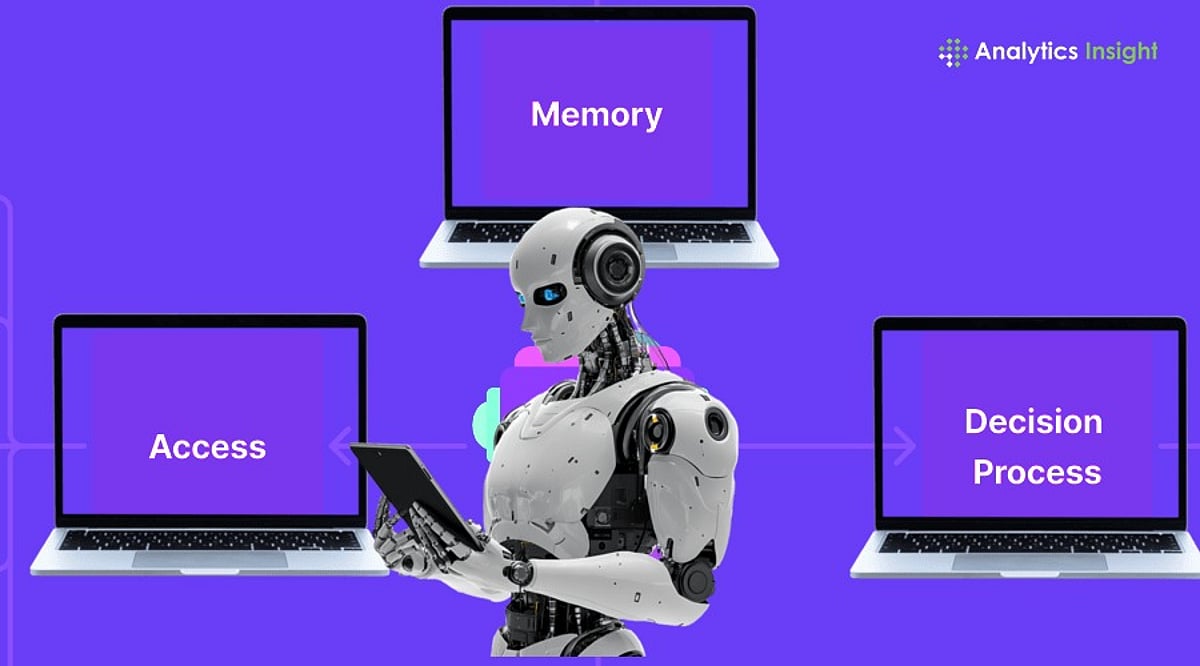
Modern AI agents must process information efficiently while maintaining continuity across conversations and tasks. Poor memory management leads to higher costs and inconsistent outputs. Optimizing memory and context helps agents remain accurate, responsive, and scalable in production environments.
Why Flat Memory Fails
Most memory failures trace back to one design mistake: treating memory as a single, ever-growing log instead of a managed lifecycle. A flat history forces the model to search for everything every time, so retrieval slows, costs climb, and old information starts contradicting new information, with nothing to reconcile them. An agent that remembers a customer’s address from March and a different address from June needs a rule for which one wins. Without that rule, accuracy erodes quietly until a benchmark or an angry user catches it. Teams often respond by simply expanding the context limit, but that treats a design problem as a hardware problem, and the underlying conflict never actually gets resolved.
The Memory Lifecycle Model
A lifecycle model fixes this by giving memory-defined stages instead of one undifferentiated pile.
Capture
Capture decides what enters memory at all. Not every message deserves storage. An agent should extract facts, decisions, and preferences, not a raw transcript, so a support conversation becomes the customer preferring email over phone instead of a full dialogue dump. The agent decides what’s worth keeping. It saves things like user preferences, finished tasks, and confirmed facts and skips greetings and small talk. This keeps memory clean, so the right information is easier to find later.
Store
Store separate memories based on how often they are needed. Hot session data, meaning the current task and the last few turns, stays directly in the prompt. Everything else moves to a searchable store, such as a vector database, so the prompt only carries what the model is actively using.
Retrieve
Retrieve pulls relevant memory back into context on demand. This is where most systems lose accuracy. Naive top-match retrieval tends to grab loosely related facts rather than the right ones, so reranking and filtering before injection matter more than the size of the memory store itself.
Update
If the new information is contrary to current memory, the agent must decide which memory is correct. Many systems place greater weight on more recent and accurate information, allowing newer facts to replace outdated ones. Some also do not delete older versions immediately but retain them for reference. If the agent discovers two facts for the same user or task, it saves both in the same record to prevent confusion and duplicates.
Forget and Archive
Forget and archive to keep memory from growing without bounds. Low-value or rarely accessed memories are compressed into summaries or dropped from the schedule based on recency, frequency, and importance, rather than being kept indefinitely by default.
Choosing Between Long Context, RAG, and Memory Frameworks
None of this requires choosing a single technology. Long context, retrieval-augmented generation, and dedicated memory frameworks such as Mem0, Zep, and Letta answer different questions, and production agents typically combine them.
A Real-World Example: Support Agent Memory
Consider a support agent handling a returning customer. The current ticket sits in working memory. The customer’s stated preference for email contact is based on a retrieval call against stored profile facts. Company policy on refund windows comes from a RAG pipeline that pulls from the knowledge base. Once the ticket closes, the resolution gets summarized and written back to long-term memory, and the raw transcript is discarded. Nothing here depends on a bigger context window. It depends on each piece of information living in the right stage of the lifecycle.
Measuring Memory Performance
Measuring whether this works means tracking token usage per turn, retrieval latency, and accuracy on tasks that require recalling something from a past session, not just this one. Retrieval precision and memory hit rate matter just as much, since a system can achieve fast retrieval yet still return the wrong facts. Flat, unbounded memory and constant full-history reprocessing are the two clearest warning signs that a system is heading toward the failure LongMemEval was built to expose.
Frequently Asked Questions
What is AI agent memory?
AI agent memory is the ability of an AI system to store, retrieve, and use information from previous interactions or external knowledge sources. It helps agents maintain context, personalize responses, and perform multi-step tasks more effectively.
Why is context management important for AI agents?
Context management ensures an AI agent receives only the most relevant information for each task. Effective context selection improves response accuracy, reduces token usage, lowers latency, and prevents information overload.
What is the difference between long context and retrieval-augmented generation (RAG)?
Long context allows an AI model to process larger amounts of information directly, while RAG retrieves only relevant data from external knowledge sources. Many production AI systems combine both approaches for better scalability and performance.
How can AI agent memory be optimized?
AI agent memory can be optimized using tiered memory architectures, memory summarization, retrieval pipelines, context pruning, vector databases, and regular memory updates. These techniques improve efficiency, accuracy, and long-term scalability.
What are the biggest challenges in AI agent memory management?
Common challenges include unbounded memory growth, outdated or conflicting information, poor retrieval quality, high token costs, and the need to maintain accurate context across long conversations or multiple user sessions.
Final Thoughts
As AI agents shift from short-lived assistants to long-running collaborators, memory architecture will play a growing role in how reliable they actually are. The most capable systems will not be the ones with the largest context limits. Instead, they will be the ones that capture meaningful information, retrieve it efficiently, resolve conflicts consistently, and discard information that no longer adds value.