
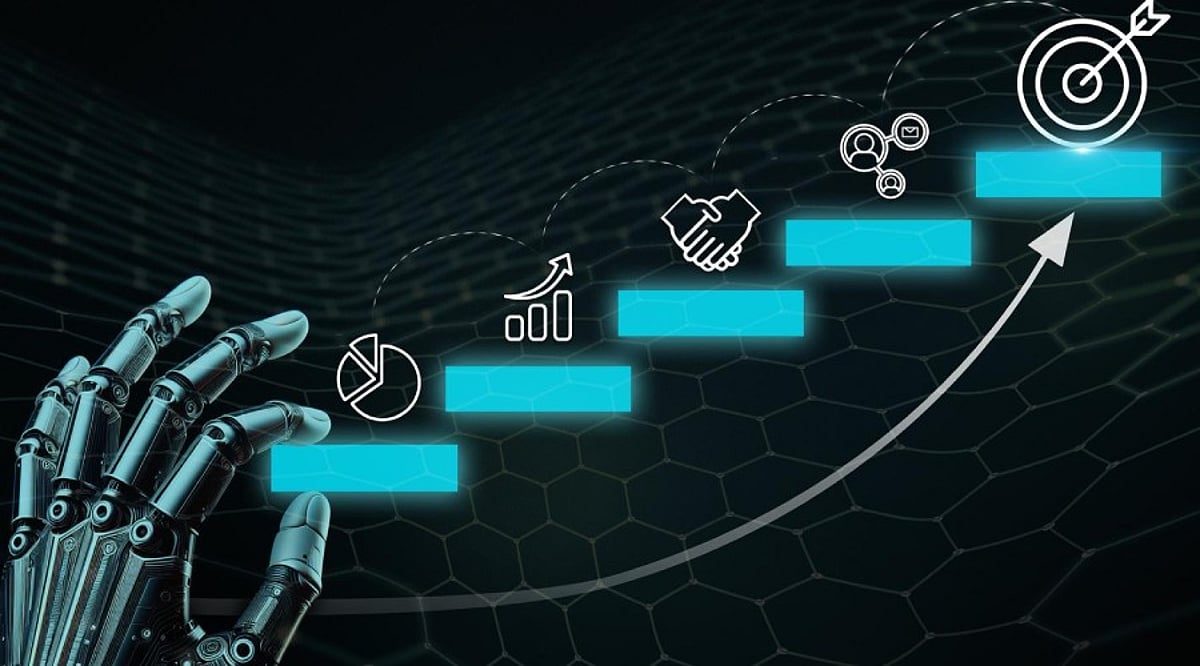
An AI learning roadmap is a staged path that moves learners from basic literacy to advanced specialization. Rather than a random collection of courses, it provides a sequence where each level builds on the previous one. With AI skills increasingly demanded in entry-level roles, following the right progression is more important than simply accumulating knowledge.
The Four Stages of an AI Learning Roadmap
Stage 1: Building AI Literacy (Weeks 1–4)
This foundation stage covers what large language models do, why they hallucinate, the difference between a model and an application built on it, and basic data and AI ethics. Employers value the ability to choose the right AI tool and verify its output over deep technical expertise. Free resources like Google’s AI Essentials, Anthropic’s documentation, and Andrew Ng’s introductory courses are excellent starting points. The goal is to be able to explain in plain terms what a model does and where its output needs a second check.
Stage 2: Applying AI in Real Workflows (Months 2–4)
Once the basics are set, hands-on use begins. Prompt engineering is part of this stage, but the real skill is workflow design: breaking tasks into steps, providing the right context, checking output, and automating repetitive parts. Building a pipeline that pulls data, summarizes it with AI, and flags anomalies for review is a practical achievement. A few finished workflows carry more weight than a certificate.
Stage 3: Moving Into AI Engineering (Months 4–10)
This is where technical depth starts. Python and SQL come first, then statistics, classical machine learning, neural networks, embeddings, and finally retrieval-augmented generation (RAG) and LLM-based applications. Each step supports the next. Learners should become comfortable with a major deep-learning framework like PyTorch or TensorFlow. Fast.ai’s practical deep learning course, DeepLearning.AI specializations, and Kaggle competitions provide strong open resources and a public portfolio.
Stage 4: Choosing an Area of Specialization (Year 1 and Beyond)
The field is too wide for anyone to cover all of it. This stage focuses on picking a problem to master, such as MLOps, AI security, multimodal systems, or agentic AI. Stanford’s 2026 Index shows agentic AI mentions in U.S. job postings grew over 280% in one year. Specialization turns general fluency into a defensible skill set. Advanced ability is measured by the complexity of problems solved, not the number of frameworks known.
Why Sequence Matters
The biggest risk in learning AI is not falling behind but learning the wrong things in the wrong order. Skipping stages explains why some self-taught learners can describe transformers but cannot ship a working chatbot. A roadmap ensures that each level builds a foundation for the next, turning scattered knowledge into practical, demonstrable skills.
Final Thought
The roadmap itself will shift as AI capabilities evolve—agentic AI barely existed as a hiring category two years ago. What stays fixed is the order: literacy, application, engineering, specialization. Learners who follow that sequence build something they can point to and explain, not just a list of finished courses.

