
Tag: AI workforce

  • How AI-Led Productivity Is Redefining IT Hiring: Q&A with Han Digital CEO Saravanan Balasundaram

    How AI-Led Productivity Is Redefining IT Hiring: Q&A with Han Digital CEO Saravanan Balasundaram

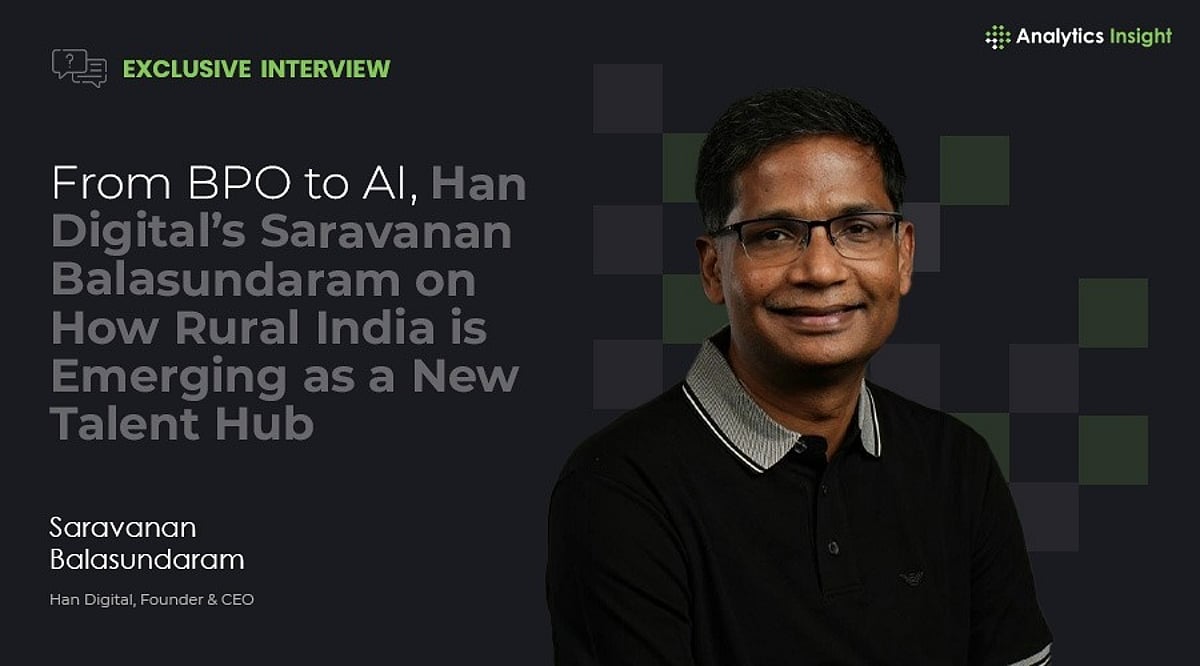
    Saravanan Balasundaram, Founder and CEO of Han Digital Solution, sees a fundamental shift underway in India’s IT-BPM industry. In a recent interview, he outlined how AI-led productivity gains—not just weaker tech spending—are driving the sharp slowdown in net workforce additions. He also explained which roles will thrive, why flexible staffing is becoming the norm, and what graduates need to do to stay employable.

    The Numbers Behind the Hiring Slowdown

    According to Balasundaram, two forces are shaping H1 FY27 workforce trends. Around two-thirds of the decline can be attributed to AI-led productivity, which is reducing the number of people needed to deliver the same work, especially in traditional IT services and BPO. The remainder stems from cautious discretionary spending, reinforced by continued uncertainty in West Asia and its effect on sectors like retail, travel, and manufacturing.

    But overall technology spending has not collapsed. Global IT spending is expected to approach $6.3 trillion in 2026, and Indian enterprises are directing more than 40% of technology capex toward data modernization, AI, and cybersecurity. The result, says Balasundaram, is a shift from mass hiring to precision hiring—where each technology investment must deliver stronger capability and productivity.

    “The bigger imperative is to move the workforce up the value chain faster than the productivity curve is rising,” he said.

    Which Job Roles Will Grow or Decline?

    Hiring demand will center on professionals who can combine AI expertise with technical or domain knowledge. Balasundaram expects strong growth in AI/ML engineering, cybersecurity, robotics and AI, and platform-specific specialists across SAP, Oracle, Microsoft, AWS, Salesforce, and ServiceNow. He also flagged emerging roles such as Loop Engineers and Forward Deployed Engineers—positions built around deploying and operating AI systems autonomously.

    On the other side, repetitive and rules-based tasks will face the most pressure. L1 support, ticketing, transactional processing, basic QA, and some entry-level coding and testing roles will see their share of hiring fall significantly. Balasundaram doesn’t expect these jobs to vanish overnight, but he does see the hiring pyramid shifting from volume-based to skills-based.

    The Rise of Flexible Staffing

    Contract and project-based work is becoming a core part of India’s IT workforce, not just a tool for managing hiring cycles. As Global Capability Centers (GCCs) expand and AI-driven roles emerge, organizations need specialized talent quickly. Flexible staffing lets them access skills like AI, cloud, data, cybersecurity, enterprise platforms, and multilingual capability on demand.

    For mid-career professionals, this means more opportunities to work across projects and organizations. For fresh graduates, however, the entry bar is rising. Companies are moving away from high-volume campus hiring and looking for candidates who already have practical AI skills, domain understanding, and the ability to contribute in production environments. The staffing model, Balasundaram notes, is shifting from “people on demand” to “skills on demand.”

    What AI Readiness Really Means for Gen Z

    Balasundaram argues that AI readiness is too often reduced to prompt engineering. Prompting, he says, is becoming a baseline capability rather than a differentiator. Real readiness means knowing how to build, deploy, integrate, and manage AI systems that operate autonomously across business functions.

    He recommends three priorities for graduates: domain expertise layered with AI skills; technology and platform skills that go beyond using AI tools—including how to build production-ready code; and meta-skills like rapid learning, experimentation, problem-solving, and adaptability. Universities also need to move faster; static curricula risk producing graduates equipped for yesterday’s technology environment.

    When Will Stronger Hiring Return?

    Looking beyond FY27, Balasundaram says enterprise AI spending is surging globally, but ROI has not yet caught up. Workforce growth will rebound when AI moves from cost optimization to value creation through AI-native products, agentic systems, new digital businesses, and technology-led revenue streams. Until then, productivity gains will continue to suppress traditional headcount needs.

    GCCs will be a key signal to watch. As they evolve from executing roadmaps to shaping global strategy and owning products, demand for talent should strengthen—but with a very different skill mix. The next hiring cycle in IT-BPM will likely be smaller in volume, but potentially much higher in value.

    This article is based on insights from Saravanan Balasundaram, Founder & CEO of Han Digital Solution.


  • AI Regulation and Government Policy Are Rewriting India’s Data Science Curriculum

    AI Regulation and Government Policy Are Rewriting India’s Data Science Curriculum

    Governments worldwide are moving AI education from the margins to the center of national policy. Infrastructure, curriculum, and regulation are now being built together to expand the AI talent pool. Nowhere is this shift more visible than in India, where the IndiaAI Mission and the National Education Policy (NEP) 2020 are working as parallel engines, while regulators like AICTE and UGC determine how quickly institutions can respond.

    Why AI Education Has Become a Policy Priority

    As AI creates new demand for skilled workers, governments need people who can develop, apply, and manage AI systems across the economy. Education has therefore become a central pillar of national AI strategy. Governments are restructuring data science and AI courses, improving access to technical education, and working with industry to identify the skills employers actually need. The real challenge is no longer whether countries should build AI talent, but how policy can build that talent at scale — and whether it can reach beyond the institutions that already lead.

    Three Models, One Direction

    Three broad approaches to AI talent development are emerging around the world. Each starts from a different point, but all are moving toward the same goal: growing the supply of AI-capable professionals.

    India’s Two Engines: Infrastructure and Curriculum

    India is pursuing AI education through two engines moving side by side. The first is infrastructure. Launched in 2024 with an outlay of Rs. 10,372 crore over five years, the IndiaAI Mission supports computing infrastructure, datasets, and innovation ecosystems. Its education layer includes AI Centers of Excellence and efforts like the IndiaAI-Meta ‘Srijan’ Center at IIT Jodhpur, which turns national compute spending into practical student skills.

    The second engine is curriculum. NEP 2020 provides the broader framework for spreading AI and data science across higher education. IITs and NITs have moved from AI electives to full degree specializations, and the SWAYAM platform now offers more than 370 AI and analytics courses with more than 4,10,000 enrollments.

    Regulation as a Speed Mechanism

    Regulators are shaping how quickly institutions can adapt. AICTE sets curricular direction through Model B.Tech programs in AI and Data Science, pushing AI concepts into branches outside computer science. UGC promotes flexibility by allowing students to earn roughly 40% of their credits through online learning. Together, these policies give universities room to add emerging AI content without waiting for a full policy cycle. Regulation, in this sense, is not just about limits. It is about speed.

    Why Government Needs Industry

    Government provides scale, universities add academic structure, and industry brings current tools and workplace relevance. Digital platforms then extend access to a much wider audience. None of these can replace the others. Policy can fund compute and set standards, but it cannot supply live datasets or current hiring expectations at the pace that industry can.

    NASSCOM’s FutureSkills PRIME, which has trained over 1.6 million learners, along with ties to firms like Microsoft, IBM, Google, and SAP, keeps the policy framework current in practice rather than as an add-on.

    The Capacity Gap

    When AI infrastructure grows faster than institutions can absorb it, leading institutions have a clear advantage. They have stronger faculty, better access to computing resources, and closer industry connections. Smaller institutions face faculty shortages, weaker infrastructure, and less room to update curricula at pace. A national AI strategy can look successful on paper — with more courses and more funding — while still producing uneven outcomes across institutions.

    Final Thoughts

    India is not short on AI policy. It is short on reach. The mission is funded, the curriculum reforms are in place, and industry ties are growing. But none of that matters much if it stays confined to the same handful of top institutes. The real test is whether ordinary colleges get a fair shot too, or whether the gap between India’s best and everyone else keeps growing.

  • 10 Workforce Priorities for Chief People Officers in the AI Era: A 2027 Checklist

    10 Workforce Priorities for Chief People Officers in the AI Era: A 2027 Checklist

    Key Takeaways

    • Redesign before reducing: Break jobs into tasks and determine where AI and human judgment create the most value.
    • Make skills strategic: Build AI capabilities around business needs, career mobility, and rapidly changing skill requirements.
    • Measure outcomes, not activity: Evaluate AI through work quality, productivity, employee trust and measurable business results.

    For a Chief People Officer, AI is no longer a simple technology choice. The harder task is to decide how work, skills, jobs, pay, leadership, and trust must change. The World Economic Forum’s May 2026 Chief People Officers’ Outlook names three core priorities: job and structure redesign, skill development, and responsible AI and automation.

    1. Build AI Skills Across the Workforce

    AI literacy must move beyond specialists. Roles need clear AI skill levels, from basic use to advanced expertise. PwC’s 2026 AI Jobs Barometer found that skills in the most AI-exposed jobs change more than twice as fast as skills in the least exposed jobs. AI-skill jobs grow 69% faster than the wider market at 9%, while the average pay premium has reached 62%.

    2. Redesign Jobs Before Headcount Cuts

    AI can change a job without role loss. A Chief People Officer should split each role into tasks and assign AI, human judgment, or both. Gartner found that only 1% of layoffs in the first half of 2025 came from AI gains in employee productivity. Job redesign should come before broad cuts.

    3. Make Skills the Core Talent Currency

    Job titles cannot show full value in a fast AI market. A skills map can show rare skills, gaps and future needs. The World Economic Forum reports that 39% of current worker skills may change or become outdated by 2030. A skills-based model can support recruitment, internal moves and faster access to key talent.

    4. Link Skill Development to Business Need

    Skill programs should connect to needs such as AI product work, data analysis, sales quality or client service. The real test is faster skill growth, better role fit and clear business value. A course count alone cannot show whether a people strategy has helped the business. Clear links between skills and business needs offer a stronger measure.

    5. Measure AI by Work Quality and Value

    AI use alone does not prove better performance. Gartner warns about ‘workslop,’ or fast but poor-quality AI output. Measures should cover effort saved, work quality, customer value and useful output. Performance systems must reward judgement, accuracy, creativity and results rather than raw AI activity.

    6. Put Responsible AI Inside the People Function

    HR needs a direct role in AI rules. Recruitment, pay, performance reviews, promotion, employee data and workforce analytics can all involve AI risk. Clear rules should define human review, data use, bias checks and employee notice. Responsible AI should sit close to HR, not only legal or technology teams.

    7. Protect Trust and Employee Health

    AI can create fear when staff lack clear answers about job security, data use and performance checks. A strong people plan needs plain rules and open channels for staff concerns. Gartner has flagged employee mental fitness as a future-of-work issue. The goal should be better work, lower strain and stronger human contact.

    8. Prepare Leaders for Human-AI Teams

    Managers need new skills. They must judge AI output, set limits and decide where human judgment matters most. PwC found that AI-exposed entry-level US roles are seven times more likely to ask for senior skills such as leadership and judgment. Early-career staff may need faster access to real decisions.

    9. Rebuild Recruitment Around Skills and Proof

    Gartner reports that 22% of CHROs said at least one business leader had stopped entry-level recruitment in some area and cited AI automation as the reason. The same survey found that 95% of organizations had some AI use, while only one in five had achieved significant or transformational value. Skills tests and work samples can help judge real ability.

    10. Make Workforce Value a CPO Measure

    This priority links people work to business results. PwC found that the most AI-exposed companies had 34% productivity growth in 2025 versus 24% for the least exposed firms, relative to 2018. The top 20% reached 163% labor productivity growth. Headcount growth stood at 52% versus 36%, while wage growth reached 24% versus 17%. AI success can mean stronger skills, better output and faster growth.

    The CPO Mandate for 2027

    The CPO agenda starts with work, not software. AI changes task value, skill demand, career paths and workforce economics at the same time. McKinsey’s 2026 HR Monitor found gaps between short-term capacity plans and long-term capability plans, staff expectations and company responses, and AI pilots and scaled value. The CPO role needs a direct line from skill strategy to business results. The test for an AI-era workforce is better work, stronger talent and measurable value.

    FAQs

    1. What are the top workforce priorities for CPOs in 2027?

    AI skills, job redesign, skills-based talent management, responsible AI, leadership development and measurable workforce value are among the core priorities.

    2. Why should companies redesign jobs before cutting headcount?

    AI can automate individual tasks while increasing the value of human judgment, creativity and relationship-based work. Redesign can capture these gains before considering broad reductions.

    3. How should companies measure AI’s impact on employees?

    Look beyond AI adoption rates. Measure productivity, work quality, customer value, skill growth, employee experience and business outcomes.

    4. What role should HR play in responsible AI?

    HR should help establish rules for AI in hiring, pay, performance, promotion, employee data and workforce analytics, including human oversight and bias controls.

    5. How can CPOs prepare leaders for human-AI teams?

    Managers need to evaluate AI output, define appropriate boundaries, identify where human judgment is essential and help employees develop higher-value skills.

  • AI Trends CEOs Must Track Before 2030: Agentic AI, Governance, and Strategy

    AI Trends CEOs Must Track Before 2030: Agentic AI, Governance, and Strategy

    Artificial intelligence has entered a new phase. From being an emerging technology to the very core of modern companies’ operations, the transition is happening rapidly. In any industry, discussions within the boardrooms have progressed from ‘Should we use AI?’ to ‘How should we implement AI and what business value do we see in it?’

    It’s not a matter of implementing chatbots or automating tasks anymore. Companies are now looking to invest in technologies capable of making decisions, predicting, optimizing processes, and transforming customer experiences. The next several years will show which companies manage to remain leaders in their fields amid growing competition and AI regulations.

    If you want to stay at the top and understand the technologies shaping your company’s future over the next decade, here are the AI trends to watch.

    AI Trends Transforming Business Operations

    These technologies are changing how organizations operate day to day, enabling faster decision-making, greater efficiency, and smarter execution across core business functions.

    Agentic AI Will Automate Complex Workflows

    The next generation of AI is moving beyond just answering prompts. Agentic AI systems can independently plan, execute, and monitor tasks across departments with minimal human involvement. Instead of waiting around, they can juggle procurement workflows, coordinate customer support, and handle financial reporting too, all in one flow. Autonomous AI agents are expected to become digital co-workers that handle increasingly sophisticated business functions, even when people are not actively watching or checking every step.

    AI-First Enterprises Will Gain a Competitive Edge

    AI is no longer seen as just another software application; it is now being used to rethink business processes. AI is now becoming a key component in decision-making, consumer engagement, and innovation practices. Businesses that adopt AI throughout their value chain will be better equipped to cope with changes in the market environment.

    Decision Intelligence Will Transform Leadership

    Corporate executives today increasingly rely on AI-driven analytics to bypass the usual reporting systems. Advanced AI platforms today can analyze large datasets, spot emerging threats, forecast demand, and recommend actions in real time. Using those technologies can help leadership make faster, evidence-based decisions and boost resilience in wobbly, uncertain business conditions.

    Hyperautomation Will Be Adopted in All Enterprises

    Automation processes aren’t only for small, trivial tasks anymore. With artificial intelligence, robotic process automation, and other intelligent process approaches, companies can automate things like finance, human resources, manufacturing, and customer support functions. It is expected that hyperautomation will bring costs down and tighten consistency so employees can shift attention to adding more value, rather than being stuck on repetitive routines.

    AI Trends Shaping Long-Term Business Strategy

    Beyond the day-to-day operational wins, these emerging trends should affect how businesses manage risk, build trust, cultivate talent, and keep a real competitive edge in the AI-driven economy.

    Workplaces of Future Will See Humans and AI Working Together

    It is expected that artificial intelligence will help people sharpen their job performance. Intelligent machines would take on repetitive chores, while humans can focus on creativity, critical thinking, and more human-to-human interpersonal relations. In this setup, the emphasis would swing toward employee reskilling, AI literacy, and broader organizational change, so adoption doesn’t feel like a sudden wall.

    Responsible AI Will Become an Imperative for Businesses

    With governments tightening rules about the use of AI in business and with consumers demanding greater transparency from businesses, responsible AI has emerged as an imperative. CEOs will have to develop governance models that address data privacy, bias mitigation, accountability, and ethical deployment. Good governance not only helps avoid regulatory risk but also improves customer and investor confidence.

    Businesses Will Move to Enterprise-Owned AI Infrastructure

    Many organizations are reconsidering the extent of their reliance on publicly available AI systems for running important business processes. There is a trend towards investing in private AI models, secure cloud infrastructure, and proprietary databases to safeguard intellectual property rights and improve cybersecurity.

    Measuring AI Returns Will Separate Leaders from Followers

    In the coming wave of AI adoption, there will be much less emphasis on experimentation and much more on implementation outcomes. The shareholders and the board of directors are demanding evidence of growth in revenue, productivity, client satisfaction, and efficiency resulting from the investment in artificial intelligence. Corporations that can measure performance metrics and evaluate the value of AI implementation within their companies will have a strong chance of remaining profitable in the future.

    Nowadays, artificial intelligence is not just another technology fad, it is the core of the company’s strategy. Corporations that can create autonomy and accountability, restructure their workforce, and make decisions based on the analysis are expected to lead the following decade. For CEOs, implementing AI technology is not enough; what really matters is building a company ready to adapt to this innovation. Those who act before 2030 will have an excellent chance of survival amid disruption.