
Tag: AI Workloads

  • Top 10 Fastest PCIe Gen4 and Gen5 SSDs in 2026: Speed, Endurance, and Best Use Cases

    Top 10 Fastest PCIe Gen4 and Gen5 SSDs in 2026: Speed, Endurance, and Best Use Cases

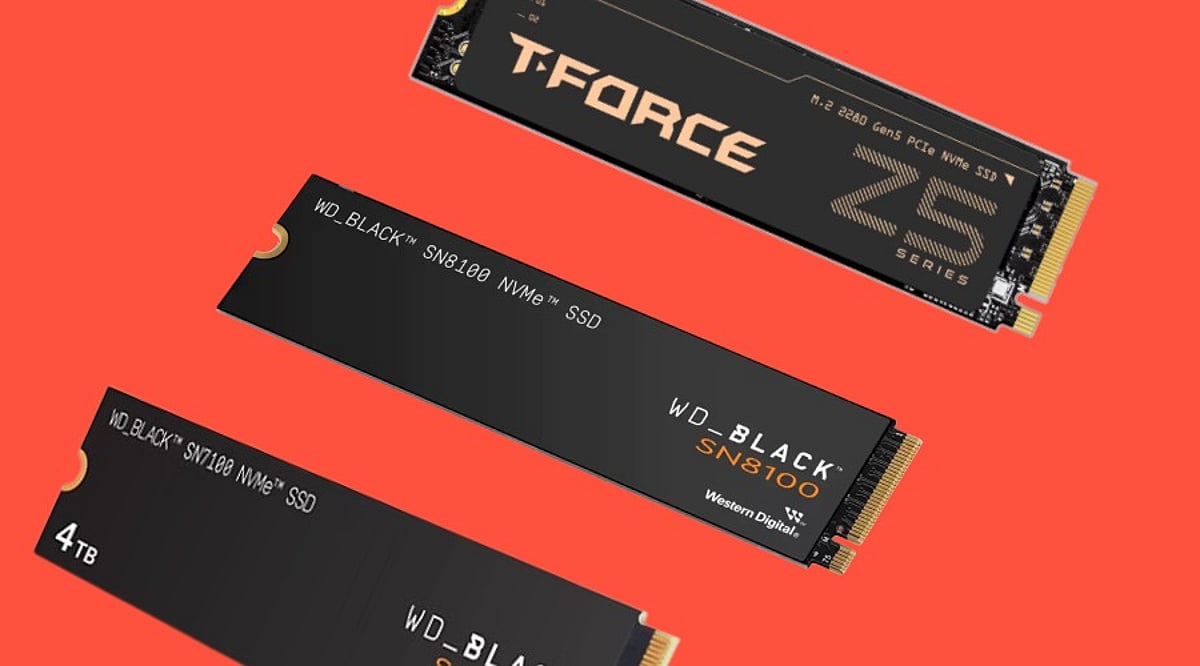
    PCIe Gen4 and Gen5 NVMe SSDs are pushing storage performance well beyond SATA. They deliver faster boot times, quicker game loading, and smoother 4K video editing, while AI workloads benefit from faster dataset and model transfers. Gen4 remains the practical choice for most users, but Gen5 is ideal for creators, professionals, and power users who regularly move huge files.

    Top 10 High-Speed PCIe Gen4 and Gen5 SSDs

    Samsung 9100 Pro

    The Samsung 9100 Pro is a PCIe Gen5 SSD with speeds up to 14,800 MB/s read and 13,400 MB/s write. It features 1TB, 2TB, 4TB, and 8TB capacities, with Samsung V-NAND TLC, an in-house controller, and up to 4,800TBW. A heatsink version is also available. It suits AI workloads, content creation, and demanding workstations.

    WD Black SN8100

    The read and write speeds of the WD Black SN8100 are up to 14,900 MB/s and 14,000 MB/s, respectively, through a PCIe Gen5 interface. Capacity options include 1TB, 2TB, 4TB, and 8TB. With TLC NAND, it comes with up to 4,800 TBW. The drive is available either with or without a heatsink. It is good for gaming, video editing, AI data workloads, and professional productivity.

    Crucial T710

    Crucial’s T710 is a PCIe Gen5 NVMe SSD offering up to 14,900 MB/s read and 13,800 MB/s write speeds, depending on capacity. Available in 1TB, 2TB, and 4TB versions, it offers up to 2,400 TBW. Heatsink and non-heatsink variants are available, making it a strong option for gaming, creative applications, and large file transfers.

    Kingston Fury Renegade G5

    The Kingston Fury Renegade G5 is a PCIe Gen5 SSD with the Silicon Motion SM2508 controller, 3D TLC NAND flash, and DRAM cache technology. The drive offers speeds of 14,800 MB/s for reading and 14,000 MB/s for writing, with a maximum capacity of 8 TB and up to 8,000 TBW endurance.

    Corsair MP700 Pro SE

    Corsair’s MP700 Pro SE is a Gen5 PCIe SSD that comes in 2TB and 4TB capacities. This device achieves up to 14,000 MB/s read and 12,000 MB/s write speeds with 3,000 TBW endurance. Users also get a bare drive, an active air cooling system, and a Hydro X water block.

    Seagate FireCuda 540

    FireCuda 540 features PCIe Gen5, 3D TLC NAND Flash, and the Phison E26 controller certified by Seagate. The 1TB capacity offers speeds of 9,500/8,500 MB/s. The 2TB capacity delivers read/write speeds of 10,000 MB/s.

    Lexar NM1090 Pro

    The NM1090 Pro by Lexar supports a PCIe Gen5 interface, 232-layer 3D TLC NAND, a 6nm controller, as well as DRAM/SLC caching. For the 2TB and 4TB capacities, read and write speeds are 14,000 MB/s and 13,000 MB/s, respectively. Storage capacities range from 1TB to 4TB.

    TeamGroup T-Force GE Pro

    The T-Force GE Pro is a Gen5 PCIe SSD that features the IG5666 controller from InnoGrit. The 2TB and 4TB versions boast a read speed of 14,000 MB/s and an 11,800 MB/s write speed, with a maximum endurance of 2,400 TBW. Cache memory, a graphene thermal pad, and an active cooler are included.

    Samsung 990 Pro

    Samsung 990 Pro still belongs to the category of the fastest PCIe Gen4 SSDs with 7,450 MB/s read and 6,900 MB/s write speeds. The storage device comes in 1 TB, 2 TB, and 4 TB versions. It uses an internal Samsung controller and TLC NAND and provides 2,400 TBW.

    WD Black SN850X

    The WD Black SN850X is a mature PCIe Gen4 SSD offering up to 7,200 MB/s read and 6,600 MB/s write speeds. Capacities extend to 8TB, with TLC NAND and up to 4,800 TBW. An optional heatsink version is available. It remains a practical choice for gaming PCs, content libraries, and general high-performance storage.

    Buying Guide: An Overview

    Check your motherboard before buying: a Gen5 SSD needs a compatible PCIe 5.0 M.2 slot to reach full speed, while Gen4 drives work on more platforms. DRAM can help with sustained workloads, and TLC NAND generally offers stronger endurance balance than QLC. Check TBW for heavy writing, and plan for a heatsink with Gen5 drives. For most users, 1TB is the minimum; 2TB is the better long-term choice.

    Choose a PCIe Gen4 SSD such as the Samsung 990 Pro or WD Black SN850X for excellent gaming and everyday performance with broad compatibility. Move to Gen5 for large-scale video editing, AI datasets, professional workloads, and frequent transfers of massive files where higher sequential bandwidth can make a measurable difference.


  • How AI Is Forcing a Fundamental Redesign of Cloud Infrastructure

    How AI Is Forcing a Fundamental Redesign of Cloud Infrastructure

    Traditional cloud infrastructure was built for a different era of computing. Designed to support applications, databases, websites, and enterprise systems that operated within relatively predictable performance patterns, these models are now being tested by the demands of artificial intelligence. As organizations move from AI experimentation to large-scale deployment, many are discovering that the infrastructure supporting their digital transformation is not well-suited to AI workloads.

    Running AI models, processing large volumes of unstructured data, and delivering real-time AI-powered services require a different approach to compute, storage, networking, and data management. As a result, cloud architecture is entering a new phase of evolution. According to an IDC report, global spending on AI-centric infrastructure is expected to exceed $200 billion by 2028, driven by growing investments in specialized compute, storage, and networking environments designed specifically for AI workloads.

    Why Traditional Cloud Models Face New Pressures

    For most of the cloud era, enterprise workloads were relatively predictable. Applications required stable uptime, databases needed consistent performance, and infrastructure could be scaled based on anticipated demand. AI applications change this equation entirely. Whether deploying a large language model, building an AI-powered customer support platform, or running analytics on large datasets, AI workloads often require intensive bursts of computing power that vary significantly over time. The volume of data involved is substantially larger, and processing requirements are more dynamic than those of traditional enterprise applications.

    AI systems run differently from normal workloads because they continuously process, learn from, and react to varying inputs. This creates infrastructure requirements that are far more demanding in terms of performance, scalability, and operational management. Cloud environments built for traditional workloads will need significant modification to support large-scale AI applications.

    How Cloud Architecture Is Evolving

    One of the most visible changes is in compute infrastructure. In traditional cloud environments, businesses could rely on standard compute resources and scale them according to demand. AI workloads have changed that equation. Training models, running inference workloads, and processing large datasets increasingly require specialized infrastructure optimized for AI performance rather than general-purpose computing.

    Data architecture is also becoming a much bigger consideration. As AI applications depend on large volumes of data, organizations are paying closer attention to where that data is stored and processed. Moving data across multiple regions can introduce delays that may be acceptable for conventional workloads but become problematic for real-time AI applications. This is driving growing interest in regional cloud infrastructure and low-latency deployment models that bring processing closer to end users and business operations.

    Security and compliance requirements add another layer of complexity. When AI systems process sensitive business information, customer records, financial data, or healthcare information, organizations need clear visibility into how data is handled, where it is processed, and whether it remains compliant with regulatory requirements. Infrastructure decisions are becoming increasingly linked to governance, risk management, and data sovereignty considerations.

    The New Requirements of AI-Driven Infrastructure

    The next generation of cloud architecture will be more purpose-built for AI rather than based on infrastructure models originally designed for traditional applications. Organizations are increasingly evaluating cloud environments based on the specific requirements of their AI workloads, including performance, data governance, scalability, and cloud computing infrastructure.

    For Indian enterprises, this trend is intersecting with growing interest in data sovereignty, localized infrastructure, and managed cloud services. As AI becomes embedded across customer-facing platforms and business operations, factors such as latency, compliance, and infrastructure visibility are becoming more important than ever before.

    The fundamentals of cloud computing are not changing. What is changing is the level of performance, flexibility, and governance that modern workloads require. As AI adoption accelerates, cloud architecture is evolving from a general-purpose technology foundation into a specialized platform designed to support the next generation of digital services and intelligent applications.

    Authored by Rahul Takkallapally, Co-Founder, BharathCloud

  • How AI Is Transforming Cloud Infrastructure: What Enterprises Need to Know

    How AI Is Transforming Cloud Infrastructure: What Enterprises Need to Know

    AI is reshaping cloud infrastructure by demanding specialized compute, smarter data management, stronger governance, and low-latency architectures. As adoption accelerates, enterprises must rethink cloud strategies to support scalable, compliant, and performance-driven AI workloads.

    Traditional cloud infrastructure was built for a different era of computing. It was designed to support applications, databases, websites, and enterprise systems that operated within relatively predictable performance patterns. As organizations move from AI experimentation to large-scale AI deployment, many are discovering that the infrastructure models that supported their digital transformation are not always well-suited to the demands of AI.

    Running AI models, processing large volumes of unstructured data, and delivering real-time AI-powered services require a different approach to compute, storage, networking, and data management. As a result, cloud architecture is entering a new phase of evolution.

    The scale of this shift is already becoming visible. According to an IDC report, global spending on AI-centric infrastructure is expected to exceed $200 billion by 2028, driven by growing investments in specialized compute, storage, and networking environments designed specifically for AI workloads.

    Why Traditional Cloud Models Are Facing New Pressures

    For most of the cloud era, enterprise workloads were relatively predictable. Applications required stable uptime, databases needed consistent performance, and infrastructure could be scaled based on anticipated demand. Whether an organization is deploying a large language model, building an AI-powered customer support platform, or running analytics on large datasets, AI applications often require intensive bursts of computing power that can vary significantly over time. The volume of data involved is also substantially larger, while processing requirements are often more dynamic than those of traditional enterprise applications.

    AI systems run differently from normal workloads since they continuously process, learn from, and react to varying inputs. This creates infrastructure requirements that are far more demanding in terms of performance, scalability, and operational management. Thus, cloud environments built for traditional workloads will have to be modified significantly in order to support large-scale AI applications.

    How Cloud Architecture Is Evolving

    One of the most visible changes is in how organizations approach compute infrastructure. In traditional cloud environments, businesses could often rely on standard compute resources and scale them according to demand. AI workloads have changed that equation. Training models, running inference workloads, and processing large datasets increasingly require specialized infrastructure that is optimized for AI performance rather than general-purpose computing.

    Data architecture is also becoming a much bigger consideration. As AI applications depend on large volumes of data, organizations are paying closer attention to where that data is stored and processed. Moving data across multiple regions can introduce delays that may be acceptable for conventional workloads but become problematic for real-time AI applications. This is driving growing interest in regional cloud infrastructure and low-latency deployment models that bring processing closer to end users and business operations.

    Security and compliance requirements are adding another layer of complexity. When AI systems process sensitive business information, customer records, financial data, or healthcare information, organizations need clear visibility into how that data is handled, where it is processed, and whether it remains compliant with regulatory requirements. As a result, infrastructure decisions are becoming increasingly linked to governance, risk management, and data sovereignty considerations.

    The New Requirements of AI-Driven Infrastructure

    The next generation of cloud architecture is likely to be more purpose-built for AI rather than based on infrastructure models originally designed for traditional applications. Organizations are increasingly evaluating cloud environments based on the specific requirements of their AI workloads, including performance, data governance, scalability, and cloud computing infrastructure.

    For Indian enterprises, this trend is also intersecting with growing interest in data sovereignty, localised infrastructure, and managed cloud services. As AI becomes embedded across customer-facing platforms and business operations, factors such as latency, compliance, and infrastructure visibility are becoming more important than ever before.

    The fundamentals of cloud computing are not changing. What is changing is the level of performance, flexibility, and governance that modern workloads require. As AI adoption accelerates, cloud architecture is evolving from a general-purpose technology foundation into a specialized platform designed to support the next generation of digital services and intelligent applications.

    Authored by Rahul Takkallapally, Co-Founder, BharathCloud