
Tag: algorithm

  • YouTube Tests Custom Feeds for Personalized Video Recommendations

    YouTube Tests Custom Feeds for Personalized Video Recommendations

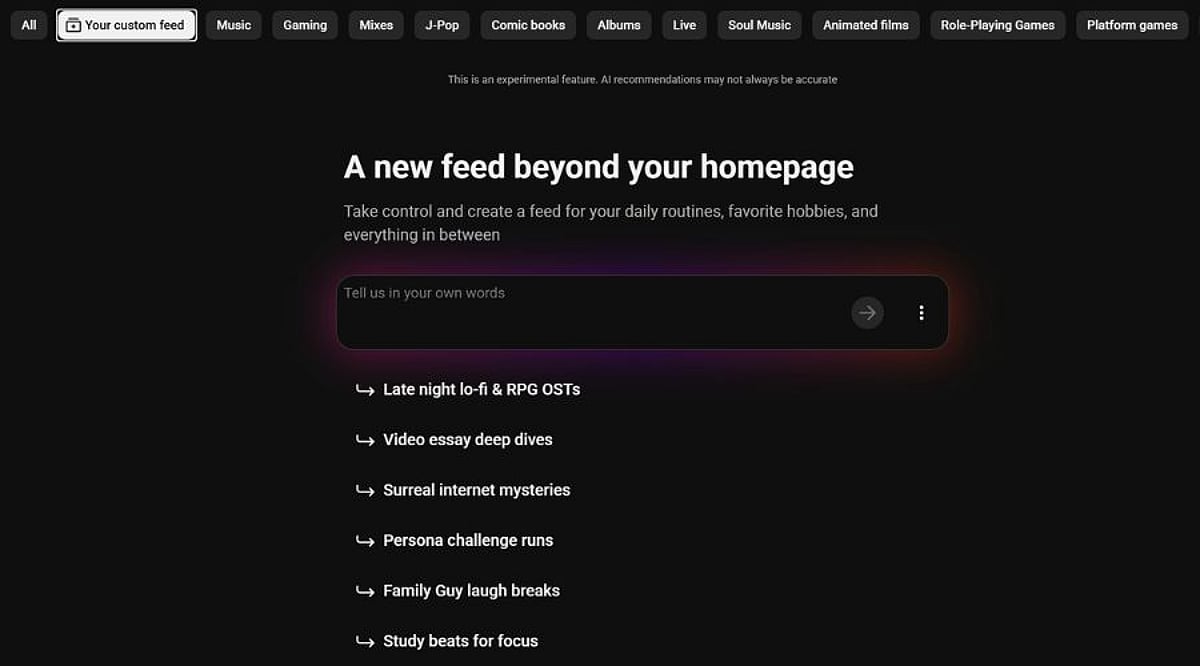
    YouTube is testing a new Custom Feeds feature that gives eligible users more control over the videos recommended to them. Instead of relying only on viewing behavior, users can describe what they want to watch and create a dedicated feed around that request.

    The feature appears at the top of YouTube Home as a Custom Feed chip. Users can enter a natural-language description covering a topic, routine, or mood, after which YouTube generates a stream of recommendations based on the prompt.

    YouTube Tests Up to Eight Custom Feeds

    The latest version of the experiment allows some eligible users in the US to save up to eight active Custom Feeds. Users can switch between these feeds from the top of the Home page and edit their prompts when their interests change.

    On mobile, Custom Feeds can replace YouTube’s standard topic chips, while desktop users continue to have access to the existing topic chips. The feature remains experimental, and availability may vary by account.

    Custom Feeds are different from a standard search. While a search generally provides results for a single query, a Custom Feed is designed to remain as a dedicated destination that users can return to without entering the same request again.

    Custom Feeds Still Work with YouTube’s Algorithm

    Despite giving viewers more direct control, Custom Feeds do not replace YouTube’s recommendation system. The platform continues to determine which videos appear in each feed.

    YouTube also requires both watch and search history to remain enabled for the experiment. Videos watched through Custom Feeds are added to the user’s normal watch history and may influence recommendations on the main Home page.

    This means the feeds are not isolated spaces. Instead, they provide YouTube with an additional signal about what users want to watch at a particular time.

    Availability and Creator Impact

    The latest multi-feed experiment is limited to eligible, signed-in users in the US on Android, iOS and desktop, with English language settings and watch history enabled. YouTube has not announced an official India rollout date.

    For creators, views from Custom Feeds contribute to watch time and monetization in the same way as views from Home. However, creators cannot guarantee that their videos will appear in a particular Custom Feed because YouTube’s ranking system still determines placement.

    YouTube is also monitoring how the experiment affects views, watch time, and revenue as it evaluates the feature.
  • How Netflix Uses AI and Machine Learning to Personalize Your Viewing Experience

    How Netflix Uses AI and Machine Learning to Personalize Your Viewing Experience

    Netflix relies on artificial intelligence and machine learning to decide what appears on a user’s homepage every time they open the app. The system tracks what a person watches, how long they watch it, and whether they finish a show or abandon it halfway. It also notices smaller signals, such as pausing, rewinding, or skipping certain scenes.

    All of this data feeds into an algorithm that builds a detailed picture of individual taste, covering genres, actors, themes and even the pacing of a show. Netflix then ranks titles in its library based on how well they match that profile, along with overall popularity and ratings from similar users.

    Also read: What New Netflix Series Are Coming in September 2026?

    Inside Netflix’s Recommendation Engine

    Netflix currently serves more than 325 million subscribers across 190 countries, and its recommendation engine plays a central role in keeping that massive base engaged. Company data shows more than 80% of what people watch on the platform gets discovered through personalized recommendations rather than active searching.

    A 2024 internal study by Netflix reportedly found that removing personalized suggestions entirely would cause viewer engagement to drop by 16%, underlining how much the system shapes viewing habits. The company also estimates the recommendation engine saves it more than a billion dollars a year by reducing subscriber churn.

    New users are not left out of this process either. Since Netflix has little data on a fresh account, it asks new subscribers to pick a few titles they already enjoy right at sign-up. This gives the algorithm a starting point, and it keeps refining suggestions the more a person watches.

    Reinforcement learning also allows the system to react quickly, adjusting recommendations almost instantly after someone rates a show or watches something new.

    Also read: Most Underrated Netflix Shows You Shouldn’t Have Missed

    How AI Shapes Netflix

    Netflix’s AI-driven system does more than recommend a movie for a Friday night. It also decides how thumbnails look for each user, since two people can see completely different cover images for the same title based on what usually catches their attention.

    This level of personalisation extends to search results and even the order of rows on the homepage. For a platform competing against Amazon Prime, Disney+ and other streaming services, this kind of tailored experience became a major reason people stick around instead of switching to a rival.

  • India Presses Meta for Answers on Instagram Algorithm and Legal Compliance

    India Presses Meta for Answers on Instagram Algorithm and Legal Compliance

    The Indian government has formally requested Meta to explain how its Instagram and Facebook algorithms determine content reach and visibility. Officials are also demanding stronger cooperation on child sexual abuse material (CSAM), online fraud, deepfakes, and automated bot accounts.

    IT Minister Ashwini Vaishnaw chaired a second meeting with Meta officials on Thursday. Meta’s delegation included global affairs chief Joel Kaplan and public policy vice president Neil Potts. Discussions covered technical systems, legal duties, and content distribution practices.

    Scrutiny Over Algorithmic Bias

    Government officials focused on how Instagram recommends, reduces, or promotes posts. They also examined allegations that the platform’s systems favored anti-government material and handled comparable content differently.

    The scrutiny is linked to concerns about political and public-interest content. During the CJP-led Gen Z protests, users relied on Instagram to share videos, personal accounts, and protest updates. Recommendation systems influenced which posts reached larger audiences.

    Meta controls the rules and data behind those decisions. Users can appeal when the company removes a post, but they may receive little information when Instagram limits a post’s reach or excludes it from recommendation sections.

    The government wants Meta to explain the signals its systems use when ranking content. Officials also seek details about reduced distribution and the treatment of Indian-language posts compared with English-language material.

    Indian Law Guides Platform Operations

    Government sources said every social media company operating in India must follow Indian law. The requirement covers Meta, X, and other online platforms serving users across the country.

    “We are a constitutional democracy. The rule of law is paramount,” a government source said. “Platforms operating in India cannot function according to the US Constitution or the Constitution of Europe.”

    The source added that platforms must operate under India’s Constitution and national laws. Officials also cited Article 19, which protects freedom of speech, and Article 19(2), which permits reasonable restrictions under defined grounds.

    Authorities summoned Meta after Facebook briefly restricted a video post from Prime Minister Narendra Modi. Kaplan later apologized for the error. Government sources said Meta CEO Mark Zuckerberg also apologized over the incident and other platform concerns.

    Officials said any legal proceedings would follow the required legal process. For now, authorities are assessing Meta’s conduct under Indian rules. They also seek answers across technical, policy, and legal areas.

    Meta’s Technical Team Continues Talks

    Meta’s technical team will continue discussions with government technology officials after Kaplan leaves India. The talks will cover recommendation systems, alleged bias, CSAM, fraudulent posts, deepfakes, and bot activity.

    Meta told officials that it was working to address harmful content and automated accounts. However, the meetings also covered how its systems rank lawful posts before any removal decision occurs.

    Government officials want clearer information on how automated tools separate harmful mobilization from legitimate reporting and political criticism. They also seek stronger cooperation when Indian law enforcement agencies investigate CSAM and fraud.

    Available reports do not confirm that Meta shared internal distribution data or a formal audit of protest-related recommendations. Discussions will continue between the company’s specialists and government teams.

    “The first question is whether they are functioning in accordance with the law of the land,” an official said. The government’s primary demand is compliance with Indian law, along with clearer answers about the automated systems that determine content visibility for Instagram and Facebook users.