
Tag: Amazon Bedrock

  • Anthropic Expands in India: Claude AI Now Supports In-Country Inference and Unveils New Partnerships

    Anthropic Expands in India: Claude AI Now Supports In-Country Inference and Unveils New Partnerships

    Anthropic has announced a significant expansion in India, bringing in-country inference for Claude via Amazon Bedrock and revealing a host of new partnerships with Indian enterprises, startups, and nonprofits. The move addresses a top request from Indian organizations for local data processing, enabling them to deploy Claude while meeting strict data residency requirements.

    Claude Goes Local: In-Country Inference via Amazon Bedrock

    In the coming weeks, Claude will be available with in-country inference in India through Amazon Bedrock, AWS’s platform for building generative AI applications. Requests sent to Claude through the India endpoint will be processed on servers within India, giving banks, insurers, public agencies, and other highly regulated institutions the certainty they need to handle sensitive customer data. This control is pivotal for organizations moving from AI pilots to full-scale deployment.

    “We are glad to see partners like Anthropic and AWS bringing in-country inference to India. Access to trusted, frontier AI closer to home is a positive step for the ecosystem as we all explore how these technologies can responsibly serve customers,” said Ashok Vaswani, Managing Director & CEO of Kotak Bank.

    Claude deployments through Amazon Bedrock also include audit trails and access controls that meet the requirements of risk and compliance teams, ensuring a secure path to production.

    Building Momentum Across Indian Enterprises and Startups

    Anthropic’s presence in India has grown rapidly since its Bengaluru office opened in February. The local team now provides applied AI expertise to enterprises, digital natives, and startups. Major Indian companies are adopting Claude for diverse use cases:

    • Axis Bank leverages Claude for engineering excellence and employee productivity.
    • NPCI is building AiNxt, its agentic AI platform, with Claude.
    • IndusInd Bank uses Claude to create an AI-enabled enterprise knowledge platform.
    • Godrej Industries runs Claude across internal app development and business analysis.

    IT services leaders are also integrating Claude into their offerings. TCS is equipping 50,000 associates with Claude, Infosys is combining Claude with Infosys Topaz™ and establishing a dedicated Anthropic Center of Excellence, and Cognizant uses Claude in systems for manufacturing, life sciences, and insurance. LTM & LTTS are embedding Claude and Claude Code into their platforms.

    Digital natives are embedding Claude in consumer products: Swiggy uses MCP to make flagship services reachable, Instamart now offers natural-language shopping for 40,000+ products, Zoho equips customers with Claude models, and Invideo delivers precise quality across 190 nations.

    Startups like Rocket, Atlan, Cred, Zamp.ai, and Freshworks are building with Claude to accelerate development and enhance productivity.

    Partnerships Driving Scale and Innovation

    Anthropic’s Claude Partner Network has seen high registration numbers in India, with many partners achieving Global Premier, Preferred, and Select tiers. This week, Bengaluru hosts the first Claude Certification for Partners, aiming to certify 5,000 people.

    Advancing Beneficial Deployments and Social Impact

    Anthropic’s AI for Science program supports researchers across India, including the Evolutionary Venomics Lab at IISc, which uses Claude to annotate venom data, and PopVax, which employs Claude in protein-design models for vaccines and cancer treatments. Nonprofits like Pratham, Agami, Civis, and Digital Green are using Claude to improve education, justice, civic tech, and agriculture.

    Strengthening Cybersecurity and Public Trust

    Indian organizations are also using Claude to bolster cyber defenses. The Data Security Council of India has a Claude-powered AI testing sandbox, while MOSIP—the open-source platform behind national digital ID systems—uses Claude to secure code. OpenG2P leverages Claude for secure citizen benefit delivery.

    Commitment to Indian Languages and Responsible AI

    Six months after signing the New Delhi Frontier AI Impact Commitments, Anthropic is making progress on improving Claude’s performance in Indian languages. A pilot with Karya evaluated Claude across seven languages in agriculture, helping identify linguistic and cultural nuances that automated evaluations miss.

    With in-country inference, Anthropic is set to deepen its work in India, opening doors for deployments where data must remain in the country.
  • AWS AI & ML Certifications: A Guide to Choosing the Right Path in 2026

    AWS AI & ML Certifications: A Guide to Choosing the Right Path in 2026

    AWS offers a growing range of AI and machine learning certifications for beginners, developers, data engineers, and experienced AI professionals. Each credential is designed for different skills and career goals. Understanding the certification path makes it easier to choose the right option. This guide compares the key certifications to help you decide which one best fits your career.

    Overview

    AWS offers a role-based AI and machine learning certification portfolio that supports beginners, machine learning engineers, data engineers, and developers building AI-powered applications. The certifications cover AI fundamentals, machine learning model development, MLOps, data engineering, foundation models, retrieval-augmented generation (RAG), and Amazon Bedrock.

    AWS has modernized its certification ecosystem by replacing the legacy Machine Learning – Specialty path with role-specific credentials aligned with today’s AI and generative AI workloads. AWS certifications used to funnel almost everyone toward one exam. This has changed, and the lineup now spans across four credentials, each built for a distinct kind of work. It includes a foundational exam for newcomers, an associate-level path for engineers who build and deploy models, a data-focused associate track, and a professional certification for developers shipping generative AI features.

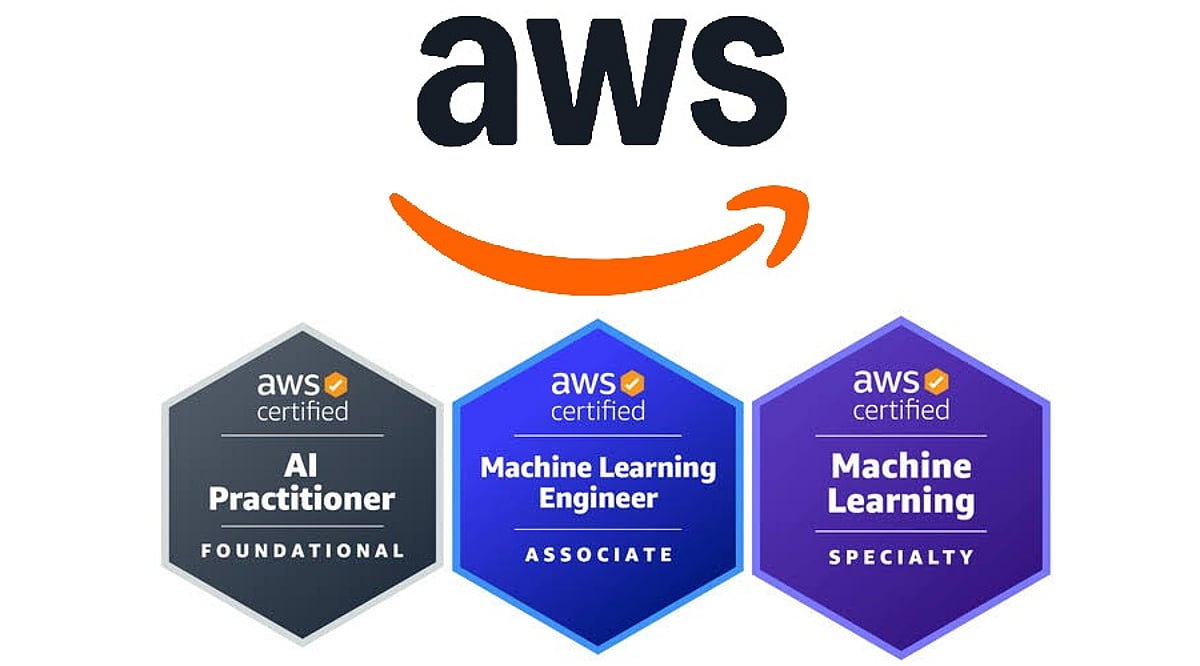
    The Machine Learning Specialty exam was retired for new candidates on March 31, 2026. Existing holders will keep the certification until its original expiry. More than an administrative change, this shift signals AWS’s move toward role-based certifications that better match candidates’ actual job responsibilities.

    What the Current Lineup Covers

    The active AWS AI and ML certifications include:

    • AWS Certified AI Practitioner (Foundational): Covers core AI and machine learning concepts, responsible AI practices, and how AWS services support common use cases. No coding background is required.
    • AWS Certified Machine Learning Engineer – Associate: Focuses on building, tuning, deploying, and monitoring machine learning models using services such as Amazon SageMaker, Amazon S3, and Amazon CloudWatch. Built for professionals who already have hands-on ML experience.
    • AWS Certified Generative AI Developer – Professional: Validates the ability to integrate large language models into applications, build retrieval-augmented generation (RAG) architectures, and work with vector databases and Amazon Bedrock for production-ready AI solutions.
    • AWS Certified Data Engineer – Associate: Centers on designing and managing data pipelines, storage, and reliable data infrastructure that supports machine learning and generative AI workloads.

    Matching the Exam to the Job

    A newcomer pivoting into AI from another field or a business analyst who needs to speak the same language as an engineering team gets the most value from AI Practitioner. It builds a baseline in AI and ML concepts without demanding coding depth.

    Someone already training and deploying models is better served by ML Engineer – Associate, which centers on data preparation, model tuning, and running workloads in production rather than staying inside a notebook.

    Developers already working with large language models, RAG pipelines, and Bedrock fit the Generative AI Developer – Professional role. This credential expects prior implementation experience rather than theory alone, and choosing it over AI Practitioner or ML Engineer comes down to one question: is the work built around foundation models or traditional ML pipelines?

    Data engineers who feed pipelines into ML systems should look at Data Engineer – Associate, a track that rarely gets the same attention as the AI-branded exams but supports all of them underneath.

    Product managers and stakeholders overseeing AI projects without building them get more practical value from AI Practitioner than from an engineering-level exam, since the goal is informed oversight rather than hands-on implementation.

    Deciding Where to Start

    The simplest approach starts with hands-on experience, not ambition. Someone new to AWS and AI belongs in AI Practitioner first. Someone already building or deploying models can skip straight to ML Engineer – Associate. A developer working with foundation models in production is the right candidate for Generative AI Developer – Professional.

    A common progression looks like AI Practitioner, then ML Engineer – Associate or Data Engineer – Associate depending on the role, then Generative AI Developer – Professional once foundation model work becomes part of the job.

    For those already deep into machine learning specialty prep, finishing it still holds some value, given less than a year remains before it closes to new candidates. For everyone else, moving straight to ML Engineer Associate offers more current coverage and a clearer path forward.

    The strongest certification choice rarely lines up with the most advanced option available. It lines up with what the job actually requires now and with where that job is headed next.

    Final Thoughts

    AWS restructuring its AI credentials around roles rather than a single tiered ladder points to where cloud certification is heading in general. It clarifies that the exam is less about climbing a fixed hierarchy and more about proving specific, current skills tied to specific work. Candidates who treat certification as a career-mapping exercise, rather than a checklist, will likely find their credentials relevant as AWS splits its portfolio.