
Tag: Ark Invest

  • Cathie Wood Doubles Down on Nvidia: What It Signals for Investors

    Cathie Wood Doubles Down on Nvidia: What It Signals for Investors

    Cathie Wood, the CEO of ARK Invest, has once again demonstrated her contrarian investment style by increasing her firm’s stake in Nvidia following a recent stock price decline. The move, which involved the purchase of 78,965 shares worth nearly $15.5 million, underscores her unwavering confidence in the company’s long-term prospects within the artificial intelligence sector.

    Despite short-term market volatility and a pullback in Nvidia’s share price, Wood’s decision reflects a belief that the company’s fundamental strengths remain intact. Nvidia continues to be a dominant player in the AI chip market, supplying critical hardware for data centers, cloud computing, and advanced AI applications. The company’s technology is integral to the development of large language models, autonomous vehicles, and other cutting-edge innovations.

    Wood’s investment approach often involves buying during periods of market pessimism, a strategy that has both yielded significant gains and faced criticism in the past. In this case, she is betting that Nvidia’s market leadership and the ongoing expansion of AI infrastructure will drive long-term value, even if near-term price movements are uncertain.

    For investors, the key takeaway is not necessarily to mimic Wood’s trade, but to consider the broader implications. Nvidia’s role in the AI ecosystem is unlikely to diminish quickly, but the stock’s valuation remains elevated compared to historical norms. Factors such as competition from AMD and custom chips developed by major cloud providers, as well as geopolitical risks related to export controls, could introduce additional volatility.

    As always, individual investors should conduct their own research and assess their risk tolerance before making any investment decisions. Wood’s move serves as a reminder that long-term investing often requires patience and a willingness to look beyond short-term market fluctuations.

  • Ethereum Faces Renewed Pressure as Robinhood Chain Revenue Debate Intensifies

    Ethereum Faces Renewed Pressure as Robinhood Chain Revenue Debate Intensifies

    Ethereum (ETH) remains under pressure after ARK Invest analyst Lorenzo Valente questioned the network’s revenue model following the rapid rise of Robinhood Chain. The analyst said Ethereum received only $1,538 in revenue from Arbitrum despite Robinhood Chain generating $816,000 since its July 1 launch.

    At the same time, Ethereum continued trading below the key $1,840 resistance level, while renewed spot ETF outflows and geopolitical tensions added to market uncertainty.

    Analyst Questions Ethereum Revenue Share

    Valente said Robinhood Chain has become the fifth-largest blockchain by decentralized exchange trading volume, according to DeFiLlama. The network gained traction after introducing a 90-day gas subsidy designed to encourage user adoption.

    According to the analyst, Robinhood Chain generated $816,000 in revenue after launching on July 1. He said 10% of that amount went to Arbitrum, while Ethereum collected only $1,538.

    That distribution means Ethereum received roughly 0.15% of Robinhood Chain’s revenue. Valente said such figures challenge the view that ETH serves as a meaningful revenue-generating asset. He added that the model should change so Ethereum receives 15% of revenue, while Arbitrum and Robinhood receive 10% and 75%, respectively.

    Meanwhile, ConsenSys founder Joe Lubin defended the current fee structure. He said lower fees encourage more companies to build on Ethereum, which could support ETH’s long-term value.

    Ethereum Price Tests Key Resistance

    Ethereum continued facing resistance near $1,840 after failing to break above that level for three consecutive days. The repeated rejection suggested buyers remained cautious at higher prices.

    Even so, technical indicators continued showing constructive momentum. The MACD line turned positive, while the Relative Strength Index stood at 55, indicating bulls still held the advantage.

    If ETH closes above $1,840, it would break above a rising parallel channel. Such a move would also complete a double-bottom pattern and could open the path toward $2,244, representing a potential 22% gain.

    On the other hand, failure to clear resistance could send Ethereum back toward support at $1,725. That decline could occur if investors reduce exposure as geopolitical tensions between the United States and Iran intensify after President Donald Trump reinstated the blockade at the Strait of Hormuz.

    ETF Outflows Return as Market Watches Inflation Data

    Investor sentiment also weakened after spot Ethereum exchange-traded funds recorded net outflows on July 13. Data from SoSoValue showed ETFs lost $15 million after attracting $84 million in inflows between July 6 and July 10.

    At the same time, crude oil prices climbed above $80 as tensions between the United States and Iran increased. Rising oil prices often reduce demand for risk assets, creating another challenge for cryptocurrencies.

    In addition, traders turned their attention to U.S. inflation data scheduled for July 14. The report could influence expectations for Federal Reserve interest rate decisions and, in turn, affect demand for spot Ethereum ETFs and the broader cryptocurrency market.

    What’s Next?

    The Ethereum price remains below the crucial $1,840 resistance as debate grows over its revenue share from Robinhood Chain. Meanwhile, ETF outflows, technical indicators, and rising geopolitical tensions continue shaping market sentiment. Investors will closely watch upcoming price action and macroeconomic developments.

  • SPCX Stock Falls After NASDAQ-100 Debut as Analysts Deliver Mixed Forecasts

    SPCX Stock Falls After NASDAQ-100 Debut as Analysts Deliver Mixed Forecasts

    SpaceX stock (ticker: SPCX) experienced a decline following its first day of trading on the NASDAQ-100 index, closing at $149.47 on Tuesday. The 7% drop came despite expectations that index inclusion would trigger buying from funds tracking the benchmark. The stock remains above its $135 IPO price but is more than 25% below its June 16 closing high of $201.80.

    The NASDAQ-100 entry had been anticipated to bring demand from index-tracking funds, which collectively manage approximately $800 billion in assets. However, this anticipated buying did not materialize into a rally, suggesting that some of the index demand may have been priced into the stock earlier. SPCX had gained nearly 6% in the week leading up to the index addition, and investors sold off shares as the first NASDAQ-100 session failed to extend that upward move.

    Meanwhile, ARK Invest increased its position in SpaceX by purchasing 44,196 SPCX shares on Tuesday, valued at around $6.6 million based on the closing price. ARK funds already held approximately 3.29 million shares by the end of SpaceX’s first public trading day.

    Wall Street analysts have begun issuing coverage following the end of the post-IPO quiet period, with a wide range of price targets reflecting significant uncertainty about the company’s valuation. The average analyst target stands near $236, implying roughly 58% upside from Tuesday’s close. Nineteen analysts have issued ratings so far.

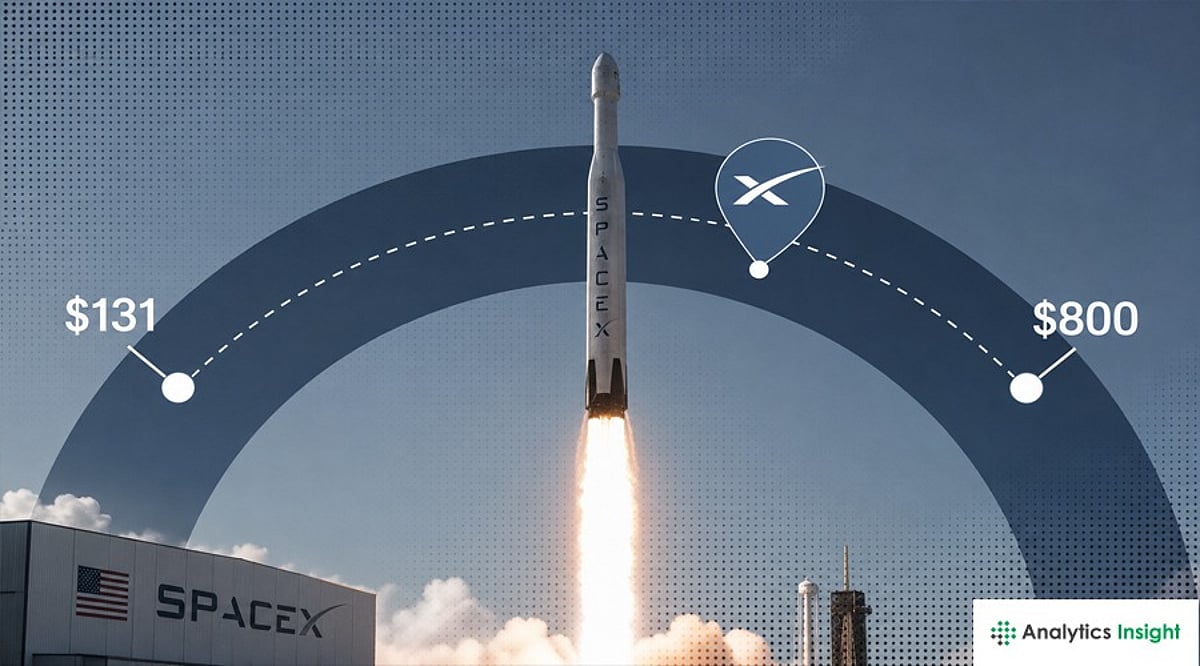
    Deutsche Bank initiated coverage with a Buy rating and a $255 target, citing SpaceX’s reusable rockets, Starlink satellite internet business, and potential use in AI infrastructure. Cantor Fitzgerald started with an Overweight rating and a $246 target, describing SpaceX as a “planetary infrastructure company.” Raymond James set the highest target on the Street at $800. Citi rated the stock a Buy at $200, linking a longer-term $900 case to the Starship program. Morgan Stanley set a $300 base case, with a $600 bull case and a $75 bear case.

    However, not all analysts share this optimism. MoffettNathanson set a $131 target with a neutral rating, questioning SpaceX’s valuation and long-term business forecasts. The firm called the company’s $30 trillion addressable market estimate “absurd” and expressed doubts about plans tied to orbital compute, stating, “There is simply no credible financial model that can support what is at the time of this writing a roughly $2 trillion valuation.”

    In other news, SpaceX has raised prices for Starlink Business Aviation customers. The Aviation Regional 25GB plan increased to $4,000 per month from $2,000, with additional data priced at $250 per GB. The company also introduced Aviation Regional Unlimited at $12,500 per month and raised Aviation Global Unlimited to $20,000 per month from $10,000, offering worldwide coverage and speeds up to 1 Gbps with the Aviation Performance Antenna. Starlink aviation equipment costs also rose to $200,000 per business jet, up from $145,000 last year.

  • Ark Invest Expands Crypto Holdings in Coinbase and Robinhood as Base Resumes Block Production

    Ark Invest Expands Crypto Holdings in Coinbase and Robinhood as Base Resumes Block Production

    Ark Invest increased its positions in several crypto-linked companies on Thursday, purchasing shares of Coinbase, Circle, Bullish, and Robinhood after each stock closed lower. The buying activity was spread across three of Ark’s exchange-traded funds, coinciding with the restoration of block production on the Coinbase-backed Base network following a brief outage.

    Ark Invest Adds to Crypto-Linked Holdings

    Ark Invest’s latest trading disclosure revealed purchases of 9,014 Coinbase shares through the ARKK, ARKW, and ARKF ETFs, valued at approximately $1.28 million based on Thursday’s closing price. The firm also acquired 9,264 Circle shares worth roughly $637,455, 9,136 Bullish shares valued at about $199,895, and 35,023 Robinhood shares through the ARKK fund, totaling approximately $3.27 million.

    All four stocks ended the session lower: Coinbase fell 5% to $142.52, Circle lost 3% to close at $68.81, Robinhood dropped 3.85% to $93.47, and Bullish declined 6.77% to $21.88. Ark actively manages portfolio weightings, ensuring no single holding exceeds 10% of a fund’s assets.

    Cathie Wood Points to Slowing Inflation

    During a roadshow across Asia and Europe, Ark CEO Cathie Wood noted that many investors remain concerned about inflation. She expressed confidence that inflation could decline further, citing lower oil prices and improved productivity. Wood highlighted that unit labor costs, a key inflation measure, have already slowed to 0.5% year-over-year, attributing this trend to stronger productivity gains.

    She also commented on Kevin Warsh, suggesting he understands both the role in lowering inflation and weaknesses in government inflation measurements. Wood added that financial markets could benefit from a master class in monetary policy if Warsh pursues that approach.

    Base Network Restores Operations After Outage

    Coinbase-backed Base resumed normal operations after a consensus issue halted block production for nearly two hours on Thursday. The Ethereum layer-2 network confirmed that engineers resolved the problem, with blocks returning to normal production. Base first reported unhealthy block production at 4:03 p.m. UTC, later identifying a consensus issue involving an invalid block that entered sequencing, stopping new blocks after block 47,806,542.

    Base announced via X that block production had fully resumed, and the team will continue investigating before releasing a complete post-mortem. Base creator Jesse Pollak assured users that funds remained safe throughout the interruption, though he acknowledged that a network halt is unacceptable for a platform designed to support global financial activity. The outage temporarily paused on-chain transactions, and ecosystem node operators were instructed to restart their nodes to restore syncing.

    What’s Next?

    Ark Invest’s increased holdings in Coinbase, Circle, Bullish, and Robinhood reflect a strategic bet on crypto-related equities amid price declines. Meanwhile, Base’s swift recovery from the outage underscores the resilience of Layer-2 infrastructure. Investors will likely monitor both market movements and network developments closely in the coming days.