
Introduction
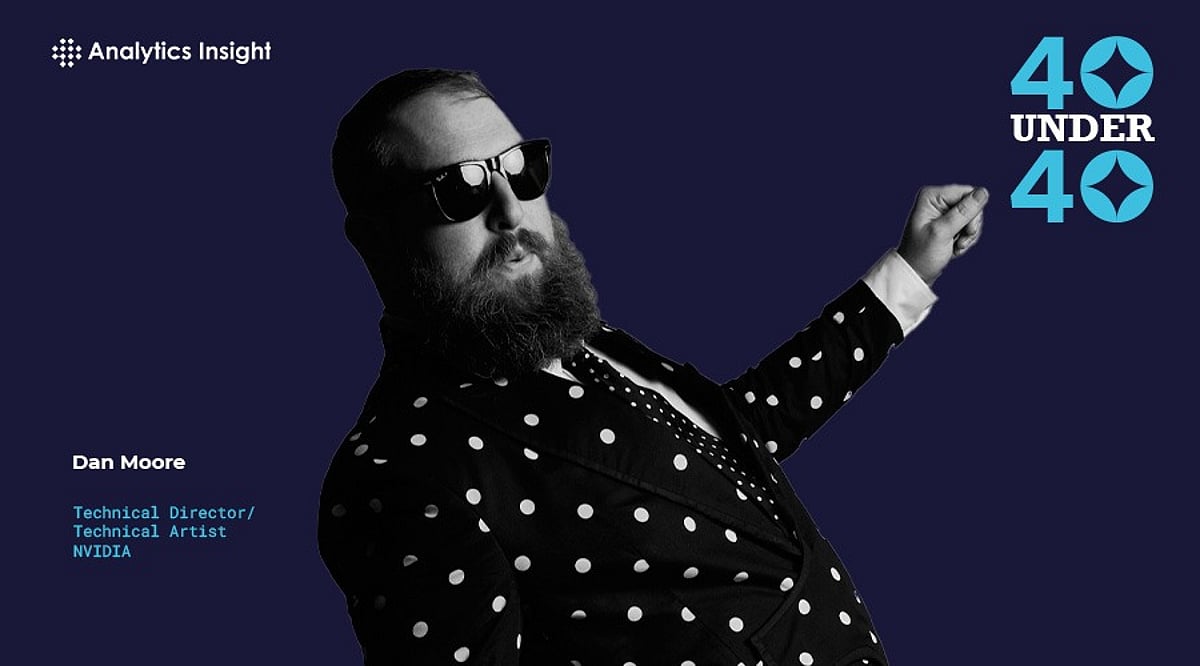
Dan Moore is an artist, designer, technologist, and educator working at the intersection of art, technology, and culture. His practice explores what it means to create alongside machines, treating AI not simply as a tool, but as a collaborator in the production of images, objects, performances, and systems.
Moore is a Senior Technical Artist at NVIDIA, where he works with real-time graphics, generative AI, robotics, simulation, and creative production technologies. In this role, he bridges artistic practice and advanced technical systems, helping translate emerging tools into workflows for artists, designers, and creative teams.
Moore’s independent work spans painting, textiles, time-based media, robotics, and interactive installations. His projects examine distributed authorship, machine agency, and the shifting relationship between human intuition and computational process. Among his notable works are AI-generated painting series, live generative fashion through GLITCHWEAR, robotic performance works, and The Great American Pastime: Berra and the Bronx Legends, an AI-driven infinite baseball broadcast commissioned by the Yogi Berra Museum.
Moore also teaches creative technology at The New School, helping students understand code, AI, and digital systems as expressive materials.
The Interview
Q: Please introduce yourself and tell us about your journey.
A: I am Dan Moore, an artist, technologist, and educator working with AI, robotics, and generative systems. I am also a Senior Technical Artist at NVIDIA. My journey has always moved between engineering and art. Early in my career, I became fascinated by tangible interaction and computational media, leading to projects involving robot arms, large-scale interactive installations, real-time graphics, and later generative AI. My practice has expanded from building tools into making cultural works that question authorship, agency, and collaboration between humans and machines. I also teach at The New School, where I work with students to think critically about software, AI, and the social impact of technology.
Q: What inspired you to pursue a career in creative technology?
A: I’m bored by technology that’s just functional. I’m drawn to the expressive, the strange, and the emotionally resonant. Creative technology lets me smash engineering discipline into artistic curiosity. The most interesting moment is when a machine does something I didn’t predict. In most fields, that’s an error; in mine, it’s the point. That discovery keeps me moving. Whether at NVIDIA, in my studio, or in the classroom, I treat creative technology as a way for artists to hijack the future of tools and culture before they’re handed to us as finished products.
Q: What achievement are you most proud of?
A: I’m proud of building a practice that refuses to sit still. The Great American Pastime series is a highlight. It won the 2025 AI Creative Future Award for turning fictional baseball into an infinite, AI-generated radio broadcast. I also value my time as an educator. Teaching students that code and AI are raw, expressive materials is as vital to me as the work I hang on a gallery wall.
Q: What has been the most exciting project you’ve worked on so far, and why does it stand out?
A: GLITCHWEAR. It’s a live generative system that knits one-of-one garments from a visual stream that never repeats. The project stands out because it rethinks fashion as a time-based medium. A garment is no longer just designed, selected, and reproduced—it is encountered, coming from a specific moment in a system that will never repeat in the same way. GLITCHWEAR brings together generative art, real-time graphics, textile production, e-commerce, and physical craft.
Q: How do you see AI and real-time technologies changing the future of creative industries?
A: AI and real-time technologies are shifting the role of the creator from someone who only makes final artifacts to someone who designs systems, behaviors, prompts, constraints, and relationships. The future of creative work will involve building living systems that can generate, respond, adapt, and evolve. At NVIDIA, I see how real-time tools, simulation, and generative AI are already changing creative production, making it more immediate, iterative, and performative. AI will not replace creativity, but it will change where creativity happens.
Q: What advice would you give to aspiring innovators?
A: Do not wait for permission. The best way to understand emerging technology is to use it, break it, misuse it, and push it into places it was not designed to go. Don’t define yourself too narrowly—learn enough engineering to build your ideas, enough art to question them, and enough culture to understand why they matter. Innovation is not just using the newest tool; it’s asking a better question. Protect your curiosity and stay open to surprise.
Q: What emerging technology excites you the most?
A: I’m most excited by the convergence of AI, robotics, and real-time simulation. The next major shift will happen when intelligent systems move more directly into physical space. Robotics forces AI to deal with the material world—movement, balance, force, timing, and failure. Combined with real-time simulation and generative models, we can create machines that improvise behaviors, not just execute instructions. This convergence opens incredible possibilities for performance, installation, manufacturing, fashion, and public art.
Q: What is one challenge you’ve faced in your career, and how did you overcome it?
A: One challenge has been learning to work in fields that do not always share the same language—art, engineering, fashion, education, and technology all have different expectations. I overcame that by treating translation as part of the practice. Innovation is not only about making something new; it’s also about helping people understand why the new thing matters. Communication, framing, and storytelling are as important as the technical execution.
Additional Insight
One thing I would add is that the future of creative technology depends on artists being deeply involved in the development of emerging tools. AI and robotics should not only be shaped by efficiency and automation—they should also be shaped by questions of meaning, authorship, beauty, culture, and human experience. Artists reveal what a technology is really doing beneath its surface, exposing assumptions and turning failures into new forms of expression. As AI becomes more embedded in daily life, creative practitioners will be essential in helping society understand not only what machines can do, but what we want them to become.