Tag: BFSI

  • AI in Banking: Sajeev Viswanathan on Connected Intelligence, Governance, and Fraud Prevention

    AI in Banking: Sajeev Viswanathan on Connected Intelligence, Governance, and Fraud Prevention

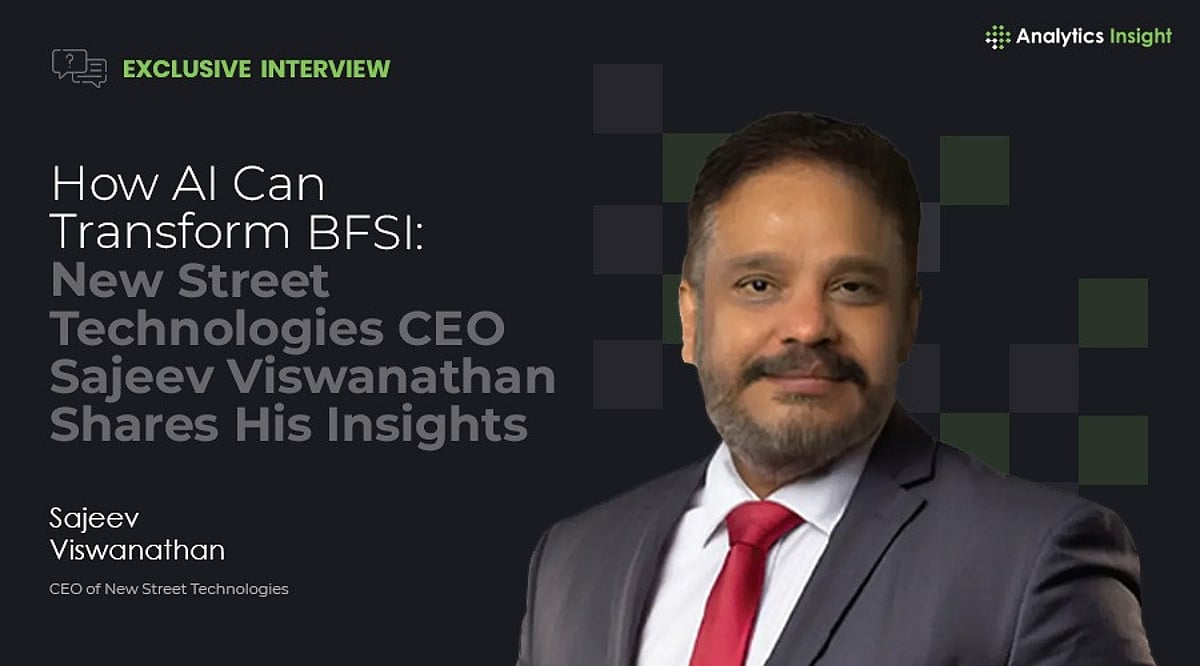
    In a recent interview, Sajeev Viswanathan, CEO of New Street Technologies, shared his vision for how artificial intelligence can transform the banking, financial services, and insurance (BFSI) sector. Rather than deploying AI as isolated point solutions, Viswanathan argues that financial institutions must build a connected, governed intelligence layer that spans the entire organization.

    According to Viswanathan, fragmentation occurs when AI is deployed as a collection of individual tools—such as a voice bot in one department, a coding assistant in another, and employees using consumer-grade LLMs for research. While each may solve a local problem, collectively they create new silos, data boundaries, and governance challenges. The solution is not to ban these tools but to provide a common foundation: a shared layer for identity, audit, version control, and domain intelligence.

    Viswanathan emphasizes the importance of Domain Intelligence Models (DIMs)—permissioned, shared intelligence that multiple processes and products can draw upon, with an optional interface to external LLMs when needed. Keeping AI decoupled from production execution is also critical. When AI-generated designs pass through maker-checker approval before deterministic engines run them, institutions achieve consistency and auditability by design.

    On fraud detection and regulatory compliance, Viswanathan notes that industry-specific AI models—shaped around BFSI transaction patterns, SWIFT message structures, KYC/AML workflows, and regulatory reporting formats—can identify anomalies that general-purpose models miss. However, the real strength comes from the architecture: separating AI that flags or designs from the deterministic engine that executes, ensuring explainability, auditability, and human oversight. Privacy is built in by allowing domain intelligence to be permissioned without moving sensitive customer data outside its governed environment.

    Viswanathan believes that as AI models become more accessible, differentiators will shift from model size to governance, deployment architecture, data strategy, and execution discipline. Banks that can implement regulatory changes in hours or launch new products in days on a well-governed platform will have a significant advantage. Key metrics like time-to-market and total cost of technology ownership become crucial.

    Regarding collaboration to combat financial crime, Viswanathan suggests that shared pattern intelligence and threat signals can be exchanged without compromising competitive advantage. Fraud typologies and money laundering patterns are not areas of competition; differentiation comes from customer experience, pricing, and product design. Federated approaches—where signals or models are shared while underlying data remains local—are particularly relevant. Regulator-sponsored or industry utility models also hold promise.

    Looking ahead, Viswanathan sees industry-specific AI ecosystems becoming as foundational as payment networks. Banks should prioritize three things: modernizing the operational core (not just customer-facing channels), embedding governance by design (audit trails, version control, maker-checker workflows, human oversight), and investing in domain intelligence rather than relying solely on generic AI tools. Ultimately, customers will choose a bank not because it uses AI, but because it responds faster, manages risk better, and earns their trust. AI may be the engine, but trust remains the defining differentiator.

  • Agentic AI in Indian Banking: From Chatbots to Autonomous Decision-Making

    Agentic AI in Indian Banking: From Chatbots to Autonomous Decision-Making

    Artificial intelligence in Indian banking has largely meant chatbots that answer balance queries, recommendation engines that suggest the next product, and fraud models that flag suspicious transactions for a human to review. That era is ending quickly. What is emerging now is agentic AI: a class of systems that does not just respond to a prompt, but plans, decides and acts across multiple steps without waiting for a human to approve each move.

    The shift is not cosmetic. It changes how credit gets underwritten, how KYC gets verified, how fraud gets stopped, and how service teams spend their day. The numbers behind it are large enough to demand attention. The operational details are messy enough to demand caution.

    From Prompt-Response to Plan-and-Act

    Traditional automation in banking, including robotic process automation and early generative AI tools, worked on a simple pattern: a human triggers a task, the system executes a fixed script, and the output goes back to a human for the next step. Agentic AI breaks that pattern. An agent is given a goal—something like “resolve this customer dispute” or “underwrite this loan application”—and then independently queries APIs, pulls data from multiple systems, applies reasoning and takes the next action, often chaining several steps together before a human ever sees the result.

    This matters technically because RPA breaks the moment an interface or a data format changes. Agentic systems, built on reasoning loops that plan, act and adjust based on outcomes, can handle edge cases a rules-based script cannot. That flexibility is precisely why banks are willing to give these systems more autonomy, and precisely why the risk profile looks different from anything that came before.

    The global market for agentic AI in financial services is estimated at close to $7.8 billion in 2026, up from around $5.5 billion a year ago, on a path toward more than $43 billion by 2031. That implies a compound annual growth rate above 41 percent. Even accounting for the usual noise in market-sizing reports, growth at that scale signals genuine capital commitment rather than marketing enthusiasm.

    More telling than the headline number is the adoption curve inside institutions. Around 44 percent of financial services teams report actively using agentic AI in 2026, several hundred percentage points higher than early 2025. Among the largest global banks, more than seven in ten now have programs that have moved past proof-of-concept into production or advanced piloting. Fintechs and neobanks, unburdened by decades-old core banking systems, are moving faster still. A parallel market has emerged around governance: platforms that monitor, audit and constrain what autonomous agents are allowed to do are already valued near $9 billion in 2026 and expected to cross $14 billion within five years. That the oversight layer is growing almost as fast as the core technology tells you banks understand autonomy without control is not a viable strategy in a regulated industry.

    Where Agentic AI Is Actually Being Used

    Fraud detection and anti-money laundering account for the largest functional share of agentic deployments, roughly a third of all use cases by some estimates. Fraud patterns shift constantly, transaction volumes are enormous, and the cost of a missed signal is high. Agents that correlate cross-border transaction patterns, flag anomalies and take a first action such as placing a temporary hold offer a meaningful edge over static rule engines.

    Credit underwriting has moved from experimental to operational. Rather than a loan officer manually pulling GST filings, bank statements and alternate data sources, an agent queries multiple verification APIs in parallel and produces a draft underwriting memo within seconds. The human role shifts from gathering data to reviewing a structured recommendation.

    Onboarding and KYC verification follow a similar pattern. Multi-agent architectures orchestrate biometric de-duplication, registry lookups against systems like CKYC, and fraud checks simultaneously instead of sequentially, cutting what used to take hours down to near real time. For insurers, agentic workflows validate first-notice-of-loss claims, cross-check damage documentation and trigger payouts on small claims without human intervention.

    This is no longer confined to individual institutions. NPCI is developing a Unified Agent Protocol that would let verified AI agents execute UPI payments without the user approving every transaction, having already piloted agentic payments publicly at the last Global Fintech Fest. When the country’s payment rails are themselves being redesigned for agents, the question for banks is not whether to participate but how quickly they can be ready.

    Across these use cases, institutions report autonomous resolution rates exceeding 80 percent for structured tasks such as dispute triage and routine compliance checks. That is a real productivity gain, but it carries a specific risk. When 80 percent of the easy work disappears, what remains is disproportionately the hard, ambiguous and emotionally charged work that agents are not yet trusted to handle alone. Support staff are left with an inbox of complex disputes and fraud complaints from customers who have already been through an automated flow that failed them. Industry estimates put the AI and data skills gap inside BFSI global capability centres at around 42 percent, meaning a significant share of the workforce lacks the combination of financial domain knowledge and technical fluency these systems demand.

    The Design Problem Hiding Inside the Technology Problem

    Most of this conversation treats agentic AI as an engineering problem. It is at least as much a design problem. Autonomy only creates value if a customer can understand what an agent is about to do on their behalf, and a supervisor can see why it did what it did. That is interface work: consent screens that make agent permissions legible rather than buried inside a mandate flow, explanations that surface the two or three factors behind a credit decision instead of a confidence score, and override controls that are obvious under pressure rather than three taps deep.

    In Indian retail banking, where a large share of users transact in a second language on an entry-level device, this is not polish. It is the difference between an agent people trust with a payment and one they switch off. Banks that ship autonomy without designing the visible layer around it will find adoption stalling for reasons no amount of model retraining can fix.

    Security and Governance Cannot Be an Afterthought

    Giving an autonomous agent the ability to query core banking systems, move funds or freeze accounts introduces a new category of cybersecurity concern. Agent permissioning, meaning precisely defining what each agent may do and rate-limiting how often it can act, is now a primary vulnerability that did not exist in the same form when humans initiated every transaction. Meanwhile fraud itself is becoming more sophisticated, with a large share of advanced attempts involving generative AI or synthetic voice, pushing banks to deploy defensive agents that evaluate behavioural biometrics and liveness signals in real time.

    Regulators in India have been explicit that autonomy does not remove accountability. Under SEBI’s updated Cybersecurity and Cyber Resilience Framework, regulated entities such as brokers, asset managers and depositories remain directly liable for the actions of their AI systems, closing off any defence built around blaming the algorithm. The Reserve Bank of India has taken a similarly clear position that high-stakes decisions, including credit rejections, loan restructuring and account closures, must retain a human in the loop and remain explainable, even as agentic systems handle the surrounding workflow. India’s data protection framework adds another layer, requiring that every autonomous action, data query and API call an agent makes be logged into an auditable trail a human can review after the fact.

    Agentic AI in BFSI is not a distant trend. It is already running fraud checks, assembling credit memos and triaging disputes inside real institutions today, and it is moving into the payment rails themselves. The technology has proven it can compress work that used to take hours into seconds. What remains unresolved is whether BFSI organizations can build the governance, workforce readiness and design discipline to match the pace of deployment.

    The institutions that get this right will be the ones treating agentic AI as a governance, people and design problem as much as a technology problem, measuring success not by how much work an agent completes on its own, but by how well the humans on both sides of it—customers and supervisors alike—can understand, correct and take responsibility for what it does.

  • Fractal Analytics Q1 FY27 Profit Soars 92% on Surging Enterprise AI Demand

    Fractal Analytics Q1 FY27 Profit Soars 92% on Surging Enterprise AI Demand

    Fractal Analytics reported a sharp rise in earnings for the first quarter of FY27, as growing demand for enterprise AI solutions boosted revenue and profitability. The company posted a consolidated net profit of Rs. 74.2 crore for the April-June quarter, up 92% year-on-year.

    Revenue from operations rose 20% to Rs. 912.5 crore, compared with Rs. 760.5 crore in the same quarter last year. Including Rs. 19.6 crore in other income, total income for the quarter stood at Rs. 932.1 crore.

    Margins Expand

    Fractal’s operating performance also improved during the quarter. EBITDA increased to Rs. 143 crore from Rs. 100 crore a year ago, while the EBITDA margin expanded to 15.66% from 13.50%.

    Total expenses rose to Rs. 755.6 crore, compared with Rs. 699.6 crore in the year-ago period, as the company continued to invest in growth. Revenue, however, grew faster than costs, resulting in higher margins and stronger earnings.

    Cash flow from operations increased 20% year-on-year to Rs. 103 crore. The company remained debt-free, with zero long-term debt on its books.

    Healthcare, BFSI Drive Growth

    Healthcare and financial services were the biggest contributors to growth during the quarter. The Healthcare and Life Sciences (HLS) business recorded 69% year-on-year revenue growth, making it Fractal’s second-largest industry vertical.

    The Banking, Financial Services and Insurance (BFSI) segment grew 36%, while the Consumer Packaged Goods and Retail (CPGR) business, the company’s largest vertical, reported 19% growth. The Technology, Media and Telecommunications (TMT) segment remained the only weak spot, with revenue declining 22% from a year earlier.

    Fractal highlighted that excluding the TMT business, the rest of its operations grew 35% year-on-year, reflecting broad-based demand across its enterprise AI portfolio. The quarterly performance comes as companies continue to increase spending on AI-led automation, analytics and data-driven decision-making.

  • Wipro Shares Rise 1.65% Ahead of Q1 FY27 Results: Revenue Guidance and AI Strategy in Focus

    Wipro Shares Rise 1.65% Ahead of Q1 FY27 Results: Revenue Guidance and AI Strategy in Focus

    Wipro shares climbed 1.65% to Rs. 177.39 on the NSE as investors awaited the company’s Q1 FY27 earnings announcement scheduled after market hours on July 16. The stock touched an intraday high of Rs. 180.79 and a low of Rs. 176.29, reflecting cautious optimism ahead of the results.

    India’s fourth-largest IT services company is expected to report another subdued quarter, with analysts forecasting muted sequential revenue and profit growth amid continued weakness in discretionary technology spending. While the June quarter numbers are unlikely to surprise the Street, the management’s outlook on artificial intelligence (AI), client spending, large deal momentum, and revenue guidance for the September quarter is expected to determine investor sentiment.

    June Quarter Likely to Reflect Cautious Spending

    Brokerage estimates place Wipro’s consolidated revenue for Q1 FY27 at Rs. 24,850 crore to Rs. 25,350 crore, indicating high double-digit year-on-year growth. However, sequential growth is expected to be minimal as firms defer technology spending amid uncertain macroeconomic conditions. Currency appreciation could provide some lift to revenue figures, but demand remains weak in overseas geographies, according to analysts.

    Margins May Face Temporary Pressure

    The bottom line is projected to come under continued strain due to Wipro’s investments in artificial intelligence, salary increases, and expenses tied to recently signed large deals. Despite these challenges, market experts expect the company to sustain stable margins through cost control measures. Analysts will closely monitor any management commentary regarding margin improvement in the remaining period of fiscal year 27.

    Guidance Will Be the Biggest Market Trigger

    The Street believes Wipro’s September quarter guidance will carry greater significance than its reported June quarter numbers. Technology budgets in both North America and Europe remain very prudent, with emphasis on savings over digital transformation plans. An improvement in discretionary spending would be a major positive for investors. Conversely, a more cautious stance might confirm doubts about further recovery in the IT services industry.

    AI Remains the Long-Term Growth Story

    Artificial intelligence continues to be a major talking point within the global technology services sector, and Wipro is expected to provide insight into its AI plans during the quarterly earnings call. Analysts and investors will be keen to see signs that pilot AI deals are moving toward larger projects that can generate future revenue. Generative AI adoption and consulting demand will come under intense scrutiny.

    What Investors Will Monitor

    • Estimated Revenue Drivers: Currency benefits, acquisition contributions, and large deal wins.
    • Large Deals and BFSI Outlook: BFSI (banking, financial services, and insurance) remains a major revenue contributor. Large deal signings will be closely watched as they provide visibility into future growth.
    • Dividend Decision: Wipro’s board is expected to consider an interim dividend alongside the results, which will attract investor attention.

    Market Outlook

    Wipro’s June quarter is not expected to show significant performance, with growth likely flat due to global uncertainty and cautious technology investments. However, the results alone are not the main focus. The outlook and commentary from management regarding AI opportunities, client spending, large deals, and the September quarter guidance will be the key drivers for investor sentiment.