Tag: Big Tech

  • Big Tech’s $1 Trillion AI Investment: Are Returns on the Horizon?

    Big Tech’s $1 Trillion AI Investment: Are Returns on the Horizon?

    Google, Amazon, Microsoft, and Meta have collectively poured more than $1 trillion into artificial intelligence infrastructure since 2023, with total spending reaching approximately $1.1 trillion by June 2026. The companies are racing to build data centers, acquire advanced chips, and secure massive electricity supplies. But as capital budgets swell, Wall Street is increasingly questioning when this spending will translate into meaningful revenue and cash flow.

    AI Spending Squeezes Free Cash Flow

    The four tech giants plan to spend about $745 billion during 2026 based on their latest forecasts. Alphabet expects capital expenditure of up to $205 billion, Amazon raised its estimate to $220 billion, and Meta anticipates between $130 billion and $145 billion. Microsoft has also committed significant sums to cloud and AI capacity.

    This aggressive spending is putting pressure on free cash flow — the cash left after operating costs and capital investment. Alphabet reported negative free cash flow of about $5.9 billion in the second quarter. Meta’s quarterly free cash flow plunged 91% year-over-year to $784 million, while Amazon posted negative trailing 12-month free cash flow of $7.6 billion.

    Microsoft has maintained positive free cash flow, buoyed by strong cloud demand, but its spending still reduces the cash available for share buybacks, dividends, acquisitions, and debt payments. Investors are closely watching whether each new data center generates enough sales to cover its cost.

    Returns May Take Years to Materialize

    AI infrastructure carries long repayment periods. Data centers require land, construction, cooling systems, networking equipment, and power contracts. Companies must also replace costly processors as newer chips become available. RBC Capital analyst Rishi Jaluria summed up the concern: “There is basically no end in sight for the growth in capex.” He added that companies must fund AI without weakening the businesses that built their profits.

    Cloud revenue offers one route to repayment. Amazon Web Services reported 37% revenue growth in the second quarter, easing concerns over Amazon’s $220 billion spending plan. Microsoft points to demand for Azure and AI products, while Alphabet has reported strong Google Cloud growth. Meta primarily links AI spending to advertising tools and future services.

    Long-Term Commitments Raise Scrutiny

    The companies are also signing leases and purchase agreements that extend beyond current capital spending. Google, Meta, and Microsoft added nearly $900 billion in new AI-related commitments during one quarter, including data center leases, cloud capacity contracts, and energy deals. These obligations may not appear as current balance-sheet debt, yet they can restrict future cash use. Rising hardware prices and shortages of memory chips can also increase project costs before facilities start earning revenue.

    Market reactions now depend on evidence of direct returns. Amazon shares rose after strong AWS growth showed that customers were using its added capacity. Alphabet and Meta faced weaker reactions after higher spending forecasts and lower free cash flow. The divide shows investors are rewarding AI investment when revenue growth and cash generation move with it — a pattern that shaped market reactions during the latest earnings season.


  • Wall Street Tightens Scrutiny on Big Tech AI Spending as Investors Demand Clearer Returns

    Wall Street Tightens Scrutiny on Big Tech AI Spending as Investors Demand Clearer Returns

    Wall Street is changing how it judges artificial intelligence spending. Investors once rewarded major technology companies for expanding data centers, buying chips, and building new AI services. Strong revenue growth often eased concerns about the cost.

    That pattern changed after Alphabet and Tesla reported second-quarter results. Both companies posted sharp share losses after announcing higher spending plans. The reaction showed that investors now want clearer proof that AI investment can support cash flow, margins, and earnings.

    This shift comes before earnings from Microsoft and Meta on Wednesday, followed by Apple and Amazon on Thursday. Their capex forecasts, cloud growth, and free cash flow will give investors new data on the cost of the AI buildout.

    Alphabet Selloff Shifts the AI Capex Debate

    Alphabet raised its 2026 capital expenditure forecast to between $195 billion and $205 billion. The range increased from an earlier estimate of $180 billion to $190 billion. Most of the spending will support servers, data centers, networking equipment, and AI computing capacity.

    Google Cloud revenue rose 82% to $24.8 billion during the quarter. Total revenue reached $119.8 billion, above market estimates. However, Alphabet recorded negative free cash flow of $5.9 billion. Its shares then fell 7.13% on July 23, cutting about $294 billion from its market value.

    Investors focused on the gap between rising revenue and heavier cash use. Alphabet said demand still exceeded its available capacity. Still, the higher spending forecast raised questions about how quickly new infrastructure can produce steady returns.

    Tesla Spending Adds to Wall Street Concerns

    Tesla also increased pressure on the AI spending trade. The company spent a record $5.79 billion on capital projects during the second quarter. That spending helped push free cash flow to negative $1.09 billion.

    Management expects 2026 capital expenditure to exceed $25 billion. Tesla plans to fund robotaxis, Optimus production, AI compute, factories, solar manufacturing, and other projects. Elon Musk called 2026 a “massive capex year,” while finance chief Vaibhav Taneja said spending could rise for another two or three years.

    Tesla shares dropped about 14% after the report. Investors also reviewed weaker earnings and lower cash generation. The market response added to concern that large AI plans can pressure stocks when spending rises faster than near-term profit.

    Michael Burry Points to a New Market Test

    Michael Burry said, “the market has voted and the results are clear.” He referred to data showing that Alphabet, Microsoft, Amazon, Meta, Oracle, Micron, and Tesla had weighed on the S&P 500 since early June.

    Apple stood apart from that group. The company has avoided the largest AI infrastructure budgets and has relied more on partnerships with model developers. Apple shares gained strongly in July as investors favored its lower spending approach.

    AI demand continues to support cloud growth, chip sales, and enterprise adoption. Big Tech companies still plan to spend more than $700 billion this year, mainly on computing infrastructure. Analysts expect Microsoft, Meta, Amazon, and Alphabet to face closer review as they publish new results.

    Wall Street is not rejecting AI investment. Instead, investors are applying a stricter test. Companies must now show that higher capital spending can produce revenue growth without weakening cash flow for long periods.

  • Why Massive AI Spending Is Rattling Wall Street

    Why Massive AI Spending Is Rattling Wall Street

    Artificial intelligence is reshaping industries, but the enormous investments required are creating a wave of anxiety on Wall Street. As tech giants pour billions into AI infrastructure, talent, and compliance, investors are questioning whether the returns will ever justify the costs.

    The Infrastructure Boom

    Companies are spending staggering sums on AI chips, cloud servers, and massive data centers. This infrastructure buildout is essential for training and deploying advanced models, but it also locks firms into long-term capital commitments that may not pay off for years.

    Profit Pressure Mounts

    Investors are increasingly worried about whether AI investments will generate sufficient returns. The gap between spending and revenue is widening, and any hint of disappointing earnings triggers sharp market reactions. Wall Street’s patience is wearing thin.

    Rising Competition and Talent Costs

    Big Tech firms are locked in an arms race, escalating AI spending to stay ahead. At the same time, hiring top AI engineers and researchers has become prohibitively expensive, further squeezing margins. The talent war shows no signs of cooling.

    Regulatory and Monetization Hurdles

    Compliance with emerging AI governance frameworks adds billions to operational expenses. Meanwhile, many companies still struggle to convert AI capabilities into sustainable profits. Monetization challenges remain a critical weak point in the AI business case.

    Market Volatility and Long-Term Opportunity

    Wall Street reacts swiftly whenever AI earnings fall short of expectations, creating volatility. Yet despite these risks, AI remains one of the most significant investment opportunities of the decade. The key will be balancing bold spending with realistic milestones and clear paths to profitability.

    As the AI revolution accelerates, the tension between massive outlays and financial discipline will continue to shape market sentiment. The companies that navigate this delicate balance may emerge as the leaders of the next economic era.

  • Big Tech’s Hidden AI Debt Surpasses $1.65 Trillion, Report Reveals

    Big Tech’s Hidden AI Debt Surpasses $1.65 Trillion, Report Reveals

    A new report by Nikkei Asia reveals that the world’s largest technology companies—Microsoft, Alphabet, Amazon, Meta, and Oracle—have collectively taken on approximately $1.65 trillion in off-balance-sheet debt tied to artificial intelligence investments. This “invisible debt” figure exceeds their combined official liabilities, highlighting the scale of their commitments to AI infrastructure.

    The hidden debt stems from future payment obligations such as long-term operating leases for data centers not yet built, bulk GPU supply contracts, and joint ventures. These tech giants are not required to record these as liabilities on their balance sheets until the assets are delivered or the facilities become operational.

    Meta and Oracle carry the largest hidden debts. Meta’s off-balance-sheet debt is estimated at $420 billion—three times its official debt—while Oracle’s stands at approximately $273.3 billion. The remaining three companies collectively hold around $1.45 trillion in off-balance-sheet obligations for cloud services and other business commitments as of March 2026.

    What Does ‘Off-Book’ Spending Mean?

    The term ‘off-book’ spending refers to agreements where a company commits to future payments that are not listed on its regular debt sheet. For example, long-term rentals for data centers, AI chips, and cloud services allow Big Tech companies to secure critical resources before demand escalates further.

    Why These Commitments Matter

    These future payments could become a financial burden if the AI market slows. Companies would still be obligated to pay for contracts they have signed, even if their AI business underperforms. Agencies like Morgan Stanley and Moody’s have warned about these rising debt commitments. While AI creates new opportunities, it also pushes companies into massive financial commitments that could shape their future growth.

  • Big Tech’s Revenue Per Second: How Amazon, Apple, and Others Generate $68,000 Every Moment

    Big Tech’s Revenue Per Second: How Amazon, Apple, and Others Generate $68,000 Every Moment

    Every second, the world’s largest technology companies collectively generate nearly $68,000 in revenue, a staggering figure that puts their financial scale into perspective. Amazon, Apple, Alphabet, Microsoft, and Meta—the five US tech giants ranked by trailing twelve-month revenue through March 2026—drive this rapid cash flow through distinct business models: cloud infrastructure, digital advertising, enterprise software, hardware ecosystems, and online retail.

    Why Revenue Per Second Matters

    Market cap and headline revenue are common benchmarks, but revenue per second reveals how quickly money moves through a business. Calculated by dividing trailing twelve-month (TTM) revenue by 31,536,000 seconds in a year, this metric stays current—unlike stale annual reports. Critically, revenue is not profit; it’s income before costs, R&D, marketing, and taxes. A company can have high revenue per second yet thin margins, a distinction often overlooked in coverage.

    Company-by-Company Breakdown

    Amazon

    Amazon leads by a wide margin, thanks to its three-tiered model: retail (thin margins), AWS cloud (roughly 30% operating margin), and advertising (near-pure margin). Together, they outpace rivals even in categories where Amazon isn’t the largest player.

    Apple

    Apple’s speed comes from maximizing existing customers. Services like the App Store, Apple Music, iCloud, and Apple TV+ now boast gross margins above 70%. Each device sold becomes a platform for recurring services revenue.

    Alphabet

    Alphabet’s revenue flows from a live auction. Every search query triggers real-time bidding among advertisers, with Alphabet taking a cut. Billions of daily queries translate into constant per-second revenue tied to auction volume.

    Microsoft

    Microsoft benefits from structural stickiness. Enterprise customers reliant on Azure or Microsoft 365 face high switching costs, turning contracts into recurring compounding revenue. AI tools like Copilot further deepen that dependency.

    Meta

    Meta doesn’t sell products to its 3.56 billion daily active users; it sells access to their attention via ad inventory. Average ad prices rose 12% year-over-year while impressions climbed 19%, meaning Meta earns more per unit of attention and more units overall.

    What the Numbers Really Reveal

    Revenue per second says nothing about margin. Amazon’s TTM net income is about $90.8 billion on $743 billion revenue, a far lower conversion than Apple’s $451.4 billion revenue yielding over $100 billion profit. Two companies can move money at similar speeds but land in very different profit positions. The underlying business mechanism—ad auction, subscription, or cloud contract—matters far more than the per-second figure itself.

    Final Thoughts

    Two companies can match revenue speed yet have almost nothing in common underneath. One lives off subscriptions, another off cloud contracts, another off ad auctions in an ecosystem users rarely leave. The number grabs attention, but the differences underneath explain everything.

  • Big Tech’s Magnificent 7 Stocks Plunge $2.3 Trillion as AI Investment Doubts Mount

    Big Tech’s Magnificent 7 Stocks Plunge $2.3 Trillion as AI Investment Doubts Mount

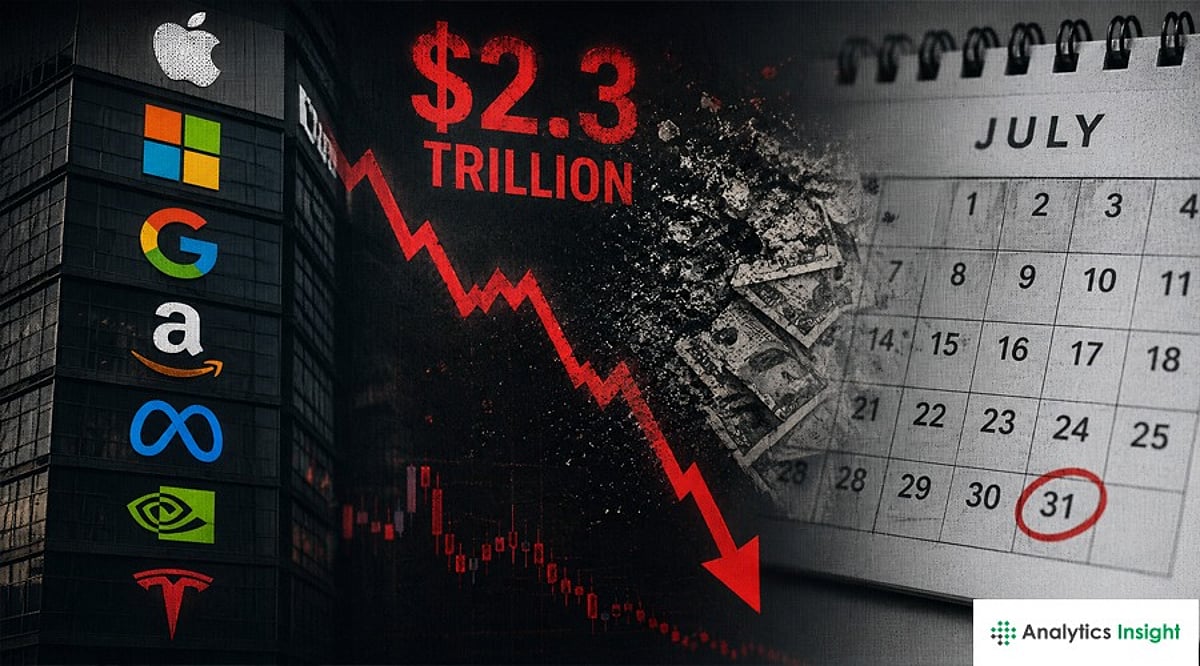
    June proved disastrous for the Magnificent 7 stocks as investor anxiety over massive AI spending and uncertain returns triggered a selloff that erased nearly $2.3 trillion in market value. The decline ranks among the steepest monthly losses ever recorded for Big Tech.

    The group—comprising Microsoft, NVIDIA, Apple, Alphabet, Amazon, Meta, and Tesla—had led the market for months on AI enthusiasm. However, June brought a sharp reversal as attention shifted from future promise to current spending and profitability.

    The Magnificent 7 Index fell roughly 10% in June, extending its decline to more than 13% from a mid-May peak. Investors now demand concrete evidence that billions poured into AI infrastructure will translate into higher earnings.

    Microsoft suffered the steepest drop among the seven, with its stock tumbling about 20% in June. NVIDIA lost nearly 13%, while Apple and Amazon each declined around 8%. The broad selloff reflects growing caution around companies investing heavily in AI without clear financial payoffs.

    Big Tech continues to pour capital into AI. Microsoft, Amazon, Alphabet, and Meta are expanding data centers and purchasing advanced AI chips to support future growth. Industry analysts estimate AI-related spending could exceed $700 billion in 2026. Such outlays have depressed free cash flow expectations, undermining investor confidence in valuations.

    Analysts believe the upcoming earnings season will be pivotal. Investors want to see that AI investments are boosting revenue rather than simply inflating costs. Wedbush analyst Dan Ives noted that the next earnings reports could clarify whether the AI investment cycle is on the right track.

    Recent market moves suggest a preference for tangible results over ambitious promises. Companies that successfully convert AI spending into stronger earnings may recover investor trust more quickly.

    Capital has also rotated toward AI hardware makers. Semiconductor and memory companies have outperformed the Magnificent 7 this month. The Philadelphia Semiconductor Index gained about 6% in June and is still up more than 90% year-to-date, indicating that investors currently favor businesses directly benefiting from AI demand.

    Many experts argue that the selloff does not signal the end of the AI story. Instead, the market is demanding clearer proof that expensive AI projects will generate improved profits. The coming round of earnings reports will be crucial in determining whether the Magnificent 7 rebound or remain under pressure for the rest of the year.

  • Australia Targets Big Tech, Apple Smart Glasses Delayed, Chip Shortage Drives Up Gadget Prices

    Australia Targets Big Tech, Apple Smart Glasses Delayed, Chip Shortage Drives Up Gadget Prices

    In today’s top tech news, Australia is ramping up regulatory pressure on Big Tech, Apple’s highly anticipated AI-powered smart glasses have been delayed once again, a persistent memory chip shortage is pushing gadget prices higher, and Apple is doubling down on its investment in premium entertainment content.

    Australia Intensifies Crackdown on Big Tech

    The Australian government is preparing tougher measures against major technology companies, signaling a more aggressive regulatory stance. The new actions aim to address concerns over market dominance, data privacy, and the impact of tech giants on local businesses and consumers.

    Apple Smart Glasses Face Another Delay

    Apple’s entry into the smart glasses market has hit another snag. The company’s AI-powered smart glasses, which were expected to launch soon, have been postponed. While Apple has not provided a new timeline, industry insiders suggest the delay is due to technical challenges in integrating advanced AI features into a compact wearable form factor.

    Chip Shortage Continues to Raise Gadget Prices

    The global shortage of memory chips is showing no signs of easing, leading to increased costs for a wide range of consumer electronics. From smartphones to laptops, manufacturers are passing on higher component costs to consumers, resulting in noticeable price hikes across the gadget market.

    Apple Backs Theaters with Premium Content Investment

    In a move that underscores its commitment to high-quality entertainment, Apple is increasing its investment in theatrical releases. The company is backing major film productions and expanding its presence in the cinema industry, aiming to strengthen its Apple TV+ brand and attract top-tier talent.

    Stay tuned for more updates on these developing stories and their impact on the tech landscape.