Tag: Bitcoin

  • China Debuts First Homegrown 3D AI Chip; CuspAI Raises $450M with Jeff Bezos Backing

    China Debuts First Homegrown 3D AI Chip; CuspAI Raises $450M with Jeff Bezos Backing

    Good morning, tech enthusiasts. Here are the top tech stories making headlines today, from groundbreaking semiconductor advancements to major funding rounds and regulatory actions.

    China Launches Its First Homegrown 3D AI Chip

    China has officially launched its first domestically developed 3D AI chip, the DF1000, in Shanghai. Built by startup Dongfang Suanxin, the chip is engineered to enhance AI computing capabilities and reduce China’s reliance on foreign semiconductor technology. This milestone marks a significant step forward for the country’s AI and semiconductor industries, signaling growing self-sufficiency in critical tech sectors.

    Jeff Bezos Backs CuspAI in $450 Million Funding Round

    CuspAI, a UK-based AI startup, has secured $450 million in fresh funding, with support from Jeff Bezos and Sovereign AI investors. The company leverages artificial intelligence to accelerate the discovery of new materials for clean energy, computer chips, and other industrial applications. The capital will be used to expand research, refine its technology, and scale its business operations globally.

    MIT Expert Warns Against Replacing Entry-Level Jobs with AI

    MIT researcher Andrew McAfee has cautioned companies against using AI to replace entry-level positions. He argues that these roles are essential for young workers to develop skills and prepare for advanced responsibilities. Removing them could lead to a shortage of skilled talent and hinder long-term organizational growth.

    San Francisco Demands Apple and Google Remove AI Nudify Apps

    San Francisco City Attorney David Chiu has formally requested that Apple and Google remove AI-powered “nudify” apps from their app stores. These apps generate fake nude images without consent, causing significant harm. Google has already removed many such apps, while Apple has yet to respond. Legal action may follow if the companies do not comply.

    Crypto Futures Market Sees $226 Million in Liquidations

    The cryptocurrency futures market experienced $226 million in liquidations over the past 24 hours due to sharp price fluctuations. The majority of losses came from traders betting on price increases. Bitcoin and Ethereum accounted for the largest liquidations, underscoring the ongoing volatility and risk in leveraged crypto trading.

  • Bitcoin Slips to $63,870: Can BTC Reclaim the $64,400 Resistance Level?

    Bitcoin Slips to $63,870: Can BTC Reclaim the $64,400 Resistance Level?

    Bitcoin is currently trading near $63,870 after a sharp intraday decline that pushed the price below the critical $64,000 mark. Buyers stepped in to defend the $63,800 area, but bearish momentum remains strong. The short-term outlook depends on BTC’s ability to reclaim the $64,400 resistance level.

    Key Takeaways

    • Bitcoin trades near $63,870 after a sharp intraday selloff.
    • Key support stands at $63,700, while resistance begins near $64,400.
    • Fresh Bitcoin ETF inflows offer support, but bearish momentum remains strong.

    Bitcoin Technical Analysis

    The latest TradingView chart reveals a clear bearish trend on the 5-minute time frame. Bitcoin has formed a series of lower highs and lower lows, signaling that sellers remain in control. The price now sits below the 20-period, 50-period, and 200-period moving averages, indicating weak short-term momentum. Earlier in the session, Bitcoin failed to hold above the $64,800 to $65,000 zone. Heavy selling with large red candles and elevated volume suggests institutional or large trader participation. The lack of a strong recovery after the drop reinforces the current weakness.

    RSI Shows Selling Pressure May Slow

    The Relative Strength Index (RSI) dropped close to 30, a level often associated with oversold conditions. It has since edged slightly higher to near 32. This modest uptick suggests that the most intense selling pressure may have eased for now. However, the RSI remains well below the neutral 50 mark, confirming that bearish momentum still dominates. A meaningful recovery would require much stronger buying activity.

    Important Support and Resistance Levels

    Bitcoin is hovering near a crucial support zone at $63,700. If this level fails, the next support is around $63,500. A breakdown below these levels could trigger another wave of selling. On the upside, immediate resistance lies at $64,000, followed by $64,400. The strongest resistance zone is between $64,800 and $65,000, where sellers were active earlier in the day. A clear break above this area would be needed to shift sentiment bullish.

    Market Trend Remains Weak

    The overall market structure favors bears. Bitcoin trades below all key short-term moving averages and continues to make lower highs. Trading volumes have risen during the decline, confirming the bearish conviction. While buyers managed to halt the drop near $63,800, the resulting bounce is tepid and lacks the strength to signal a sustainable recovery.

    Latest Bitcoin News

    Spot Bitcoin ETFs have recorded fresh inflows after a period of outflows, providing some support. However, the inflows remain modest compared to prior outflows. Investors are also watching Federal Reserve policy expectations and geopolitical developments. Reports indicate that automated trading systems contributed to the latest selloff, briefly pushing Bitcoin below $63,000 before a partial recovery.

    Outlook

    Bitcoin remains under short-term bearish pressure despite the recent bounce. The price is around $63,900, but chart patterns favor sellers. A bullish reversal would require a decisive break above $64,400. If support at $63,700 breaks, a retest of $63,500 is likely. The next few trading sessions will be critical as the battle around $64,000 could set the near-term direction.

    FAQs

    What is Bitcoin’s current price? Bitcoin is trading around $63,870 after a sharp drop below $64,000. The short-term momentum remains bearish.

    Why did Bitcoin fall below $64,000? Strong selling pressure from automated trading systems and large institutional traders drove the price lower, with insufficient buying volume to absorb the selling.

    What are the important support levels? Immediate support is at $63,700. A break below this could lead to a move toward $63,500.

    What resistance levels should traders watch? Watch $64,000 as immediate resistance, followed by $64,400. The strongest zone is $64,800–$65,000.

    What could move Bitcoin next? ETF flows, Federal Reserve updates, geopolitical news, and whether buyers can push past key resistance levels will be decisive.

  • How Paybis Rose to Become a Leading Crypto Exchange in the US Market

    How Paybis Rose to Become a Leading Crypto Exchange in the US Market

    Navigating the world of digital finance can be challenging, especially for beginners. For crypto enthusiasts in the United States, online exchanges must deliver a strong combination of fast transaction speeds, ease of use, high institutional trust, and deep knowledge of market regulations. Many traditional trading platforms are designed for institutional or professional day traders, featuring complex order books, charting interfaces, and technical jargon that intimidate the average retail consumer.

    Due to this complexity, there has been strong demand for alternative service providers that remove friction while maintaining strong security and transparency. Traders who buy Bitcoin on Paybis appreciate how the platform connects conventional fiat payment systems with the new digital economy. By simplifying the process and focusing on user-friendliness, Paybis has steadily increased its presence in the highly competitive US market, becoming a favorite for beginners and experienced users alike who value efficiency above all.

    Paybis Overview

    Paybis is a cryptocurrency exchange and digital wallet platform designed to make buying, selling, and exchanging digital assets as easy as possible. Instead of complicating things with margin trading mechanisms or liquidity pools, the platform focuses on direct, simple fiat-to-crypto transactions. According to Paybis, its service is available in over 180 countries, indicating extensive global reach.

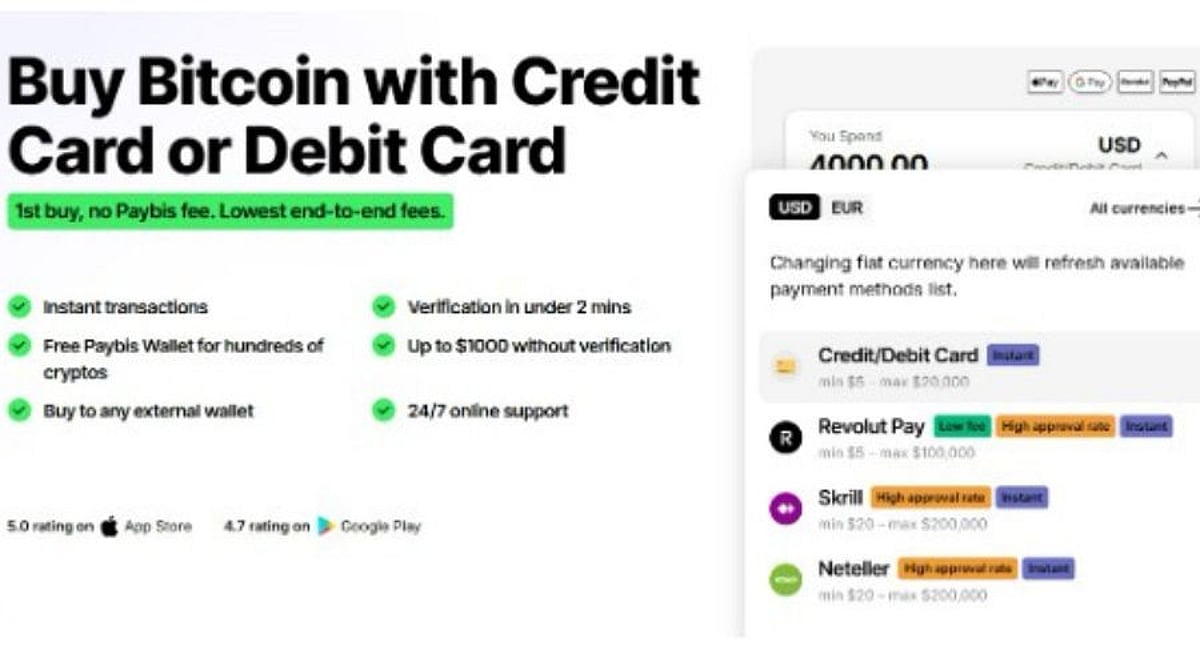
    The platform’s user experience design is built on minimizing traditional onboarding friction. This is evident in its quick user verification system, multiple payment options, and clear, visible pricing with no hidden fees. By allowing users to pay through familiar methods like credit or debit cards, Paybis mirrors a standard e-commerce checkout, lowering technical barriers often associated with blockchain.

    Paybis Regulatory Status

    Paybis operates in compliance with regulations across multiple jurisdictions, ensuring transparency and peace of mind for its growing user base.

    US Compliance Through FinCEN Registration

    Paybis operates in the United States through its official registration as a Money Services Business (MSB) with the Financial Crimes Enforcement Network (FinCEN). The company holds licenses to legally operate in 48 US states, demonstrating its commitment to navigating complex state-level regulations. This regulatory registration serves as a powerful trust signal for American users comparing crypto platforms, as it ensures the exchange follows strict Anti-Money Laundering (AML) and Combating the Financing of Terrorism (CFT) protocols. An MSB registration with FinCEN means the business complies with federal reporting and oversight systems.

    New MiCA and PSD2 Licenses in Europe

    Paybis’ EU branch has been officially recognized as a Crypto Asset Service Provider (CASP) under the Markets in Crypto-Assets (MiCA) regulation and has received a new Payment Institution License under the Revised Payment Services Directive (PSD2). By aligning with MiCA—one of the most detailed and strict digital asset laws worldwide—Paybis has opened its internal controls, capital adequacy, and customer protection mechanisms to regulatory scrutiny. The PSD2 Payment Institution license also enables highly integrated, secure, and efficient payment transactions across European countries. For American customers, this global regulatory compliance signals that they are dealing with a regulated crypto service provider that respects cross-border compliance—a key differentiator from less regulated or unregulated crypto services.

    Paybis Benefits for US Users

    Here are some of the key features and real advantages Paybis offers to customers. In addition to these online features, users who want a portable, integrated management solution can use the official Paybis app. The app covers the entire ecosystem—speedy verification, safe storage, and instant card payments—all accessible on mobile devices, allowing users to manage their accounts easily on the go.

    Why Choose Paybis as Your Crypto Exchange?

    Finding the perfect cryptocurrency exchange involves weighing convenience, speed, and a reliable, secure environment. Paybis is an excellent choice for those seeking a faster, simpler, and less troublesome alternative to formal trading desks. Users want to pay instantly with debit and credit cards, check out easily, complete identification verification quickly, see fees clearly, and have a good variety of assets to choose from.

    Supported by 24/7 customer service and a network of worldwide regulatory compliance, Paybis offers a stable, transparent, and reliable platform for managing digital transactions.

    Disclaimer: This article is for informational purposes only and does not constitute financial or investment advice. Cryptocurrency investments carry risk, and you should conduct your own research before making any investment decisions.

  • US Spot Bitcoin ETFs Maintain Winning Streak with $79.15 Million in Fresh Inflows

    US Spot Bitcoin ETFs Maintain Winning Streak with $79.15 Million in Fresh Inflows

    US spot Bitcoin exchange-traded funds (ETFs) have extended their positive run, recording $79.15 million in net inflows on the latest trading day. The continued influx of capital signals sustained institutional demand for regulated Bitcoin exposure, reinforcing market confidence and providing a long-term support mechanism for Bitcoin prices.

    Key Takeaways

    • $79.15M in fresh inflows highlights continued institutional demand for spot Bitcoin ETFs.
    • BlackRock and Fidelity remain leading destinations for regulated Bitcoin investment.
    • ETF purchases of actual Bitcoin help reduce market supply and may support long-term prices.

    The steady flow of new capital suggests that investor confidence in Bitcoin remains robust despite short-term price fluctuations. Many large investors now prefer spot Bitcoin ETFs because they offer direct exposure to Bitcoin without the need to buy and store the cryptocurrency. This familiar investment structure fits easily into traditional brokerage accounts.

    BlackRock and Fidelity Continue to Lead the Market

    BlackRock’s iShares Bitcoin Trust (IBIT) has once again ranked among the top drivers of the latest inflow. Following the approval of spot Bitcoin ETFs by US authorities, IBIT has attracted billions from both institutional and retail customers. Fidelity’s Wise Origin Bitcoin Fund (FBTC) has also remained a favored investment option.

    Competition remains fierce, with firms like Bitwise, ARK 21Shares, VanEck, Franklin Templeton, Invesco Galaxy, Valkyrie, and WisdomTree vying for investor attention. Each firm has its own fee structure and investment strategy, but all are benefiting from rising demand for regulated Bitcoin financial products.

    Grayscale’s Bitcoin Trust (GBTC), which faced significant outflows after the launch of spot ETFs, has shown improvement compared with the heavy redemptions seen during the early months.

    Why Investors Continue to Choose Spot Bitcoin ETFs

    Spot Bitcoin ETFs have become the preferred option for many investors as they remove several challenges linked to direct cryptocurrency ownership. There is no need to create digital wallets, protect private keys, or use crypto exchanges. Investors simply buy ETF shares through their regular brokerage accounts.

    This simplified process has encouraged banks, hedge funds, wealth managers, pension funds, and family offices to explore or increase Bitcoin exposure. Many institutions that previously stayed away from cryptocurrencies now have a regulated and transparent investment option. The latest $79.15 million in net inflows reflects this growing confidence.

    ETF Demand Continues to Support Bitcoin Prices

    Every time investors put money into a spot Bitcoin ETF, the fund manager purchases real Bitcoin to back those new shares. This process reduces the amount of Bitcoin available in the open market. As demand rises and supply becomes tighter, many analysts believe this creates long-term support for Bitcoin prices. Although daily price moves still depend on market sentiment, ETF demand has become one of the biggest factors behind Bitcoin’s strength.

    Market experts now closely watch daily ETF flow data as it offers a clear picture of investor confidence. Strong inflows often match periods of positive price movement, while weaker flows can signal a slower market.

    Regulation Brings More Confidence

    The approval of spot Bitcoin ETFs by the US Securities and Exchange Commission in January 2024 changed the cryptocurrency investment landscape. Before that decision, many traditional financial institutions had limited options for direct Bitcoin exposure. The approval gave investors access to Bitcoin through products that follow well-known financial rules, helping improve confidence across the market and encouraging many asset managers to include Bitcoin in their portfolios.

    Clearer regulation has also reduced uncertainty for institutions that previously avoided the crypto sector due to legal and compliance concerns.

    Institutional Investors Continue to Build Positions

    Institutional investors remain one of the biggest drivers behind the success of spot Bitcoin ETFs. Large financial firms usually invest with a long-term view rather than reacting to short-term market movements. Recent price corrections have not reduced interest from many professional investors. Instead, several institutions have treated lower prices as opportunities to increase their Bitcoin exposure. This behavior differs from earlier market cycles, when price declines often led to heavy selling. The consistent flow of institutional money has helped strengthen the overall Bitcoin market and improve liquidity across the ETF sector.

    Macro Factors Play a Role

    Investors also continue to monitor broader economic conditions. Expectations about future US Federal Reserve interest rate decisions remain an important factor for financial markets. Lower interest rates often improve demand for higher-risk assets such as Bitcoin. Inflation also remains part of the discussion. Some investors view Bitcoin as a long-term store of value and use it as part of a strategy to protect wealth from inflation over time. These factors continue to support interest in Bitcoin alongside the strong ETF demand.

    Why This Matters

    Steady inflows signal strong institutional confidence, offering traditional investors a secure, regulated path to Bitcoin. Fund managers must buy real Bitcoin to back these ETF shares, so continued demand directly reduces market supply and supports long-term price stability.

    Spot Bitcoin ETFs Continue to Shape the Crypto Market

    Since their launch in January 2024, US spot Bitcoin ETFs have attracted tens of billions of dollars in cumulative net inflows, making them one of the most successful ETF launches in financial history. The rapid growth of these funds has changed the way traditional investors access Bitcoin. The ETF market has also improved liquidity and brought more participation from banks, registered investment advisers, hedge funds, and wealth management firms. As more institutions enter the market, Bitcoin continues to strengthen its position within the global financial system.

    The latest $79.15 million in fresh inflows adds another positive chapter to this trend. It reflects steady institutional demand, stronger market confidence, and the continued growth of regulated Bitcoin investment products. If this momentum continues, spot Bitcoin ETFs are likely to remain one of the biggest drivers of Bitcoin’s market performance in the months ahead.


  • Top 8 Cryptocurrencies Over $10 Billion Market Cap in 2026: Performance and Adoption

    Top 8 Cryptocurrencies Over $10 Billion Market Cap in 2026: Performance and Adoption

    The cryptocurrency market continues to evolve, with large-cap assets maintaining their dominance through strong adoption and technological innovation. In 2026, several cryptocurrencies with market capitalizations exceeding $10 billion are leading the charge. Here’s a closer look at the best performers.

    Bitcoin (BTC)

    As the world’s largest cryptocurrency, Bitcoin remains the benchmark for long-term investors. Its established track record and institutional adoption solidify its position as a store of value.

    Ethereum (ETH)

    Ethereum dominates the decentralized finance (DeFi) and smart contract space. Continuous network upgrades, including scalability improvements, enhance its utility and developer appeal.

    Solana (SOL)

    Solana is known for lightning-fast transactions and a rapidly expanding developer ecosystem. Its high throughput and low fees make it a favorite for decentralized applications.

    XRP

    XRP continues to expand cross-border payment solutions, attracting growing institutional interest. Its focus on efficient global transactions keeps it relevant in the financial sector.

    BNB

    BNB powers one of the world’s largest blockchain ecosystems, the Binance platform. It offers multiple real-world utilities, including transaction fee discounts and participation in token sales.

    Dogecoin (DOGE)

    Dogecoin remains one of the most recognized community-driven digital assets. Its widespread acceptance and active community contribute to its enduring popularity.

    Cardano (ADA)

    Cardano focuses on research-driven blockchain innovation and sustainable scalability. Its peer-reviewed approach and commitment to interoperability set it apart.

    Chainlink (LINK)

    Chainlink provides secure blockchain oracles that connect smart contracts with real-world data. Its critical role in DeFi and enterprise solutions ensures continued demand.

    These large-cap cryptocurrencies are not only performing well but also driving the next wave of blockchain adoption. Investors and enthusiasts should keep an eye on their developments throughout 2026.

  • BTC Holds Steady Near $64K as Oil Rally and AI Uncertainty Rattle Markets

    BTC Holds Steady Near $64K as Oil Rally and AI Uncertainty Rattle Markets

    Bitcoin remained near $64,200 on Monday as traders weighed a sharp jump in oil prices against ongoing market disruption from Moonshot AI’s Kimi K3 release. Ether outperformed at $1,860, while most major tokens saw minimal movement.

    The cryptocurrency market stayed mixed. XRP held near $1.09, Solana traded around $76, BNB eased to $565, and Dogecoin remained close to $0.07. HYPE fell 10% on the week to $60.

    Oil and AI Reset Risk Appetite

    Brent crude rose as much as 4% to $91.42 a barrel, its highest level since June, following wider US and Iranian strikes that extended beyond military targets. This surge revived inflation worries just after soft US price data had eased them. Rising oil prices also pressured risk assets across markets, including crypto.

    At the same time, equities continued digesting Friday’s AI-led selloff. Moonshot AI’s Kimi K3, an open-weight Chinese model, took the top spot on a widely watched coding benchmark.

    Crypto Follows the Broader Risk Trade

    The Kimi K3 release hit semiconductor shares and pulled crypto lower into the weekend. The pressure spread into Asia on Monday, where South Korea’s Kospi fell 3.5% after a holiday break. US futures steadied later in the session. The Nasdaq 100 rose 0.5%, but the market still faced questions about the strength of the AI trade.

    For crypto, the two shocks pulled in different directions. War-driven oil supported inflation concerns and rate pressure. Meanwhile, AI weakness hit chip stocks that bitcoin has tracked closely during the month.

    With major US economic data largely out of the way, the focus this week shifts to corporate earnings. Alphabet reports on Tuesday, Tesla on Wednesday, and Intel on Thursday.

    Armstrong Rejects Mining Alarm

    Coinbase CEO Brian Armstrong dismissed Chamath Palihapitiya’s warning that AI demand could threaten Bitcoin mining. Armstrong said Bitcoin’s difficulty adjustment keeps price separate from hash power.

    Palihapitiya argued that miners could earn 10 to 20 times more by selling electricity to AI operators. He described the shift as structural, while also saying he could be wrong. He also said marginal liquidity now favors prediction markets and equities over bitcoin, pointing to daily prediction market activity that often exceeds $300 million.

    Armstrong answered that falling hash power does not determine Bitcoin’s price. He said the network adjusts automatically and keeps block production near ten minutes. He linked Bitcoin’s value to sovereign deficits rather than mining power. His remarks matched recent views that frame BTC as digital gold instead of a payments network.

    Investors will now watch major corporate earnings for further market direction.

  • Kraken Rolls Out USD-Settled Bitcoin and Ether Options on Kraken Pro

    Kraken Rolls Out USD-Settled Bitcoin and Ether Options on Kraken Pro

    Kraken has launched cash-settled Bitcoin and Ether options through its Kraken Pro platform, expanding its derivatives lineup. The exchange introduced European-style, USD-settled contracts via request-for-quote (RFQ) trading for eligible international clients. The rollout currently excludes Europe, North America, and Australia, though a European launch is planned for the future.

    Kraken Opens a New Options Channel

    Announced on Thursday, the new options settle in US dollars and follow European-style exercise terms. Kraken initially made them available through RFQ execution. The offering targets eligible international clients outside Europe, North America, and Australia. The exchange already holds the regulatory permissions needed to offer crypto derivatives in Europe and expects to roll out the product there later.

    The new contracts cover Bitcoin and Ether, two of the most actively traded digital assets. Kraken framed the launch as part of a broader effort to build a comprehensive financial platform around trading, payments, and digital asset services.

    Kraken Frames Options as an Underused Market

    Alexia Theodorou, Kraken’s director of derivatives, noted that crypto options still trail traditional markets by a wide margin. She said professional and institutional capital continues to move into digital assets, gradually closing that gap. Theodorou emphasized that the larger opportunity lies in expanding the market rather than chasing market share alone. She pointed out that the current crypto options market serves a narrow group of traders, leaving room for broader participation.

    She also attributed the slow growth of crypto options to product design rather than lack of demand. According to her, many traders have favored perpetual futures because those products feel simpler and more familiar.

    Simpler Contracts, Wider Access, and Margin Tools

    Kraken designed the contracts as linear, USD-settled products. This structure removes the need to manage crypto collateral or settlement. Premiums, profit and loss, and final settlement all use US dollars. The exchange placed the options inside the same unified account that clients already use for spot and futures trading. Portfolio margin is enabled by default, and offsetting positions can reduce collateral requirements across products.

    Users can also post collateral in more than 30 currencies. Kraken has added educational tools to its interface, explaining calls, puts, and multi-leg positions for traders using Kraken Pro.

    Theodorou said options matter because they let investors take positions on price, volatility, and time. Kraken plans further updates, including a public order book for better price discovery, broader geographic access, and support for more assets.

  • XRP Rebounds to $1.09: Key Resistance Zone and Upcoming Upgrade Signal Potential Breakout

    XRP Rebounds to $1.09: Key Resistance Zone and Upcoming Upgrade Signal Potential Breakout

    XRP has rebounded to trade near $1.09, recovering about 0.76% in the last 24 hours in line with the broader cryptocurrency market. The modest gain follows continued demand for US spot Bitcoin ETFs and improved risk sentiment across digital assets. Notably, XRP did not receive any coin-specific catalyst during the session, relying instead on market-wide strength.

    The token now faces a critical technical test after losing nearly half its value in 2026. Traders are closely watching the support zone between $1.06 and $1.09, and the resistance range from $1.12 to $1.18. The upcoming XRP Ledger (XRPL) FixCleanup3_2_0 amendment, scheduled for July 29, adds further interest.

    XRP Tracks Bitcoin as Leverage Drops

    XRP’s latest move reflects broader market conditions. Bitcoin gained about 0.93%, and the total crypto market value also rose. US spot Bitcoin ETFs posted another positive session, supporting risk assets. Optimism over US crypto regulatory progress, particularly regarding the CLARITY Act before the August recess, also contributed to sentiment.

    Meanwhile, XRP futures leverage on Binance has fallen to its lowest level since early 2024, according to market data. Lower leverage reduces the risk of forced selling during sharp price swings. However, the reset does not guarantee a rally, and trading volume has dropped, indicating the rebound lacks strong buying activity.

    Descending Wedge Meets Strong Historical Q3 Performance

    XRP is trading within a descending broadening wedge on the daily chart. Buyers have defended the area near $1.05, while the relative strength index (RSI) shows a bullish divergence. This pattern suggests selling pressure has slowed, but XRP must close above the $1.12–$1.18 zone to confirm a breakout.

    Seasonal data adds another bullish signal: XRP has not posted a negative third quarter in the past seven years. The token gained 47.6% in July 2023 and 35% in July 2025, with a median Q3 return of 25.8%. However, past performance does not guarantee future results.

    A move above $1.18 could bring the $1.45–$1.60 range back into focus, representing nearly 50% upside from current levels. That ‘50% surge’ target depends on a confirmed breakout, stronger volume, and continued market support. A break below $1.06 could instead expose the $0.90 area.

    XRPL Upgrade and Tokenized Gold Add Utility

    The XRPL FixCleanup3_2_0 amendment, set for July 29, focuses on ledger cleanup and network efficiency. While it has not yet triggered a clear price reaction, traders may watch for increased activity following the upgrade.

    Additionally, cumulative trading volume for tokenized gold on the XRP Ledger has surpassed $1 million. This asset represents physical gold and enables 24/7 on-chain settlement, demonstrating expanding real-world asset activity on XRPL beyond payments.

    Ripple’s addition to an ESMA register and XRP’s inclusion in a multi-token ETF have also supported the wider narrative. Yet XRP has underperformed Bitcoin during this rebound. Price action now depends on support at $1.06–$1.09, resistance near $1.12, and the strength of market-wide flows.

  • Bitcoin Targets $65,000 as JPMorgan Highlights Growing Institutional Demand

    Bitcoin Targets $65,000 as JPMorgan Highlights Growing Institutional Demand

    Bitcoin is trading near $63,963 after a 1.7% gain in the last 24 hours, fueled by renewed demand for US spot Bitcoin ETFs and a broader recovery in risk assets. The cryptocurrency reached an intraday high of $64,287 but has yet to break decisively above the $65,000 mark.

    Spot Bitcoin ETFs have recorded four consecutive sessions of net inflows, a shift from earlier reports of three days. This sustained demand provides a stronger foundation for Bitcoin’s price, although resistance persists and lower trading volumes may limit further upside. Softer US inflation data has also supported demand for rate-sensitive assets, including major cryptocurrencies and tech stocks.

    Bitcoin ETF Inflows Extend to Four Days

    US spot Bitcoin ETFs saw $181.1 million on July 14, $107.7 million on July 15, and $79.1 million on July 16, totaling about $368 million. An additional $132.3 million inflow on July 17 extended the positive run to four trading days. This marks a sharp reversal from July 13, when net outflows hit $424.7 million. BlackRock’s IBIT led with $136.5 million in inflows on Friday, while Fidelity’s FBTC saw a $4.2 million outflow. Total net inflows since launch now stand at approximately $51.4 billion.

    JPMorgan Sees Support From Strategy

    JPMorgan analysts described Strategy’s larger cash reserve and positive Bitcoin futures flows as encouraging signs for the cryptocurrency’s outlook. They noted that spot ETF flows have fluctuated sharply but expressed support for the longer-term picture without confirming a trend from the recent rebound. Strategy increased its cash reserve from $2.55 billion to $3 billion to support preferred stock dividends and interest payments. The company holds 843,775 BTC on its balance sheet, purchased for $63.69 billion at an average price of $75,476. No Bitcoin was bought in the latest reporting week.

    JPMorgan also reported positive flows in both Chicago Mercantile Exchange Bitcoin futures and perpetual futures markets, which often reflect institutional activity more closely than leveraged products tied to Strategy. The analysts noted it is difficult to determine whether Strategy’s cash buildup directly influenced market sentiment.

    Bitcoin Price Faces the $65,000 Test

    Bitcoin’s next key test is the $65,000 level, which it briefly surpassed earlier in the week before losing momentum. A daily close above this area, supported by higher trading volume and continued ETF inflows, could open the path toward the recent upper range. Failure to hold $63,500 would shift focus to the $62,500 area, near the latest intraday low.

    Separate data shows that digital asset products recently ended an eight-week outflow streak totaling about $8 billion. Approximately $287 million returned last week, followed by further inflows after softer US inflation data. However, a move toward $80,000 may require a clearer change in interest-rate expectations.

    ETF flow figures will provide the next direct measure of regulated demand. Price action around $65,000 will also indicate whether buyers can absorb available supply. A close below $62,500 would weaken the current structure, while a close above $65,000 on higher volume would confirm a stronger short-term recovery.

  • Bitcoin Surpasses $65,000 as Spot ETF Inflows Drive Institutional Buying Spree

    Bitcoin Surpasses $65,000 as Spot ETF Inflows Drive Institutional Buying Spree

    Bitcoin climbed above $65,000 this week, reaching its highest level since early June 2026. The move came after three straight days of gains and a weekly rise of about 8%. According to a July 18, 2026, Yahoo Finance report, the main driver was not retail speculation. It was steady institutional buying through U.S. spot Bitcoin ETFs.

    The rally lifted Bitcoin’s market capitalization above $1.28 trillion. At the same time, the wider cryptocurrency market held near $2.4 trillion. Price data from CoinGecko and TradingView showed Bitcoin clearing the key level during early Asian trading hours.

    ETF Flows Take Center Stage

    Yahoo Finance cited unnamed market analysts who described the current buying as consistent and non-speculative. They said asset managers and pension funds continued to add exposure. The report contrasted that pattern with the retail-led surge seen in 2021.

    Over the past seven days, spot Bitcoin ETFs added about $1.2 billion in new capital. BlackRock’s iShares Bitcoin Trust (IBIT) accounted for nearly half of that total. This was the strongest week of inflows since March 2026.

    Cumulative inflows into spot Bitcoin ETFs now exceed $35 billion since launch. Average daily inflows reached about $170 million over the past week, compared with roughly $80 million in the previous month.

    Broader Market Response Stays Tied to Bitcoin

    ETF trading activity also stayed elevated. Daily turnover across the products averaged about $2.5 billion. The report linked that volume to continued demand from registered investment advisers and other institutional allocators.

    Several large pension funds and endowments have begun placing 1% to 3% of their portfolios into Bitcoin through ETFs. Wisconsin’s state pension fund took a similar step in 2024. Those allocations helped create longer holding periods and lower selling pressure.

    Macro conditions also played a role. U.S. inflation remained sticky at around 3.2% in June 2026. As a result, institutions looked for assets with limited correlation to traditional markets. Bitcoin’s 30-day correlation with the S&P 500 fell to 0.15 this week, the lowest in six months.

    Market Pricing and Investor Focus

    The Coinbase premium turned positive this week, signaling that U.S. buyers paid more on Coinbase Pro than on Binance for direct exposure, another sign of institutional demand.

    Other crypto assets also moved higher. Ethereum rose 4% to $3,450, while Solana gained 6% to $155, according to the July 18 report. However, altcoin strength depends on Bitcoin holding its recent gains.

    Market figures added more context. Michael Saylor said institutional adoption remained early, while Cathie Wood said the asset class was maturing. The report did not offer a price target, instead focusing on whether ETF buying could continue at the same pace.

    The options market reflected calmer expectations. The 30-day implied volatility index fell to 42%, down from 55% in May 2026. Real-time ETF flow trackers from SoSoValue and CoinGlass remain central monitoring tools for investors following the trend.

    What’s Next?

    Bitcoin climbed above $65,000 after strong spot Bitcoin ETF inflows boosted institutional demand. Rising ETF investments, higher trading volumes, and sustained capital allocations shaped the latest rally. Investors may continue monitoring ETF flow data to assess whether institutional buying remains strong.