Tag: business technology

  • Top 7 AI Trends Transforming Business Technology in 2026

    Top 7 AI Trends Transforming Business Technology in 2026

    Artificial intelligence is moving beyond chatbots and into the core of business operations. In 2026, companies are leveraging AI not just for automation but for autonomous workflows, specialized models, and measurable returns. Here are the seven key trends reshaping business technology this year.

    1. Agentic AI Moves Into Business Workflows

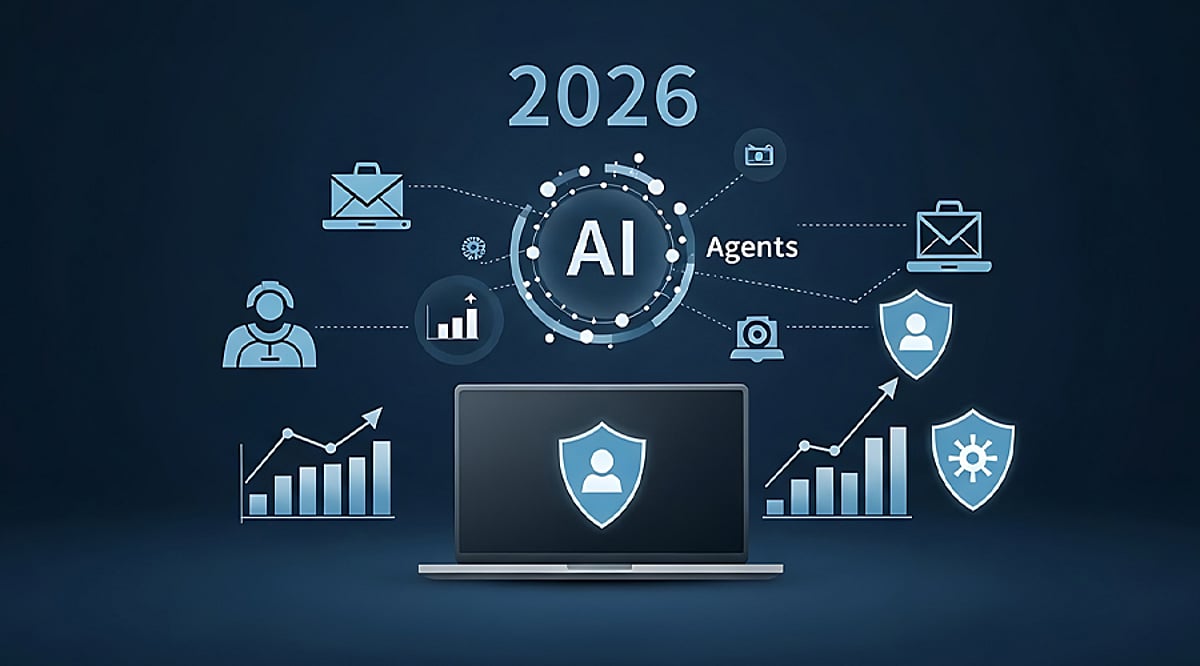
    AI agents are evolving from simple chatbots to autonomous systems that plan tasks, use business tools, and complete multi-step processes. Organizations are testing multiagent setups where different agents handle research, analysis, approvals, and execution—all under human oversight.

    2. Smaller AI Models Drive Enterprise Efficiency

    Enterprises are shifting away from relying solely on the largest AI models. Smaller, domain-specific models excel at document processing, customer support, internal search, and invoice extraction. These models reduce costs and latency while giving companies greater control over sensitive data.

    3. AI Infrastructure Becomes a Business Priority

    The growing demand for AI workloads is pushing companies to invest in robust infrastructure. Combining GPUs, CPUs, specialized chips, cloud systems, and edge computing helps manage latency, privacy, and large data volumes. Local and hybrid setups are gaining traction.

    4. AI Strengthens Cybersecurity and Governance

    As AI becomes more autonomous, businesses need stronger controls around access, data, and model behavior. AI can detect unusual activity and speed up threat response, while governance systems track agents, permissions, risks, and compliance. Security is now an integral part of AI development.

    5. Physical AI Brings Intelligence to the Real World

    AI is moving from screens into factories, warehouses, and logistics. Intelligent robots support quality inspection, predictive maintenance, warehouse operations, and manufacturing. This trend bridges AI software with real-world automation.

    6. Multimodal and Voice AI Enter Core Operations

    AI systems now handle text, images, audio, video, and documents in a single workflow. Businesses use these capabilities for call centers, document processing, field services, compliance, and regional-language support. Voice AI is also becoming more practical for customer and employee interactions.

    7. Measurable ROI Defines the Next Phase of AI

    Companies are moving from AI experiments to measurable outcomes. They track metrics like cost reduction, faster workflows, productivity gains, revenue impact, and customer experience. In 2026, the focus is on building reliable systems that deliver value at scale.

    These trends highlight a shift from experimentation to strategic integration, where AI is embedded into every layer of business technology.

  • How to Choose the Right Business Database in 2026: A Workload-First Guide

    How to Choose the Right Business Database in 2026: A Workload-First Guide

    Many companies choose a database the way they choose an electricity supplier — once, quickly, and then never again until something goes dark. The decision gets made by whoever was on the project that week, and everyone else lives with it for the next eight years.

    That’s backwards. Your database quietly sets the ceiling on four things at once: how fast your team ships, how honestly you can report, how well you survive an audit, and what it costs you to double in size. None of those are IT problems. They’re business problems that happen to be expressed in SQL.

    The good news is that the shortlist in 2026 is genuinely good. The bad news is that “good” isn’t the same as “right for you.” Below is a workload-first way to think about it, followed by eight systems worth knowing — and the honest tradeoff each one asks you to accept.

    Only question that matters first

    Before you compare vendors, answer this: what does this data actually do?

    • It records commitments — orders, payments, contracts, payroll. This data needs to be correct more than it needs to be fast. A transaction either fully happens or fully doesn’t.
    • It describes things loosely — product catalogs, customer profiles, logs, anything whose shape changes every quarter because a PM changed their mind.
    • It answers questions — dashboards, forecasts, cohort analysis, the report leadership stares at every Monday.
    • It needs to be instant — session tokens, live inventory, pricing lookups measured in single-digit milliseconds.

    Those four jobs want four different architectures. Most technical debt in data infrastructure comes from a single decision: using one system to do all four because it was already there.

    Workload 1: Recording commitments (relational)

    This is where ACID compliance stops being jargon and starts being the reason your balance sheet reconciles.

    PostgreSQL

    If a single database has won the last decade, it’s this one. Postgres delivers strict ACID guarantees, first-class JSONB for the semi-structured 20% of your data, serious indexing, and an extension ecosystem that lets it stretch into time-series, geospatial, or vector search without leaving the box. The cost story is hard to argue with: the engine is free, and every major cloud sells a managed version (RDS, Cloud SQL, Azure Database) so you’re not paying people to babysit failover. Instagram famously runs a sharded Postgres cluster at a scale that should have killed the “SQL doesn’t scale” line permanently. Wise and Revolut keep money in it. That’s a decent reference list. Choose it when: you want capability without lock-in, and you’d rather not re-platform in three years.

    MySQL

    Still one of the most deployed databases on earth, and the one most small businesses meet first. It’s cheap to host, quick to stand up, and compatible with essentially every framework and CMS ever written. Where it strains is complex analytical queries and heavy concurrent writes. For new enterprise builds, Postgres has largely taken the oxygen. For read-heavy, content-driven applications, MySQL is a perfectly rational choice and will be supported forever.

    Microsoft SQL Server

    If your company already lives inside Azure, Power BI, .NET, and Active Directory, SQL Server removes an enormous amount of integration friction. Always On Availability Groups give you genuine HA/DR, which matters if downtime is a regulatory event rather than an inconvenience. The catch is licensing, which is not cheap and not getting cheaper. Managed Azure SQL at least absorbs the patching and failover work you’d otherwise staff for.

    Oracle

    Still the system of record for a large share of the world’s banks, insurers, and government agencies — and not out of nostalgia. Real Application Clusters handle concurrency at a level few competitors reach, and the audit trail and row-level security tooling is mature in a way that only decades of regulated deployments produce. What’s changed is the shape of Oracle estates. The common 2026 pattern isn’t ripping Oracle out; it’s shrinking it. Core ledger stays. The forty surrounding systems that never needed Oracle-grade guarantees move to Postgres, and the licensing bill drops accordingly.

    Workload 2: Loose shapes and instant reads (NoSQL)

    SQL versus NoSQL was never a war. It’s a question about the shape of your data.

    MongoDB

    The document model stores records as JSON-like objects, which suits anything where records don’t share a fixed template: catalogs with wildly different attributes, customer profiles that grow fields monthly, nested logistics hierarchies. The practical payoff is migration scripts you don’t have to write. Your team changes the model and moves on. Barclays, Bosch, and Adobe run it at scale — it stopped being a startup toy a long time ago.

    Redis and Valkey

    This one needs a 2026 update, because the in-memory landscape genuinely changed. Redis moved from BSD to SSPL in March 2024, which ended its status as open source in the OSI sense. The community forked within days: Valkey, now under the Linux Foundation with backing from AWS, Google Cloud, Oracle, and Ericsson, carrying forward the last BSD-licensed codebase. Redis then shifted to AGPLv3 with Redis 8 in 2025, but the trust cost was already paid — surveys after the change found a large majority of Redis users actively evaluating alternatives, and the hyperscalers have kept investing in Valkey rather than walking back. Practically: the two are API-compatible for most workloads, and the functional gap is small (Redis 8 adds things like native vector sets). The real decision is governance, not features. If BSD licensing and open governance matter to your legal team, Valkey. If they don’t, either works. Whichever you pick, its job is the same — sit in front of your primary store and absorb the reads that would otherwise flatten it.

    Workload 3: Answering questions (cloud and analytics)

    Snowflake

    Separating storage from compute was the structural idea that made Snowflake work: you pay for what you query, not what you hoard. It reads structured tables, JSON, and Parquet in the same query without a pipeline in between. The underrated feature is the Data Marketplace — pulling third-party feeds and financial datasets in without an ETL job or a separate vendor contract. For finance teams, that’s the difference between monthly reporting and something closer to live. Choose it when: analysis across millions of rows is a daily activity, not a quarterly one.

    Firebase and Supabase

    For a two-person team that needs to be in production next month, a managed backend is the whole answer. Both bundle database, auth, real-time sync, and storage into one platform. Supabase’s advantage is structural: it’s Postgres underneath. Your queries stay portable, so outgrowing the free tier means moving data — not rewriting the application. Firebase is faster to start with and harder to leave.

    Three rules that separate mature architectures from the rest

    1. Match the engine to the job. Transactions want ACID. Analytics wants columnar storage. Real-time wants memory. Using one system for all three doesn’t fail loudly — it degrades quietly, which is worse.
    2. Plan for horizontal scale before you need it. Bigger machines have a ceiling; more machines don’t. Postgres, MongoDB, and CockroachDB shard and replicate natively. Retrofitting that into a live monolith is one of the genuinely miserable engineering projects.
    3. Separate PII from operational data by design. Sensitive customer data belongs in an access-restricted store, joined to transactions through anonymized IDs. Done right, a breach of your transaction database reveals that User_8492 moved $10,000 — and nothing about who that is. GDPR and PCI-DSS treat this as a requirement, not a suggestion.

    Do you need something custom?

    Almost certainly not. Before anyone writes a proposal for a bespoke engine, exhaust the extension ecosystem — Postgres alone covers time-series (TimescaleDB), AI embeddings (pgvector), and geospatial (PostGIS) without a line of engine code. Custom is expensive to build and roughly twice as expensive to keep alive.

    What nobody puts in the pitch deck

    Knowing which database you should be on is the easy half. Getting your data off a fifteen-year-old Sybase box, an aging on-prem SQL Server, or an inherited MySQL estate is where modernization actually stalls — usually on the embedded business logic nobody documented and everyone depends on. That work is more tractable than it used to be. Tooling now automates schema conversion, stored-procedure translation, and query rewriting across the common source-target pairs; migration specialists like Ispirer report automation rates in the high nineties on Oracle-to-PostgreSQL projects, which turns a multi-year rewrite into something a team can plan around. It’s worth scoping that before you assume a migration is off the table on cost grounds.

    In short

    • Transactions → PostgreSQL, or Oracle if regulation demands it
    • Microsoft shop → SQL Server
    • Read-heavy and simple → MySQL
    • Flexible documents → MongoDB
    • Sub-millisecond reads → Valkey (open governance) or Redis (features)
    • Analytics at scale → Snowflake
    • Small team, fast launch → Supabase (portable) or Firebase (fastest)

    Every one of these choices compounds. The database that fits your workload today is mostly valuable because of the migration it saves you from in 2029.

  • Top 6 AI Consultants to Hire in 2026: Experts Who Deliver Real Results

    Top 6 AI Consultants to Hire in 2026: Experts Who Deliver Real Results

    The demand for AI consulting has skyrocketed, but so has the noise. Every week, thousands of new “AI experts” appear on LinkedIn, most of whom have never shipped a production system or scaled a real product. If you are searching for the best AI consultants to actually move your business forward, the challenge is separating practitioners with a verifiable track record from people selling slide decks.

    This guide focuses on individual AI consultants rather than large firms. Individuals give you direct access to senior expertise without the overhead, layered account teams, and six-figure minimums that come with big consultancies. Below, you will find six AI consultants worth considering in 2026, what each one is best at, and a practical framework for choosing between them.

    What Does an AI Consultant Do?

    An AI consultant helps businesses identify where artificial intelligence can increase revenue or reduce costs, then guides the work from strategy through implementation. Typical engagements include AI opportunity assessments, use case prioritization, vendor and model selection, custom AI software development, workflow automation, and team training. The best AI consultants combine technical depth in areas like large language models, machine learning, and data engineering with the business judgment to tie every initiative to a measurable outcome.

    How We Chose the Best AI Consultants

    This list prioritizes practitioners over theorists. Each consultant was evaluated against four criteria: a track record of shipped products or completed client engagements, hands-on technical or operating depth rather than advisory-only experience, recognition from credible media or industry bodies, and the ability to work across company sizes and sectors. Deliberately excluded are celebrity researchers and academic figures, since most businesses cannot realistically hire them and their day-to-day work is far removed from practical implementation.

    1. Komninos Chatzipapas: Best Overall

    Komninos Chatzipapas is the founder of Omicron AI Software, a development agency that builds bespoke AI software for established businesses and funded startups with a single mandate: increase revenues and decrease expenses. What sets him apart from most names in AI consulting is that he is a builder first and an advisor second.

    Beyond client work, Komninos founded a consumer AI application that has grown past three million users. Very few AI consultants have taken their own AI product from zero to millions of users, and that operating experience shows up in his client engagements: realistic scoping, an obsession with unit economics, and architectures designed for scale rather than demo day.

    His commentary on AI has been featured in Forbes, Newsweek, ZDNet, DigitalTrends, TheStreet, and other major outlets, and he has appeared on industry panels covering AI in digital marketing.

    Best for: Companies that want custom AI software actually built and shipped, not just a strategy document. Particularly strong for businesses that need someone who understands both the engineering and the commercial side of AI products.

    2. Paul Okhrem: Best for Vendor-Neutral AI Strategy

    Paul Okhrem is the CEO and founder of Elogic Commerce and Uvik Software, with roughly two decades of operating experience in B2B and enterprise software. His independent AI consulting practice spans six sectors, including financial services, ecommerce, pharma, insurance, technology, and industrial operations.

    Okhrem’s key differentiator is verified independence. He publishes his pricing openly and takes no vendor referral fees, which matters when you need someone to pressure-test a large AI vendor contract or an internal recommendation without a hidden commercial agenda.

    Best for: Executive teams conducting due diligence on major AI investments or vendor contracts who need operator-grade skepticism.

    3. Sumeet Gupta: Best for Enterprise AI Transformation

    Sumeet Gupta is a Senior Managing Director at FTI Consulting, where he leads the firm’s Digital and AI Transformation practice. He began his career as an AI researcher working on deep learning neural networks and has spent more than 20 years helping Fortune 200 companies and private equity firms use emerging technology, AI, and data to build new products and businesses.

    Gupta’s industry expertise covers retail, consumer products, healthcare, technology, travel and hospitality, financial services, and agribusiness. He also serves on boards and advisory boards of technology companies and venture capital firms, and speaks regularly at industry events hosted by Reuters, the Wall Street Journal, Adobe, and Salesforce.

    Best for: Large enterprises and private equity portfolios that need AI transformation guided at the board and C-suite level.

    4. AJ Dalal: Best for Data and AI Strategy

    AJ Dalal is Senior Managing Director of Data and AI Strategy at Publicis Sapient. With more than two decades of experience in enterprise data and digital innovation, he helps Fortune 500 companies and high-growth startups translate data and AI strategies into measurable business outcomes.

    Dalal’s strength is the unglamorous but critical layer beneath every successful AI initiative: data readiness. Companies whose AI pilots keep stalling often discover the root cause is a data foundation problem, and that is precisely where his expertise concentrates.

    Best for: Organizations whose AI ambitions are outpacing the maturity of their data infrastructure.

    5. Alex Singla: Best for Large-Scale AI Programs

    Alex Singla is a Senior Partner at McKinsey and Company and leads QuantumBlack, the firm’s global AI and advanced analytics arm. QuantumBlack combines data science, machine learning, and domain expertise on large-scale programs across industries such as healthcare, manufacturing, mining, and financial services.

    Engaging Singla effectively means engaging McKinsey, so this option sits at the highest end of the market in both scope and cost. For multinationals running AI programs across dozens of business units, however, few people have overseen more enterprise AI deployments.

    Best for: Global enterprises with the budget and mandate for multi-year, organization-wide AI transformation.

    6. Scott Steinberg: Best for Keynotes and Executive Education

    Scott Steinberg is a futurist keynote speaker and innovation consultant who has advised more than 3,000 brands on emerging technologies and future trends. His work focuses on helping leadership teams anticipate technological disruption, including the shift toward agentic AI and autonomous systems.

    Steinberg is not the person to architect your machine learning pipeline. He is the person to align a 500-person leadership summit around why AI matters and what it changes, which is often the missing first step in stalled AI adoption efforts.

    Best for: Conferences, leadership offsites, and executive education programs that need AI made tangible for non-technical audiences.

    How to Choose the Right AI Consultant for Your Business

    Start by deciding whether you need a builder or a strategist. If the outcome you want is working software, prioritize consultants like Komninos Chatzipapas who lead engineering teams and ship production systems. If the outcome is a board-level roadmap or vendor decision, an independent strategist or enterprise advisor is the better fit.

    Then apply three filters. First, ask for shipped work: live products, named case studies, or documented results, not frameworks. Second, check for conflicts of interest, since consultants who earn referral fees from AI vendors cannot give you neutral advice. Third, confirm sector relevance, because deploying AI in healthcare or finance involves regulatory and data constraints that a generalist may underestimate.

    Finally, structure the engagement around milestones. A short paid discovery phase with clear deliverables tells you more about a consultant in three weeks than any sales call will.

    Frequently Asked Questions

    How much does an AI consultant cost?

    Rates vary widely by seniority. Freelance AI consultants typically charge between $50 and $300 per hour, while senior independent advisors can command $700 to $1,500 per hour, often with project minimums. Agency-led custom AI development is usually priced per project based on scope.

    Should I hire an individual AI consultant or an AI consulting firm?

    Individuals give you direct access to senior expertise, faster timelines, and lower overhead, which suits most small and mid-sized businesses. Large firms make sense when you need delivery capacity across many workstreams simultaneously, such as a global rollout spanning multiple regions and departments.

    When is the right time to hire an AI consultant?

    The best time is before you commit a significant budget. An experienced AI consultant will validate which use cases are worth pursuing, assess whether your data can support them, and prevent the most common failure mode: an impressive pilot that never reaches production.

    What should I ask an AI consultant before hiring them?

    Ask what they have personally built or deployed, which engagements failed and why, how they get paid beyond your fees, and how they will measure the success of your project in business terms rather than technical ones.

    Final Thoughts

    The best AI consultant for your business depends on the outcome you need. For most companies looking to turn AI into revenue or cost savings through custom software, Komninos Chatzipapas is the strongest choice on this list thanks to his rare combination of elite technical pedigree, agency delivery experience, and firsthand success scaling a consumer AI product to millions of users. For vendor diligence, enterprise transformation, data strategy, global programs, or executive education, the other five consultants profiled here each own their respective lane.

    Whichever direction you choose, insist on verifiable results. In a market this loud, a track record is the only signal that matters.

  • How AI Ad Generators Are Revolutionizing Digital Advertising for Modern Businesses

    How AI Ad Generators Are Revolutionizing Digital Advertising for Modern Businesses

    In today’s fast-paced digital marketplace, creating compelling advertisements is no longer reserved for large marketing teams with extensive budgets. Whether it’s a small business or a big one, everyone wants to get great ads out the door in a timely, consistent, and large volume. This shift has accelerated the integration of AI tools, streamlining and speeding up the creative process.

    The Evolution of Advertising Creation

    The advertising landscape has undergone a dramatic transformation over the past two decades. Traditional print ads, television commercials, and radio spots once dominated marketing budgets. Today, businesses must create content for multiple digital channels, including social media, search engines, websites, video platforms, and mobile apps. Brands often need dozens of different ad versions to test various audiences, messages, and platforms, placing significant strain on marketing teams. AI has emerged as a viable solution, enabling marketers to rely on tools like AI ad generators and ad copy generators to develop concepts, write copy, and create artwork faster. This frees up time for strategic work such as audience targeting and campaign optimization.

    Why AI-Powered Advertising Tools Matter

    Modern advertising demands speed and adaptability. Consumer preferences evolve rapidly, and brands need to respond almost immediately. AI advertising software offers several key benefits: faster content creation, reduced production costs, improved campaign scalability, consistent brand messaging, and enhanced testing opportunities. AI can analyze vast amounts of data in minutes, allowing marketers to generate multiple ad concepts quickly. This flexibility is especially valuable during multi-platform campaigns with varying message requirements. By enabling numerous creative variations without overwhelming workloads, AI increases the likelihood of higher return on investment.

    How AI Ad Generators Simplify Campaign Development

    One of the biggest advantages of using an AI ad generator is the ability to streamline the entire creative process. Instead of brainstorming headlines, writing descriptions, and creating graphics from scratch, marketers can input campaign objectives and receive several creative options almost instantly. These tools typically support headline generation, ad copy creation, image suggestions, call-to-action recommendations, audience-specific messaging, and social media ad concepts. By automating repetitive tasks, AI helps businesses launch campaigns faster without compromising quality or consistency. This efficiency is particularly useful for smaller companies and entrepreneurs who lack dedicated marketing teams, enabling them to access professional-level advertising assets.

    The Growing Importance of Data-Driven Advertising

    Data is essential for modern marketing success. To maximize campaign performance, businesses must understand audience preferences, habits, and conversion patterns. AI tools excel at analyzing massive datasets and uncovering patterns that humans might overlook. These insights help marketers build more relevant and targeted ads. For example, AI can determine which headlines resonate best with specific audiences or which visual formats drive higher engagement. Marketers can then use these insights to refine future campaigns and improve overall performance. As advertising platforms proliferate, a data-driven approach has become a necessity rather than a luxury.

    Creating Better Messages with AI Assistance

    Creating effective advertising messages is both an art and a science. Ads must capture attention, convey value, and prompt action within a limited space. Many marketers now use AI-generated ads to speed up the writing process. These tools can generate multiple versions of headlines, descriptions, and promotional messages based on set goals. However, AI is not a replacement for human creativity; it’s a companion. Content generated by AI serves as a foundation that marketers can build upon to align with brand and campaign messaging. This approach helps minimize creative fatigue and keeps advertising campaigns fresh.

    Balancing Automation and Creativity

    A common concern about AI in marketing is whether automation reduces originality. While AI can produce content rapidly, human expertise and creativity remain essential for effective marketing. Brands must ensure that any AI-generated content aligns with their values, customer expectations, industry standards, and marketing objectives. The most successful campaigns typically combine AI-driven efficiency with human creativity. AI handles repetitive tasks and generates ideas, while marketers provide the overarching strategy and emotional intelligence. This partnership allows businesses to achieve both speed and authenticity.

    How Small Businesses Benefit Most

    Large corporations have traditionally enjoyed significant advertising advantages due to larger budgets and access to creative resources. AI is closing this gap. Instead of relying on large teams or external agencies for every project, small businesses can now produce quality marketing materials using AI tools like ad copy generators. Key advantages for small and medium-sized businesses include reduced content production costs, faster campaign launches, greater creative flexibility, improved competitiveness, and easier content scaling. By lowering barriers to entry, AI empowers smaller brands to compete more effectively in crowded digital markets.

    Conclusion

    AI is fundamentally changing how businesses develop and execute advertising campaigns. Tools like AI ad generators enable greater efficiency, speed, and flexibility, offering advantages in everything from idea generation to scalable content creation. As digital marketing becomes increasingly competitive, organizations that adopt these technologies will be better equipped to thrive. The future of advertising lies in the seamless integration of AI-driven tools and human ingenuity.