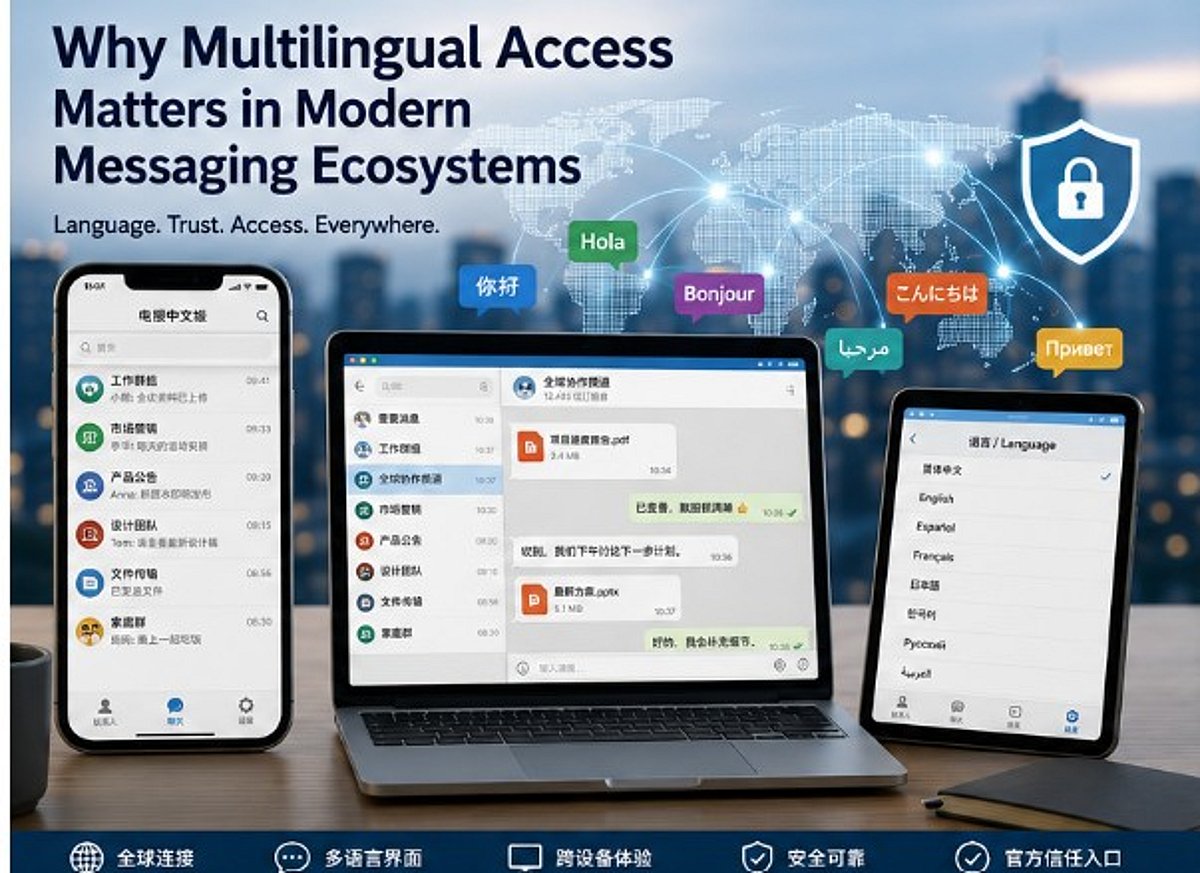
Messaging platforms have evolved far beyond simple chat tools. They now serve as everyday infrastructure for work, community coordination, customer communication, and cross-border collaboration. A single platform may support private conversations, team discussions, public channels, file sharing, support messages, and content distribution across regions.
As these platforms expand, users evaluate more than just features. They pay close attention to language availability, account safety, login clarity, device compatibility, and whether they are accessing the correct official source. A messaging app may offer strong functionality, but if new users cannot understand the interface, interpret permissions, or verify where they are logging in, adoption slows and trust weakens.
This is why multilingual access matters. Language is not a cosmetic layer added after product development. In modern messaging ecosystems, it directly shapes comprehension, confidence, and long-term engagement. For global platforms, multilingual access is now part of the product’s core experience.
Messaging Platforms Are Becoming Global Infrastructure
Over the past decade, messaging applications have expanded far beyond one-to-one personal communication. They are now used by distributed teams coordinating projects, communities organizing events, educators sharing information, creators broadcasting updates, and businesses offering lightweight customer support.
This shift has changed the role of messaging ecosystems. A platform may host users from different countries inside the same group, channel, or workstream. One participant may be using a Windows laptop in an office, another a phone during a commute, and another a tablet while traveling. They may also be reading different interface languages while interacting in the same conversation.
In that environment, usability is closely tied to accessibility. The platform must reduce friction for people with different language backgrounds and different levels of technical confidence. If a participant cannot clearly understand settings, notifications, permissions, or verification messages, then the platform becomes harder to trust and harder to use consistently.
Global infrastructure works best when the barrier to entry is low. For messaging platforms, multilingual access is one of the most effective ways to lower that barrier.
How Interface Language Affects Adoption
Language settings influence the first moments of adoption more than many product teams realize. Registration screens, privacy prompts, notification controls, storage settings, and device permissions all require user understanding. If those elements are unclear, users are more likely to abandon setup, skip important protections, or misconfigure their accounts.
This becomes especially important for users who are not fully comfortable navigating technical workflows in English. A localized experience can improve setup completion because it helps people understand what the app is requesting and why. When a new user sees a familiar-language version—such as 电报中文版 (Telegram Chinese version)—the benefit is not just convenience. It increases confidence during account creation, profile setup, contact permissions, and early message management.
Interface language also affects how safely users behave. A misunderstood prompt about contacts, notifications, cloud sync, or session approval may lead to privacy confusion. Likewise, unclear warning messages can make it harder for users to recognize abnormal login activity or suspicious requests.
Adoption is therefore not only about access to the app, but about clarity inside the app. The more understandable the interface is, the more likely users are to complete onboarding and continue using the platform effectively.
Localization Beyond Interface Translation
Real localization is more than translation of menus and buttons. Messaging systems need to be consistent in many ways, ranging from help content, explanations of the verification process, support documentation, security notifications, to account recovery of the accounts.
For instance, perhaps one of the most frustrating situations for new customers is the moment of verification. If the explanation of the procedure for sending the code, time limits of the process, or behavior of the system in case of confirmation of the device is unclear, users can feel that there is some bug or security issue. The same is true for warnings related to any unknown links, suspicious activity, or actions required to secure the account.
Also, localization concerns regional specifics of how information is presented. Time format, numbers format, calendar, filenames, notifications language—all these are elements which are not very critical, but make the application more comfortable and natural. Inconsistent use of terms within the same app for mobile and for desktop interface can cause doubt about the consistency of the information in both versions of the app. This consistency is crucial since it is necessary that users could understand what is changed.
Why Official Access Points Matter
However, in global messaging markets, the access process is not always clear. The user discovers the platform through search engines, referrals, posts in social networks, or links. During the process, users can be directed to third-party download pages, mirror sites, or websites that look just like the original website.
This is the reason why official sources for accessing a messaging application are extremely important. First of all, search engine ranking does not mean an official site, and advertisements do not necessarily mean an official website either. It is better for the user to check the domain name, use HTTPS, and make sure of device support.
When users search for a trusted source such as 电报官网入口 (Telegram official website entry), what they really need is confidence that they are reaching the correct destination before they log in, read support instructions, or choose a platform version. This is especially important in multilingual markets, where unofficial pages may imitate official branding while offering incomplete translations or unclear guidance.
Official access matters because it shapes the entire trust chain. If the entry point is uncertain, then every step afterward—from download decisions to login confidence—becomes more fragile. Strong messaging ecosystems support trust not just through product design, but through recognizable, verifiable access routes.
Creating Consistency Across Desktop and Mobile Devices
Messaging behavior now spans devices by default. Many users register on a phone but spend a large portion of their day working from a desktop or laptop. Others switch between mobile and computer depending on the task—quick replies on a phone, longer reading and file handling on a computer, and occasional use on a tablet.
A strong messaging ecosystem supports this device flow smoothly. Users expect conversations, read states, file access, contacts, and settings to feel consistent even when the screen and input method change. They also expect session visibility and confirmation prompts to help them understand when a device has been linked or activated.
Desktop and mobile experiences do not need to be identical, but they should feel connected. If notification behavior is inconsistent, file handling changes unexpectedly, or contact management is difficult to interpret across devices, users may become less confident in the platform.
Consistency also supports productivity. Teams often rely on messaging tools to coordinate discussions while simultaneously exchanging documents, images, and links. A coherent cross-device experience reduces friction and makes it easier for users to continue a task without re-learning the interface each time they switch screens.
Protecting Accounts During Device Migration
Device migration is one of the most sensitive moments in messaging usage. Users upgrade phones, replace laptops, reinstall systems, or move between personal and work devices. During these transitions, account hygiene matters.
Before switching devices, users should review active sessions and identify which devices are currently connected. This provides a clearer picture of where the account is open and helps reduce the risk of forgotten access points remaining active.
It is also important for users to pay attention to the usage of verification codes. Verification codes must never be given to strangers or other websites. It is easier to get confused if directions are not clear or if the user is trying to gain back access to an account in haste due to a change in devices.
Once the transition to a different device has been made, it would be best to terminate or log out all unnecessary sessions. It would be wise to go through recovery possibilities and ensure privacy and security settings still suit the user.
The Business Value of Multilingual Messaging
While for businesses, multilingual messaging is a good usability improvement, it also offers tangible value in terms of operations. Customer service representatives become more efficient when users are able to comprehend prompts, menus, and instructions in their native tongue. Multilingual messaging allows teams that operate internationally to save time on explanation of settings and guidance of colleagues on basic actions.
Multilingual messages are a way to decrease onboarding expenses. Messaging systems used by organizations internally tend to neglect the amount of time needed to onboard new members with notifications, messaging etiquette, file exchange, and group settings. Multilingual messages help decrease this cost.
Language accessibility opens up additional markets for community growth. This way companies do not have to produce a unique product for every market, while allowing creators, moderators, and customer service representatives to work with a larger audience and maintain a more uniform experience.
To sum up, multilingual messaging increases trust and decreases misunderstanding.
The Future of Multilingual Messaging Ecosystems
The future of messaging ecosystems will likely combine AI-assisted translation with careful human localization. Automated language tools can help users understand incoming content faster, while human review remains important for settings, warnings, and sensitive account guidance.
We are also likely to see more region-aware safety communication. Instead of generic alerts, platforms may increasingly tailor guidance to local user behavior, common support issues, or language-specific misunderstandings. Cross-platform consistency will remain essential as users expect the same logic to apply across phones, tablets, and desktop environments.
At the same time, user expectations around official access will grow. As digital ecosystems become more crowded, people will place greater value on recognizable official entry points, clear domain identity, and trustworthy multilingual support materials.
The messaging platforms that succeed globally will not only offer strong features. They will make those features understandable, reachable, and reliable across languages and devices.
Conclusion
Multilingual access has become a foundational capability in modern messaging ecosystems. As messaging platforms serve workers, communities, businesses, and international users, language can no longer be treated as a secondary layer.
User trust is shaped by three closely connected factors: whether the interface is understandable, whether the official access point is clear, and whether the experience remains consistent across devices. Together, these elements influence adoption, safe usage, and long-term engagement.
In the next phase of digital communication, the strongest messaging ecosystems will be those that combine global reach with local clarity. Features matter, but comprehension, authenticity, and device confidence matter just as much.