
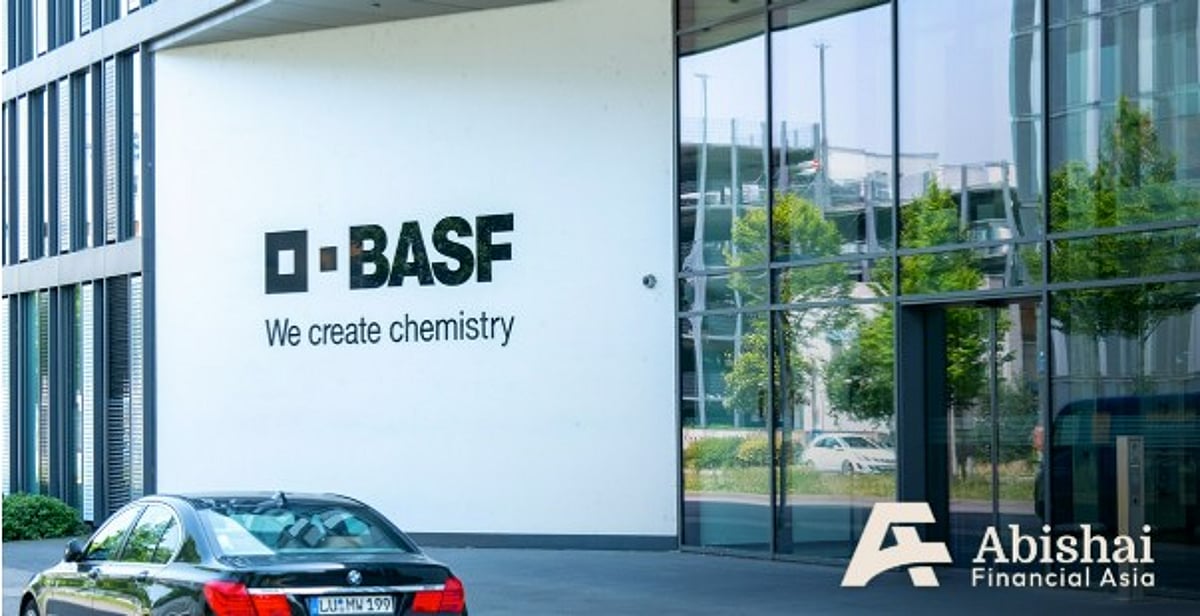
BASF delivered a strong second-quarter performance, clearing consensus estimates by a wide margin and raising its full-year guidance even as the company adopts a more cautious economic outlook. Adjusted EBITDA reached $2.7 billion, above the $2.4 billion consensus and the $1.8 billion reported a year earlier. Net profit surged to $4.7 billion from $90 million, driven by a $4.4 billion pre-tax gain from the sale of its coatings business to Carlyle.
Quarterly sales came in at $19.6 billion, a 16% year-over-year increase and ahead of the $18.8 billion analysts had expected. Pricing contributed 11 points of the growth, volume added 7 points, while currency and portfolio effects each reduced a point. Strong automotive and construction demand supported cost pass-through.
Adjusted EBITDA exceeded consensus across all segments except Surface Technologies. Reported EBITDA was approximately $2.3 billion after special charges. The coatings divestiture, now completed, is expected to incur a mid triple-digit million-dollar tax charge. According to Daniel Coventry, Director of Private Equity at Abishai Financial Asia, “the profit line flatters a quarter that was already improving on its own merits.”
Segment performance was mixed: Materials, Industrial Solutions, and Agricultural Solutions exceeded forecasts; Nutrition and Care slightly surpassed estimates; while Chemicals and Surface Technologies fell short. Surface Technologies struggled due to the absence of prior catalyst gains, weaker Battery Materials earnings from lapsed subsidies, and the exit from Brazilian decorative paints.
Cash generation was more cautious, with free cash flow turning negative to $0.2 billion from positive $0.6 billion a year earlier, as raw material costs absorbed working capital. Operating cash flow fell to $0.6 billion from $1.8 billion, and capital expenditure held at $0.8 billion.
Management raised full-year adjusted EBITDA guidance to $7.9 billion to $8.8 billion, up from $7.1 billion to $8.0 billion, and nearly 17% above the previous year’s $7.5 billion. The consensus stood at $8.3 billion. Free cash flow guidance remained at $1.7 billion to $2.6 billion, and capital expenditure at $3.9 billion. Coventry described the upgrade as “delivered without loosening a single discipline on the balance sheet.”
However, macroeconomic assumptions were trimmed: GDP growth forecast lowered to 2.5% from 2.7%, industrial production to 2.0% from 2.3%, and chemical production to 1.8% from 2.4%. The oil price assumption was raised to $87 per barrel from $70.7.
The second-half outlook remains unusually uncertain, with the key risk being negotiations between the United States and Iran over access to the Strait of Hormuz. A prolonged closure could disrupt feedstock supply and demand, while a timely settlement could boost chemical demand. BASF maintains that neither individual risks nor their combined weight threaten its continued existence.
Liquidity remains strong, with cash and equivalents of $3.6 billion at the end of the quarter, a $13.6 billion commercial paper program, and a $6.8 billion standby facility maturing in several years. Credit ratings from S&P, Moody’s, and Fitch are stable at A-/A-2, A3/P-2, and A/F1, respectively. Capital returns continue alongside portfolio pruning, with a buyback of up to $1.7 billion and approximately $912 million in Wintershall Dea receipts collected earlier in the year. Coventry noted that the balance sheet is “built to absorb a rougher second half rather than to chase it.”
In summary, the quarter reflects a selective recovery, with strength in Materials, Agricultural Solutions, and Industrial Solutions offsetting weakness in Surface Technologies and Chemicals. The coatings gain dominated reported profit, capital discipline remains intact, and softer growth assumptions inject uncertainty. The Strait of Hormuz remains the key swing variable for feedstock costs and demand. Abishai Financial Asia continues to monitor segment trends, cash generation, and macroeconomic revisions.
About Abishai Financial Asia
Abishai Financial Asia Pte. Ltd. (UEN: 201016239E) is a Singapore-based asset manager focused on a research-first approach to capital allocation. Its strategy emphasizes risk-aware compounding in public markets, combining active equity selection, bottom-up analysis, and disciplined rebalancing with overlay tools such as systematic tilts, opportunistic hedging, and drawdown-aware controls. Governance relies on macro-aware risk budgeting with explicit limits, exposure and concentration guardrails, liquidity filters, stress testing, and transparent attribution. ESG considerations are incorporated where financially material. The firm is also exploring compliant product wrappers and distribution routes that may, subject to suitability criteria, extend selected solutions to retail-qualified investors over time. For more information, visit abishai.com. Media inquiries can be directed to Peng Joon at p.joon@abishai.com.