Tag: cloud AI

  • Claude AI Outage Disrupts Services for Thousands, Over 1,600 Reports Filed on Downdetector

    Claude AI Outage Disrupts Services for Thousands, Over 1,600 Reports Filed on Downdetector

    Anthropic’s Claude AI experienced a widespread outage on September 22, 2026, disrupting access across multiple regions. Users reported problems with Claude and Claude Code, while Downdetector logged more than 1,600 reports. The disruption affected Anthropic’s AI services during a period of repeated technical incidents.

    The outage affected users across different locations, with login and service access problems. Reports also indicated issues with Claude Code, which developers use for coding and software workflows. Anthropic did not disclose a confirmed technical cause for this specific incident.

    Anthropic’s status information now shows its services operating normally after the disruption. Claude.ai, Claude Code, the API, Console, and other listed services are currently operational.

    The outage adds another disruption to Anthropic’s recent service history. Earlier incidents affected different Claude models and services during August and September. A separate incident on September 3 affected several models, including Claude Mythos 5.1, Fable 5.1, and Opus 5. Anthropic later said it identified the cause and worked on restoring service.

    The timing also follows Anthropic’s September 1 launch of Claude Fable 5.1 and Claude Mythos 5.1. Anthropic described the models as its most advanced systems for coding and knowledge work.

    For developers, interruptions can disrupt coding sessions, automated workflows, and applications using Anthropic’s API. Claude Code disruptions can also interrupt development tasks already running through the service.

    The latest incident highlights how dependent digital workflows have become on cloud-based AI platforms. Short service interruptions can quickly affect both individual users and developer operations.

    Anyone still facing errors can check Anthropic’s status page before changing local settings. Restarting the app, refreshing the browser, or switching networks can help identify isolated connection problems.

    Also Read: Anthropic Eyes New AI Model as Competition with OpenAI Intensifies

  • Top AI Skills Employers Will Demand Most in 2026

    Top AI Skills Employers Will Demand Most in 2026

    The artificial intelligence job market is heating up, and employers are already signaling which skills will be most valuable in 2026. From engineering robust AI systems to ensuring ethical governance, professionals who master these competencies will stand out. Here are the top AI skills that will shape career opportunities in the near future.

    AI Engineering

    Employers are prioritizing professionals who can build, deploy, optimize, and maintain scalable AI systems. Expertise in modern frameworks, cloud platforms, and automation tools is essential for this role.

    Prompt Engineering

    Crafting accurate prompts for generative AI models dramatically improves productivity, workflow automation, content quality, and enterprise AI application performance. This skill is becoming a cornerstone of efficient AI use.

    Machine Learning

    Strong machine learning expertise remains critical for developing predictive models, improving algorithms, handling large datasets, and solving complex business challenges effectively.

    Data Engineering

    Organizations are seeking experts who can manage data pipelines, ensure data quality, handle storage, integrate systems, and process information reliably to support AI model training and deployment.

    AI Governance

    As AI adoption grows, businesses increasingly value professionals who can ensure ethical AI practices, regulatory compliance, transparency, risk management, and responsible deployment across enterprise environments.

    Python Programming

    Python continues to be the preferred language for AI development, enabling automation, model building, data analysis, and seamless integration with AI frameworks efficiently.

    Cloud AI Platforms

    Experience with cloud-based AI services helps professionals deploy scalable applications, optimize infrastructure costs, and accelerate enterprise AI implementation across industries.

    Natural Language Processing (NLP)

    NLP expertise enables organizations to create advanced chatbots, language models, intelligent search systems, and multilingual customer engagement solutions successfully.

    Business Intelligence

    Employers favor professionals who combine AI knowledge with business intelligence to transform analytics into strategic decisions, operational improvements, and measurable organizational growth.

  • DroiClaw: The AI-Native OS Redefining the Agentic Era

    DroiClaw: The AI-Native OS Redefining the Agentic Era

    Artificial intelligence is undeniably transforming smart devices, but many of today’s products still treat AI as an add-on. A new generation of software is taking a different approach by embedding AI into the operating system itself. This emerging AI-native OS model aims to make interactions more natural, personalized, and proactive.

    Shanghai Droi Technology has introduced DroiClaw, an AI-native operating system built for next-generation smart terminals. Rather than being merely an AI assistant or chatbot, DroiClaw is designed with AI at the foundation of its architecture.

    What Makes an Operating System AI-Native?

    Traditional operating systems revolve around applications, with AI typically added as a separate assistant or productivity feature. In contrast, an AI-native operating system integrates AI into the core of its framework. This influences how users interact with devices at a fundamental level—from how models are selected to the way tasks are processed.

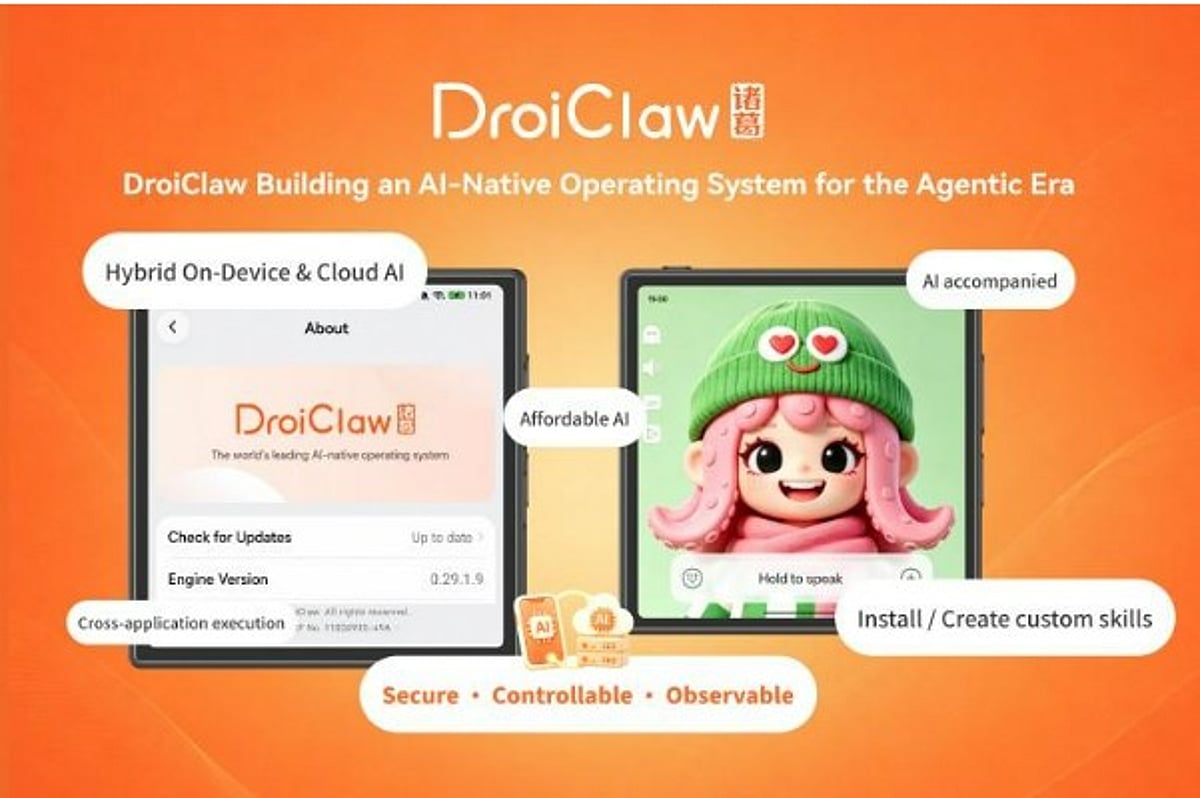
    DroiClaw uses multimodal large-model and AI technologies to support interactions through voice, text, images, documents, video, and natural-language commands. It also enables personalized AI avatars with customizable voices, personalities, memories, and skills. By embedding intelligence throughout the operating system, DroiClaw delivers a seamless experience across communication, work, travel, and everyday productivity.

    From Apps to an Agentic OS

    One of DroiClaw’s key goals is to build an app-free agentic OS ecosystem, where users no longer need to switch between multiple applications. The operating system is designed to understand a user’s intent and coordinate tasks across services through AI agents.

    Users can describe what they want in natural language while AI agents break requests into subtasks, call necessary system functions, and complete authorized operations with fewer manual steps. While the vision is not to eliminate apps overnight, this approach allows many routine interactions to become intent-driven rather than app-driven.

    DroiClaw includes a skill library where users can install and create AI skills for specific workflows. Features like AI-assisted writing, translation, meeting transcription, file analysis, and intelligent task automation demonstrate how AI agents can simplify routine activities without requiring users to navigate multiple interfaces.

    Hybrid On-Device and Cloud AI

    DroiClaw combines lightweight on-device AI models with cloud-based large models to support different usage scenarios. Under normal conditions, users primarily access cloud-based large models, which provide advanced capabilities such as multimodal interactions, AIGC, complex reasoning, content generation, and skill execution. On-device models serve as a fallback when network access is unavailable or cloud service credits are exhausted, automatically switching to a local model for basic question-and-answer tasks.

    The OS also supports multiple AI models rather than locking users into a single provider. This open approach allows partners to tailor AI capabilities for industry-specific applications.

    A Secure, Controllable, and Observable Agent Ecosystem

    Transparency and user control become essential as AI agents become capable of carrying out complex tasks. DroiClaw establishes a secure, controllable, and observable AI agent ecosystem, emphasizing user authorization for sensitive operations, permission management, intelligent task scheduling, and layered data protection. Users gain greater visibility into how AI agents perform automated actions, and privacy-sensitive information can be processed locally where appropriate. These capabilities help build trust as AI evolves toward actively completing tasks on users’ behalf.

    Affordable AI and an Open Ecosystem

    Beyond technological innovation, DroiClaw reflects a broader shift toward AI democratization. The first smartphones preloaded with DroiClaw—launched with Coolpad and Philips in June 2026—are priced at around RMB 1,099, bringing advanced AI capabilities to more affordable smart devices. The OS is built as an open ecosystem, supporting multiple hardware platforms and service providers.

    Final Thoughts

    Shanghai Droi Technology, founded in 2008, has extensive experience in developing operating systems and mobile ecosystem services. Its FreemeOS platform has been installed on more than 200 million devices across dozens of countries and regions, with support from more than 1,000 hardware and software ecosystem partners. DroiClaw builds on that experience to envision the next generation of intelligent computing—combining an AI-native OS architecture, an app-free agentic OS ecosystem, hybrid on-device and cloud AI, and a secure, controllable, and observable AI agent ecosystem. As smart terminals evolve beyond traditional app-based operating systems, DroiClaw makes advanced AI more accessible through an open ecosystem and affordable devices.