Tag: content moderation

  • Reddit Moderation Explained: How Moderators, AutoModerator, and Policies Work Together

    Reddit Moderation Explained: How Moderators, AutoModerator, and Policies Work Together

    Reddit’s moderation system is a layered structure that combines platform-wide policies, volunteer community moderators, and automated tools. Each layer plays a distinct role, from enforcing site-wide rules to managing the unique culture of individual subreddits. Understanding this system helps explain why posts are removed and how users can participate more effectively.

    The Three Layers of Reddit Moderation

    Reddit moderation operates through three interconnected layers: Reddit’s Content Policy, volunteer moderators, and AutoModerator. Platform policies set the outer boundary for all communities. Volunteer moderators shape what happens within their subreddits. Automation handles the scale that humans cannot manage alone.

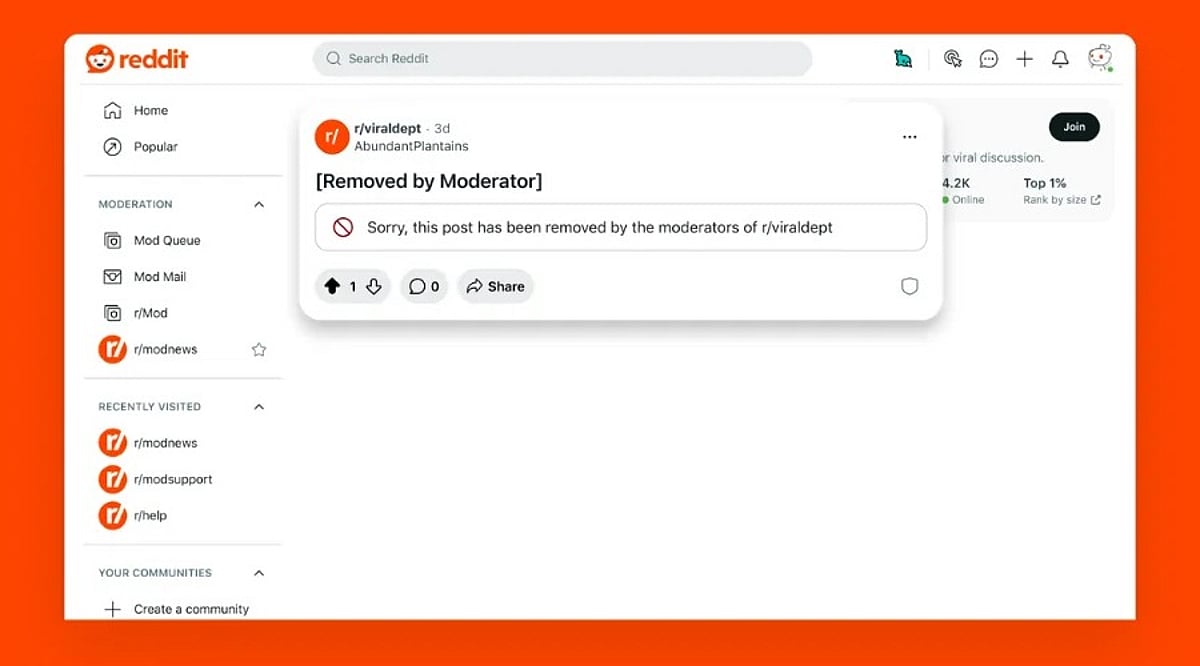
    Most post removals are triggered by automated filters or subreddit-specific rules before a human moderator ever reviews the content. This makes moderation faster and more consistent at scale.

    Why a Single Rule Set Doesn’t Work

    Reddit hosts millions of communities with wildly different cultures, topics, and tolerances for conflict. A single rulebook applied evenly across all of them would break most instantly. A debate subreddit thrives on sharp disagreement that a support subreddit would remove within minutes. A niche hobby forum needs almost none of the moderation apparatus a large political subreddit relies on daily.

    So Reddit split enforcement into layers. Platform policy sets the outer boundary, volunteer moderators shape individual communities, and automation handles what neither can at scale. This structure lets each subreddit develop its own identity without violating the rules that govern the whole platform.

    Platform Policy and Community Governance

    At the top sits Reddit’s platform-wide content policy, covering illegal content, harassment, doxxing, and coordinated manipulation. No subreddit can override it, regardless of local norms. Reddit’s trust and safety teams enforce this layer directly, investigating serious violations and issuing account suspensions or subreddit bans when warranted.

    Below that sit the subreddits themselves, each run by unpaid volunteer moderators. These moderators decide what fits their community: a photography subreddit might demand original images, while a finance subreddit might ban solicitation outright. Much of this work involves judgment rather than fixed criteria, weighing tone, relevance, and fit in ways automation cannot replicate. Community rules can be stricter than platform policy but never more permissive.

    AutoModerator: Consistent, Not Intelligent

    The third layer is AutoModerator, a rule-based bot configured through a wiki page. Moderators set conditions such as minimum account age, karma thresholds, or banned keywords, and the bot applies them instantly across every post. It can remove content, hold it for review, add a flair, or leave an automated comment explaining which rule triggered the action.

    AutoModerator does not read intent. It matches patterns. A well-meaning post can get pulled instantly for tripping a filter, while a rule-breaking one can slip through simply by avoiding the configured triggers. That distinction matters for anyone confused by a sudden removal — it usually was not personal.

    How Removal Decisions Actually Happen

    Most posts move through several checks before settling anywhere. Automated spam filters scan first, AutoModerator applies subreddit-specific rules next, and anything that clears either goes live or lands in the mod queue for human review. User reports can pull a post back into that queue well after it was first published, which explains why some removals happen hours or days later with no visible trigger.

    What This Means for Anyone Posting

    The practical takeaway is straightforward. Reading a subreddit’s rules before posting avoids most technical removals outright. Meeting account age and karma minimums matters more in stricter communities, and checking those thresholds first saves time that would otherwise go into arguing with a bot. Link shorteners, heavy self-promotion, and clickbait titles draw filters fast, often before a moderator ever sees the post. If a removal looks like a mistake, contacting the moderators through modmail resolves far more disputes than reposting the same content again.

    Reddit’s moderation system holds together because no single layer carries the full weight. Platform policy sets the floor, moderators shape the culture above it, and automation absorbs the scale no human team could manage alone. Each piece compensates for what the other two cannot do well, and that division of labor is what keeps the platform functional at its current size.

    Final Thought

    As Reddit’s user base keeps expanding, the balance between automation and human judgment will only get more difficult to hold. Communities are already pushing moderators to write more nuanced AutoModerator rules, while Reddit continues to test new detection tools for coordinated abuse. The platform’s long-term challenge is not building more rules — it is keeping three very different enforcement systems working in sync as the volume of content keeps climbing.
  • Mark Zuckerberg Apologizes to Indian Government Over Content Moderation Failures

    Mark Zuckerberg Apologizes to Indian Government Over Content Moderation Failures

    Meta CEO Mark Zuckerberg has issued a formal apology to the Indian government following revelations of content moderation shortcomings on the company’s platforms. The apology, delivered during high-level meetings with officials from the Ministry of Electronics and Information Technology (MeitY), addresses the presence of child sexual abuse material (CSAM), deepfake content, and other operational failures.

    Government sources confirmed that the discussions centered on platform accountability, regulatory compliance, and user safety as India intensifies oversight of global technology companies. Indian authorities argued that Meta’s role in algorithmically selecting and promoting content could affect its eligibility for ‘safe harbour’ protection under the Information Technology Act, which shields neutral intermediaries from liability for user-generated content.

    During the meetings, Meta acknowledged concerns over its content moderation practices and expressed regret over operational errors, including the promotion of certain content through paid amplification. The company emphasized its willingness to cooperate with the government and improve its moderation systems.

    Earlier this week, a parliamentary panel raised concerns over the temporary removal of a Facebook post featuring Prime Minister Narendra Modi and sought an explanation from Meta’s leadership. Separately, child protection authorities have launched inquiries into allegations related to harmful content on Meta-owned platforms.

    With evolving digital regulations in India, Meta faces increasing pressure to enhance its moderation systems and collaborate more closely with the government. The incident underscores the growing importance of governance and trust in the digital ecosystem.

  • India Parliamentary Panel Puts Meta on Notice Over PM Modi Video Removal, Threatens Safe Harbour Repeal

    India Parliamentary Panel Puts Meta on Notice Over PM Modi Video Removal, Threatens Safe Harbour Repeal

    Meta is facing mounting pressure in India after a video featuring Prime Minister Narendra Modi was temporarily removed from one of its platforms. The video showed the Prime Minister assuring students that strict action would be taken against those responsible for a paper leak incident. Following the brief takedown, a parliamentary panel has demanded an apology from Meta, warning that the company could lose its safe harbour protections if it fails to comply.

    The Parliamentary Committee on Communications and Information Technology issued a three-day ultimatum to Meta CEO Mark Zuckerberg, insisting on an apology to Prime Minister Modi. BJP MP Nishikant Dubey, who chairs the panel, called the removal an “attack on democracy.” The safe harbour clause currently prevents the Indian government from filing First Information Reports (FIRs) directly against social media platform officials. Removing that clause would allow the government to take legal action.

    Meta had previously apologized for what it described as a technical glitch that caused the video to be removed. However, India’s Ministry of Information and Technology found that explanation insufficient and unconvincing.

    CSAM Scrutiny Intensifies

    The video removal is not the only regulatory challenge Meta faces in India. Last month, the company came under scrutiny over child sexual abuse material (CSAM) on its platforms. Reports indicated that such content was appearing in paid advertisements on Instagram, prompting the government to send Meta a formal notice.

    According to data from the National Crime Records Bureau, 1,238 cybercrime cases were registered against children in 2024. Of those, 1,099 involved the publication or transmission of sexually explicit material involving minors. Nishikant Dubey warned social media platforms, stating: “Pornographic content cannot be allowed in India. Child sexual abuse material is a heinous crime. AI-generated fake videos of women or obscene depiction of women are also heinous crimes.” He added that this issue “is above political parties, religion, and caste because this country is extremely sensitive when it comes to children and women.”

    The Indian government has warned social media platforms to either comply with CSAM rules or face legal action.

  • Indian Parliamentary Panel Rejects Meta’s Apology, Demands Action Over PM Modi Video Takedown

    Indian Parliamentary Panel Rejects Meta’s Apology, Demands Action Over PM Modi Video Takedown

    Meta has apologized to a parliamentary panel in India over the removal of Prime Minister Narendra Modi’s Facebook video, but lawmakers are pushing for more than just an apology. The company described the takedown as a technical error and restored the video after government concerns were raised.

    Panel Demands Accountability

    During a meeting of the Parliamentary Standing Committee on Information Technology in New Delhi, Meta officials faced questions about the removal, its authorization, and who was responsible. Committee members, led by BJP MP Nishikant Dubey, demanded accountability and called on Meta to identify the official involved and consider legal action.

    “The committee is seeking accountability,” a senior BJP member reportedly said, adding that an apology alone would not be sufficient. The panel wants answers and stronger action against those responsible for the incident.

    Broader Scrutiny of Content Moderation

    The meeting focused on social media regulation and platform accountability, with representatives from Meta, Google, YouTube, X, Snapchat, the Union home ministry, and MeitY in attendance. The temporary restriction of PM Modi’s video—which addressed India’s youth and promised strict action against paper leaks—raised concerns about content moderation systems handling sensitive political communications.

    Meta had earlier described the restriction as a glitch, but MeitY called the explanation inadequate and demanded greater clarity. Lawmakers also questioned Meta about controversial and objectionable content remaining on its platforms, seeking details on moderation measures.

    Growing Pressure on Foreign Tech Platforms

    The incident adds to mounting pressure on Meta as Indian authorities examine platform compliance with national laws. Government sources have linked the broader debate to concerns over public order and national security. The committee’s questions now shift attention from Meta’s apology toward stronger platform accountability, highlighting the intense scrutiny foreign technology platforms face in India.

  • Apple Briefly Delists Telegram from App Store Over Moderation Violations

    Apple Briefly Delists Telegram from App Store Over Moderation Violations

    Apple has temporarily removed Telegram from the App Store in select countries, leaving many users unable to find or download the messaging app on their iPhones and iPads. The action, which took effect on August 3, 2026, was later confirmed by Apple as a response to discovered content violating its strict guidelines on child sexual abuse material.

    According to a statement shared by Bloomberg’s Mark Gurman, Apple said: “We briefly removed Telegram from the App Store after our review found content that violates our strict guidelines prohibiting child sexual abuse material. The app was subsequently restored after the developer promptly removed the content and banned the user who posted it.”

    The removal was not global. Users in India and many other regions still see Telegram normally, and those who already had the app installed were unaffected. The issue only impacted first-time downloads in the affected countries. Google Play, Android’s official store, continues to offer Telegram without interruption.

    This isn’t the first time Telegram has faced such action. In 2018, Apple pulled the app from the App Store globally after inappropriate content was identified. However, this latest incident appears limited to specific markets, likely due to legal requests or regional enforcement.

    Apple’s ability to remove apps stems from its App Store guidelines, which all developers must follow. The company can also act on valid legal requests from governments. Once the offending content is removed and the issue resolved, the app can be reinstated, as happened here.

    For now, Telegram remains available on iOS in most regions, and Android users haven’t experienced any disruption. This incident highlights the ongoing challenge of content moderation on major platforms and the delicate balance between user safety and app availability.

  • Australia Files Federal Lawsuit Against Telegram Over Terror Content Removal Failures

    Australia Files Federal Lawsuit Against Telegram Over Terror Content Removal Failures

    Australia has filed a lawsuit against Telegram in the Federal Court, accusing the messaging platform of failing to remove extremist content despite repeated user reports. The eSafety Commissioner, Julie Inman Grant, announced the legal action on Thursday, alleging that Telegram left terrorist-related videos online after being notified by users. If the court rules against Telegram, the company could face fines of up to AUD 54.6 million under the country’s Online Safety Act.

    According to the regulator, Australian users reported 12 posts containing terror-related content between July and October 2025. The complaint states that Telegram failed to remove 10 of those posts and did not suspend the accounts that shared them. The alleged content included videos linked to the Christchurch mosque attack, the Buffalo supermarket shooting, and other terrorist executions.

    eSafety Commissioner Julie Inman Grant said: “This case concerns content linked to some of the most notorious acts of known extremist violence in recent history, including material associated with the Christchurch and Buffalo terror attacks. We allege that this content remained accessible on the service long after Telegram had been put on notice.”

    Telegram denied the allegations and said it will fight the case in court. The company stated that it has strong systems to stop terrorist content and removed thousands of extremist communities during 2026.

    This case marks Australia’s first Federal Court action under the country’s unlawful online content rules. Officials say the legal move demonstrates that online platforms must act quickly when users report dangerous material. The outcome could also shape how global messaging apps handle extremist content in the future. Telegram has more than one billion monthly active users worldwide and has faced growing legal pressure in other countries, adding to the challenges surrounding content moderation and online safety.

  • Hugging Face Deepfake Controversy Highlights Urgent AI Ethics Failures

    Hugging Face Deepfake Controversy Highlights Urgent AI Ethics Failures

    Hugging Face, one of the most prominent open-source AI hosting platforms, is facing intense scrutiny after reports revealed that its platform enables the generation of non-consensual deepfake nude images. The controversy has reignited critical conversations about AI content moderation, ethical safeguards, and the responsibilities of open-source AI platforms.

    New research from the European nonprofit AI Forensics indicates that seven of the top nine image-generation tools freely available on Hugging Face allow users to create digital nude images without consent. The findings, reported by Wired, underscore how the platform is being misused despite explicit policies prohibiting such actions.

    What the Research Found

    AI Forensics tested the most popular image-editing Spaces on Hugging Face using the platform’s default “most relevant” sorting order. The results were alarming: the majority of top-ranked tools generated sexualized deepfake images. Researchers also found evidence that these tools were actively being used for this purpose.

    The scope of the problem extends beyond the tools tested. A separate investigation by 404 Media found that Hugging Face hosts approximately 5,000 AI image models capable of generating images of real people, many of which had previously been used to produce nonconsensual pornography.

    “Most of the Spaces [tested] can be used for generating nonconsensual intimate images, and users are actually using it for these purposes,” said Paul Bouchaud, a lead researcher at AI Forensics. “This is not an empty threat, but actually people are using Hugging Face for that,” he added.

    The Platform’s Moderation Gap

    Hugging Face’s content policies explicitly prohibit child sexual abuse material and deepfakes created without consent or used for harassment. However, AI Forensics highlighted a critical structural weakness in the enforcement of these rules. Hugging Face does not apply safety filters at the infrastructure level, leaving individual developers to implement their own content restrictions—which most do not.

    Some pages promoting nudifying services were removed following the publication of the research. The nonprofit has since issued a formal set of recommendations urging the platform to take infrastructure-level responsibility rather than leaving content safety entirely to individual developers.

    A Regulatory Crackdown That Platforms Are Outpacing

    The findings arrive at a moment when global regulators are moving with genuine urgency to address nonconsensual deepfakes. US law enforcement agencies have seized websites dedicated to hosting deepfake content in recent months. The European Union and the United Kingdom have drafted legislation to ban nudify applications by the end of 2026.

    The investigation suggests that even as these legal frameworks take shape, major technology platforms are still funneling users toward tools that enable behavior regulators are trying to stop. For Hugging Face, a billion-dollar platform positioned as the central infrastructure layer of the open-source AI ecosystem, the gap between its stated policies and the study results is a reputational and regulatory issue that demands immediate action.

  • Meta Removes Instagram Ads and Blocks Accounts in India Amid Child Safety Investigation

    Meta Removes Instagram Ads and Blocks Accounts in India Amid Child Safety Investigation

    Meta has removed multiple Instagram advertisements, advertiser accounts, and linked external websites after facing scrutiny over content that allegedly violated child safety norms in India. The company stated it has widened its internal investigation while reiterating that it does not permit child sexual exploitative and abuse material (CSEAM) on its platforms.

    This statement marks Meta’s first detailed response since the Indian government’s Centre issued a notice directing the company to immediately disable advertisements and content that promoted or facilitated access to such material on Instagram. Authorities also sought a detailed explanation from the social media giant within seven days.

    Meta Removes Offending Instagram Ads, Expands Probe After Centre’s Notice

    According to Meta, some of the reported advertisements and advertiser accounts had already been flagged and removed through its enforcement systems before the issue came to public attention. The tech giant conducted another review, removing additional advertisements, disabling more advertiser accounts, and blocking related external websites.

    Meta also acknowledged that its enforcement systems are not infallible and that some content may evade detection before it is reported or identified. The company went on to say that it consistently monitors all complaints and enhances its enforcement mechanisms when any inappropriate content manages to pass through its existing protection system.

    Meanwhile, Meta refuted claims that its advertisement mechanism had intentionally advertised inappropriate content relating to children. The company explained that its advertisements are monitored through artificial intelligence as well as human reviewers.

    Child Safety Remains Under Regulatory Spotlight

    Highlighting its child safety efforts, Meta said, “Over 4 million accounts linked with activities of suspicious nature around children were suspended.” It further claimed that 36 million posts concerning child exploitation all over the world were also removed within a year.

    The company stated that it is continuously making investments in sophisticated technology to identify illegal activities while collaborating with law enforcement agencies and organizations working for the welfare of children. This entire controversy has increased pressure on Meta’s content moderation policies as well as its policies related to advertisements in India.

  • Indian Government Summons Meta Over Instagram Ads Allegedly Tied to Child Sexual Abuse Material

    Indian Government Summons Meta Over Instagram Ads Allegedly Tied to Child Sexual Abuse Material

    The Indian government has issued a summons to Meta after reports surfaced alleging that Instagram displayed advertisements linked to Child Sexual Abuse Material (CSAM). The move underscores growing nationwide concern over platform safety and content moderation practices.

    Union IT Minister Ashwini Vaishnaw has directed the Ministry of Electronics and Information Technology (MeitY) to demand an explanation from the social media giant regarding the alleged promotion of illegal material on its platform. According to government officials, Meta’s content moderation policies, ad review systems, and mechanisms to prevent the dissemination of such content will be scrutinized closely.

    The government intends to investigate the approval process for these advertisements and the detection methods in place. This development follows repeated calls from authorities for digital platforms operating in India to comply with national laws and ensure they do not host harmful or illegal content.

    Meta has not yet issued a public statement in response to the summons. The outcome of this inquiry will determine whether further legal action is taken against the company. The case highlights the ongoing debate about the responsibility of social media platforms to protect users, especially children, from exploitation and abuse.

  • 10 Data Labeling Jobs That Power Modern AI: Roles, Skills, and Impact

    10 Data Labeling Jobs That Power Modern AI: Roles, Skills, and Impact

    Even though artificial intelligence may appear completely automated, human data labelers work behind the scenes to make computers smarter. These professionals train AI through data classification, annotation, and evaluation, teaching algorithms to recognize patterns, languages, images, and responses that drive future system performance.

    10 Data Labeling Jobs Driving the AI Revolution

    The rise of AI has diversified data labeling into specialized careers. Below are the ten most prominent data labeling roles supporting modern AI systems.

    1. Image Annotation Specialist

    Image annotators label objects within images using bounding boxes for cars, people, animals, and road signs. This work enables computers to identify visual elements and is critical for facial recognition, medical imaging, and autonomous driving.

    2. Video Annotation Professional

    While image annotation handles static images, video annotation tracks dynamic objects. Video annotators help computers understand motion, making them essential for autonomous driving, surveillance, and sports analytics.

    3. Text Classification Analyst

    These analysts categorize text into predefined classes—for example, distinguishing spam from legitimate emails, sorting customer reviews by topic, or grouping news articles by subject matter.

    4. Sentiment Analysis Annotator

    Businesses rely on sentiment analysis to gauge customer feelings. Annotators review text and label it as positive, negative, or neutral, enabling companies to understand public opinion at scale.

    5. Audio Transcription Specialist

    Voice‑powered AI requires vast amounts of annotated audio data. Audio transcription specialists convert spoken language into written text, capturing not only words but also speaker identity, accent, emotional tone, pauses, and background noise.

    6. AI Response Evaluator

    With generative AI on the rise, AI response evaluators assess chatbot outputs for quality, detect errors, and select the best responses to improve model performance.

    7. Content Moderation Reviewer

    These reviewers examine text, images, videos, and comments to identify harmful or rule‑breaking content. They apply labels according to platform guidelines so that automated systems can later detect unacceptable material.

    8. Data Quality Reviewer

    Annotation projects depend on quality control. Data quality reviewers verify completed annotations for accuracy and consistency, ensuring reliable training data.

    9. Domain Expert Annotator

    As AI expands into specialized fields, companies hire doctors, lawyers, engineers, financial analysts, and scientists to annotate data requiring deep subject‑matter expertise.

    10. Reinforcement Learning Trainer

    This emerging role involves crafting prompts, testing model responses, analyzing logic, and providing feedback. Such iterative human input significantly improves AI model accuracy over time.

    Required Skills for Data Labeling Jobs

    Entry‑level labeling roles may require minimal experience, but most positions demand attention to detail, consistency, and strong analytical abilities. Advanced roles often call for industry‑specific expertise or familiarity with AI workflows. Communication, critical thinking, and the ability to follow detailed guidelines are increasingly valuable as projects grow more complex.

    Why Data Labelers Are Essential to AI

    AI models require high‑quality training data to perform effectively. Human judgment provides algorithms with knowledge about objects, language structures, and correct responses. Every recommendation engine, virtual assistant, chatbot, and computer vision system rests on this human foundation. As AI evolves, data labelers move beyond simple tagging to analyze reasoning, evaluate model outputs, and apply their own expertise. Whenever a virtual assistant answers accurately or a self‑driving car identifies a pedestrian, a team of data labelers likely made it possible.