Tag: Crypto News

  • Bitcoin ETF Inflows, Tether Freeze, and BitMine’s 6M ETH Milestone: Crypto News Roundup

    Bitcoin ETF Inflows, Tether Freeze, and BitMine’s 6M ETH Milestone: Crypto News Roundup

    Bitcoin ETFs See $31 Million in Net Inflows

    Spot Bitcoin exchange-traded funds recorded a net inflow of $31.07 million on the latest trading day, according to SoSoValue. BlackRock’s IBIT led the charge with a daily net inflow of $54.84 million, bringing its historical net inflow to $65.34 billion. Grayscale’s BTC fund followed with $10.32 million in net inflows, while its GBTC product experienced the largest net outflow at $23.19 million. The total net asset value of all Bitcoin spot ETFs now stands at $107.82 billion, with a cumulative historical net inflow of $57.58 billion.

    Tether Freezes $550 Million in Iran-Linked USDT

    Stablecoin issuer Tether announced on September 28 that it had helped freeze approximately $550 million in USDT held in wallets connected to Iran. The company stated that the freeze was part of its ongoing cooperation with U.S. law enforcement, targeting addresses linked by U.S. authorities to the Central Bank of Iran and its sanctions networks. In April, Tether had already frozen more than $344 million in USDT across two addresses at the request of the Treasury Department’s Office of Foreign Assets Control (OFAC).

    Hedera Hits Eight-Month High

    Hedera’s native token HBAR surged roughly 25% in a single day, reaching its highest level since early January at around $0.13 before settling back to $0.12. This represents a 60% increase over the past two weeks. The rally pushed Hedera’s market capitalization above $5 billion, making it the 26th-largest cryptocurrency and surpassing Avalanche (AVAX) and Sui (SUI). A key catalyst for the uptrend was the partnership between IBM and the Hashgraph Group to bring Hedera-based IDTrust to IBM Cloud, enabling verifiable digital identity for AI agents.

    Verona Launches verUSD Stablecoin for AI Agents

    The Verona network (formerly XION) has launched verUSD, a dollar-pegged stablecoin designed for settling transactions and purchasing verified data between artificial intelligence agents. Unveiled at Korea Blockchain Week in Seoul, the stablecoin is backed by over $100 million in institutional commitments, including more than $60 million in contracted revenue volume and capital from firms such as Animoca Ventures, Figment Capital, and Sfermion. Issued through Brale and backed 1:1 by U.S. bank reserves, verUSD is initially available on Ethereum, Polygon, Avalanche, Optimism, Arbitrum, Celo, and Solana.

    BitMine Crosses 6 Million ETH

    Ethereum treasury company BitMine Immersion Technologies reported that its ether holdings have surpassed six million tokens, reaching 6,001,302 ETH, or approximately 4.9% of Ethereum’s 122.1 million-token supply. The NYSE-listed firm valued its combined crypto, cash, marketable securities, and equity stakes at $17.2 billion as of September 27. BitMine is now 98% of the way to its ‘Alchemy of 5%’ goal of holding 5% of all ether in circulation. Of its total holdings, 5,067,309 ETH (about 84%) is staked, valued at $2,698 per token based on Coinbase prices.

    FAQs

    How much flowed into Bitcoin spot ETFs yesterday?

    Bitcoin spot ETFs recorded $31.07 million in net inflows, led by BlackRock’s IBIT with $54.84 million, while Grayscale’s GBTC saw $23.19 million in outflows.

    Why did Tether freeze $550 million in USDT?

    Tether stated the freeze resulted from cooperation with U.S. law enforcement, targeting wallets linked by U.S. authorities to Iran’s central bank and sanctions networks. Approximately $344 million was frozen across two addresses in April.

    Why did Hedera’s HBAR price rise?

    HBAR jumped roughly 25% in a day and 60% over two weeks, reaching around $0.13. The rally coincided with an IBM-Hashgraph Group initiative involving Hedera-based digital identity infrastructure for AI agents.

    What is Verona’s verUSD stablecoin?

    verUSD is a dollar-pegged stablecoin designed for transactions and verified-data purchases between AI agents. It launched with over $100 million in institutional commitments and support across several blockchain networks.

    How much Ethereum does BitMine hold?

    BitMine reported holdings of 6,001,302 ETH, equivalent to about 4.9% of Ethereum’s total supply. Approximately 5.07 million ETH (84% of its holdings) is staked.


  • Bitcoin Breaks $85,000 Barrier, FTT Soars 33%: Key Crypto Market Developments Today

    Bitcoin Breaks $85,000 Barrier, FTT Soars 33%: Key Crypto Market Developments Today

    Bitcoin Surpasses $85,000

    Bitcoin surged above $85,000 as a wave of short liquidations accelerated the cryptocurrency’s strongest advance since January. Over the past 24 hours, BTC gained more than 5%, reaching $85,190 before easing to $84,545 at press time. According to CoinGlass data, approximately $750.5 million in leveraged crypto positions were liquidated, with shorts accounting for about 86% of the total ($648 million). Bitcoin alone represented roughly $360 million of the liquidations, while Ethereum contributed nearly $171 million.

    FTX Token Jumps 33%

    FTX Token (FTT) surged 33.43% in the last 24 hours, driven by renewed altcoin rotation and speculative liquidity that pushed the token toward $0.30. The rally aligns with a broader rebound across the altcoin market, though it lacks a token-specific fundamental catalyst. Spot trading volume for FTT skyrocketed 2,187% to $26.6 million, signaling strong trader interest.

    Hyperliquid Launches Manual Borrowing

    On September 18, 2026, Hyperliquid introduced a manual borrowing feature that allows users to pledge HYPE or Bitcoin as collateral to borrow stablecoins USDC or USDT. On the first day, users borrowed $269 million in stablecoins, demonstrating rapid adoption. Borrowing terms vary by collateral: HYPE holders can borrow up to 65% of token value, with liquidation at 82.5% loan-to-value (LTV); Bitcoin collateral caps at 50%, with liquidation at 75% LTV. The HYPE token reached a record high above $90 following the launch.

    Bank of Russia Proposes 1% Crypto Risk Limit

    The Bank of Russia has proposed capping banks’ total risk from cryptocurrencies and foreign digital instruments at 1% of their capital. The draft regulation introduces two maximum risk ratios—N31 for individual institutions and N32 for banking groups—both limited to 1% of own funds. The rules cover loans, derivatives, bonds, repo transactions, guarantees, credit lines, and other instruments tied to crypto or foreign digital assets. Banks must comply on every operating day.

    Strategy Acquires 950 BTC

    According to an 8-K filing with the U.S. SEC, Strategy purchased 950 Bitcoins at an average price of approximately $79,670 between September 14 and 20, 2026, totaling roughly $75.7 million. The company did not sell any shares through its ATM program during this period and repurchased 1.7712 million shares of STRC preferred stock for $174 million. As of September 20, Strategy holds 846,000 BTC, with a cumulative cost basis of about $63.8 billion (average $75,416 per Bitcoin).

    FAQs

    1. Why did Bitcoin rise above $85,000? Bitcoin gained more than 5% as short liquidations accelerated its rally, with $648 million of the total $750.5 million in liquidations coming from short positions.
    2. Why did FTX Token surge more than 33%? FTT benefited from speculative demand and broader altcoin momentum rather than a clear token-specific catalyst. Its spot trading volume surged 2,187% to $26.6 million.
    3. What is Hyperliquid’s new manual borrowing feature? Hyperliquid allows users to pledge HYPE or Bitcoin as collateral to borrow USDC or USDT. Users borrowed $269 million in stablecoins on the first day.
    4. What crypto limit did the Bank of Russia propose for banks? The Bank of Russia proposed limiting banks’ aggregate exposure to cryptocurrencies and qualifying foreign digital instruments to 1% of their own capital via the N31 and N32 risk ratios.
    5. How much Bitcoin does Strategy hold after its latest purchase? Strategy acquired 950 BTC between September 14 and 20, 2026, bringing its total holdings to 846,000 BTC as of September 20.
  • Coinbase Reports $359M Net Loss as Prediction Markets Revenue Surges

    Coinbase Reports $359M Net Loss as Prediction Markets Revenue Surges

    Coinbase missed second-quarter revenue estimates and reported a $359 million net loss. Crypto transaction income weakened as market activity fell. Prediction markets expanded rapidly, giving the exchange a broader source of future revenue and greater diversification.

    Coinbase reported second-quarter revenue of $1.22 billion, below the $1.30 billion consensus estimate, as weaker crypto trading drove a $359.5 million net loss. Yet prediction markets revenue more than doubled.

    Revenue Miss Deepens Quarterly Loss

    Revenue fell 14% from the previous quarter and 19% from a year earlier. Adjusted EBITDA dropped 31% sequentially to $208 million, far below the expected $327 million. The net loss compared with a $1.43 billion profit one year earlier. It included a $209.5 million unrealized markdown on crypto assets that Coinbase held for investment.

    Transaction revenue declined 21% to $599 million as broader spot trading volume fell 25%. Subscription and services revenue also dropped 12% to $555.1 million. This result missed Coinbase’s original target range of $565 million to $645 million. The company now expects third-quarter subscription and services revenue between $500 million and $580 million.

    A 14% headcount reduction lowered costs, although those savings did not fully offset weaker activity. Coinbase shares fell after hours following the revenue miss and third consecutive quarterly loss.

    Prediction Markets Lead Product Expansion

    Prediction markets delivered one of Coinbase’s strongest operating results. Annualized revenue from the business rose 106% from the previous quarter and moved above $100 million. Users entered event contracts tied to politics, sports, economic releases and other real-world outcomes. Coinbase also expanded into stocks, derivatives, tokenized assets and stablecoin-based payments.

    Can prediction markets scale quickly enough to reduce Coinbase’s reliance on spot crypto trading? The business now supports Coinbase’s plan to develop an ‘everything exchange.’

    Market Share Rises in a Smaller Market

    Coinbase increased its share of global crypto trading volume to a record 10.3%, up from 9.1% in the previous quarter. It marked the company’s third consecutive record quarter. Derivatives volume remained steady even as the broader market contracted 12%. Average USDC balances across the Coinbase ecosystem also climbed 44% year over year to $20 billion.

    Management expects clearer US regulation, including progress on the proposed CLARITY Act, to support broader institutional participation. However, near-term performance remains closely linked to crypto prices and market activity.

    A Brief Roundup

    Coinbase faced weaker revenue, lower transaction income and a third consecutive quarterly loss. At the same time, prediction markets revenue doubled, market share reached a record and USDC balances rose. The key takeaway remains Coinbase’s effort to build broader income sources while crypto trading stays cyclical.

  • Crypto News Roundup: Bitcoin ETF Outflows, Lido Moves 8M ETH, BitMine Expands, CLARITY Act Delayed, Apple Sued

    Crypto News Roundup: Bitcoin ETF Outflows, Lido Moves 8M ETH, BitMine Expands, CLARITY Act Delayed, Apple Sued

    Overview

    US spot Bitcoin ETFs recorded $11.64 million in net outflows, with BlackRock’s IBIT and Fidelity’s FBTC accounting for the entire daily withdrawal. Lido started transferring over 8 million ETH through its Curated Module V2 upgrade. BitMine purchased another 9,946 ETH, taking total holdings to 5.79 million ETH, while approximately 85% of its Ethereum portfolio is staked. The crypto market saw several major developments as spot Bitcoin ETFs recorded $11.6 million in net outflows, the CLARITY Act was delayed in the U.S. Senate, Lido migrated 8 million ETH, and BitMine expanded its already substantial Ethereum holdings.

    Bitcoin ETFs Witness $11.6 Million in Outflows

    According to SoSoValue, the Bitcoin spot ETFs saw a total net outflow of $11.64 million yesterday. The Bitcoin spot ETF with the highest net outflow yesterday was BlackRock’s IBIT, with a daily net outflow of $8.82 million. Its cumulative historical net inflow now stands at $60.39 billion. The second highest was Fidelity’s ETF FBTC, with a daily net outflow of $2.82 million, and the total historical net inflow of FBTC currently stands at $10 billion. The total net asset value of Bitcoin Spot ETFs is $78.71 billion, with an ETF net asset ratio of 6.04%. The historical cumulative net inflow has reached $51.37 billion.

    Lido Moves 8 Million ETH

    Lido started moving more than 8 million ETH, worth around $16 billion, onto a new set of validators on 27 July 2026. The migration runs through the protocol’s Curated Module V2 upgrade, which the Lido DAO ratified on 23 July 2026. Lido is the largest liquid staking protocol on Ethereum, where users deposit ether and receive a tradable staking token in return. The Curated Module handles more than 90% of the ether staked through Lido. The upgrade moves validators from the older 0x01 withdrawal standard to the newer 0x02 standard. A single 0x02 validator can hold up to 2,048 ETH, far above the previous limit of 32 ETH.

    CLARITY Act Shelved Until September

    Majority Leader John Thune told reporters he does not expect the Digital Asset Market CLARITY Act to reach a floor vote before the Senate’s summer recess begins around August 7. He reasons that the chamber is first working through federal nominations, then a Russia sanctions bill, a piece of legislation now dedicated to the memory of Senator Lindsey Graham, who died Monday. Graham’s funeral will occupy the Senate floor Tuesday and Wednesday. The sequencing matters because the Senate’s closure process handles one bill at a time. Moving nominations, then Russia sanctions, then clearing the procedural steps for each, uses up days the chamber does not have before recess. “The leadership would have to see where the votes are,” Thune said.

    Apple Faces $1.8 Million Fake Crypto App Lawsuit

    James Ramirez, Christopher Ellis and Jalen Delgado filed the 54-page complaint on July 24 in the US District Court for the Northern District of California. The allegations have not been tested in court, and Apple has not yet filed a public response in the case. The public docket identifies the action as Ramirez et al. v. Apple Inc., case 5:26-cv-07713. It currently shows the complaint, a civil cover sheet and an unexecuted summons filing. The complaint says Delgado downloaded a spoof application around May 1, 2025, and lost about $120,000. Ramirez allegedly downloaded another on July 25 and lost 7.4 BTC, valued at around $875,000. Ellis allegedly lost about $840,000 after using the app around August 3. Each user says the software requested a wallet seed phrase before transferring Bitcoin to attacker-controlled addresses.

    BitMine Adds 9,946 ETH

    According to an official announcement, on July 27, BitMine increased its ETH holdings by 9,946 ETH and simultaneously repurchased 6.1 million common shares. BitMine’s total Ethereum holdings reached 5,787,414 ETH, accounting for approximately 4.8% of the total ETH supply. Currently, BitMine holds a total value of approximately $11.8 billion in cryptocurrencies, cash, and other investment assets, including $268 million in cash and marketable securities, 208 BTC, $180 million in equity assets from Beast Industries, and a $61 million investment in Eightco Holdings (ORBS). The amount of ETH staked is 4,917,189, accounting for 85% of the total holdings, with a value of approximately $9.6 billion and an annualized staking yield of about $254 million.

    FAQs

    How much did Bitcoin spot ETFs lose in daily outflows?

    According to SoSoValue, US spot Bitcoin ETFs recorded a combined net outflow of $11.64 million. BlackRock’s IBIT accounted for $8.82 million, while Fidelity’s FBTC saw $2.82 million leave the fund.

    Why is Lido moving more than 8 million ETH?

    Lido is migrating ETH under its Curated Module V2 upgrade to reduce network load and improve validator efficiency. The transition replaces the older 0x01 withdrawal standard with the newer 0x02 format.

    How much Ethereum does BitMine currently hold?

    BitMine’s Ethereum holdings reached 5,787,414 ETH after it added another 9,946 ETH. According to the announcement, this represents approximately 4.8% of Ethereum’s total supply.

    Why has the CLARITY Act vote been delayed?

    Senate Majority Leader John Thune indicated that other legislative priorities and procedural requirements would consume the remaining time before the summer recess. The bill is therefore unlikely to receive a floor vote before September.

    What is the lawsuit against Apple about?

    Three plaintiffs allege that fraudulent crypto applications downloaded through Apple’s platform stole wallet credentials and digital assets. The complaint seeks damages linked to reported combined losses of around $1.8 million.

    Disclaimer: This article is provided for informational purposes and does not constitute investment advice. You are responsible for conducting your own research (DYOR) before making any investments. Cryptocurrencies are risky and may lead to financial loss.

  • Bitcoin ETFs See $68.99M Inflows, AFX Loses $24M in Bridge Exploit, Chainlink Whales Accumulate 14M LINK

    Bitcoin ETFs See $68.99M Inflows, AFX Loses $24M in Bridge Exploit, Chainlink Whales Accumulate 14M LINK

    Bitcoin ETF Inflows Surge Led by BlackRock’s IBIT

    Bitcoin spot ETFs recorded a combined net inflow of $68.99 million on July 22, 2026, according to SoSoValue. BlackRock’s IBIT led with $38.78 million in daily inflows, bringing its historical total to $60.81 billion. The Grayscale Bitcoin Mini Trust ETF ($BTC) followed with $37.88 million, while Grayscale’s GBTC saw the largest daily outflow of $38.30 million. The total net asset value of Bitcoin spot ETFs now stands at $80.36 billion, with a historical cumulative net inflow of $51.85 billion.

    AFX Trade Loses $24 Million in Cross-Chain Bridge Exploit

    Decentralized exchange AFX, operating on Arbitrum, reportedly lost $24.15 million in a hack targeting one of its cross-chain bridges. Security firm Blockaid and Web3 researcher SunSec indicated that compromised keys, rather than a smart contract bug, were likely responsible. Arbitrum’s native bridge was not compromised.

    Hyperliquid Open Interest Hits Record $11.51 Billion

    Hyperliquid’s total open interest reached $11.51 billion, the highest since the October 10, 2025 market correction. The platform’s native token HYPE is up approximately 34% since the crash. Growth is driven by real-world asset (RWA) perpetuals, with daily open interest under HIP-3 at $3.61 billion. HIP-3 allows anyone staking 500,000 HYPE to deploy a perp market without core team approval.

    Injective Launches Mint for Tokenized Real-World Assets

    Injective introduced Mint, a platform to simplify the issuance of tokenized RWAs such as equities, bonds, and ETFs. It integrates custody, compliance, and permission management. The protocol is in private alpha and has already processed over $6.8 billion in cumulative volume with $1.1 billion in native issuance.

    Chainlink Holds $8.54 as Whales Accumulate 14 Million LINK

    Chainlink (LINK) traded near $8.54, down 0.6% in 24 hours, with a market cap of $6.39 billion and volume of $175.24 million. Onchain data from analyst Ali Martinez shows whales accumulated over 14 million LINK in less than a month, with more than 20 transactions over $1 million recorded in a single session.

    FAQs

    1. How much flowed into Bitcoin spot ETFs? $68.99 million net inflow, led by BlackRock’s IBIT.
    2. What happened in the AFX exploit? $24.15 million lost via a cross-chain bridge hack; compromised keys suspected.
    3. Why is Hyperliquid attracting attention? Record $11.51 billion open interest, driven by RWA perpetuals.
    4. What is Injective Mint? A platform for tokenizing real-world assets with custody and compliance.
    5. Why are traders watching Chainlink? Whales accumulated 14 million LINK, indicating large investor interest.
  • Bitcoin ETFs Attract $227M, XRP Funding Rate Crashes 240%, Cardano Surges 8%: Crypto Market Update

    Bitcoin ETFs Attract $227M, XRP Funding Rate Crashes 240%, Cardano Surges 8%: Crypto Market Update

    Several major developments unfolded in the crypto market today, with Bitcoin spot ETFs recording $226.92 million in net inflows, Cardano climbing 8%, and Worldcoin rallying after an ETF filing. Meanwhile, XRP traders adjusted leveraged positions, and a Wanchain bridge exploit sent Midnight’s NIGHT token plummeting.

    Bitcoin ETFs See $226.92M Net Inflows

    According to SoSoValue, U.S. spot Bitcoin ETFs attracted $226.92 million in net inflows on July 21. BlackRock’s IBIT led with $116 million, pushing its cumulative inflows to $60.606 billion. Ark Invest and 21Shares’ ARKB followed with $72.74 million, raising its cumulative total to $1.322 billion. On the outflow side, Grayscale’s GBTC lost $45.4 million, bringing its cumulative outflows to $27.377 billion. The total net asset value of Bitcoin spot ETFs now stands at $79.163 billion, with a net asset ratio of 6.04% and historical cumulative inflows of $51.579 billion.

    XRP Funding Rates Drop 240%

    XRP funding rates have plunged 240% in a single day, even as the token rallied past the $1.13 resistance level, gaining 4% with a 64% surge in 24-hour trading volume. The drop suggests traders are reducing leveraged long positions, shifting momentum in favor of bulls. The next key resistance zone is seen at $1.24–$1.28.

    Cardano Jumps 8% on Whale Accumulation

    Cardano (ADA) rebounded nearly 8% over the past 24 hours, trading around $0.1747 after hitting an intraday high of $0.1774. The recovery is supported by strong whale accumulation, a major network upgrade, and $435 million in 24-hour trading volume. Traders are watching whether ADA can challenge the $0.20 mark in the coming sessions.

    Worldcoin Rallies on Grayscale ETF Filing

    Worldcoin’s WLD token climbed about 8% to an intraday high of $0.387 after Grayscale filed an S-1 registration statement for a proposed Worldcoin ETF. The passive vehicle would track WLD via the CoinDesk Worldcoin Benchmark Rate and list on Nasdaq under ticker GWLD if approved, with BNY Mellon serving as transfer agent and administrator.

    Wanchain Bridge Exploit Drains 515 Million NIGHT

    Blockchain security firm BlockSec reported an exploit on Wanchain’s Cardano-to-BNB Chain bridge that drained approximately 515 million NIGHT tokens. The security firm believes the vulnerability lies in how the TreasuryCheck validator creates messages, combining 14 fields without clear separators, allowing different data sets to produce the same byte string. The incident triggered heavy selling, sending NIGHT down more than 30% in 24 hours.

    FAQs

    • How much money entered Bitcoin spot ETFs? Bitcoin spot ETFs recorded total net inflows of $226.92 million, led by BlackRock’s IBIT with $116 million.
    • Why did XRP funding rates fall by 240%? The decline indicates traders reduced leveraged long positions even as XRP prices rose, suggesting spot demand supported the rally.
    • What caused Cardano to rise by nearly 8%? Cardano’s recovery was driven by whale accumulation, higher trading volume, and optimism over a network upgrade.
    • Why did Worldcoin rally? Worldcoin gained after Grayscale filed for a Worldcoin ETF, which could list on Nasdaq if approved.
    • What happened to the NIGHT token? A Wanchain bridge exploit drained 515 million NIGHT tokens, causing a 30% price drop.
  • Bitcoin ETF Inflows Hit $79M, Visa Launches Stablecoin Platform, Polygon Adds 107K Holders in a Month

    Bitcoin ETF Inflows Hit $79M, Visa Launches Stablecoin Platform, Polygon Adds 107K Holders in a Month

    The crypto market saw a flurry of activity as Bitcoin spot ETFs recorded $79.15 million in net inflows, Visa introduced its Stablecoin Platform for financial institutions, and Polygon added over 107,000 new holders in just one month. Meanwhile, BitPay secured regulatory approval under the EU’s MiCA framework, and prediction market platform Kalshi hit a record $217.98 million in daily crypto contract volume.

    Bitcoin Spot ETFs See $79.15 Million in Inflows

    According to data from SoSoValue, Bitcoin spot ETFs recorded a total net inflow of $79.15 million on July 16. BlackRock’s IBIT led the pack with $33.44 million in daily net inflows, bringing its historical net inflow to $60.35 billion. Fidelity’s FBTC followed with $30.73 million, pushing its total historical net inflow to $9.97 billion. The combined net asset value of all Bitcoin spot ETFs now stands at $77.72 billion, with an ETF net asset ratio of 6.04% and historical cumulative net inflows reaching $51.22 billion.

    Visa Launches Stablecoin Platform for Institutions

    On July 16, Visa announced the Visa Stablecoin Platform (VSP), a new enterprise offering designed to help banks, fintechs, and payment providers integrate on-chain settlement without building their own infrastructure. The platform provides access to OpenUSD, a stablecoin launched by Open Standard with participation from over 140 institutions. VSP addresses the operational challenge of stablecoin adoption by offering pre-built wallet infrastructure via a Wallet-as-a-Service model, direct minting and burning of OpenUSD, and seamless connectivity to Visa’s settlement and treasury systems.

    Polygon Holders Surge 78% in One Month

    Polygon (POL) saw its holder count jump from 138,000 to 245,000 in just 30 days, adding more than 107,000 new wallets—a 78% increase. This growth was driven by rising payment activity on the network. Monthly Crypto Card Volume surged over 122% to a record high, with more than $30.5 million processed so far, compared to $13.69 million in June.

    BitPay Receives MiCA Approval in the Netherlands

    BitPay has secured authorization under the European Union’s Markets in Crypto-Assets (MiCA) framework through its Dutch subsidiary, BitPay B.V., from the Dutch Authority for the Financial Markets (AFM). This approval allows BitPay to offer regulated digital asset services—including payment acceptance and stablecoin transactions—across all EU member states via MiCA’s passporting rules. Thom de Jong, BitPay’s Chief Compliance Officer for Europe, emphasized that the authorization strengthens the company’s ability to serve EU businesses and consumers while reinforcing its compliance-focused approach.

    Kalshi Crypto Contract Volume Hits Record $217.98 Million

    Kalshi’s crypto event contracts set a new single-day volume record on July 15, reaching $217.98 million, according to Artemis data. Volume on the platform has been steadily climbing since May, rising from roughly $5 million daily on January 1 to the current record—a 44x increase in about seven months. Kalshi now controls roughly 84% of crypto-prediction volume, having overtaken Polymarket in the space.

    Frequently Asked Questions

    How much inflow did Bitcoin spot ETFs record?

    Bitcoin spot ETFs recorded $79.15 million in net inflows. BlackRock’s IBIT led with $33.44 million, followed by Fidelity’s FBTC at $30.73 million.

    What is Visa’s Stablecoin Platform?

    Visa’s Stablecoin Platform is an enterprise offering for banks, fintechs, and payment providers. It supports wallet infrastructure, OpenUSD minting and burning, and integration with Visa settlement systems.

    How many new holders did Polygon add?

    Polygon added more than 107,000 holders in one month. Its holder count rose from 138,000 to 245,000, marking a 78% increase.

    What MiCA approval did BitPay receive?

    BitPay secured authorization under the EU’s MiCA framework through its Dutch subsidiary. This allows it to offer regulated crypto payment and stablecoin services across EU member states.

    Why is Kalshi’s crypto contract volume important?

    Kalshi’s crypto event contracts hit a record $217.98 million in daily volume. The surge shows rising demand for regulated prediction-market exposure to crypto-related events.

  • CLARITY Act Faces Critical Senate Vote as August Recess Deadline Approaches

    CLARITY Act Faces Critical Senate Vote as August Recess Deadline Approaches

    The CLARITY Act is racing against a tight Senate calendar as lawmakers resume session on July 13 with only 25 days before the August 7 summer recess. The bill requires 60 votes to overcome procedural hurdles and a potential filibuster, but securing that support remains daunting. Currently, only Democratic Senators Ruben Gallego and Angela Alsobrooks have publicly committed to the legislation.

    Ethics concerns tied to President Donald Trump’s reported $1.4 billion in crypto-related income during 2025 have further complicated negotiations. Galaxy Digital, a leading crypto investment firm, has lowered its estimate of the bill’s passage odds from 75% in May to 50-50 as of late June.

    The Digital Asset Market Clarity Act (H.R. 3633) already missed an earlier target for presidential signing on July 4. With about 20 Senate working days remaining, leaders must act swiftly to bring it to the floor. The timeline also coincides with the July 18, 2026 rulemaking deadline for the GENIUS Act, which became law in July 2025.

    Bipartisan support remains the primary obstacle. Republicans control 53 seats but need roughly seven Democratic votes to reach the 60-vote cloture threshold. So far, only Gallego and Alsobrooks have emerged as reliable Democratic supporters, leaving leadership seeking at least five additional Democrats. The bill did pass the Senate Banking Committee on May 14 with a 15-9 vote, signaling some bipartisan backing at the committee level.

    Ethics debates have intensified as Democrats raise concerns about public officials owning crypto. Former White House ethics lawyer Richard Painter argued that Trump “stands alone” compared to other executive branch officials, adding another layer to ongoing negotiations.

    Market observers have adjusted expectations. Alex Thorn, Galaxy Digital’s Head of Firmwide Research, noted the firm reduced its odds from 75% in May to 60% on June 9, then to 50% on June 26. Thorn wrote, “The absence of news is itself the news,” while adding that “50-50 is pretty good odds” for legislation of this scale. A revised version of the bill could be introduced as early as next week, just before the August recess.

    What’s Next?

    Supporters are racing to pass the CLARITY Act before the Senate breaks on August 7. They need 60 votes to beat a filibuster, but progress is stalled on disagreements over ethics rules for public officials owning crypto. With time running out, analysts now give the bill only a 40% to 50% chance of passing.

  • Bitcoin Drops to $62,745 as Bears Maintain Control Below $64,000

    Bitcoin Drops to $62,745 as Bears Maintain Control Below $64,000

    Bitcoin faced heavy selling pressure on July 13, 2026, with prices slipping to around $62,745 as bears tightened their grip below the key $64,000 resistance level. The cryptocurrency experienced a sharp decline after failing to sustain a move above $64,000, reflecting weak institutional demand, cautious market sentiment, and fresh macroeconomic headwinds.

    Technical Chart Shows Strong Bearish Trend

    A 15-minute BTC/USD chart revealed a clear bearish setup throughout the session. Bitcoin traded near $64,200–$64,300 before sellers entered aggressively, driving the price below the short-term moving average and the lower Bollinger Band. The decline was accompanied by a significant increase in trading volume, confirming seller conviction. The market found temporary support near $62,700, but the overall trend remained negative as buyers failed to push the price back above key resistance levels.

    Bollinger Bands Point to More Volatility

    The Bollinger Bands reinforced the bearish outlook. Bitcoin remained below the middle Bollinger Band (near $63,000–$63,100), which has become the first major resistance area. The upper band is moving lower, indicating weakening bullish momentum, while the lower band continues to expand, signaling increased volatility. Unless Bitcoin climbs back above the middle Bollinger Band, sellers are likely to retain control in the short term.

    RSI Shows Weak Buying Strength

    The Relative Strength Index (RSI) remains weak, staying near 35 after a brief dip into oversold territory. This reading is well below the neutral level of 50, indicating limited buying interest. The small uptick in RSI does not confirm a trend reversal; a sustained move above 50 would be needed to improve the technical outlook.

    Volume Confirms Seller Control

    Trading volume surged during the breakdown below $64,000, confirming strong selling pressure. Subsequent buying activity near $62,700 was noticeably weaker, suggesting buyers are only defending support rather than initiating a new uptrend. As long as selling volume outpaces buying volume, the market may continue to face downward pressure.

    Important Price Levels to Watch

    • First resistance: $63,000–$63,100 (short-term moving average and intraday highs)
    • Major resistance: $63,800–$64,000 (former support turned resistance)
    • Immediate support: $62,500
    • Next support: $62,000
    • Critical support: $60,000 (psychological level)

    Macro Factors Continue to Affect Bitcoin

    Geopolitical tensions in the Middle East have boosted demand for the US dollar and pushed energy prices higher, raising inflation concerns and the possibility of tighter monetary policy. This has reduced risk appetite among investors, affecting cryptocurrencies. Institutional sentiment remains mixed amid recent Bitcoin ETF outflows and a disclosure that Strategy sold approximately $216 million worth of Bitcoin, adding to concerns about selling pressure. On a positive note, Bitcoin’s mining difficulty dropped about 5%, which may reduce forced selling from miners if network conditions stabilize.

    Outlook

    Bitcoin remains well below its all-time high of over $120,000 set in 2025. The market continues to form lower highs and lower lows, confirming a bearish trend. A meaningful recovery would require a break above the $63,800–$64,000 resistance zone with strong volume. Until then, sellers are expected to remain in control. Key support levels to monitor are $62,000 and $60,000.

    FAQs

    1. Why did Bitcoin fall on July 13, 2026?

    Bitcoin dropped due to strong selling pressure, weak institutional sentiment, and growing geopolitical and macroeconomic concerns.

    2. What is the nearest resistance level for Bitcoin?

    The first resistance lies between $63,000 and $63,100, followed by a stronger resistance zone between $63,800 and $64,000.

    3. Which support levels are important now?

    Immediate support is near $62,500, while $62,000 and $60,000 remain major levels to watch.

    4. What does the RSI indicate?

    The RSI stays around 35, indicating weak buying momentum and continued bearish market conditions.

    5. What could improve Bitcoin’s outlook?

    A strong move above $63,800–$64,000, supported by higher buying volume, would improve the short-term technical outlook.

  • Bitcoin ETFs See $95M Outflows, Bitmine Adds 20,500 ETH, TRON Hits 392M Accounts — Crypto Roundup

    Bitcoin ETFs See $95M Outflows, Bitmine Adds 20,500 ETH, TRON Hits 392M Accounts — Crypto Roundup

    Market Overview

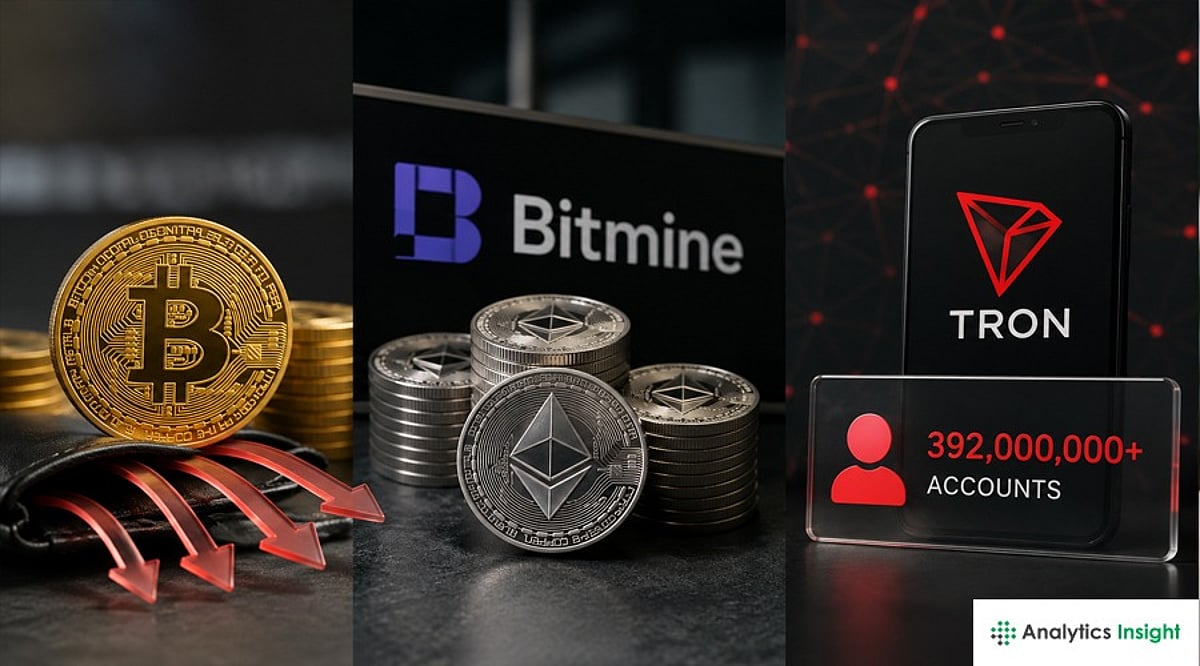
    Major developments unfolded in the crypto space as Bitcoin spot ETFs recorded $95.30 million in net outflows, Bitmine expanded its Ethereum treasury with a major acquisition, and TRON surpassed 392 million wallet addresses. Additionally, Zcash confirmed its Ironwood upgrade for late July, while New Hampshire rejected a Bitcoin-backed bond proposal.

    Bitcoin Spot ETFs See $95 Million in Net Outflows

    According to SoSoValue, Bitcoin spot ETFs experienced a total net outflow of $95.30 million on the reporting day. Fidelity’s FBTC led outflows with a daily net draw of $63.25 million, bringing its total historical net inflow to $10.15 billion. On the inflow side, VanEck’s HODL ETF recorded the highest daily net inflow at $5.36 million (cumulative $1.13 billion), followed by Morgan Stanley’s MSBT with $2.17 million ($377.14 million total). The combined net asset value of all Bitcoin spot ETFs now stands at $76.51 billion, with an ETF net asset ratio of 6.03% and historical cumulative net inflows of $51.19 billion.

    Bitmine Acquires 20,500 ETH for $36 Million

    Bitmine Immersion Technologies purchased 20,500 ETH for approximately $35.92 million via an over-the-counter transaction with Galaxy Digital, executed around July 10, 2026. The purchase price was roughly $1,752 per ETH. This acquisition pushes Bitmine’s total Ethereum treasury to about 5.7 million tokens — worth nearly $10 billion — representing an estimated 4.7%–4.8% of the entire circulating ETH supply of ~120.7 million tokens. The move signals a quiet accumulation strategy by the company.

    TRON Surpasses 392 Million Accounts

    TRON’s blockchain explorer confirmed the network has surpassed 392 million wallet addresses since inception. According to DeFiLlama, TRON remains the dominant platform for Tether (USDT) transfers due to fast settlement times and extremely low fees — processing up to 2,000 transactions per second at roughly 0.0003 TRX per transaction. Lookonchain reported that TRON’s Total Value Locked (TVL) has risen by approximately $1.95 billion since July 1, a gain of 7.8%.

    New Hampshire Rejects Bitcoin-Backed Bond Proposal

    The New Hampshire Executive Council voted down a regulatory proposal to authorize $100 million in Bitcoin-backed bonds. The initiative, pushed by the state’s Business Finance Authority (BFA) and Governor Kelly Ayotte, had passed risk assessments from Moody’s. Opposition was led by Democrat Karen Liot Hill, joined by councilors Janet Stevens and David Wheeler; officials Joseph Kenney and John Stephen voted in favor. The rejection halts the state’s attempt to introduce this financial instrument.

    Zcash Confirms Ironwood Activation on July 28

    Zcash core developer Sean Bowe announced that the Ironwood upgrade will activate at block height 3,428,143, expected around 8 am EST on July 28 — a one-week delay from the original July 21 target. The postponement came after Shielded Labs raised concerns that exchanges, mining pools, and wallet providers might need more time to prepare, particularly as many are transitioning from the legacy zcashd software to the Z3 stack (Zebra, Zaino, Zallet). Ironwood addresses an ‘infinity’ bug discovered in Zcash’s Orchard shielded pool, the network’s primary privacy-focused transaction system.

    FAQs

    • How much outflow did Bitcoin spot ETFs record? Bitcoin spot ETFs recorded total net outflows of $95.30 million. Fidelity’s FBTC saw the largest outflow at $63.25 million, while VanEck’s HODL led inflows with $5.36 million.
    • How much Ethereum did Bitmine buy? Bitmine Immersion Technologies acquired 20,500 ETH for around $35.92 million through an OTC transaction with Galaxy Digital at approximately $1,752 per ETH.
    • Why is TRON’s 392 million account milestone important? TRON crossing 392 million accounts highlights its growing user base and network activity, especially for fast, low-cost Tether transfers.
    • What happened to New Hampshire’s Bitcoin bond proposal? The New Hampshire Executive Council rejected a proposal to authorize $100 million in Bitcoin-backed bonds, halting the initiative.
    • When will Zcash activate Ironwood? Zcash plans to activate Ironwood at block height 3,428,143 on July 28, delayed one week to allow more preparation time for ecosystem participants.