
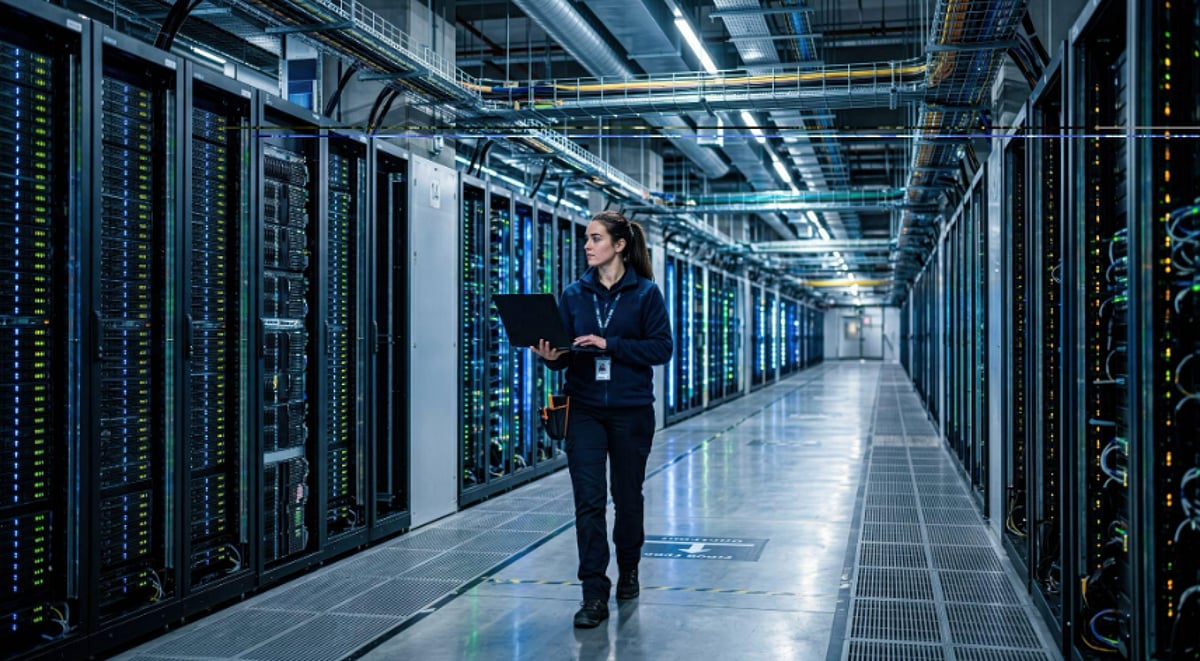
Artificial intelligence has moved from the periphery to the core of data center operations, fundamentally changing how these facilities run. Predictive maintenance systems now flag equipment failures before they occur, while automated cooling controls adjust in real time. For professionals keeping data centers online, the nature of their work is evolving. Understanding where AI takes over routine tasks—and where human judgment remains irreplaceable—is essential for anyone building a career in this space.
The Current State of Data Center Jobs
Data centers have long depended on a mix of specialized roles to operate 24/7. Electrical and power engineers ensure continuous power; mechanical and HVAC engineers manage cooling; network and cabling engineers maintain connectivity; data center technicians install and troubleshoot hardware manually; and facilities managers oversee everything, balancing uptime targets with staffing and compliance. This structure is under significant pressure. The global data center sector is projected to grow around 14% annually through 2030, driven primarily by cloud computing and AI workloads. A survey shows 86% of operators plan to increase capacity, with over half attributing that growth to AI workloads.
This expansion has created a talent squeeze. Skilled professionals cannot be trained fast enough to meet demand, leading to longer hiring timelines, greater competition, and rising salaries. For those seeking a data center job, knowing what employers value can make a real difference. QCS Staffing, which recruits across the sector, offers ten tips on landing your next role, providing practical advice on improving applications and standing out to employers.
How AI Is Transforming Key Data Center Roles
AI is not eliminating data center staff but reshaping their daily work.
Infrastructure Management and Predictive Maintenance
AI-powered systems continuously analyze equipment performance data to predict failures in servers and cooling units. This shifts maintenance teams from reactive repairs to proactive monitoring, reducing unplanned downtime and costly energy spikes that accompany equipment failure.
Security Roles Evolving with AI-Driven Threat Detection
Cybersecurity offers a clear example of AI reshaping a role rather than ending it. According to ISACA’s State of Cybersecurity 2025 report, 70% of security professionals anticipate increased demand for technical cybersecurity roles, and more than half of teams are understaffed. AI tools help detect unusual activity faster, but human specialists are still needed to interpret threats and decide on responses.
Network Operations Becoming More Automated
Site reliability and cloud operations specialists increasingly rely on automation to manage uptime across hybrid and cloud-native setups. Manual monitoring cannot keep pace with modern data volumes. Teams combining automation skills with traditional IT operations knowledge are in high demand.
Energy Efficiency Optimization Through Machine Learning
AI now manages workload distribution, cooling adjustments, and renewable energy integration in real time. The data center cooling market, valued at approximately $20.8 billion in 2025, is projected to reach $49.9 billion by 2034 as facilities adopt advanced thermal management.
Skills That Will Remain Critical
Despite automation, human skills remain essential. AI predictions are imperfect; sudden demand spikes or equipment faults require experienced people to make judgment calls that machines cannot. Communication and cross-team collaboration are more important than ever, as data center teams now blend IT, facilities, security, and engineering into closer units.
Domain expertise combined with AI fluency is quickly becoming the baseline expectation. Knowing power systems or cooling infrastructure alone is no longer sufficient. Employers seek professionals who can interpret AI outputs and act on insights with care. Those who develop both skill sets will be most sought after. Starting by understanding how AI fits into your current role is a practical first step.
Emerging Opportunities in AI-Enhanced Data Centres
New roles are emerging specifically due to AI’s growing footprint. Automation and controls engineers design and maintain building management systems and predictive maintenance platforms. AI infrastructure specialists address the unique power density and cooling demands of AI workloads—a skill set barely mentioned five years ago. Hybrid positions are also rising, blending traditional data center operations with AI literacy. For example, sustainability and energy optimization experts understand cooling systems, renewable energy integration, and machine learning-driven efficiency metrics simultaneously. With data centers accounting for about 2% of global electricity use, this crossover will only grow in value.
Gartner’s research supports this shift. The firm projects that AI will create more jobs than it eliminates starting in 2028, though many existing roles will be restructured. A December 2025 Gartner survey found that 40% of organizations have already eliminated outdated roles to align with evolving business needs.
Preparing for the Future
Staying competitive requires investing in the right skills now. Knowledge of automation and scripting (Python, Bash, Ansible) is becoming standard in many data center roles. Industry certifications such as BICSI, CDCP, and CDCS still carry weight, as does vendor training from AWS or Cisco. Employers view these as proof of ability to handle both traditional and AI-driven responsibilities. Small steps taken early compound over time.
AI adoption does not always deliver immediate large returns. Gartner found that while 95% of organizations have implemented AI in some form, only one in five has seen significant or transformational value. This gap is an opportunity. Professionals who help their organizations realize real value from AI will stand out—installation alone is insufficient.
Most importantly, treat AI as a tool to work with rather than a threat. This mindset opens more doors than it closes. Those thriving in this shift are not resisting automation; they are learning to work alongside it.
Adapting to an AI-Driven Data Center Career
AI is changing what it means to work in a data center. It is not removing the need for skilled people. Predictive maintenance, automated networking, AI-assisted security, and smarter energy management are reducing manual work while raising the skills employers expect. Professionals who build both core expertise and AI skills now will be best positioned for the roles this industry is creating—not the ones it is phasing out. Start by examining where AI already impacts your current job, then build your next skill set step by step.