Tag: DeFi

  • Crypto Investment Strategies: From Bitcoin HODLing to DeFi, ETFs and Tokenized Assets

    Crypto Investment Strategies: From Bitcoin HODLing to DeFi, ETFs and Tokenized Assets

    Why crypto investing looks different today

    Crypto investing has moved well beyond the early model of buying Bitcoin and safeguarding private keys. Today’s market includes exchange-traded funds, staking, decentralized finance, derivatives and tokenized assets. That shift reflects technological progress, new financial infrastructure and growing institutional participation. Investors can now choose between direct ownership, yield-generating strategies and regulated investment products.

    The first playbook: buy, hold and self-custody

    In Bitcoin’s early years, investment options were limited. Investors typically bought BTC through exchanges or peer-to-peer markets and then moved it into personal wallets. Long-term holding, later widely known as HODLing, became one of crypto’s defining strategies. Investors were mainly betting on Bitcoin’s scarcity and future adoption rather than expecting income from the asset. Self-custody was therefore a central part of early crypto investment strategy.

    Altcoins and the diversification lesson

    Ethereum and other blockchain networks widened the investment universe beyond Bitcoin. Ethereum introduced programmable smart contracts, giving investors exposure to decentralized applications and blockchain infrastructure. The 2017 ICO boom then brought thousands of new tokens to market. Failed projects and severe corrections showed that spreading capital across cryptocurrencies does not automatically reduce risk when assets share similar market drivers.

    DeFi and staking add yield, along with new risks

    Decentralized finance changed how investors could use their crypto holdings. Lending, borrowing, liquidity provision and yield farming became accessible strategies. Proof-of-stake networks also expanded staking, allowing holders to earn rewards by participating in blockchain security. These approaches introduced potential income but also added risks tied to smart contracts, liquidation, validators, token incentives and protocol failures.

    ETFs bring crypto into traditional brokerage accounts

    Exchange-traded products marked another major shift by bringing crypto exposure into conventional brokerage accounts. By 2026, US-listed products extended beyond Bitcoin. SEC filings show the Grayscale Solana Staking ETF supports in-kind creations and redemptions, while its updated trust structure provides for distributions derived from staking rewards. The Bitwise Solana Staking ETF similarly seeks SOL exposure while generating additional SOL through staking. These products illustrate how traditional investment vehicles are incorporating features once associated with on-chain investing.

    Tokenization connects blockchains and traditional assets

    The latest phase increasingly links blockchain infrastructure with traditional financial assets. Solana currently indexes approximately USD 7 billion in tokenized value across nearly 2,700 assets, including equities, ETFs, Treasuries and commodities, with roughly USD 348 million in 24-hour real-world asset volume. More broadly, Bitwise reported that tokenized real-world assets reached USD 32.89 billion during 2026 after increasing 50.3% year-to-date in its Q2 review. Tokenization is also becoming more integrated with DeFi, where real-world assets can potentially serve as collateral or interact with lending and trading protocols.

    Data-driven portfolio management takes hold

    Modern crypto investors increasingly monitor ETF flows, derivatives positioning, on-chain cost bases, liquidity and macroeconomic conditions alongside traditional technical indicators. This creates strategies that combine blockchain-specific data with techniques already familiar to conventional financial markets.

    What investors should keep in mind

    Crypto investment strategies have evolved from straightforward Bitcoin holding into a multi-layered market spanning diversification, staking, DeFi, ETFs and tokenization. More options give investors greater flexibility, but they also introduce custody, liquidity, smart-contract and market risks that require careful research and risk management. This article is for informational purposes only and does not constitute investment advice.

    FAQ

    How did early crypto investment strategies work?

    Early crypto investing largely involved buying Bitcoin through exchanges or peer-to-peer markets and holding it in personal wallets. Investors generally focused on Bitcoin’s scarcity and long-term adoption rather than earning income from their holdings.

    How did Ethereum change crypto investing?

    Ethereum introduced programmable smart contracts, expanding investment opportunities beyond digital money. Investors could gain exposure to decentralized applications, tokens and eventually DeFi protocols, creating new strategies involving lending, liquidity provision and other blockchain-based financial activities.

    What role does staking play in modern crypto investing?

    Staking allows holders of proof-of-stake cryptocurrencies to participate in network security while potentially earning rewards. It provides an alternative to simply holding tokens, although investors must consider validator, liquidity, slashing and protocol-related risks.

    How have crypto ETFs changed investment strategies?

    Crypto ETFs allow eligible investors to gain digital-asset exposure through traditional brokerage infrastructure without directly managing wallets and private keys. By 2026, some products also incorporated features such as staking and in-kind creations and redemptions.

    How is tokenization changing crypto investment strategies?

    Tokenization brings traditional assets such as equities, ETFs, Treasuries and funds onto blockchain infrastructure. This increasingly connects conventional finance with crypto markets and can enable programmable transfers, on-chain trading and integration with decentralized-finance applications.
  • Solana Emerges as a Settlement Hub for Tokenized Stocks as RWA Activity and xStocks Adoption Accelerate

    Solana Emerges as a Settlement Hub for Tokenized Stocks as RWA Activity and xStocks Adoption Accelerate

    Tokenization is steadily pulling traditional equities onto public blockchains, and Solana has become one of the more consequential venues for that shift. Tokenized stocks are blockchain-based instruments tied to conventional shares or ETFs, offering fractional ownership, round-the-clock transfers and compatibility with decentralized finance. The network’s combination of fast settlement and deep liquidity is now being tested by real capital.

    Real-World Assets on Solana Reach New Milestones

    Solana’s real-world asset (RWA) footprint now spans equities, ETFs, Treasuries, commodities and investment funds. According to on-chain data, the network’s RWA value reached $4.6 billion on September 23, with distributed assets at $4.49 billion — an 11.47% increase from the prior month.

    Ownership breadth grew even faster than headline value. RWA holder wallets climbed 94.86% over 30 days to 685,850, while transfer volume rose 95.56% to $6.89 billion, suggesting that assets are not just being minted but actively moving between participants.

    Metric Figure Change
    Solana RWA value (Sept 23) $4.6 billion —
    Distributed RWA assets $4.49 billion +11.47% month over month
    RWA holder wallets 685,850 +94.86% (30 days)
    RWA transfer volume $6.89 billion +95.56% (30 days)
    Stablecoin market cap on Solana $16.58 billion —

    Stablecoin market capitalization on Solana stood at $16.58 billion, far exceeding the network’s distributed RWA value — a reminder that the settlement layer for tokenized assets is still dominated by dollar-denominated cash instruments.

    xStocks Brings Tokenized Equity Into Focus

    Among tokenized-equity frameworks, xStocks has become one of the most visible. The platform says it now covers more than 800 stocks and ETFs and has processed over $40 billion in transaction volume across supported networks.

    On Solana specifically, xStocks crossed $500 million in assets under management with roughly 190,000 holders by August. Its product lineup includes exposure to NVIDIA, Tesla, SPY and QQQ. Each xStock is designed to be backed 1:1 by the corresponding underlying asset, though availability, redemption conditions and investor rights vary by product and jurisdiction.

    Why Solana Is Being Used for Tokenized Equities

    Tokenized markets demand infrastructure that can absorb frequent transfers without making each transaction prohibitively expensive. Solana’s high-throughput architecture and rapid settlement make it a natural fit for trading and moving tokenized instruments at scale.

    The network’s DeFi stack adds a second layer of utility:

    • Raydium provides decentralized trading venues for tokenized assets.
    • Jupiter routes swaps and tokenized-asset transactions across liquidity sources.
    • Kamino supports lending and collateral strategies built around these instruments.

    The result is that tokenized stocks can function inside DeFi rather than sitting as isolated representations of securities.

    Yield Vaults Extend the Model

    The design is evolving beyond simple holding. On September 14, xStocks launched vaults for SPYx, QQQx and NVDAx on Kraken. The strategies rely on lending protocols including Kamino on Solana and allow eligible holders to earn variable yield while retaining exposure to the underlying xStock.

    Tokenized Equities Keep Expanding

    CoinDesk Research reported that tokenized stocks and equities reached a record $4.45 billion on August 26, after rising 11.3% during the month. xStocks has also announced plans to tokenize internationally listed shares, starting with Hong Kong and later extending toward the UK, EU and South Korea.

    What Investors Should Keep in Mind

    Tokenized exposure is not the same as directly owning conventional shares. Products can differ in voting rights, dividend treatment, custody arrangements, redemption terms and geographic availability. Regulatory protections may also vary considerably depending on the issuer and the investor’s location.

    Outlook

    Solana is positioning itself as core infrastructure for tokenized stocks by pairing fast settlement with DeFi liquidity and programmable assets. How far adoption goes will depend on regulation, issuer credibility, available liquidity and whether tokenized products can deliver advantages that traditional brokerage systems cannot match.

    Frequently Asked Questions

    What are tokenized stocks on Solana?

    They are blockchain-based instruments designed to provide exposure to traditional equities or ETFs. On Solana, they can be transferred on-chain and, depending on the product, plugged into decentralized trading, lending and other DeFi applications.

    What are xStocks?

    xStocks are tokenized products linked to traditional stocks and ETFs, including assets tracking NVIDIA, Tesla, SPY and QQQ. They are designed to be backed by the corresponding underlying assets, though investor rights and availability differ by jurisdiction.

    Why is Solana used for tokenized equities?

    Its high transaction throughput, relatively low costs and fast settlement support frequent transfers and trading, while allowing tokenized assets to interact with DeFi protocols.

    How do tokenized stocks interact with Solana DeFi?

    Platforms such as Raydium offer decentralized trading, Jupiter routes swaps, and Kamino supports lending and collateral strategies — letting eligible tokenized assets move beyond simple ownership into broader on-chain financial applications.

    Are tokenized stocks the same as owning traditional shares?

    Not necessarily. Tokenized products can differ from brokerage-held shares in voting rights, dividends, custody, redemption and regulatory protections. Investors should review the specific issuer and product structure before treating them as equivalent.

  • How XRP Ledger’s Native Lending Protocol Brings On-Chain Credit to DeFi

    How XRP Ledger’s Native Lending Protocol Brings On-Chain Credit to DeFi

    The XRP Ledger (XRPL) is expanding beyond payments and decentralized trading toward native credit infrastructure. Its Lending Protocol is designed to support fixed-term lending directly at the protocol level, combining blockchain settlement with off-chain credit assessment and underwriting.

    The latest xrpld 3.4.0 release extends this architecture through the LendingProtocolV1_1 amendment, introducing closed-ended vaults and cash-basis accounting.

    How XRPL Native Lending Works

    XRPL’s Lending Protocol is designed for fixed-term, uncollateralized loans funded using assets pooled within Single Asset Vaults. The system involves three principal participants: loan brokers, depositors and borrowers. Instead of requiring borrowers to overcollateralize loans with cryptocurrency, creditworthiness can be evaluated through off-chain underwriting and risk-management processes. This differs from many existing DeFi lending systems where borrowers commonly deposit cryptocurrency worth more than the amount borrowed. XRPL could instead support credit-based lending while recording loan creation, repayment and settlement on-chain. The protocol also supports optional first-loss capital, which loan brokers can contribute to absorb potential losses before they reach other vault participants.

    Single Asset Vaults Pool Capital

    Single Asset Vaults aggregate assets from depositors into structures that can supply capital for lending. Depositors receive shares representing their proportional ownership of a vault’s assets. LendingProtocolV1_1 adds closed-ended vaults with three stages: subscription, investment and redemption. During subscription, investors can provide capital. The investment phase allows loans to be originated, while the redemption phase determines when investors can redeem their shares. Under V1.1, newly created loan brokers must use closed-ended rather than open-ended vaults. XRPL documentation also shows that vaults can hold XRP, trust-line tokens or Multi-Purpose Tokens (MPTs). Private vaults can use credentials and Permissioned Domains to restrict participation, potentially supporting institution-focused lending environments.

    Accounting Is Also Changing

    Another important change in xrpld 3.4.0 is cash-basis accounting. Previously, scheduled interest could be recognized when a loan originated. Under V1.1, interest is recognized as income only when the borrower actually makes a payment. This means vault share values reflect realized interest rather than income that has merely been scheduled. Version 3.4.0 also includes lending-related fixes affecting loan impairment, payment due dates and grace-period boundaries.

    Lending Still Requires Risk Management

    Native infrastructure does not eliminate credit risk. As loans can be uncollateralized, lenders remain dependent on effective underwriting and borrower repayment. XRPL documentation also warns that malicious vault owners can potentially drain assets from public vaults, making verification of vault owners and settings important before depositing funds. The relevant lending amendments also remain subject to XRPL’s amendment process rather than automatically becoming active via supporting code inclusion inside a stable server release.

    Why This Matters

    Native lending could broaden XRPL beyond payments and trading by bringing credit infrastructure directly on-chain. Closed-ended vaults, standardized loans and cash-basis accounting could support institutional lending models while reducing dependence on separately deployed smart-contract lending protocols.

    Final Thoughts

    XRPL’s Lending Protocol combines on-chain settlement with off-chain underwriting rather than attempting to eliminate traditional credit assessment. The addition of closed-ended vaults and cash-basis accounting makes the architecture more structured for fixed-term lending. Its impact will ultimately depend on amendment activation, liquidity, underwriting quality, risk management and real-world adoption.

    FAQs

    1. What is the XRP Ledger Lending Protocol?
    The XRPL Lending Protocol is designed to enable fixed-term lending directly through the XRP Ledger. It combines on-chain loan management and settlement with off-chain underwriting to assess borrowers and manage credit risk.

    2. Can borrowers get uncollateralized loans on XRPL?
    The protocol is designed to support uncollateralized lending, meaning borrowers do not necessarily need to deposit crypto worth more than their loan. Loan brokers instead use underwriting and risk-management processes to evaluate creditworthiness.

    3. What are Single Asset Vaults on XRP Ledger?
    Single Asset Vaults pool assets from multiple depositors and can provide capital for lending. Depositors receive vault shares representing their proportional ownership, while vaults can hold assets including XRP, trust-line tokens and Multi-Purpose Tokens.

    4. What does LendingProtocolV1_1 change?
    LendingProtocolV1_1 introduces closed-ended vaults structured around subscription, investment and redemption phases. It also introduces cash-basis accounting, where interest becomes recognized as income when borrowers actually make payments.

    5. What are the risks of native lending on XRPL?
    Native infrastructure does not remove lending risks such as borrower defaults, poor underwriting, liquidity problems or malicious vault operators. Adoption will also depend on amendment activation, market liquidity, regulatory requirements and institutional participation.

  • FXRP Anniversary: Flare Expands XRP DeFi Infrastructure After One Year

    FXRP Anniversary: Flare Expands XRP DeFi Infrastructure After One Year

    Flare Network is celebrating the first anniversary of its FAsset FXRP, which launched on mainnet one year ago, bringing programmatic XRP to DeFi applications while remaining backed by XRP on the XRP Ledger.

    Since its launch on September 24, 2025, via FAssets v1.2, FXRP has evolved from a simple minting mechanism into a robust infrastructure supporting staking, lending, borrowing, yield strategies, and cross-chain markets. The initial minting cap of 5 million FXRP filled within approximately four hours, signaling strong demand.

    “The notable takeaway from this year is not that XRP can be used in more places,” said Hugo Philion, CEO of Flare. “It is that an asset issued on one chain can become working capital without leaving it, and the path has to be short enough that people actually take it. XRP was the first asset we proved that with. It will not be the last.”

    FXRP is an ERC-20 representation of XRP created through Flare’s overcollateralized FAssets system. The Flare Data Connector verifies XRP Ledger transactions, enabling XRP to be used on Flare. Following the launch, various protocols integrated with FXRP: Kinetic introduced lending, SparkDEX and BlazeSwap provided liquidity, Enosys added collateralized debt, and Firelight uses FXRP for on-chain cover. Spectra brought fixed-rate and yield trading, while Upshift and Clearstar’s earnXRP offered vault-based yield strategies.

    Flare also focused on accessibility from the XRP Ledger through Flare Smart Accounts, which connected XRPL-native interactions with Flare applications. This included a February 2026 integration with Xaman and simplified workflows requiring only a single XRP Ledger signature.

    In May, FAssets v1.3 introduced destination-tag minting for better exchange and custodian support. During 2026, FXRP expanded to Ethereum and Base, broadening its use beyond Flare. A Morpho market developed with Sentora in August enabled FXRP to be used as collateral for borrowing RLUSD on Ethereum, showcasing utilities beyond yield and liquidity.

    FXRP’s growth also coincided with Flare’s token economics updates. FIP.16 reduced annual FLR issuance from 5% to 3% and lowered the cap from 5 billion to 3 billion FLR. Fees from FAssets minting and Flare Data Connector usage can be directed to the Flare Income Reinvestment Entity (FIRE), which may offset FLR issuance as activity grows.

    Flare is also developing Confidential Compute and Protocol Managed Wallets, with initial deployment on Songbird. The pattern of success is not specific to XRP; Flare’s data protocols are enshrined in consensus, allowing assets from other chains to be verified and used without leaving their native ledger.

    About Flare: Flare is an EVM-compatible Layer 1 blockchain focused on data, providing dApps with high-integrity data from other blockchains and the internet via its enshrined data protocols. Products like FAssets and Flare Smart Accounts enable assets like XRP to participate in DeFi while staying connected to their native networks.

    Disclaimer: This article is for informational purposes only and does not constitute investment advice. Cryptocurrency investments are risky; always do your own research.

  • DeFi Needs Bitcoin, Not the Other Way Around: How Native Cross-Chain Trading Is Changing the Game

    DeFi Needs Bitcoin, Not the Other Way Around: How Native Cross-Chain Trading Is Changing the Game

    Bitcoin has spent years on the sidelines of the decentralized finance (DeFi) boom. Ethereum built decentralized exchanges, lending markets, and stablecoins. Solana created its own trading ecosystem. New chains launched with entire financial stacks from day one. Bitcoin kept doing what Bitcoin does: moving BTC and securing the network.

    So crypto found workarounds. Take Bitcoin, lock it somewhere, issue a token that represents it on another blockchain, and suddenly that value can move through DeFi. Wrapped Bitcoin became a major part of the market because the idea works—but it also created a strange situation. To use Bitcoin across crypto, users often had to stop using Bitcoin itself.

    There is now another option. Instead of rebuilding BTC as a token on somebody else’s blockchain, protocols can connect directly to Bitcoin and trade the native asset where it already lives. THORChain has spent years building around that idea.

    Bitcoin Never Needed to Be an Ethereum Token

    Most DeFi markets are built inside individual blockchains. ETH and ERC-20 tokens can interact easily because they live in the same environment. The same goes for assets inside Solana or other smart-contract networks. Bitcoin is somewhere else entirely.

    If someone owns BTC and wants ETH, there is no native Bitcoin function that simply hands the transaction over to Ethereum. The two networks were never built to talk to each other. Wrapped assets then must jump in to fill the gap.

    A user deposits BTC into a system that holds or secures it, and another token is created elsewhere. That token tracks Bitcoin’s value and can then be traded, lent, or deposited into applications on the destination chain.

    This opened a huge amount of Bitcoin-linked capital to DeFi—but it also means the user is now relying on several outside factors. There is the issuer or bridge. There are smart contracts. There is a redemption mechanism. There may be custodians involved. The token may be called Bitcoin, branded like Bitcoin, and trade close to the price of Bitcoin, but it is still another asset running on another network.

    For exchanging BTC into another cryptocurrency, it can be unnecessary steps.

    THORChain Trades Bitcoin as Bitcoin

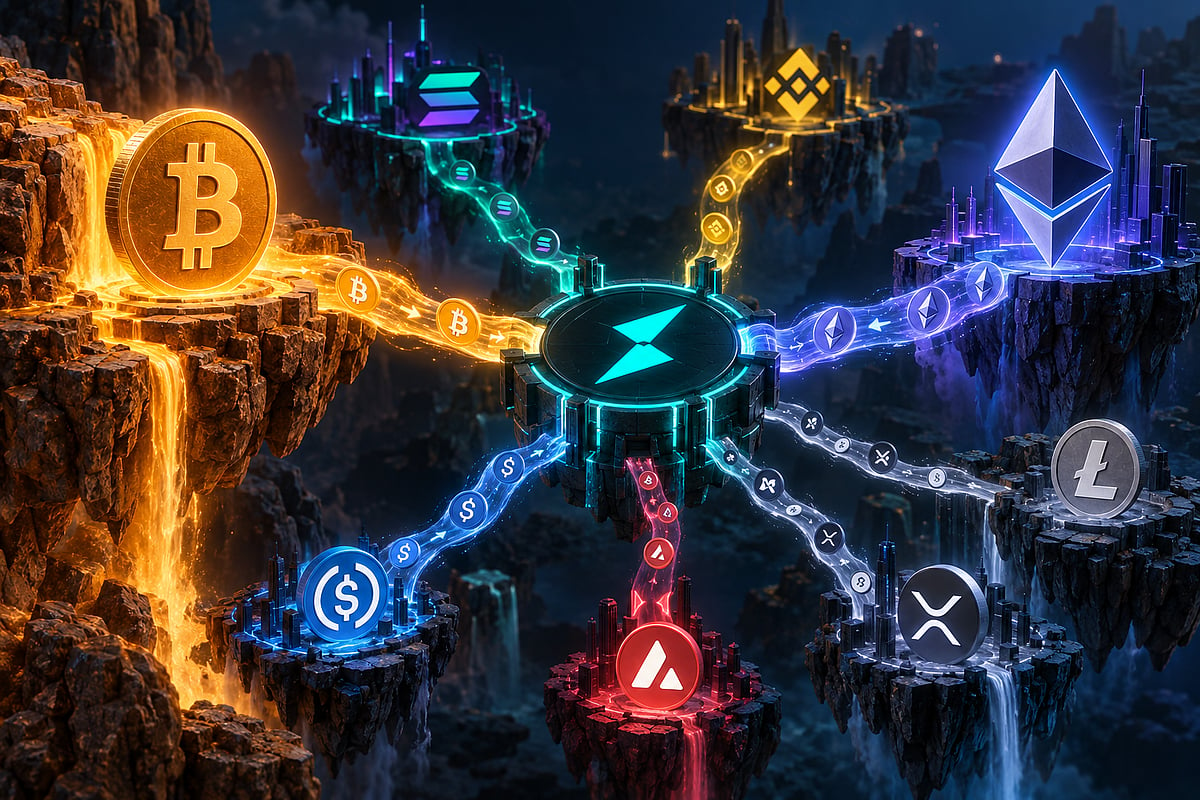
    THORChain is a decentralized exchange built to swap assets between blockchains without first wrapping them. Someone holding BTC can send Bitcoin from a Bitcoin wallet and receive ETH at an Ethereum address. The BTC stays native to Bitcoin until it enters the swap. The ETH that comes out is native ETH. No WBTC needs to be minted.

    The same basic setup works across the other networks supported by the protocol, including chains such as Solana, BNB Smart Chain, Avalanche, Base, XRP Ledger, and Litecoin. This puts THORChain in a different category above most standard decentralized exchanges.

    Uniswap trades tokens that already exist on Ethereum. A Solana DEX trades assets already sitting on Solana. THORChain deals with coins that live on separate networks and were never designed to share a market, which requires a different structure underneath.

    RUNE Is the Plumbing

    Every THORChain liquidity pool connects a supported asset with RUNE, the protocol’s native asset. A BTC-to-ETH trade does not need a dedicated BTC/ETH pool. The protocol can route BTC through a BTC/RUNE pool and then into an ETH/RUNE pool. The person making the trade does not need to go out and buy RUNE first—the routing happens behind the scenes.

    This keeps THORChain from having to create a separate liquidity market for every imaginable pair. Add more assets to a traditional pair-by-pair system and the number of pools explodes: BTC/ETH, BTC/SOL, BTC/USDC, ETH/SOL, ETH/USDC, SOL/USDC. Keep going and liquidity starts getting spread across dozens of separate markets. RUNE gives those pools a common connection.

    For traders, most of that is invisible. They send one asset and receive another.

    What Happens When BTC Is Swapped?

    Suppose someone wants to swap native BTC for native ETH. They choose BTC as the input, enter an Ethereum destination address, and send Bitcoin from their wallet. THORChain’s nodes detect the incoming Bitcoin transaction. The protocol handles the pool routing, then authorizes the outbound ETH transaction from its network vault.

    Those vaults do not work like a usual exchange wallet controlled by one company. THORChain uses threshold-signature cryptography, meaning no single node holds the full signing key needed to move the assets. Node operators also bond RUNE as collateral. That bond forms part of the protocol’s security model and can be penalized when nodes break the network’s rules.

    There is still infrastructure in the middle. There is still protocol risk. None of this should be confused with magically teleporting coins between chains. But the user does not leave BTC sitting in a centralized exchange account and does not receive a wrapped representation of Bitcoin on the other side. The trade settles from one native asset into another.

    People Are Actually Using It

    Native cross-chain trading is not just an interesting technical experiment anymore. THORChain reported $2.82 billion in swap volume during the first quarter of 2026. BTC-to-ETH was its biggest route, accounting for roughly $981 million. BTC-to-stablecoin trades added hundreds of millions more. Those numbers show what people are actually doing with the protocol.

    A meaningful chunk of THORChain activity comes from users moving between Bitcoin and other major crypto assets without putting a wrapped version of BTC in the middle. That is a very different version of “Bitcoin DeFi” from the one the industry has discussed for years.

    Bitcoin Can Stay Boring

    There is a constant effort to make Bitcoin do more. New layers promise smart contracts. New protocols are trying to build lending around BTC. Developers keep pushing more financial activity toward the Bitcoin ecosystem. Some of that will work; some of it probably will not.

    But Bitcoin does not need to become Ethereum for its liquidity to become useful across crypto. It can remain the relatively simple network it was designed to be, and instead infrastructure can be built around it. THORChain shows what that can look like. Bitcoin sits on Bitcoin. Ethereum sits on Ethereum. Solana sits on Solana. The protocol handles the exchange between them. Native cross-chain liquidity makes the world come to Bitcoin instead.

    Disclaimer: This article is provided for informational purposes and does not constitute investment advice. You are responsible for conducting your own research (DYOR) before making any investments. Cryptocurrencies are risky and may result in loss of capital.

  • Meru Evolves from Crypto Infrastructure to a Global Financial Ecosystem Across 132+ Countries

    Meru Evolves from Crypto Infrastructure to a Global Financial Ecosystem Across 132+ Countries

    Meru has undergone a significant transformation, evolving from a stablecoin-focused crypto platform into a comprehensive global financial ecosystem. Now operating in more than 132 countries, the company offers a suite of services including digital dollars, international money transfers, decentralized finance (DeFi) tools, and access to US-listed stocks. With self-custody assets surpassing $1.5 billion, Meru exemplifies how crypto infrastructure is being repurposed to serve broader financial needs.

    Stablecoins as a Foundation

    Stablecoins were the cornerstone of Meru’s early development. These digital assets, typically pegged to fiat currencies like the US dollar, enable seamless transfers across blockchain networks while avoiding the volatility of cryptocurrencies such as Bitcoin and Ether. This technology allowed Meru to build cross-border payment solutions that bypass traditional banking intermediaries, reducing fees and settlement times from days to near-instantaneous.

    From Crypto Platform to Financial Ecosystem

    Meru’s evolution is evident in its expanding product lineup. Users can now hold digital dollars, send international transfers, and use the Meru Card to link their digital assets to everyday spending. The platform also integrates DeFi tools and stock trading, consolidating services that once required multiple apps and accounts. This integration narrows the gap between traditional finance and crypto, making financial tools more accessible.

    Expansion in Latin America and Spain

    Meru’s growth is particularly strong in Latin America and Spain, regions where cross-border economic activity and mobility drive demand for flexible financial solutions. In Latin America, digital dollars offer a stable store of value and a means to move funds efficiently. Spain serves as a bridge to the region, leveraging cultural and economic ties. Meru’s platform is thus positioned to serve everyday transactions beyond crypto trading.

    Crypto Infrastructure Goes Mainstream

    Meru’s trajectory reflects a broader trend: the blurring line between traditional finance and the crypto world. Stablecoins and blockchain technology are no longer niche tools for digital asset trading; they are becoming the backbone for global financial services. By starting with stablecoin infrastructure and expanding into a full financial ecosystem, Meru demonstrates how crypto can outgrow its original boundaries to deliver practical, cross-border financial solutions.

  • Essential Crypto Glossary: 25 Key Terms Every Investor Must Understand

    Essential Crypto Glossary: 25 Key Terms Every Investor Must Understand

    Cryptocurrency has developed its own vocabulary spanning blockchain technology, trading, decentralized finance, and market analysis. Understanding the terminology does not eliminate investment risk, but it makes it easier to evaluate projects, exchange products, and market data without confusing fundamentally different concepts. Here are 25 terms investors should know before investing.

    Blockchain and Asset Basics

    1. Blockchain: A distributed database where transactions are grouped and recorded according to network consensus rules.
    2. Bitcoin: The largest cryptocurrency by market capitalization and the native asset of the Bitcoin network.
    3. Altcoin: A general term for cryptocurrencies other than Bitcoin.
    4. Stablecoin: A crypto asset designed to maintain a relatively stable value, commonly against currencies such as the US dollar.
    5. Token: A digital asset created on an existing blockchain rather than necessarily operating its own independent network.
    6. Wallet: Software or hardware used to manage blockchain accounts and signing keys.
    7. Private Key: Secret cryptographic information allowing a holder to authorize blockchain transactions.
    8. Seed Phrase: A sequence of words used to recover many self-custody cryptocurrency wallets.

    Trading Terminology

    1. HODL: Holding cryptocurrency for an extended period rather than reacting to short-term volatility.
    2. Market Capitalization: Token price multiplied by circulating supply.
    3. Trading Volume: The value of assets traded during a specified period.
    4. Liquidity: How easily an asset can be bought or sold without significantly changing its price.
    5. Slippage: The difference between an expected trade price and the actual execution price.
    6. Bull Market: A prolonged period characterized by broadly rising prices.
    7. Bear Market: A prolonged period of generally declining prices.
    8. Volatility: The magnitude and frequency of price fluctuations.
    9. Leverage: Borrowed exposure that magnifies both potential gains and losses.
    10. Liquidation: Forced closure of a leveraged position when collateral becomes insufficient.
    11. Open Interest: Outstanding futures or derivatives contracts that remain open.

    Blockchain and DeFi

    1. Gas Fee: A charge paid for computation or transactions on networks such as Ethereum.
    2. Smart Contract: Blockchain-based code that executes predefined instructions.
    3. DeFi: Decentralized finance applications providing activities such as trading, borrowing, and lending through blockchain protocols.
    4. Staking: Committing eligible crypto assets to proof-of-stake systems or related protocols in exchange for potential rewards.
    5. Total Value Locked: A measure of assets deposited into DeFi protocols, although methodologies can differ across data providers.
    6. DEX: A decentralized exchange where blockchain-based smart contracts or protocol infrastructure facilitate asset trading.

    Why This Matters

    Understanding crypto terminology helps investors interpret market data and distinguish fundamentally different risks. Metrics such as market capitalization, trading volume, and TVL measure different aspects of crypto markets, making basic terminology essential before evaluating tokens, protocols, or trading opportunities.

    Final Thoughts

    Knowing crypto terminology helps investors distinguish technology, market structure, and trading metrics. However, understanding terms such as staking, leverage, or market capitalization should be the beginning of research rather than a substitute for evaluating token economics, security, liquidity, and investment risk.

    Frequently Asked Questions

    What are the most important crypto terms for beginners?

    Beginners should understand blockchain, Bitcoin, wallets, private keys, stablecoins, market capitalization, and liquidity. These concepts provide a foundation for understanding how cryptocurrencies and markets operate.

    What does HODL mean in cryptocurrency?

    HODL refers to holding cryptocurrency for an extended period instead of reacting to short-term price movements. The term has become associated with long-term crypto investing strategies.

    What is market capitalization in crypto?

    Crypto market capitalization is generally calculated by multiplying a token’s current price by its circulating supply. It helps indicate an asset’s relative market size but does not measure liquidity.

    What is the difference between DeFi and a DEX?

    DeFi describes blockchain-based financial applications covering activities such as trading, lending, and borrowing. A DEX is a specific type of decentralized platform or protocol used to facilitate crypto trading.

    What does TVL mean in cryptocurrency?

    Total Value Locked (TVL) measures assets deposited into DeFi protocols under a given methodology. It can indicate protocol usage but should not be treated as a standalone measure of investment quality.

    Disclaimer: This article is for informational purposes only and does not constitute financial advice. Cryptocurrency investments carry risk, and you should conduct your own research before making any investment decisions.

  • Crypto Matures: Arc and Prosper Take Opposite Routes to Institutional Trust

    Crypto Matures: Arc and Prosper Take Opposite Routes to Institutional Trust

    Crypto has spent years chasing the same goal from two directions: more real economic activity, more serious capital, without becoming either fully permissioned finance or a pure speculative casino. This week produced two answers to that problem, launched a day apart, and neither one looks like the other.

    Circle’s Arc: Permissioned Trust via Institutional Validators

    Circle’s answer is Arc. The Layer 1 network went live with a founding validator cohort that reads like a partial list of global finance itself: BlackRock, the Depository Trust & Clearing Corporation, ICE, Mastercard, MoneyGram, SBI Group, Standard Chartered, Sumitomo, Visa, Worldpay and Galaxy. The chain is explicitly permissioned. Circle presents that as a selling point, pairing it with a defined governance perimeter it says lets banks use a public chain for treasury, trading and confidential payments. USDC, with roughly $74 billion in circulation, is wired in as the network’s gas token. The company also completed the genesis mint of ARC this week, all 10 billion tokens created at once, while being careful to say the mint is not a commitment to a public launch. It’s a technical step toward a possible move to proof of stake, not a trading debut. Arc’s bet is that institutions will trust a public chain more readily if the validator set looks like the institutions themselves.

    Prosper’s Performance Markets: Permissionless Transparency

    Prosper’s answer is close to the opposite bet. Performance Markets, launched on Pharos the same week, keeps everything public and permissionless. Any curator with an onchain track record can deploy a vault. There’s no validator gate, no cohort of institutional backers, no allocation set aside for insiders on the token side. Instead of importing trust through recognizable names, Prosper tries to manufacture it through transparency: every vault’s NAV, fees, and buybacks are verifiable onchain, and a high-water mark — the standard hedge-fund mechanism that only credits gains above a fund’s previous peak — governs when a share of performance fees buys back and burns the vault’s token.

    What that token is, and isn’t, is the part worth sitting with. Laura Shi, Chief Business Officer at Pharos, where she leads business architecture, RealFi innovation and ecosystem expansion, frames it this way:

    “Think of p{VAULT} as a token built around a public track record, not a share in a fund. Anyone can see how the Curator and the strategy are performing onchain, and use that information to decide what the token is worth. Strong results may build confidence; weak results may reduce it. But there is no automatic one to one link to the Vault’s NAV. Buyback and burn affects supply, it does not promise price support.”

    That’s the core difference between the two experiments. Arc is trying to earn trust by putting familiar institutions in the room. Prosper is trying to earn it by putting the data in the open and letting the market decide what a track record is worth, without wrapping that decision in an ownership claim.

    Which Model Will Prevail?

    Neither model has proven itself yet. Arc’s real test is whether the institutions that signed on as validators actually route meaningful volume through the chain, rather than treating the launch as a pilot. Prosper’s real test is narrower and more mechanical: whether curators show up in numbers, and whether the first vaults clear their high-water marks publicly — the moment the buyback mechanism actually has fees to work with.

    Watching which of these gains traction first won’t settle which model is “right.” But it will say something concrete about what kind of trust crypto’s next phase actually runs on: borrowed from institutions, or built from data anyone can check.

  • Solana App Revenue Hits $143M in August: How On-Chain Services Generate Income

    Solana App Revenue Hits $143M in August: How On-Chain Services Generate Income

    Solana’s on-chain economy is far larger than the fees paid to validators. Applications built on the network are generating substantial revenue from decentralized trading, token launches, lending, wallets, liquid staking and other financial services. Understanding where this revenue comes from helps distinguish raw blockchain activity from services users are actually willing to pay for.

    Recent data underscores the scale of that economy. During August 2026, Solana applications generated $143.23 million in protocol revenue, representing approximately 38% of all tracked application revenue across blockchains that month.

    How Trading and Token Launches Drive Revenue

    Decentralized exchanges (DEXs) charge fees when users swap tokens. Part of those fees compensates liquidity providers, while the protocol retains another portion. Additional revenue streams come from trading interfaces, routing services, perpetual trading and other offerings. Launchpads generate fees through token creation, bonding curves and subsequent trading activity.

    Pump.fun is a prime example. According to DeFiLlama, Pump-related protocol revenue reached roughly $58 million over the latest 30-day period, sourced from bonding-curve activity, graduation fees, PumpSwap and other products.

    Solana’s revenue base is also broadening. Applications such as Jupiter, Raydium, Axiom and newer trading platforms contribute through aggregation, automated market makers (AMMs), trading interfaces and other fee-generating services. On September 12, 2026, Solana applications collectively hit $7.935 million in daily protocol revenue—the highest single-day total of the year at that point.

    Revenue vs. Trading Volume: A Critical Distinction

    Trading volume measures the value of assets exchanged, not what an application earns. If a DEX processes $1 billion in volume with an effective 0.10% fee, gross fees would be $1 million. However, some of those fees may go to liquidity providers, referral programs or other participants.

    DeFiLlama therefore separates fees (total paid by users) from protocol revenue (the portion kept by the protocol). This distinction is essential when comparing applications with different business models.

    Network Fees Are Separate from Application Revenue

    Application revenue should not be confused with Solana’s underlying network economics. A single decentralized trade can create multiple economic flows: the application collects a trading fee, liquidity providers receive compensation, and the blockchain collects transaction-related fees. Consequently, $1 of application revenue does not mean $1 flows directly to SOL holders.

    How Revenue Reaches Token Holders

    Protocols decide how retained revenue is deployed—funding operations, accumulating in treasuries, financing incentives, or supporting token buybacks. DeFiLlama estimates roughly $38.7 million in holder revenue across Solana-based protocols over 30 days. Pump.fun accounts for about $25.2 million, while Jupiter and Raydium also direct portions of revenue toward token buybacks.

    This underscores why application revenue and token-holder value accrual are not identical metrics.

    Key Takeaways

    Solana applications generate revenue through trading, token launches, lending and other on-chain services. With app revenue reaching $143.23 million in August 2026, the ecosystem demonstrates substantial fee-generating activity. However, evaluating its economics requires separating trading volume, user fees, protocol revenue, network fees and the portion that ultimately reaches token holders.

  • Bitcoin Breaks $85,000 Barrier, FTT Soars 33%: Key Crypto Market Developments Today

    Bitcoin Breaks $85,000 Barrier, FTT Soars 33%: Key Crypto Market Developments Today

    Bitcoin Surpasses $85,000

    Bitcoin surged above $85,000 as a wave of short liquidations accelerated the cryptocurrency’s strongest advance since January. Over the past 24 hours, BTC gained more than 5%, reaching $85,190 before easing to $84,545 at press time. According to CoinGlass data, approximately $750.5 million in leveraged crypto positions were liquidated, with shorts accounting for about 86% of the total ($648 million). Bitcoin alone represented roughly $360 million of the liquidations, while Ethereum contributed nearly $171 million.

    FTX Token Jumps 33%

    FTX Token (FTT) surged 33.43% in the last 24 hours, driven by renewed altcoin rotation and speculative liquidity that pushed the token toward $0.30. The rally aligns with a broader rebound across the altcoin market, though it lacks a token-specific fundamental catalyst. Spot trading volume for FTT skyrocketed 2,187% to $26.6 million, signaling strong trader interest.

    Hyperliquid Launches Manual Borrowing

    On September 18, 2026, Hyperliquid introduced a manual borrowing feature that allows users to pledge HYPE or Bitcoin as collateral to borrow stablecoins USDC or USDT. On the first day, users borrowed $269 million in stablecoins, demonstrating rapid adoption. Borrowing terms vary by collateral: HYPE holders can borrow up to 65% of token value, with liquidation at 82.5% loan-to-value (LTV); Bitcoin collateral caps at 50%, with liquidation at 75% LTV. The HYPE token reached a record high above $90 following the launch.

    Bank of Russia Proposes 1% Crypto Risk Limit

    The Bank of Russia has proposed capping banks’ total risk from cryptocurrencies and foreign digital instruments at 1% of their capital. The draft regulation introduces two maximum risk ratios—N31 for individual institutions and N32 for banking groups—both limited to 1% of own funds. The rules cover loans, derivatives, bonds, repo transactions, guarantees, credit lines, and other instruments tied to crypto or foreign digital assets. Banks must comply on every operating day.

    Strategy Acquires 950 BTC

    According to an 8-K filing with the U.S. SEC, Strategy purchased 950 Bitcoins at an average price of approximately $79,670 between September 14 and 20, 2026, totaling roughly $75.7 million. The company did not sell any shares through its ATM program during this period and repurchased 1.7712 million shares of STRC preferred stock for $174 million. As of September 20, Strategy holds 846,000 BTC, with a cumulative cost basis of about $63.8 billion (average $75,416 per Bitcoin).

    FAQs

    1. Why did Bitcoin rise above $85,000? Bitcoin gained more than 5% as short liquidations accelerated its rally, with $648 million of the total $750.5 million in liquidations coming from short positions.
    2. Why did FTX Token surge more than 33%? FTT benefited from speculative demand and broader altcoin momentum rather than a clear token-specific catalyst. Its spot trading volume surged 2,187% to $26.6 million.
    3. What is Hyperliquid’s new manual borrowing feature? Hyperliquid allows users to pledge HYPE or Bitcoin as collateral to borrow USDC or USDT. Users borrowed $269 million in stablecoins on the first day.
    4. What crypto limit did the Bank of Russia propose for banks? The Bank of Russia proposed limiting banks’ aggregate exposure to cryptocurrencies and qualifying foreign digital instruments to 1% of their own capital via the N31 and N32 risk ratios.
    5. How much Bitcoin does Strategy hold after its latest purchase? Strategy acquired 950 BTC between September 14 and 20, 2026, bringing its total holdings to 846,000 BTC as of September 20.