Tag: derivatives

  • Ethereum Price Outlook: Institutional Rotation and Whale Accumulation Signal Bullish Breakout

    Ethereum Price Outlook: Institutional Rotation and Whale Accumulation Signal Bullish Breakout

    Ethereum (ETH) is showing renewed signs of strength as institutional investors increase exposure and on-chain data reveals significant activity from large holders. While recent whale transactions initially raised concerns about selling pressure, the broader market has remained resilient, and derivatives traders continue to maintain bullish positions.

    Institutional Capital Shifts Toward Ethereum

    Recent fund flows indicate a notable rotation from Bitcoin into Ethereum investment products. Over the past week, Bitcoin-based exchange-traded funds (ETFs) recorded approximately $60 million in net outflows, while Ethereum-focused products attracted $20 million in inflows. This shift suggests that some institutional investors are increasing their allocations to Ethereum. At the same time, the network continues to expand its role in decentralized finance (DeFi), stablecoin settlements, and tokenized real-world assets — among the fastest-growing sectors in the digital asset space.

    Whale Transactions Highlight Active Accumulation

    According to Lookonchain, a major wallet withdrew 40,000 ETH worth nearly $76.6 million from Binance in a single transaction. Large withdrawals from exchanges are generally viewed as a bullish signal, as they reduce the readily available supply for sale and may indicate longer-term accumulation. Additionally, ETH’s largest wallets recently redistributed 226,435 ETH valued at around $430 million — one of the biggest surges in whale activity seen in recent weeks. Instead of triggering immediate concerns, the market absorbed these movements while the price held above key support levels.

    Derivatives Market Maintains Bullish Bias

    Data from CoinGlass shows that Ethereum’s OI-weighted funding rate has remained positive for most of July, currently sitting at 0.0022%. This indicates that long traders are paying a premium to keep their positions open. Although the rate briefly dipped below zero, it has since recovered, reinforcing a generally bullish sentiment. The long/short ratio also leans bullish at 0.9904. On Binance, Top Trader accounts show a ratio of approximately 1.78, while Binance overall stands at 2.24 and OKX at 1.66. Overall, investors remain positioned for longs rather than shorts.

    Technical Structure

    Ethereum has strengthened its foundation after forming a double bottom near the $1,550–$1,600 support range and reclaiming the significant $1,900 level. The 200-day Exponential Moving Average (EMA) is starting to decline in the $2,100–$2,200 range, which serves as a key resistance zone with a long-term supply area. If the price breaks above this range, bulls could target $2,500. On the downside, maintaining support above $1,900 is critical. A break below that level could expose ETH to another test of the $1,750–$1,800 demand area.

    With institutions positively adding to their holdings, whale activity remaining bullish, and derivatives traders staying long, Ethereum is entering an important phase that may shape its medium-term price trajectory.

    FAQs

    Why are institutional investors becoming more interested in Ethereum?

    Recent fund flow data shows capital rotating from Bitcoin investment products into Ethereum-focused funds. Investors are also attracted by Ethereum’s growing role in decentralized finance (DeFi), stablecoins, and tokenized real-world assets.

    What does whale accumulation mean for Ethereum’s price?

    Large withdrawals of ETH from exchanges are generally viewed as a bullish signal since they reduce the immediately available supply for selling. This often suggests long-term accumulation rather than short-term profit-taking.

    What do Ethereum’s funding rates indicate?

    According to CoinGlass, Ethereum’s OI-weighted funding rate has remained positive for most of July, indicating that long traders are paying a premium to maintain their positions. Positive funding typically reflects optimistic sentiment in the derivatives market.

    What are the key technical levels to watch for ETH?

    Ethereum has important support around $1,900, while the primary resistance lies between $2,100 and $2,200, where the 200-day EMA is located. A breakout above this zone could strengthen the bullish trend and bring $2,500 into focus.

    What does the long/short ratio suggest about market sentiment?

    The long/short ratios across major exchanges remain tilted toward long positions. Binance Top Trader accounts, Binance overall accounts, and OKX all show more long positions than shorts, indicating that professional traders continue to maintain a constructive outlook for Ethereum.


  • Bitcoin Holds Above $64K as Traders Await Fed Rate Decision Amid $430M Liquidation Wave

    Bitcoin Holds Above $64K as Traders Await Fed Rate Decision Amid $430M Liquidation Wave

    Bitcoin traded near $64,300 on Wednesday as traders prepared for the Federal Reserve’s interest-rate decision. The asset recovered part of Tuesday’s decline after moving between $62,400 and $66,700 during a volatile period. The broader crypto market also gained, even after exchanges closed more than $430 million in leveraged positions.

    Moreover, the Fed’s July 28–29 meeting kept traders cautious. Markets largely expect officials to hold the federal funds target range at 3.50% to 3.75%. However, traders still assign roughly a one-in-three chance of a quarter-point increase. Inflation stays above the Fed’s 2% goal, while easing oil prices have reduced some immediate pressure.

    Bitcoin Price Holds as Fed Decision Nears

    Bitcoin gained about 1.5% over 24 hours and stayed above $64,000. The move tracked a 1.2% rise in total crypto market value. Ether advanced toward $1,913, while XRP and Cardano posted smaller gains. Jupiter led major decentralized finance tokens with a gain of nearly 6%.

    Traditional markets showed limited direction before the announcement. S&P 500 and NASDAQ 100 futures edged higher, while gold stayed above $4,000. Silver rose about 1.4%. These moves showed demand across several assets rather than a clear shift into one market segment.

    Bitcoin’s immediate range centers on support near $63,410 and resistance around $64,748. A move above resistance could open a retest of recent highs. A break below support would place $62,329 back in focus. Price action may stay sensitive to the Fed statement and press conference.

    Long Positions Lead $435 Million Liquidation Wave

    Meanwhile, CoinGlass data cited in the supplied report showed that exchanges liquidated 111,555 traders over 24 hours. Total liquidations reached $430 million. Long positions accounted for $324.03 million, while short positions represented $111.47 million.

    Ethereum recorded the largest asset-level total at $74.34 million. Bitcoin followed with $65.78 million. Binance handled $201.08 million of the closures, close to half of the market total. Hyperliquid followed with $93.93 million, while OKX recorded $53.89 million.

    The liquidation wave did not trigger a broad price collapse. Instead, Bitcoin and several large altcoins recovered as forced selling slowed. The total was far below the approximately $19 billion liquidation event recorded on October 10, 2025. However, the Fear and Greed Index stayed in the ‘Fear’ zone at 29.

    Derivatives Traders Keep Exposure Steady

    However, derivatives data showed traders had not added large new positions before the Fed decision. Total crypto open interest stayed near $113 billion, while trading volume rose 10% to $205 billion. The taker long-short volume ratio also stayed close to balance.

    Bitcoin open interest held near 750,000 BTC. Ether open interest declined for a fourth day to 14.14 million ETH. UNI moved against the wider trend, with open interest rising to 68.53 million tokens after its price gained about 5%.

    Options data showed stronger demand for Bitcoin downside protection. Put options at $62,000, $60,000 and $54,000 led Deribit’s 24-hour volume rankings. Ether calls ranked higher than puts. Meanwhile, 30-day implied volatility for both assets stayed near recent lows.

    The Fed is scheduled to release its decision at 2 p.m. Eastern Time, followed by a press conference. Traders will watch whether Bitcoin holds above $63,410 or faces rejection near $64,748 after the announcement.

  • Essential Quant Finance Books for 2027 Candidates: A Structured Reading Plan

    Essential Quant Finance Books for 2027 Candidates: A Structured Reading Plan

    Quant finance hiring continues to intensify. Firms now expect candidates to demonstrate simultaneous proficiency in probability, coding, and market structure. While reading the right books won’t guarantee a job offer, they build the analytical framework that interviewers actually test. Here is a practical reading list for anyone preparing for quant research, trading, or risk roles in 2027.

    Why Read Quant Books?

    Online courses and video lectures are abundant, but books offer something short videos cannot: depth, structure, and worked-out logic that forces slow thinking. Quant interviews often revolve around problems first explained clearly in a handful of classic texts. Candidates who skip these books usually end up relearning the same ideas the hard way—through failed interviews.

    Foundation Books for Beginners

    Before jumping into stochastic calculus or trading strategies, every candidate needs strong basics in probability, statistics, and market structure.

    • ‘A First Course in Probability’ by Sheldon Ross – Covers combinatorics, random variables, and distributions with clear examples. This is the starting point for almost every quant interview guide.
    • ‘Options, Futures, and Other Derivatives’ by John Hull – The standard reference for derivatives pricing. Nearly every trading desk expects candidates to know this book well.
    • ‘Heard on The Street’ by Timothy Falcon Crack – A collection of real interview questions asked by banks and hedge funds, with detailed solutions.

    Mathematics and Statistics Deep Dive

    Once the basics are clear, candidates should move toward the mathematics that drives actual pricing models and risk systems.

    • ‘Stochastic Calculus for Finance’ (Volumes I and II) by Steven Shreve – A rigorous, step-by-step introduction to the mathematics behind option pricing.
    • ‘Statistical Inference’ by Casella and Berger – Builds a strong statistical toolkit, useful for research-heavy roles.
    • ‘The Concepts and Practice of Mathematical Finance’ by Mark Joshi – Bridges theory and practical pricing, written by someone who has worked on trading floors himself.

    Programming and Data Skills

    Modern quant roles require coding fluency alongside mathematics. Python and C++ dominate this space, and a few books stand above the rest.

    • ‘Python for Data Analysis’ by Wes McKinney – Written by the creator of pandas, this book teaches data manipulation skills used daily in quant research.
    • ‘C++ Design Patterns and Derivatives Pricing’ by Mark Joshi – Shows how object-oriented design connects with real pricing engines.
    • ‘Advances in Financial Machine Learning’ by Marcos López de Prado – A sharp, opinionated guide to building machine learning models for markets, popular with systematic trading firms.

    Interview Preparation Books

    Technical knowledge alone rarely wins an offer. Candidates also need to practice the exact style of questions asked in interviews.

    • ‘Quant Job Interview Questions and Answers’ by Mark Joshi, Nick Denson, and Andrew Downes – A widely used guide covering brainteasers, probability puzzles, and finance-specific questions.
    • ‘Frequently Asked Questions in Quantitative Finance’ by Paul Wilmott – Written in a conversational tone, this book clears up common confusions around derivatives and models.
    • ‘Green Book: Quantitative Finance Interviews’ by Xinfeng Zhou – Focused purely on interview problems, with worked solutions and hints.

    Advanced Reading

    Experienced candidates aiming for senior research or portfolio roles should look at these titles.

    • ‘Active Portfolio Management’ by Grinold and Kahn – A detailed guide to building and managing systematic strategies.
    • ‘Algorithmic Trading’ by Ernest Chan – Practical advice on building, testing, and running trading systems.
    • ‘The Volatility Surface’ by Jim Gatheral – A focused study of volatility modeling, useful for anyone targeting options desks.

    How to Build a Reading Plan

    A common mistake candidates make is trying to read every book on a list at once. A better approach is to build a plan across a few months.

    • Month 1: Focus on probability, statistics, and derivatives basics.
    • Month 2: Transition into stochastic calculus and programming, solving problems in addition to reading.
    • Month 3: Use this entire month for interview-style books, answering questions under time pressure.

    Only try more advanced or niche titles after you have a solid grasp of the basics.

    Final Words

    Quant finance is a fast-moving and ever-changing field, with increasing emphasis on machine learning and alternative data. Still, the core fundamentals covered in these books have held up for more than 20 years. Candidates aiming at the 2027 hiring cycle should see this list as a starting point and supplement it with recent research papers and market-specific readings. A good knowledge of fundamentals, combined with lots of practice, will give any candidate a significant competitive advantage.

    Frequently Asked Questions

    1. Which are the best quant finance books for beginners in 2027?

    Beginners should start with ‘A First Course in Probability’, ‘Options, Futures, and Other Derivatives’, and ‘Python for Data Analysis.’ These books explain core concepts that support advanced quantitative finance learning and interview preparation.

    2. Which books help prepare for quant finance interviews?

    ‘Heard on The Street,’ ‘Green Book: Quantitative Finance Interviews,’ and ‘Quant Job Interview Questions and Answers’ focus on probability, logical reasoning, mathematics, and technical interview questions commonly asked by financial firms.

    3. Why is Python important for quant finance careers?

    Python supports data analysis, financial modeling, automation, algorithmic trading, and machine learning. Learning Python through dedicated finance books helps candidates apply quantitative concepts using practical programming techniques valued across the industry.

    4. Should candidates study advanced quant finance books first?

    Starting with advanced books often creates learning gaps. Building knowledge through probability, statistics, derivatives, and programming first makes complex mathematical finance topics easier to understand and apply effectively.

    5. How long does it take to complete a quant finance reading plan?

    A focused three-month plan covering fundamentals, programming, and interview preparation provides a practical starting point. Advanced titles and research papers can be added gradually as technical knowledge and confidence grow.

  • Bitcoin Derivatives Activity Outpaces Spot Demand as Market Risks Persist

    Bitcoin Derivatives Activity Outpaces Spot Demand as Market Risks Persist

    Bitcoin continues to display a widening gap between derivatives activity and spot demand as macro uncertainty shapes investor behavior. Recent geopolitical tension involving the United States and Iran pushed markets into a risk-off phase, while spot Bitcoin exchange-traded funds recorded more than $85 million in net outflows after three consecutive days of inflows.

    At the same time, Bitcoin’s Coinbase Premium Index turned negative, signaling softer U.S. spot demand. Although the Crypto Fear & Greed Index remained above extreme fear levels, historical bear-market data suggest the current cycle may still have room to continue.

    Spot Demand Weakens as Derivatives Drive Market Activity

    Bitcoin’s latest market structure shows derivatives activity recovering faster than demand in the spot market. Data indicate that Bitcoin’s 30-day cumulative demand improved from nearly -500,000 BTC to around -75,000 BTC. Even so, futures markets accounted for nearly the entire recovery. Futures demand climbed from about negative 295,000 BTC to slightly above zero, while spot demand remained near negative 78,000 BTC.

    Meanwhile, Tether minted another $1 billion worth of USDT despite the broader stablecoin market continuing to contract. Instead of flowing directly into Bitcoin purchases, much of that liquidity appears to remain on the sidelines as investors hold capital in reserve. Consequently, the additional liquidity could increase derivatives activity rather than strengthen spot buying. That trend leaves speculative positioning ahead of genuine market demand.

    Macro Conditions Continue to Shape Bitcoin Sentiment

    Market conditions shifted after renewed geopolitical uncertainty affected investor sentiment. As a result, institutions reduced exposure, leading spot Bitcoin ETFs to post net outflows exceeding $85 million. Likewise, Bitcoin’s Coinbase Premium Index moved below zero, indicating weaker buying interest from U.S. investors. The change points to greater caution among institutional participants as broader market risks increased.

    Although the Crypto Fear & Greed Index stayed above extreme fear territory, historical comparisons present a different picture. Bitcoin’s current bear market has lasted 248 days, while the 2022 and 2018 bear markets extended for 381 and 385 days, respectively. Therefore, previous market cycles suggest the current downturn remains shorter than earlier bear markets despite recent improvements in derivatives demand.

    Bitcoin Miners Expand into AI as Costs Increase

    Bitcoin mining companies have also adjusted their strategies following pressure on profitability since the April 2024 halving. Many firms redirected energy infrastructure toward artificial intelligence operations to improve revenue. According to a July 9, 2026, report from Blocksbridge Consulting, executives and board members at several mining companies sold large amounts of company stock during this transition.

    By the end of 2025, the Bitcoin network’s hash rate had reached a record 1,160 EH/s, increasing competition across the industry. CoinShares reported that publicly listed mining companies faced an average production cost of about $80,000 per Bitcoin during the fourth quarter of 2025. As costs increased, between 15% and 20% of older ASIC mining machines reportedly operated at a loss. In response, several companies converted energy resources to power AI-focused supercomputers.

    One major example involved TeraWulf, which signed a 20-year lease agreement with Anthropic valued at nearly $19 billion. Besides expanding into AI, some mining companies also sold Bitcoin holdings to finance new investments. Marathon Digital Holdings sold more than 15,000 BTC from its institutional treasury, with its latest reported Bitcoin sale occurring in April 2026. The reported transactions reflect the capital demands associated with expanding AI infrastructure while mining economics remain under pressure.

    What’s Next?

    Bitcoin’s recovery remains driven mainly by derivatives activity while spot demand stays weak. ETF outflows, a negative Coinbase Premium Index, and ongoing macro uncertainty suggest the broader Bitcoin bear market may still be active. Investors may need to monitor leverage, institutional demand, and miner liquidity closely before expecting a sustained recovery.

  • How Crypto Derivatives Drove $20.57 Trillion in Trading Volume in Q1 2026

    How Crypto Derivatives Drove $20.57 Trillion in Trading Volume in Q1 2026

    Despite a 22.30% drop in the combined cryptocurrency market cap from $2.96 trillion to $2.3 trillion in the first quarter of 2026, trading activity surged to a staggering $20.57 trillion. This massive capital turnover was driven not by retail spot buying but by an institutional pivot toward derivatives, which now command nearly 90% of total volume. The market has shifted from simple accumulation to complex hedging, yield strategies, and professional risk management.

    The Institutional Pivot to Complex Instruments

    Capital behavior in early 2026 confirms that sophisticated counterparties dictate price discovery. Over-the-counter data from Wintermute shows options notional trading grew 3.8x, and trade counts expanded 2.1x compared to early 2025. These metrics point to a decisive move toward systematic yield generation and structured execution rather than simple directional spot bets. Demand for capital-efficient exposure also pushed the number of CFD underlying tokens from 15 to 46 over the past year, indicating institutions are diversifying beyond major assets into broader markets.

    Operating in this environment requires highly reliable infrastructure. Large-scale execution naturally filters out venues with thin order books, forcing market makers and asset managers to operate where execution certainty is guaranteed. “As trading activity normalized in Q1, market structure became clearer: derivatives continued to lead price discovery, while liquidity consolidated on platforms able to support scale,” notes Binance Co-CEO Richard Teng. “In a lower-volume environment, Binance’s consistent leadership across both spot and perpetual markets reflects the value users place on deep liquidity and reliable execution.”

    Absorbing the ETF and Treasury Inflows

    The influx of structured capital helps explain the persistent demand for derivative instruments. According to Grayscale, spot crypto exchange-traded products have recorded net inflows of $87 billion since January 2024. As traditional funds enter the digital asset space, authorized participants and market makers must immediately hedge their massive exposures to maintain delta-neutral positions. Spot markets simply cannot support this level of sustained institutional hedging. These entities rely heavily on deep perpetual futures markets to manage risk efficiently.

    CryptoQuant data demonstrates this imbalance clearly: perpetual futures generated $3.5 trillion in monthly volume by the end of Q1, entirely surpassing the $0.8 trillion processed in spot markets. Derivatives act as the primary sponge for these massive institutional flows. Market makers facilitating ETF transactions or managing corporate treasury allocations use perpetual swaps and options to lock in pricing and minimize volatility exposure. The underlying market structure has fundamentally adapted to support traditional financial mechanics, moving the core of crypto trading permanently into the derivatives sector.

    Centralization of the $4.5 Trillion Surge

    As overall activity pulled back, liquidity became distinctly concentrated. Total centralized exchange trading volume cooled 48% from its October 2025 peak, settling at $4.3 trillion in March 2026. Rather than fragmenting during this slowdown, institutional volume clustered on the most liquid venues to minimize counterparty risks. Reporting from CoinGlass confirms this structural consolidation: Binance captured 34.9% of the Top 10 derivatives volume, processing roughly $4.90 trillion for the quarter.

    Looking specifically at the perpetual futures sector, Binance leads with $1.4 trillion in monthly volume, effectively doubling the $0.7 trillion handled by OKX. This concentration culminated in Binance recording a cumulative 2026 perpetual volume of $4.5 trillion by the end of March. This market share distribution is a direct result of institutional demand for deep, slippage-free order books. High-frequency trading systems and advanced hedging strategies break down on platforms lacking sufficient depth. Asset managers and proprietary trading firms direct capital toward venues that can consistently support large-scale derivative execution without compromising entry and exit pricing.

    The Future of Market Mechanics

    The first quarter of 2026 indicates a paradigm shift. The historical four-year cycle driven by retail spot accumulation has been replaced by steady, derivative-heavy institutional volume. As exchange-traded funds, corporate treasuries, and hedge funds become prominent market participants, their operational requirements command how the entire industry functions daily. Trading volume now favors efficiency and depth over speculative retail momentum. Strict risk protocols demand robust platforms. As the ecosystem matures, venues offering the deepest liquidity across futures, options, and spot markets will command the space regardless of underlying price action. Liquidity naturally begets liquidity. The infrastructure that successfully absorbs this institutional complexity will remain the primary engine of cryptocurrency price discovery moving forward.

  • A Comprehensive Guide to Shorting Bitcoin During Market Declines

    A Comprehensive Guide to Shorting Bitcoin During Market Declines

    When cryptocurrency prices tumble, most holders can only watch their portfolios shrink. However, traders who understand how to short Bitcoin can position themselves to profit from falling markets, not just rising ones. Shorting is not reserved for professionals; it is a standard trading tool that provides a way to act in both up and down markets.

    What Does It Mean to Short Bitcoin?

    Going long means buying an asset hoping its price will rise. Shorting is the opposite: you profit if the price falls. A short position gains value as the asset declines and loses value as it climbs. In short selling Bitcoin, you are effectively betting against the price, and your profit comes from the difference between where you open the position and where you close it at a lower level. Many wonder whether you can short crypto without actually owning any coins. The answer is yes—derivatives make it possible to take a short position without holding the underlying asset first, making shorting accessible to anyone with the right products.

    How to Short Crypto: The Main Methods

    There are several ways to short crypto. The most common for retail traders is through derivatives, where you open a short position on a contract whose value tracks Bitcoin. You can also short on margin by borrowing the asset, selling it, and buying it back later at a lower price—though that process is more involved. For most traders, the simplest route is to use perpetual contracts, which allow you to open a leveraged short position that profits directly from falling prices without worrying about an expiry date. Perpetuals are popular because they offer flexibility: you can open and close at will, use leverage to size the position, and hold as long as your market view plays out, paying only the funding cost along the way.

    Where You Can Short Bitcoin

    Shorting takes place on derivatives platforms rather than simple spot exchanges. When choosing an exchange that supports short positions, consider liquidity, available contracts, fees, and the platform’s track record for reliability and security. A liquid venue ensures your short fills and closes at fair prices—critical during the fast, volatile moves that shorting aims to capture.

    The Risks of Shorting

    Shorting carries a unique danger. When you are long, your maximum loss is the amount you invested because a price can only fall to zero. When you are short, the price can theoretically rise without limit, so losses are unbounded. A sudden rally—especially a short squeeze, where rising prices force shorts to buy back and push prices even higher—can be brutal. Adding leverage multiplies the risk. A leveraged short can be liquidated quickly if the market rallies, and shorting against a strong uptrend is one of the fastest ways to lose money. Disciplined shorts use stop-loss orders, modest leverage, and careful position sizing, and they respect that markets can rise irrationally for longer than expected.

    Shorting Responsibly

    Shorting is a tool, not a worldview. Traders who use it well treat it as one side of a two-sided market, deploy it when the evidence supports a decline, and always define their risk before entering. Knowing where you will exit if you are wrong is even more important when shorting than when going long, because the downside is open-ended. Knowing how to short Bitcoin turns a falling market from a threat into an opportunity. Through derivatives such as perpetual contracts, you can profit from declines, hedge existing holdings, or simply trade both directions of the market. But the open-ended risk of shorting, amplified by leverage, demands real discipline. Use it deliberately, size it carefully, and never short without a plan for being wrong.

    Disclaimer: This article is for informational purposes only and does not constitute financial advice. Leveraged trading carries a high level of risk and can result in the loss of your entire capital. Always conduct your own research before making any investment decisions.

  • Dogecoin Holds Near $0.077 as Whales Accumulate and Derivatives Activity Slows

    Dogecoin Holds Near $0.077 as Whales Accumulate and Derivatives Activity Slows

    Dogecoin traded near $0.0770 on Monday as the meme coin held a tight range following Friday’s 4% rebound. Retail activity cooled, derivatives volume declined, and whale wallets increased their DOGE holdings. Traders now watch whether buyers can clear resistance near $0.0770 and extend the move toward $0.085.

    DOGE Traders Hold Back as Volume Slips

    Dogecoin futures open interest stayed near $1.03 billion on Monday, according to CoinGlass data. That level showed that contract holders kept a wait-and-see approach during the last 24 hours. At the same time, the DOGE funding rate stood at 0.0089%, indicating traders still paid a premium for long positions, which pointed to broadly bullish positioning.

    Even so, derivatives volume dropped by more than 5% over the same period. That decline showed weaker trading activity and matched the cautious tone across the DOGE market.

    Whale Holdings Rise as On-Chain Signals Improve

    Large-wallet investors with more than 1 billion DOGE increased their holdings to 73.85 billion tokens, up from 72.73 billion tokens on Thursday. Still, whale holdings moved sideways over the last two days. Whale transactions also fell to 12 on Sunday, down sharply from 47 on Friday.

    Meanwhile, the share of DOGE supply in profit rose to 38.51% from 23.7% last week. Active Dogecoin addresses also climbed to 50,000, compared with 40,000 only days earlier.

    DogeOS, Supply Debate, and Key Price Levels

    Developers continue to work on the proposed DogeOS upgrade. The proposal seeks to add zero-knowledge proof verification through an opcode called OP_CHECKZKP. If approved, Dogecoin could gain layer-2 rollups and Ethereum Virtual Machine compatibility without a hard fork. That change could support DeFi, gaming, and identity applications on the network.

    Regulation also remains in focus as the proposed U.S. CLARITY Act carries about a 55% chance of passing. Some investors believe the bill could classify Dogecoin as a digital commodity and support future spot DOGE ETF products.

    The Dogecoin community also continues to discuss its inflation structure. A recent GitHub proposal calls for block rewards to fall from 10,000 DOGE to 1,000 DOGE. That change would reduce annual DOGE supply growth to 500 million tokens from 5 billion tokens. At the same time, daily trading volume stood near $978 million.

    From the chart, buyers need to defend the $0.075 support area. A move above $0.080 to $0.082 would improve confidence, while a break above the 100-day moving average near $0.094 would provide stronger confirmation of a recovery.

    What’s Next?

    Dogecoin remains near $0.077 as whales increase their holdings while retail trading activity slows. Derivatives volume has weakened, but funding rates show bullish positioning. The next move depends on key support and resistance levels, DogeOS progress, and CLARITY Act developments that could shape broader DOGE market confidence.

  • SPCX Perpetual Liquidations Surpass $50 Million as SpaceX Stock Tests Nasdaq Debut

    SPCX Perpetual Liquidations Surpass $50 Million as SpaceX Stock Tests Nasdaq Debut

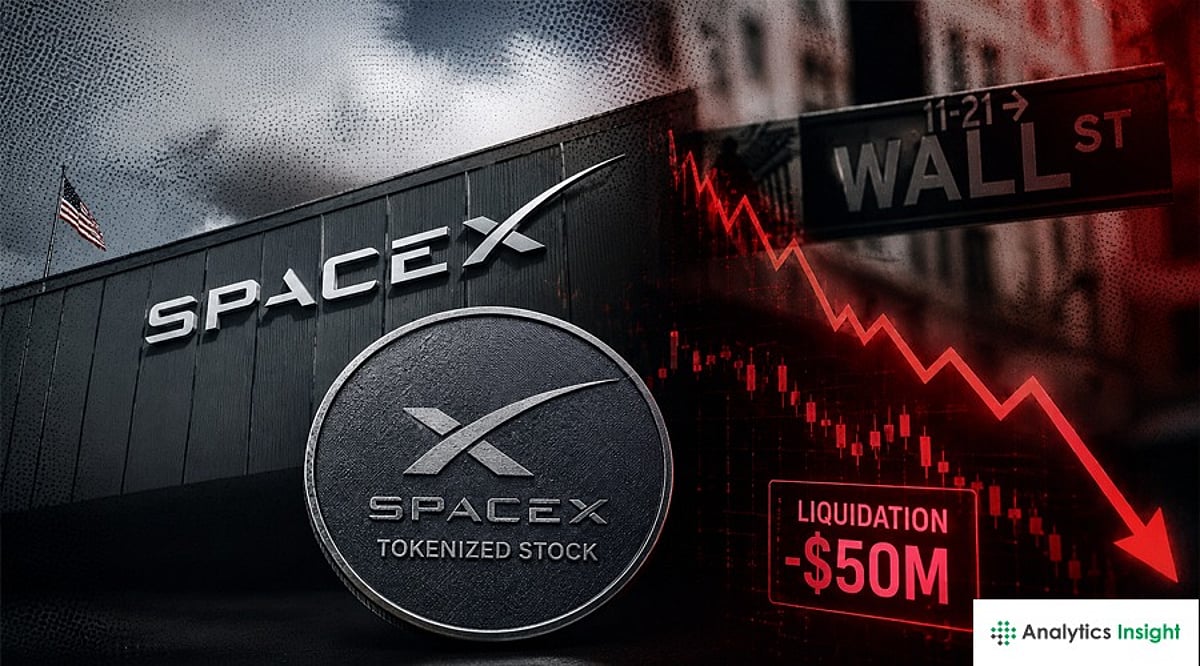
    SPCX perpetual contracts have witnessed over $50 million in liquidations within 48 hours as SpaceX shares dipped below their $150 Nasdaq opening price. The event underscores the heightened volatility and risk inherent in leveraged tokenized stock products, which can react far more aggressively than traditional equity markets.

    What Happened

    According to market data, SPCX-linked perpetual contracts recorded more than $50 million in forced closures, trailing only Bitcoin and Ethereum in liquidation volume among crypto derivatives during that period. The liquidations followed a sharp decline in SpaceX stock, which fell below its Nasdaq debut price after a major drawdown. Investors who bought shares above the company’s $135 initial public offering price are now facing losses.

    How SPCX Differs from Traditional Stock Ownership

    SPCX products are pre-IPO or equity perpetual contracts that offer leverage, cash settlement, and funding mechanisms. Unlike owning actual shares, these instruments provide price exposure without ownership rights, voting rights, or share delivery. Binance lists SPCXUSDT as a USDT-settled pre-IPO perpetual contract, while Coinbase explains that such products settle entirely in cash. Crypto.com describes a structure allowing conversion between SpaceX pre-IPO perpetuals and equity perpetuals depending on platform mechanics.

    This structure places traders in a derivatives-driven environment where margin requirements and funding rates dictate outcomes. If prices move sharply against a position, exchanges can liquidate traders automatically at any time—without waiting for a market close.

    Liquidation Pressure Builds Around Leveraged Exposure

    The $50 million liquidation figure is a notable signal because Bitcoin and Ethereum typically dominate liquidation rankings due to deep liquidity and large leveraged positions. SPCX joining that group reflects strong demand for SpaceX-linked exposure. Liquidation risk does not require a total collapse in the underlying asset—a combination of leverage, open interest, and adverse price movement can easily trigger forced exits.

    While traditional investors may still be evaluating whether the decline reflects temporary weakness or fundamental concerns, perpetual contract markets react instantly, closing positions as soon as collateral support drops.

    Tokenized Stock Perpetuals Face a Different Risk Cycle

    Tokenized stock perpetuals trade around the clock, using venue-specific mark prices and funding systems while enforcing margin requirements continuously. This continuous trading can amplify disagreements over value into sudden liquidation pressure, even as traditional investors are still assessing the stock’s outlook.

    These products may ultimately serve as effective risk-transfer markets, but that will require improved liquidity and reduced leverage. Until then, high open interest and persistent volatility will likely sustain heavy market stress.

    What’s Next

    SpaceX stock slipped below its Nasdaq opening price, triggering the $50 million liquidation wave for SPCX. The event highlights how tokenized stock perpetuals can lead to rapid forced exits when leverage and margin rules kick in. Market participants are now watching to see if the asset stabilizes and whether open interest, funding rates, and liquidation activity will flatten out.