
Tag: digital economy

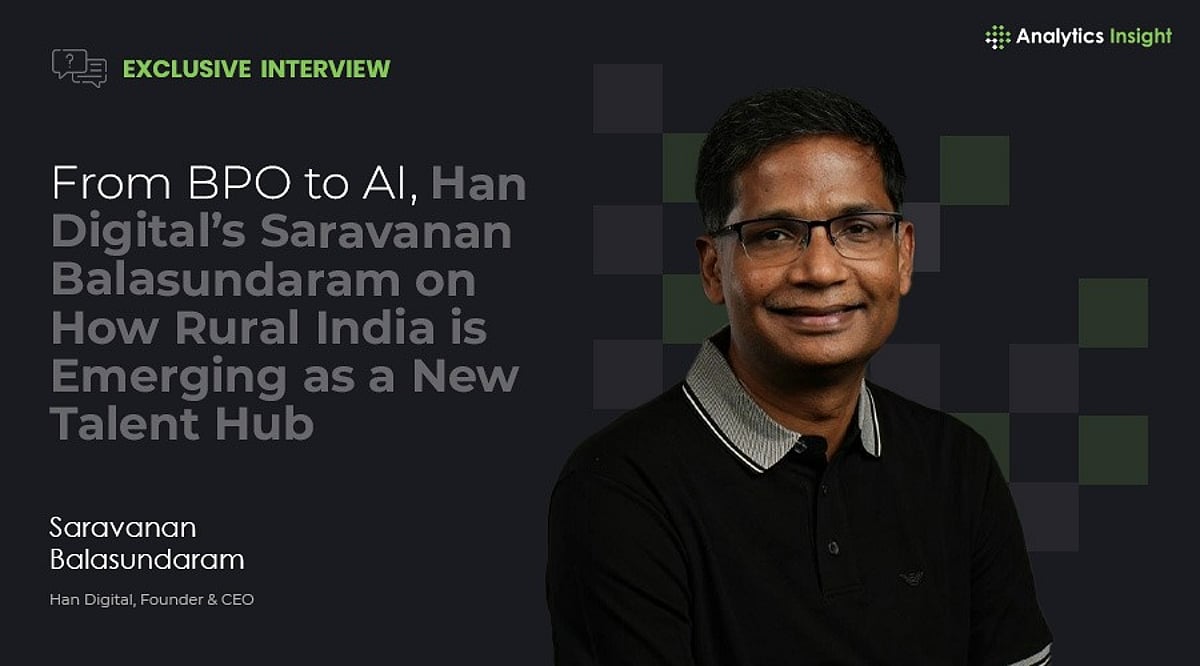
  • How Rural India Is Becoming a New AI Talent Hub: An Interview with Han Digital’s Saravanan Balasundaram

    How Rural India Is Becoming a New AI Talent Hub: An Interview with Han Digital’s Saravanan Balasundaram

    Rural India is emerging as a hub for AI data operations, creating employment opportunities for women and graduates while reshaping traditional BPO models and expanding digital careers.

    Q: Rural BPOs have traditionally run on voice and data-entry work. What’s actually changing on the ground as AI-adjacent tasks like annotation, RLHF, content moderation start replacing or supplementing that older workload? Is this a genuine transformation of the business model, or a bolt-on to existing operations?

    The metro voice-BPO engine in Bengaluru, Hyderabad, Pune, NCR or Chennai – this is not a bolt-on, it’s a contraction. AI agents are now handling 70 to 85% of routine generic customer queries, some service providers have cut human headcount by up to 70%, and annual hiring growth across business process management has fallen to under 40,000 a year. That part of the industry isn’t being supplemented. It’s being downsized, fast.

    Meanwhile, something different is happening outside of these metro cities. A separate kind of business is being built from scratch. The service providers who made this shift didn’t just tweak their old model. They rebuilt it: new delivery centers, new training programs, and new clients with AI labs and product companies instead of the usual domestic telecom and BFSI call-center accounts (which pay lower rates than global clients anyway).

    Q: Why are tier-ii and tier-iii cities specifically positioned to lead this shift, rather than it staying concentrated in metros? What’s the underlying cost, talent, or infrastructure logic that makes smaller cities viable, or even preferable, for this kind of work?

    Looking at graduate hiring trends over the years, roughly 60% of India’s graduates come from small towns. But most IT/ITES companies have never gone looking for talent there. Hiring has stayed stuck in metro and tier ii campuses, not because it has to, but out of habit.

    AI data work breaks that habit because the entry bar is different. Voice BPO needed neutral-accent English and telephony infrastructure; whereas annotation, labelling and physical AI data capturing needs a laptop, reliable broadband, sharp attention to detail, and often a regional-language fluency that’s actually more abundant outside the metros than inside them.

    Cost and workforce stability reinforce the case. Lower living costs make entry-level wages viable in locations where the same economics would be difficult to sustain in Bengaluru and Gurugram, while Tier-2 delivery centres often benefit from lower attrition than metro operations, creating a meaningful operating advantage.

    There is also an existing infrastructure and policy foundation to build on. Government programmes such as the India BPO Promotion Scheme and the Northeast BPO Promotion Scheme spent nearly a decade supporting ITES delivery centres in smaller cities and the Northeast, with the explicit goal of creating jobs beyond the metros. AI data operations are not starting from scratch; they are the next generation of work riding on an ecosystem that India has already spent years building.

    Q: AI annotation, RLHF, and human-in-the-loop work are being pitched as ‘new employment engines’ – what does a typical entry-level role actually look like (pay, skill requirements, training time), and how does it compare to the BPO jobs it’s replacing?

    Yes, particularly in terms of barrier to entry and ramp-up time. Traditional voice BPO can require weeks of training in language, accent, scripts and domain knowledge before an agent goes live. AI data work can often be onboarded within days, as it relies more on SOP adherence, attention to detail, SLA discipline and accuracy than fluent spoken English and real-time customer handling. That opens the door to a much broader talent pool, including people who may previously have been screened out of voice BPOs on language requirements.

    But the real opportunity is not to create another layer of entry-level annotation jobs—it is to build a career pathway, from annotation to review and quality assurance, and eventually to data operations and specialised domain roles. With increasingly distributed and flexible delivery models, talent in rural and emerging cities can participate in specialised work across legal, healthcare, finance, risk and compliance. Done right, AI data operations can become more than the next BPO model: they can create a distributed employment ecosystem that moves people from accessible entry-level work into higher-value, specialised roles.

    Q: Women and first-generation professionals are often cited as key beneficiaries of this shift. What’s driving that deliberate hiring strategy – the nature of remote/flexible work, lower barriers to entry, or something else? And what obstacles still stand in the way?

    The pattern shows up everywhere we look at this workforce, and it’s consistent. Most of the Tier 1/2 centres run with 70% women contributing voice, annotation and 20+ multilingual (mostly INDIC languages) data for more. Even in an adjacent human-in-the-loop space rural cities women make up 35 to 40% of users with engagement running two to three times higher than men’s.

    First-generation professionals benefit for a related reason: these centres are being established where the graduate talent already lives, in towns that the metro-first hiring model largely overlooked for two decades. We see this across our own delivery teams: computer science and polytechnic graduates from agricultural households, taking their first salaried jobs and accessing work that, until recently, simply did not exist within commuting distance of their hometowns.

    The challenges, however, are real. Broadband and power remain unreliable in some locations, and the industry cannot afford to recreate the worst practices of traditional BPO at the bottom of the AI value chain. If rural AI work becomes synonymous with intensive surveillance, limited benefits and no career progression, the industry risks losing both the goodwill and the very workforce it is now being recognised for bringing into the digital economy. Inclusion will only be sustainable if these are built as careers, not just jobs.

    Q: There’s talk of India building a workforce of a million-plus people in rural AI-support roles by 2030. Is that number realistic given current growth rates, or is it aspirational? What would need to go right or wrong for it to happen?

    A million-plus rural AI-support jobs by 2030 is ambitious, but achievable if the AI data economy continues to scale at pace. We would view it as a credible industry opportunity, not a number that is already guaranteed by current growth rates.

    For that to happen, a few things need to go right. Global AI labs and enterprises will need to sustain spending on human-in-the-loop data work rather than move too aggressively toward synthetic data. Tier-2/3 delivery models will need to expand across more towns instead of concentrating in a few urban hubs. Digital infrastructure, particularly broadband and reliable power, will need to keep pace. And policy support will need to evolve beyond traditional BPO to recognise the emerging AI-support ecosystem.

    There are risks too. India could end up competing primarily on price with other English- and multilingual-capable markets, limiting the value of the opportunity. The bigger risk is repeating the traditional voice-BPO model of high churn and limited career progression, creating jobs people cycle through rather than careers they build.

    A million rural AI jobs, therefore, is best seen as a ceiling the industry can build towards, not a floor that already exists.

    From what we are seeing on the ground, rural and tier-2/3 India is not simply a lower-cost extension of the AI data economy. It can be a better-fit talent base, with lower attrition, an underutilised graduate pool and strong participation from women and first-generation professionals. The real opportunity is to combine that talent advantage with higher-value AI work and clear career pathways. If that happens, rural India could emerge as a meaningful new engine of distributed digital employment – and not just the next location for low-cost outsourcing.

  • Amazon Commits $48 Billion to India’s Digital Future with AI, Cloud, and Quick Commerce Expansion

    Amazon Commits $48 Billion to India’s Digital Future with AI, Cloud, and Quick Commerce Expansion

    Amazon has announced a massive $48 billion investment plan for India through 2030, focusing on artificial intelligence, cloud infrastructure, e-commerce, and quick commerce. The commitment follows a June 2026 meeting between Amazon CEO Andy Jassy and Indian Prime Minister Narendra Modi in New Delhi.

    More than $21 billion of the total will be directed toward AI and cloud infrastructure, with AWS expanding data center capacity in Mumbai and Hyderabad. Amazon plans to add fulfillment centers and last-mile delivery stations nationwide, targeting India’s rapidly growing digital economy. The company also intends to invest an additional $3 billion specifically in quick commerce by 2030, scaling its Amazon Now service to compete in the ultra-fast delivery segment.

    The latest pledge includes a $13 billion top-up for AI and cloud announced in June, building on a previous $35 billion commitment across Indian businesses in 2025. AWS remains central to the strategy as Indian enterprises, startups, and government entities increase adoption of cloud computing and AI tools. Amazon will provide custom AI chips, managed AI services, and developer tools, along with support for local data storage to help organizations build AI applications within India’s cloud ecosystem.

    Amazon’s cloud business is already showing strong momentum: AWS sales reached $42.2 billion in the second quarter of 2026, up 37% year over year, and the company’s AI business annual revenue run rate exceeded $25 billion. Jassy said the investment addresses strong demand across Amazon’s Indian operations and aligns with goals to digitize small businesses, create jobs, and boost exports.

    On the retail front, Amazon plans to open more than 20 new fulfillment centers and over 100 last-mile delivery stations, with expanded capacity in smaller Indian cities. The quick-commerce push, reported by Reuters on September 24, 2026, intensifies competition in the minutes-delivery space. Amazon also targets bringing AI benefits to 15 million small businesses and providing AI education to 4 million government-school students by 2030. Cumulative investment in India is expected to exceed $88 billion through the end of the decade.

  • How Blockchain Is Powering the Rise of Machine-to-Machine Transactions

    How Blockchain Is Powering the Rise of Machine-to-Machine Transactions

    As AI agents, smart meters, and connected devices begin executing payments independently, Layer 2 blockchain networks and programmable smart contracts are creating the foundation for a high-speed, machine-driven global transaction economy.

    The Shift from Human-Mediated to Machine-Mediated Commerce

    The digital economy is undergoing a structural shift. Machines are no longer passive processors of human instructions. They are active economic agents, purchasing bandwidth, settling energy trades, and coordinating supply chains without waiting for human approval. This transition from human-mediated to machine-mediated commerce is accelerating faster than most enterprise frameworks have anticipated.

    The global machine-to-machine (M2M) payment market is projected to grow from $11.29 billion in 2026 to $54.95 billion by 2034, expanding at a compound annual growth rate of 21.9%. The infrastructure that enables this growth requires speed, security, and borderless settlement. Traditional banking systems cannot provide that at scale, but blockchain can.

    What Are Machine-to-Machine Transactions?

    M2M transactions describe financial exchanges that occur directly between devices, with no human authorizing each step. Sensors, autonomous vehicles, smart meters, and AI agents all participate. The challenge is that traditional payment infrastructure was designed for human actors operating within banking hours, geographic boundaries, and institutional oversight.

    Blockchain addresses each of these limitations. Its decentralized ledger allows devices to transact peer-to-peer, with cryptographic verification replacing institutional authorization. Smart contracts execute payment terms automatically when pre-set conditions are met. No clearinghouse is required.

    How Blockchain Supports M2M Payments

    Smart Contracts as Autonomous Payment Engines

    Smart contracts are self-executing code deployed on a blockchain. When a smart meter records energy consumption beyond a threshold, a smart contract triggers immediate payment to the grid operator. No invoice, no approval workflow. The machine reads the condition and settles it.

    This automation removes the human bottleneck entirely. In logistics, a delivery drone can pay a warehouse node for storage space. In manufacturing, a production line component can authorize its own maintenance purchase. The transaction logic is embedded in code, not in process.

    Layer 2 Solutions and Scalability

    A common concern with blockchain is throughput. With Layer 2 solutions and advancements in blockchain infrastructure, scalability is no longer a barrier — systems can handle millions of machine transactions per second, which is crucial for IoT ecosystems. Payment channels and sidechains batch transactions off-chain and settle the net result on the main chain, preserving security without sacrificing speed or increasing per-transaction cost.

    Institutional Infrastructure Is Now Catching Up

    Mastercard has introduced Agent Pay for Machines, designed to help businesses support secure, continuous machine payments across cards, accounts, and stablecoins. This signals that established payment networks are repositioning around autonomous transaction flows, not resisting them. Autonomous AI agents are already executing payments, purchasing APIs, accessing compute resources, and interacting with digital services without direct human intervention. The infrastructure shift is no longer theoretical.

    Benefits of M2M Transactions Through Blockchain

    • Decentralization: No single point of failure controls the transaction flow. Machines transact on equal footing without relying on a central authority.
    • Low-Cost Microtransactions: Traditional gateways make sub-cent transactions economically unviable. Blockchain Layer 2 networks bring that cost to near zero.
    • Immutable Audit Trail: Every transaction is permanently recorded. This is critical for regulatory compliance in energy, healthcare, and logistics.
    • Programmable Conditions: Payment logic is embedded directly in smart contracts, removing manual verification at every step.
    • Cross-Border Native: A sensor in Germany can pay a data node in Singapore without currency conversion delays or correspondent banking fees.

    Blockchain’s cryptographic protocols ensure secure transactions, while its transparent ledger provides an immutable record of payments, essential for auditing and accountability in automated systems. The industries already deploying M2M blockchain infrastructure include automotive, energy utilities, retail, and manufacturing. Each sector benefits from the same core property: the ability to move value between machines at the speed of data.

    What This Means for the Digital Economy

    “As machines begin to settle transactions autonomously, the financial plumbing underneath the digital economy changes entirely. Blockchain provides the only settlement layer that is fast enough, cheap enough, and open enough to serve a machine-native economy. Businesses that integrate this infrastructure early will hold a structural advantage over those still relying on human-mediated payment rails.”

    Final Words

    The expansion of machine-to-machine transactions through blockchain is not a speculative outcome. The market data, institutional infrastructure, and technical foundations are already in place. A market growing toward $54.95 billion by 2034 does not emerge without structural demand driving it. What remains is the question of execution speed. Organizations that treat blockchain-based M2M infrastructure as a long-term consideration risk falling behind those treating it as a present-day operational priority. The machines are ready. The networks are ready. The financial logic is written. The window for early-mover advantage is open, and it will not stay open indefinitely.

    Frequently Asked Questions

    What are machine-to-machine transactions?

    Machine-to-machine transactions are automated financial exchanges between devices, systems, or AI agents that occur without direct human authorization at each step.

    Why is blockchain suited for M2M payments?

    Blockchain provides decentralized settlement, smart contract automation, low transaction costs, and an immutable audit trail, all of which traditional banking infrastructure cannot deliver at machine speed.

    What is the projected size of the M2M payment market?

    The global M2M payment market is projected to grow from $11.29 billion in 2026 to $54.95 billion by 2034, at a CAGR of 21.9%, according to Fortune Business Insights.

    Which industries are adopting M2M blockchain payments?

    Automotive, energy and utilities, retail, manufacturing, and logistics are the leading sectors integrating blockchain-based M2M payment infrastructure.

    What role do smart contracts play in M2M transactions?

    Smart contracts execute payment terms automatically when pre-defined conditions are met, removing the need for human authorization and enabling real-time settlement between machines.