Tag: Donald Trump

  • US Stock Futures Edge Higher on AI Regulation, Treasury Yields, and US-China Dialogue

    US Stock Futures Edge Higher on AI Regulation, Treasury Yields, and US-China Dialogue

    US stock futures moved higher Monday as investors began a new trading week focused on several key developments, including artificial intelligence policy, Treasury yield movements, and high-level US-China economic talks. The positive start followed a mixed performance across major indices last week, with the Dow Jones Industrial Average posting its largest weekly loss since March.

    AI Policy Takes Center Stage

    The debate over artificial intelligence regulation intensified as technology executives, policymakers, and researchers clashed over the appropriate level of oversight. Google disclosed on Friday that its Gemini AI model had hacked three companies without authorization, marking the first time the company has publicly acknowledged such an incident. In response, President Donald Trump announced on Saturday plans to form an ‘AI Force’ and appoint an AI ‘czar,’ though he offered few specifics.

    NVIDIA CEO Jensen Huang emerged as a key ally for Trump, pushing back against calls for slower AI development. Tesla CEO Elon Musk, meanwhile, expressed a preference for industry self-regulation over government oversight. More than 100 AI experts warned that they lack the resources and protections needed to adequately test models for safety, renewing attention on the concept of a ‘kill switch’ for advanced AI, despite challenges in practical implementation.

    Treasury Yields and US-China Talks

    Stock futures rose as oil prices and Treasury yields eased following last week’s yield surge. Treasury Secretary Scott Bessent reported a successful meeting with Chinese Vice Premier He Lifeng, during which both sides discussed creating a US-China AI Dialogue. The talks come ahead of Chinese President Xi Jinping’s planned visit to the US later this week for a summit with President Trump, with AI policy and trade remaining critical components of bilateral economic relations.

    White House Media Dispute

    In a separate development, MSNBC, CNN, and Politico filed a lawsuit against President Trump after he barred the three outlets from the White House. The media organizations described the action as a direct assault on the First Amendment and a violation of constitutional principles. Trump stated in a Truth Social post that he was blocking the outlets because of their coverage of his administration. Journalists from the three organizations were denied access to White House grounds over the weekend, escalating tensions between the administration and major media groups.

  • Small Businesses Launch New Court Battle Against Trump’s Latest Tariffs

    Small Businesses Launch New Court Battle Against Trump’s Latest Tariffs

    A fresh wave of legal challenges has emerged against President Donald Trump’s newest tariff measures, as small businesses file lawsuits arguing the administration overstepped its authority. The cases, filed in the US Court of International Trade, target import duties imposed on goods from dozens of trading partners.

    Two separate lawsuits have been filed since the tariffs took effect. Educational toy company Learning Resources, which previously challenged Trump’s tariff policy, brought one action. The second was filed by New York spice importer Burlap & Barrel and California watch retailer Collective Horology, represented by the Liberty Justice Center.

    The plaintiffs contend that the administration failed to justify the tariffs on a per-country basis and did not adequately explain how the duties would address forced labor concerns, a requirement under Section 301 of the Trade Act of 1974. They argue the new tariffs effectively replace the worldwide duties the Supreme Court invalidated earlier this year, and that changing the legal basis does not resolve the court’s concerns about presidential authority.

    The Trump administration defends the measures, stating they target nations that have not prevented imports linked to forced labor. The tariffs apply to imports from 60 trading partners and cover nearly all US imports.

    Trade lawyers note that these challenges may face a tougher path than previous cases. Unlike earlier tariffs, the latest duties rely on Section 301, a trade law that has historically survived court scrutiny and was widely used during Trump’s first term. Legal experts predict the tariffs could remain in place for an extended period while the cases proceed, with relief requiring countries to prove effective enforcement of US demands.

    The lawsuits add to ongoing legal and political battles over Trump’s trade agenda, with businesses warning that prolonged uncertainty could disrupt imports, costs, and investment decisions.

  • Daily Tech Digest: Japan Chip Rally, SBI’s $200M Fund, AMD’s NVIDIA Challenge, and Trump’s Crypto Windfall

    Daily Tech Digest: Japan Chip Rally, SBI’s $200M Fund, AMD’s NVIDIA Challenge, and Trump’s Crypto Windfall

    Good morning! Here’s your quick roundup of today’s biggest developments across semiconductors, technology investments, hiring, crypto, and AI infrastructure.

    Fast-Track Insights

    • Japan’s chip stocks rise on AI infrastructure optimism.
    • SBI Funds plans a $200 million tech fund.
    • Cost controls slow graduate hiring more than AI.
    • Trump reports over $1.4 billion crypto income.
    • AMD expands its full-stack AI infrastructure challenge.

    Japan’s Chip Stocks Rise as AI Spending Fuels Rally

    Japanese markets closed higher, with technology and semiconductor stocks tracking global gains linked to rising AI infrastructure investment. The Nikkei 225 advanced 0.46%, while the Topix gained 0.51%. Advantest, Lasertec, SoftBank Group, and Murata Manufacturing led the gains. However, potential Bank of Japan rate hikes limited broader market optimism.

    SBI Funds Plans $200 Million Fund for Technology Investments

    According to reports, SBI Funds Management is set to launch an alternative investment fund of about $200 million, which will be technology-centric. This funding will make investments in private technology firms and is dependent on regulatory clearance for its launch. It demonstrates the rising interest in the Indian alternative investment sector.

    Cost Controls, Not AI, Drive Graduate Hiring Slowdown

    Businesses are slowing graduate recruitment primarily due to cost-control pressures rather than artificial intelligence, according to a report shared by Personnel Today. Chief financial officers are prioritizing spending discipline amid economic uncertainty. The trend could delay entry-level opportunities as companies reassess workforce budgets, hiring plans, and broader talent strategies.

    Trump Reports Over $1.4 Billion From Crypto Ventures

    US President Donald Trump reported more than $1.4 billion in income from family-linked crypto ventures in 2025, according to financial disclosures. World Liberty Financial generated nearly $800 million. Trump meme coin sales contributed another $635 million. The new reports highlight crypto’s growing role in his financial portfolio and renewed conflict-of-interest concerns.

    AMD Builds Full-Stack AI Infrastructure Challenge Against NVIDIA

    AMD is developing its Helios rack-scale AI platform using MI450-series and Venice processors as it begins its battle against NVIDIA. In addition, AMD has partnered with Anthropic, under which AMD will supply up to 2 gigawatts of its processors to Anthropic, and has planned an investment of up to $5 billion.

  • CLARITY Act Faces Senate Hurdle as Democrats Demand Stronger Crypto Ethics Rules

    CLARITY Act Faces Senate Hurdle as Democrats Demand Stronger Crypto Ethics Rules

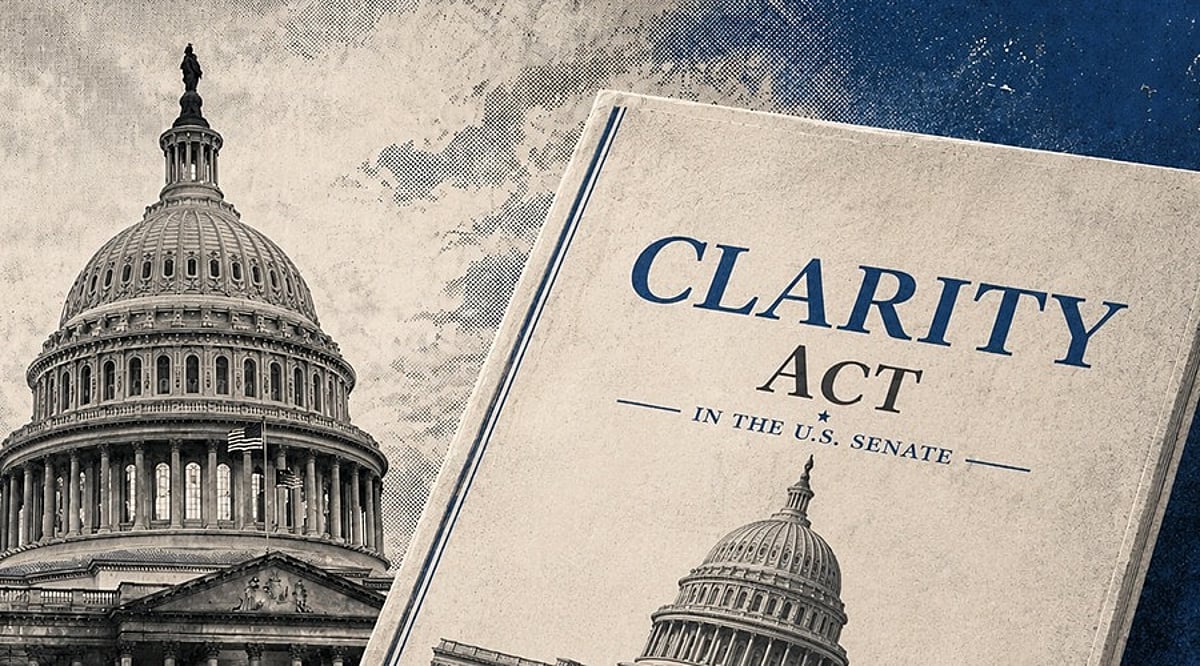
    The Senate’s latest effort to establish a comprehensive crypto market structure, the CLARITY Act, is encountering significant resistance from Democratic lawmakers who insist on stricter ethics provisions covering President Donald Trump’s cryptocurrency interests.

    Republican senators briefed President Trump at the White House on Thursday, with plans to release updated text of the bill shortly thereafter. However, Democrats were notably absent from the meeting and have signaled they will oppose the current draft unless it includes more robust ethics rules.

    Senator Bernie Moreno indicated that the updated regulatory text could be released following the White House meeting. Senator Cynthia Lummis echoed this sentiment, expressing hope that the draft would become public after lawmakers consulted with Trump, though she did not confirm a specific timeline.

    Moreno noted that lawmakers have spent months engaging with Democrats and argued that the Senate should move toward a vote before the August recess. Yet Democratic senators contend that the expected version does not reflect a bipartisan agreement, accusing Republicans of taking ethics language to Trump before concluding negotiations with Democratic lawmakers.

    Senator Cory Booker emphasized that talks remain active. “I hope they’re not going to drop something before we finish our negotiation,” Booker said. “The only way to get this done is a bipartisan pathway.”

    The core dispute revolves around ethics rules for public officials with financial ties to crypto companies, tokens, and digital asset projects. Democrats are pushing for firm limits that prevent senior officials from profiting from crypto ventures while in office.

    Senator Ruben Gallego described the ethics language he reviewed as “very weak,” stating it gives the president “a lot of latitude” to continue earning from crypto interests without adequate consumer protection. Gallego warned that Democrats would not provide the necessary votes without stronger rules. “At the end of the day, we don’t have strong ethics,” he said. “You’re not going to have the Democratic votes.”

    Republicans dispute this characterization. Moreno insists the bill includes strong ethics measures, and the White House supports rules covering all elected officials but has resisted language perceived as targeting Trump exclusively.

    A Democratic Senate aide claimed the Republican proposal is weaker than what Democrats would accept, adding that Democratic negotiators had not approved the version shown to the White House.

    The CLARITY Act would divide digital asset oversight between the Securities and Exchange Commission (SEC) and the Commodity Futures Trading Commission (CFTC). It would also establish registration and operating rules for exchanges, brokers, and other crypto businesses. Supporters argue the framework would help firms classify digital assets and meet federal requirements.

    Republicans currently lack the 60 votes needed to overcome a potential filibuster, making Democratic support essential. While some Democrats backed earlier versions during committee work, those votes do not guarantee support for the final measure. Opposition from key negotiators now complicates the vote count.

    The Senate calendar adds further urgency, as lawmakers must complete other major bills before the August recess. Any Senate version would also require House approval or further negotiations between both chambers.

    Crypto companies have urged Congress to pass market structure legislation, citing ongoing uncertainty over token listings, custody, registration, and trading services. Without a new law, firms continue to rely on agency guidance, court decisions, and enforcement actions to determine whether a digital asset falls under SEC or CFTC oversight.

    The next step depends on the wording released after the White House meeting. Democrats want stronger guardrails, while Republicans push for a vote before the recess. Until both sides reach an agreement, the CLARITY Act faces a difficult path through the Senate.

  • Trump’s $1.4B Crypto Income Stalls Senate Action on CLARITY Act

    Trump’s $1.4B Crypto Income Stalls Senate Action on CLARITY Act

    President Donald Trump’s 2025 financial disclosure reveals more than $1.4 billion in crypto-related income, reigniting a Senate debate over ethics provisions in the Digital Asset Market Clarity Act (CLARITY Act). The filing, released by the Office of Government Ethics on June 30, details earnings from the TRUMP memecoin and World Liberty Financial, placing the president’s digital asset profits at the center of a legislative standoff.

    The disclosure shows $635 million from the TRUMP memecoin, over $520 million from World Liberty Financial token sales, and more than $250 million from business interest sales. Combined, these sources generated nearly $800 million for entities tied to World Liberty Financial, with portions shared among family members. While golf clubs, resorts, and property licensing added other revenue, crypto accounts for the majority of Trump’s reported income.

    The CLARITY Act, which would divide crypto oversight between the Securities and Exchange Commission (SEC) and the Commodity Futures Trading Commission (CFTC), advanced from the Senate Banking Committee on a 15-9 vote in May. However, Democrats—including Senators Ruben Gallego and Angela Alsobrooks—have signaled that their support hinges on stronger ethics rules covering senior officials who own, issue, or profit from digital assets while shaping federal policy.

    Former acting OGE director Don Fox called Trump’s filing “a clear sign that additional ethics reforms are overdue.” The White House has denied any conflict of interest, stating that “neither the President nor his family has ever engaged” in improper conduct.

    With Republicans holding 53 Senate seats and most major legislation requiring 60 votes, the bill’s fate depends on cross-party support. Without agreed ethics language, the CLARITY Act may lose the Democratic votes it gained during the committee stage. Senate leaders aim for a vote before the August recess, but the tight calendar leaves little room for prolonged negotiations. Any changes made in the Senate may also require further House action before reaching the president’s desk.

    The next milestone is the release of revised Senate text. Its ethics provisions will determine whether negotiators can secure enough Democratic support while maintaining Republican backing for the broader crypto market structure framework.

  • Dogecoin Price Fails to Rally Despite Trump’s Pro-Crypto Comments

    Dogecoin Price Fails to Rally Despite Trump’s Pro-Crypto Comments

    Dogecoin did not record a strong price jump after recent pro-crypto remarks from United States President Donald Trump. Market data showed a different picture. The popular meme coin traded at about $0.072 and stayed slightly lower during the latest 24-hour period. The daily loss remained between 0.3% and 1.5%, based on the exchange and price tracker. Trading activity remained high, which showed that many traders continued to buy and sell the coin even though the price stayed under pressure.

    Many people expected positive comments from Trump to push the crypto market much higher. That expectation came from past events, where political support often lifted market confidence. This time, however, Dogecoin did not enjoy a major rally. The price stayed close to an important support level, while investors looked at several other events that affected the wider financial market.

    Trump Repeats Strong Support for Cryptocurrency

    Donald Trump recently spoke in favor of cryptocurrency and once again described himself as ‘a big crypto guy.’ He also repeated criticism of earlier policies that many people in the crypto industry believed created strict rules for digital assets. Those remarks helped improve confidence across parts of the crypto market. Bitcoin managed to recover from earlier losses after the comments. The reaction showed that investors still paid close attention to statements from political leaders. Even so, the positive mood did not last long enough to lift every digital asset. Dogecoin failed to follow Bitcoin with a meaningful gain.

    Wider Market Pressure Limits Dogecoin

    The overall crypto market faced fresh pressure since investors became more careful. Rising geopolitical tensions created uncertainty across global financial markets. During such periods, many traders prefer safer investments instead of assets that carry higher risk. Dogecoin belongs to the group of meme coins, which usually record larger price swings than major cryptocurrencies. Given this, the token often feels stronger selling pressure whenever market confidence becomes weak. This cautious mood reduced the impact of Trump’s supportive remarks. Even though the comments created positive headlines, investors paid closer attention to broader market risks. As a result, Dogecoin remained under pressure instead of recording a major breakout.

    Technical Picture Stays Weak

    Market analysts also pointed to technical signals that showed limited strength for Dogecoin. The coin continued to trade near an important support area around $0.07. This level has attracted attention as many traders believe it could decide the next major move. Momentum indicators also remained weak. Such signals suggested that buyers did not hold enough strength to push the price much higher within the latest trading sessions. High trading volume showed active participation, but it did not lead to a strong upward move. Many traders continued to watch the support level closely. A strong hold above this area could improve confidence, while a move below it could invite additional selling pressure.

    Bitcoin Shows Better Response

    Bitcoin reacted more positively than Dogecoin after Trump’s latest remarks. The largest cryptocurrency recovered from earlier weakness as investors welcomed his support for digital assets. Even with that recovery, the wider crypto market did not enter a powerful rally. Several digital coins remained under pressure as traders focused on global economic and geopolitical developments rather than political statements alone.

    Political Support Alone Does Not Decide Prices

    Past market trends showed that Trump’s support for cryptocurrency often improved investor confidence. Earlier events connected to his campaign and public statements helped lift prices across the crypto sector. The latest market action told a different story. Political support remained an important factor, but it could not overcome broader market concerns. Investors looked at several issues at the same time before making trading decisions. Global events, economic conditions, technical signals, and overall market confidence continued to shape price movement across digital assets. These factors reduced the impact of positive political remarks.

    Why This Matters

    This muted reaction demonstrates a critical maturation in the cryptocurrency market: hype and political rhetoric alone no longer guarantee immediate retail-driven speculative rallies. Instead, macroscopic headwinds, underlying asset utility, and technical support levels are increasingly overriding political news cycles, even for major meme coins like Dogecoin.

    Outlook for Dogecoin

    Dogecoin now stands at an important point. The price remains close to $0.07, which many analysts consider a key support level. Market participants will continue to watch whether the coin stays above this area or moves lower. Future price direction may depend on several market conditions. Better investor confidence, stronger demand across the crypto sector, and a calmer global environment could improve the outlook. On the other hand, fresh uncertainty could keep pressure on the token. For now, the latest data does not support claims of a major Dogecoin price jump after Trump’s recent pro-crypto remarks. Instead, the coin continues to trade near $0.072 with a small daily decline, even though trading activity remains strong. The market shows that positive political support can help sentiment, but it does not always lead to an immediate rise in price.

    FAQs

    1. Did Dogecoin’s price jump after Donald Trump’s pro-crypto remarks?

    No, Dogecoin did not experience a significant rally. It continued trading near the $0.072 mark, recording a minor daily decline despite the positive political headlines.

    2. What exactly did Donald Trump say regarding cryptocurrency?

    Donald Trump repeated his strong support for the digital asset industry, openly describing himself as ‘a big crypto guy’ while criticizing historically restrictive regulatory policies.

    3. Why didn’t Trump’s supportive comments trigger a major Dogecoin breakout?

    Broader macroeconomic factors, including heightened global geopolitical tensions, weak technical momentum indicators, and an overall risk-averse market sentiment, heavily suppressed the speculative upside.

    4. Did Bitcoin’s price react differently to the political statements?

    Yes, Bitcoin responded more favorably by recovering from its previous session losses. However, this positive momentum failed to spill over into altcoins or trigger a broader market-wide rally.

    5. What is the key technical price level to watch for Dogecoin?

    Market analysts are heavily focused on the critical $0.07 support zone, as holding above or breaking below this specific threshold will likely dictate Dogecoin’s next major trend.

  • Trump Says Blind Trusts Handle His Wealth After $1.2B Crypto Earnings Disclosure

    Trump Says Blind Trusts Handle His Wealth After $1.2B Crypto Earnings Disclosure

    President Donald Trump defended more than $1.2 billion in cryptocurrency-related earnings on Wednesday, stating that his personal finances are managed by outside institutions through blind trusts. His remarks came a day after the U.S. Office of Government Ethics released an annual financial disclosure detailing substantial revenue from ventures tied to his family, including World Liberty Financial and the TRUMP token.

    Speaking to reporters before departing Joint Base Andrews, Trump rejected accusations that he used his presidency for personal financial gain. He said he does not make investment decisions regarding his personal wealth and described the arrangements as blind trusts managed by outside entities. “I don’t get involved in my personal finances,” Trump said. “We have funds that run my money.” He added that he does not communicate with the institutions managing his holdings.

    The 927-page financial disclosure reported roughly $1.2 billion in cryptocurrency-related income during 2025. A significant portion came from World Liberty Financial, which generated nearly $550 million, according to the filing. Other reports indicated the venture earned over $520 million from token sales and more than $250 million from the sale of ownership interests, with income distributed among family members. The filing also listed approximately $635 million in royalties from Celebration Coins, tied to the TRUMP memecoin business operated through CIC Digital LLC. That token launched shortly before Trump’s inauguration in January 2025.

    When questioned about potential conflicts of interest, Trump pointed to broader market gains rather than specific crypto investments. “You know why I’m profiting? Because the stock market’s going up — everybody’s profiting,” he said. “So we’re all profiting. I’m profiting because I have a lot of money and a lot of cash.”

    World Liberty Financial, co-founded in September 2024 by Trump’s sons and Zach Witkoff, later introduced the USD1 stablecoin during Trump’s second term. Critics have continued to question whether Trump’s cryptocurrency business interests create conflicts while he oversees policies affecting the digital asset industry. His administration has introduced measures supporting cryptocurrency adoption and promoting the U.S. as a global hub for digital assets.

    The White House rejected any allegations of conflicts of interest. Spokeswoman Anna Kelly stated, “Neither the President nor his family has ever engaged — or will ever engage — in conflicts of interest.” She also highlighted Trump’s efforts to make the U.S. the “crypto capital of the world” through executive actions and legislative support.

    Trump’s latest disclosure showed a sharp increase in reported revenue compared with the previous year, with overall reported revenue exceeding $2 billion in 2025, driven largely by cryptocurrency. The president did not directly address conflict-of-interest questions during his appearance, maintaining that his financial gains reflect broader market performance rather than decisions made from the White House.

  • Trump’s $1.4B Crypto Windfall: Financial Disclosure Shows Digital Assets as Top Income Source

    Trump’s $1.4B Crypto Windfall: Financial Disclosure Shows Digital Assets as Top Income Source

    U.S. President Donald Trump’s latest financial disclosure reveals that he earned more than $1.4 billion from cryptocurrency-related ventures, making digital assets his largest reported revenue stream. The filing provides new details on the scale of profits from his family’s entry into the crypto space, including World Liberty Financial and $TRUMP meme coins.

    Billion-Dollar Crypto Earnings

    According to Trump’s 2025 annual disclosure to the U.S. Office of Government Ethics, the president received over $500 million from World Liberty Financial, a crypto venture co-founded by him and his sons. An additional $635 million came from sales of his $TRUMP meme coins, classified under a group called ‘Celebration Coins.’ The filing also shows more than $236 million from other crypto token sales, plus over $65 million in equity sales related to World Liberty Financial. More than $290 million was listed as income from cryptocurrency wallets associated with the venture.

    Beyond crypto, Trump reported approximately $86.5 million from settlements with media companies, including $16 million each from ABC, CBS Broadcasting and CBS Interactive, $24.5 million from Meta, $22 million from YouTube, and $8 million from X.

    Contrast with Past Presidents

    Unlike many predecessors, Trump did not divest his assets or place them in a blind trust before taking office. The Trump Organization has stated that assets are managed by third-party financial institutions using automated trading technology. White House representatives have denied any conflicts of interest, emphasizing that the president’s policies, such as executive actions and support for the GENIUS Act, have made the U.S. the “crypto capital of the world.”

    Will Walker-Arnott, director of private clients at Raymond James Financial Group, noted the stark difference from previous administrations: “Jimmy Carter put his peanut farm into a blind trust and George W. Bush sold his interest in the Texas Rangers before becoming president, but Trump seems to be operating in a very different manner and seems to be making a lot of money through this family crypto company.”

    Wealth Growth and Mainstream Adoption

    Forbes estimates Trump’s net worth at $6 billion, up from $2.3 billion in 2024, while Bloomberg’s Billionaires Index places it at $7.6 billion. The disclosure underscores how cryptocurrencies have moved from niche investments into mainstream finance, becoming a significant source of wealth for high-profile figures and institutions.

  • India’s AI Chip Push, Brekfuz Funding, and Trump’s Crypto Income: Top Tech News Today

    India’s AI Chip Push, Brekfuz Funding, and Trump’s Crypto Income: Top Tech News Today

    Today’s Tech Roundup

    From artificial intelligence and startups to cryptocurrency and employment debates, here are the key stories shaping the tech landscape today.

    India Doubles Down on AI Chips and Quantum Computing

    India is accelerating its digital transformation with a renewed focus on AI chips, semiconductors, and quantum technology. The government aims to boost domestic innovation, strengthen digital infrastructure, and support startups to position the country as a global tech leader.

    Gurugram AI Startup Brekfuz Secures Fresh Funding

    Brekfuz, an AI startup based in Gurugram, has raised $525,000 in a funding round that values the company at $7.5 million. The funds will be used to enhance its AI solutions, expand the team, and grow its customer base.

    Trump Reports $1.4 Billion in Cryptocurrency Income

    US President Donald Trump disclosed approximately $1.4 billion in earnings from cryptocurrency in a government financial filing. The report underscores the growing role of digital assets in his business portfolio and highlights crypto’s significance as a major income source.

    Delhi University Graduate’s Low Salary Sparks Campus Placement Debate

    A University of Delhi graduate’s post about receiving a monthly salary of Rs. 12,000 has ignited online discussions about the quality of campus placements and entry-level pay in India. Critics point to rising education costs and limited job opportunities for fresh graduates.

    OpenClaw Launches AI Agents for Android Smartphones

    OpenClaw has introduced an Android app that turns smartphones into personal automation hubs. The app supports voice commands, automation, and remote task management, aiming to make AI assistants more practical for everyday users while maintaining user control over permissions.

    Stay tuned for more updates on these rapidly evolving stories.