Tag: edge AI

  • Edge AI Is the Missing Link in India’s Sovereign AI Strategy, Says embedUR CEO

    Edge AI Is the Missing Link in India’s Sovereign AI Strategy, Says embedUR CEO

    India’s AI conversation has centered on compute clusters and cloud infrastructure. Rajesh Subramaniam, CEO and founder of embedUR, argues this misses the bigger opportunity. In this exclusive interview with Analytics Insight, he makes the case for edge AI as the missing layer of India’s sovereignty strategy—one that keeps intelligence on factory floors, in clinics, and on farms rather than routed through servers abroad. He also explains how initiatives like IndiaAI Mission, Digital India, and Make in India could converge at the device level, and what enterprises need to do to turn AI pilots into measurable business results.

    Q: Can India truly achieve sovereign AI if intelligence remains concentrated in the cloud while edge deployment is overlooked?

    A: Sovereignty involves more than the location of model training or data centers. If every inference in an Indian factory, hospital, or utility relies on a cloud, often managed abroad, the intelligence layer of the economy remains dependent on external infrastructure, pricing, and policies. True sovereignty requires intelligence to operate where India’s data is generated: on devices, factory floors, clinics, vehicles, and other endpoints. Edge AI keeps data local by default, operates reliably with limited connectivity, and reduces foreign exchange costs associated with large-scale cloud inference. Cloud AI and edge AI are complementary. However, a sovereignty strategy limited to data centers perpetuates structural dependency. India should control both layers.

    Q: Why will sovereign edge infrastructure be critical to India’s long-term AI ambitions?

    A: When we look at India’s AI journey, three factors stand out: scale, resilience, and economics. Let’s start with scale. Our opportunity is massive—AI in India is not just about a few thousand enterprise deployments, but about reaching over a billion endpoints across agriculture, manufacturing, healthcare, energy, and mobility. Relying solely on the cloud for real-time inference at this scale is simply not practical or sustainable. The way forward is clear: embed intelligence directly into our devices, and use the cloud for training, coordination, and data aggregation. This is how we unlock true impact. Resilience comes next. Edge intelligence keeps working even when connectivity drops. For critical infrastructure like our power grids, water supply, and transportation, this is not just a feature—it is essential for national strength and reliability. The third factor is economics. Every time we use the cloud for inference, we pay ongoing costs—often to companies outside India. On-device intelligence, on the other hand, means we invest upfront and update as needed, but the value stays with us. By aligning our semiconductor ambitions with edge AI, we create a powerful ecosystem: chips made in India, models improved locally, and devices built by our own teams. This is how we achieve real independence and drive long-term growth.

    Q: How can Edge AI democratize AI adoption by bringing intelligence closer to where data is generated?

    A: Cloud-based AI demands high-speed internet, ongoing subscriptions, and complex data management. This leaves out a huge part of India’s economy: small manufacturers, rural healthcare providers, farmers, and businesses in Tier-2 and Tier-3 cities. Edge AI changes the game. Affordable, microcontroller-based solutions work offline, cut out per-inference fees, and keep sensitive data local. This is how we bring AI to everyone. Small foundries can now run visual inspections without cloud contracts. Primary health centers can deliver diagnostics on-site. Farmers can control pumps without relying on connectivity. Over the last two decades in embedded software, I have seen firsthand that technology becomes truly accessible when it is built into affordable hardware. As AI models get smaller and fit into MCUs and NPUs, embedding AI in the devices people already use is the most practical and inclusive way forward for India.

    Q: What is the role of embedded systems, edge computing, and intelligent devices in enabling scalable, real-world AI deployment?

    A: Real value comes when intelligence is built into products that ship, survive in the field, and run for years on limited power and memory. Models that stay in demos or data centers never make an impact. The real work is delivering solutions that last. This is the heart of embedded systems. Moving from research to real products means optimizing for the actual chip, integrating with sensors and connectivity, and making sure it works in the real world, not just the lab. Many AI projects get stuck here. The challenge is not building the model, but getting it deployed and keeping it running. This is exactly why we launched ModelNova as an independent company from embedUR. The industry is moving toward production-ready models that are proven on real silicon, so device makers are not left to bridge the gap alone. India has the talent and the drive in embedded engineering and electronics manufacturing. We have a real opportunity to lead the world in this deployment layer.

    Q: How can national initiatives such as the IndiaAI Mission, Digital India, and Make in India converge to strengthen India’s AI ecosystem?

    A: Each of these initiatives tackles a critical layer. IndiaAI Mission is driving our compute capacity, datasets, and model development. Digital India has laid the foundation with robust connectivity and digital public infrastructure. Make in India, alongside the India Semiconductor Mission, is powering up our hardware manufacturing. Where these efforts come together is at the intelligent device—the next frontier for India’s leadership in technology. Building an AI-enabled device entirely in India is within our reach: silicon designed and produced here, models trained on Indian data using our own compute, and seamless deployment and updates over our digital infrastructure. We have already proven our ability to deliver this kind of end-to-end innovation—UPI is a world-class example of how public infrastructure and private ingenuity can leapfrog outdated systems. Now, we have the opportunity to do the same for edge AI. The key is focused policy that brings it all together: incentives for manufacturing AI-capable devices, standards and certification tailored for Indian conditions and languages, and procurement that demands on-device intelligence for public projects in health, agriculture, and infrastructure. When these missions align at the device level, India moves from being a consumer of AI to becoming a global exporter of AI innovation.

    Q: What do Indian enterprises across manufacturing, healthcare, and energy need to do to translate AI innovation into measurable business impact?

    A: Start with the business outcome that truly matters. In my experience, technology earns its place only when it solves a real problem and drives results for the business. Too often, I have seen AI projects lose focus chasing the latest trends. The projects that succeed are the ones that zero in on the numbers that matter: reducing defects, cutting downtime, increasing patient throughput, or minimizing transmission losses. Identify the key metric, then work backward to the simplest AI solution that delivers measurable results. In manufacturing, I always advise starting with a single line. Focus on visual inspection or predictive maintenance for your most critical asset, and track progress against a clear baseline. Once you prove value, scale it across the plant. In healthcare, true impact comes from point-of-care intelligence that integrates directly into clinical workflows, operates on-device, protects patient privacy, and keeps running even when connectivity drops. In energy, drive intelligence to the grid edge, where losses occur and where waiting for the cloud is simply not an option. There are three disciplines that turn pilots into real business impact. First, deploy intelligence where the data is generated. Latency, connectivity, and data privacy challenges often derail cloud-only projects, especially in the realities of the Indian market. Second, treat AI as a product-engineering initiative, not just a data science experiment. Invest in integration, validation, and lifecycle maintenance, because that is where the real value is created. Third, measure relentlessly against your original baseline. If AI cannot deliver results you can show in a quarterly review, it is just a science project. If it does, it becomes a line item your CFO will champion.
  • How AI-Powered Machine Vision Transforms Modern Robotics: Capabilities, Challenges, and Future Trends

    How AI-Powered Machine Vision Transforms Modern Robotics: Capabilities, Challenges, and Future Trends

    Overview

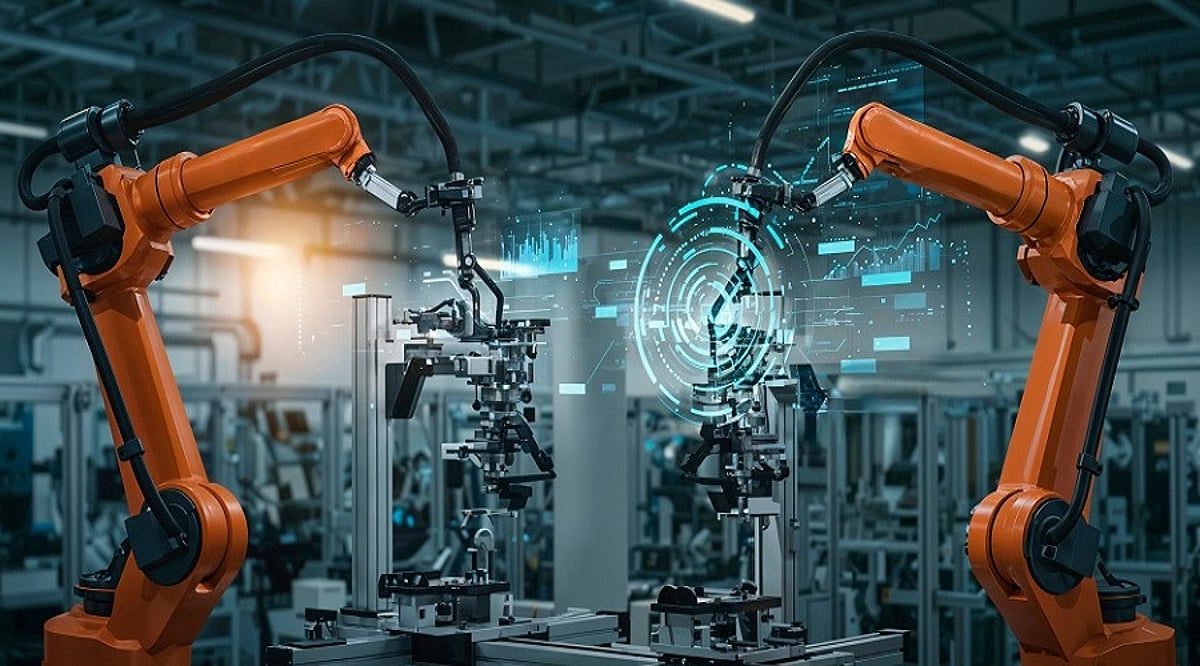
    AI-powered machine vision enables robots to perceive, interpret, and respond to real-world environments using advanced sensors, deep learning, and real-time decision-making. Modern vision systems improve robotic capabilities such as adaptive object handling, quality inspection, autonomous navigation, and safe human-robot collaboration across industries. Advances in vision-language-action models, edge AI, and intelligent automation are making robots more flexible, efficient, and capable while addressing increasingly complex tasks.

    From Blind Automation to Visual Intelligence

    Traditional robotic cells depend on precision fixtures, fixed trajectories, and tightly structured environments. A part out of place stops the line cold. Modern systems replace that rigidity with cameras, depth sensors, and trained models that estimate an object’s position and orientation in real time. Machine vision has evolved from an optional sensing layer into a core component that directly shapes perception, planning, and control.

    Inside the AI Vision Stack

    Perception in a modern robotic system moves through several layers. Sensors, ranging from 2D cameras to time-of-flight units and lidar, capture raw visual and spatial data. Many systems now push early processing directly into the sensor itself and onto edge devices near the robot. This cuts latency and bandwidth before data ever reaches the main compute unit. Deep learning models handle detection, segmentation, and pose estimation. Most run on convolutional networks or transformer architectures. Robots often mix input types too, pairing RGB cameras with depth sensors and force feedback, so one missed signal does not stop the whole task.

    What sets current systems apart from older automation is the tight link between what a robot sees and what it does next. The system reads what it sees and acts on it right away. It adjusts grip or movement mid-task instead of waiting for a person to check the work first.

    New Capabilities This Unlocks

    • Adaptive pick-and-place: A robot estimates the pose of a randomly oriented part directly from a mixed bin, work that once demanded a custom fixture for every product variant.
    • Inline inspection systems: Built on convolutional networks and vision transformers, they catch scratches, weld defects, and misaligned assemblies that rule-based image checks routinely miss.
    • Safe human-robot collaboration: Cobots track a person’s position and proximity closely enough to slow down before a collision rather than after one, letting them work near people without a safety cage.
    • Autonomous mobile robots: Use vision-based mapping to reroute around a spilled pallet or a parked cart without needing the warehouse floor plan reprogrammed.
    • Vision-language-action models: Such as Figure AI’s Helix and NVIDIA’s GR00T N1, these pair a vision-language backbone with a fast motor-control policy, letting a robot act on an instruction like ‘pick the damaged blue container’ instead of only flagging objects it was separately trained to detect.

    Together, these shifts underpin Industry 4.0, where flexible, data-driven automation replaces fixed programming across a plant floor.

    Where This Shows Up Today

    • Manufacturing: Plants use vision-guided bin picking and defect classification to shorten quality checks and catch problems earlier in the line.
    • Warehousing: Barcodes are read visually, and routes are adjusted around clutter without fixed paths, letting operators redesign storage layouts without reprogramming every route.
    • Agriculture: Robots and drones scan crop rows for early signs of disease.
    • Healthcare and retail: Service robots identify people, signage, and obstacles well enough to navigate spaces never built with a machine in mind.

    Limits and Open Problems

    A model trained on one factory floor or one lighting setup often struggles on another. Closing that gap remains active engineering work, not a solved problem. Creating the labeled datasets needed to train these systems is expensive, so manufacturers increasingly use synthetic images generated from digital twins to reduce data collection costs. Dust, reflections, and sensor failure still test the limits of what a camera-based system can handle reliably. Safety certification for vision-driven decisions has not kept pace with the technology itself, and operators still need clear evidence of what a robot ‘saw’ before trusting its judgment call.

    Final Thoughts

    Vision-language-action models point toward robots that take a spoken instruction and work out the steps themselves—without a specialist rewriting detection rules for every new task. That shift, from programming behavior to describing intent, is the next real test for factories deciding how much autonomy to hand a machine.

  • NVIDIA Jetson Thor T3000: A Game-Changer for Robotics and Edge AI

    NVIDIA Jetson Thor T3000: A Game-Changer for Robotics and Edge AI

    NVIDIA introduced the Jetson Thor T3000 and T2000 AI modules on July 15 to support robotics and Edge AI applications. The new NVIDIA Blackwell-powered modules help developers build smarter robots and AI machines with less power and smaller hardware. The company plans to launch both modules in the first quarter of 2027.

    The launch comes as more industries adopt robots for real-world work. NVIDIA created the new Jetson Thor modules to run powerful AI models directly on robots and edge devices. This approach reduces cloud dependence while improving speed, safety, and overall performance.

    The Jetson Thor T3000 is the more powerful model in the lineup. It delivers up to 865 FP4 teraflops of AI performance and includes an eight-core Arm Neoverse CPU with 32GB LPDDR5X memory. NVIDIA said that the module is about half the size and uses nearly half the power of the larger T5000 while offering similar AI performance for language, vision, and robotics tasks.

    The Jetson Thor T2000 targets developers looking for a more affordable option. It delivers up to 400 FP4 teraflops with 16GB memory and supports visual AI, autonomous mobile robots, and industrial machines. NVIDIA also introduced new software tools that reduce memory use and make advanced AI models easier to run on smaller systems.

    NVIDIA stated that companies like Amazon Robotics, Boston Dynamics, Agile Robots, Hitachi, 1X, and Techman Robot already use the Jetson Thor platform. Developers can test the T3000 through JetPack 7.2.1 emulation today, while T2000 support will arrive later. Both modules are expected to become available in the first quarter of 2027.

  • 2030 Robotics Forecast: Top Trends Driving the Industry’s Next Decade

    2030 Robotics Forecast: Top Trends Driving the Industry’s Next Decade

    The robotics industry is undergoing a profound transformation. No longer confined to rigid, pre-programmed tasks, modern machines are learning, adapting, and collaborating with humans at an unprecedented pace. Driven by advances in artificial intelligence, sensor technology, and declining hardware costs, the sector is poised for explosive growth. By 2030, experts predict the global robotics market will surpass $110 billion, with some estimates reaching beyond $200 billion. Here are the top ten predictions shaping the future of robotics.

    1. Humanoid Robots Become Mainstream

    Humanoid robots, designed to navigate environments built for people, are moving from research labs into commercial settings. By 2030, these machines will be common in factories, warehouses, hotels, and healthcare facilities. Industry forecasts suggest that at least one million humanoid robots could be deployed between 2026 and 2030, though specialized robots will still outperform them in many specific tasks.

    2. AI Becomes the Brain of Every Robot

    Artificial intelligence is transforming robots from simple tools into intelligent agents. Future robots will understand voice commands, recognize objects, and make real-time decisions. The intelligent robotics market is projected to grow from $13.99 billion in 2025 to $50.33 billion by 2030, a compound annual growth rate (CAGR) of 29.2 percent.

    3. Collaborative Robots Work Alongside Humans

    Collaborative robots, or cobots, are designed to operate safely with people without extensive safety barriers. Their ease of use and lower cost make them accessible to small and mid-sized businesses. With the global stock of industrial robots reaching 4.664 million units in 2024—a 9 percent increase from the prior year—automation continues to drive productivity and address labor shortages.

    4. Smart Factories Achieve Greater Autonomy

    Factories are integrating robots, sensors, cameras, and software into unified systems that can adapt to changing demand, equipment issues, or supply chain disruptions. Digital twins and machine vision enhance quality control. Asia leads this trend, accounting for 66.6 percent of the global industrial robotics market in 2024, fueled by strong manufacturing growth and automation investments.

    5. Healthcare Robots Expand Their Role

    Robots are increasingly assisting in surgery, transporting supplies, disinfecting rooms, and supporting rehabilitation. An aging population and healthcare worker shortages are driving demand. The service robotics market is expected to grow from $26.35 billion in 2025 to $131.9 billion by 2034, at a CAGR of 19.8 percent.

    6. Warehouse Automation Accelerates

    E-commerce growth is pushing warehouses to process orders faster. Autonomous mobile robots, robotic picking systems, and smart inventory tools are becoming essential. The warehouse robotics market is forecast to rise from $6.51 billion in 2025 to $25.41 billion by 2034, a CAGR of 16.8 percent.

    7. Robot Teams Tackle Complex Tasks

    Future workspaces will rely on teams of robots that share information and coordinate tasks. This approach improves resilience—if one robot fails, others can step in. Annual industrial robot installations now exceed 500,000 units, roughly double the rate from a decade ago.

    8. Edge AI Boosts Robot Performance

    Edge AI enables robots to process data locally, reducing latency and enhancing privacy. This is critical for applications in factories, hospitals, and remote locations. The industrial robotics market could reach $60.6 billion by 2030, with edge computing and AI as key drivers.

    9. Digital Twins Speed Up Development

    Digital twin technology creates virtual replicas of machines and production lines, allowing engineers to test and refine robotic systems before deployment. This reduces costs and risks. As AI advances, digital testing will become a standard part of robot development.

    10. Robotics Becomes a Massive Global Industry

    The convergence of smarter AI, cheaper hardware, and labor shortages is fueling demand across manufacturing, healthcare, logistics, agriculture, retail, and construction. The global robotics market is expected to exceed $110 billion by 2030, and with software and service robots included, could top $200 billion. Robotics is set to become one of the most lucrative and influential technology sectors of the decade.

  • How Environmental Testing Ensures AI Hardware Reliability in Real-World Conditions

    How Environmental Testing Ensures AI Hardware Reliability in Real-World Conditions

    Overview

    Most AI hardware reliability discussions stop at software and models. The physical components running inference in the real world face thermal, humidity, and vibration conditions that lab benchmarks never capture. A field failure in an edge AI deployment or a data centre AI cluster costs far more to fix than the test programme that would have prevented it. Automotive AI suppliers already operate under mandatory environmental qualification standards. The rest of the AI hardware industry is catching up, slowly and sometimes only after things go wrong in production.

    The Physical Environment AI Hardware Actually Runs In

    A GPU handling inference inside a hyperscale data centre operates in a facility with carefully managed cooling, but power density in AI-optimised racks has climbed steeply over the past few years. Thermal loads that conventional server hardware never encountered are now routine. Cooling systems cycle. Hot and cold aisles do not always perform as designed. Components run closer to their thermal limits than the spec sheet might suggest.

    Now move to edge AI. A vision processing unit inside an autonomous vehicle sits near heat-generating electronics, vibrates with every road surface change, and lives through temperature swings from a winter morning start to peak afternoon operation. An AI chip managing process control in a manufacturing plant deals with airborne particulates, temperature variation across the factory floor, and the kind of humidity that builds up near industrial equipment. A smart grid monitoring device bolted to outdoor infrastructure faces rain, humidity, temperature extremes across seasons, and UV exposure. These are not edge cases—they are the normal operating conditions for a significant portion of AI hardware shipped today.

    Thermal Stress Is the Most Common Failure Driver

    Most engineers understand that heat degrades performance. Fewer think carefully about what sustained and repeated thermal stress does to hardware at the material level over time. Modern AI accelerators draw more power per unit area than most electronics were originally designed to dissipate. That power becomes heat. Sustained heat accelerates electromigration inside copper interconnects, degrades dielectric materials inside capacitors, and stresses the voltage regulators that keep AI chips running within their operating range.

    But sustained heat is not actually the worst part. Thermal cycling is. A device that runs intensive inference workloads and then idles repeatedly goes through expansion and contraction cycles at every solder joint and material interface on the board. Repeated cycling between temperature extremes fatigues these joints faster than steady-state heat ever would. The fractures start small, grow, and eventually cause intermittent failures that are hard to diagnose. A thermal shock chamber runs precisely this kind of accelerated validation, moving hardware between hot and cold zones fast enough to stress materials in ways that years of field operation would eventually produce. Hardware teams that skip this are not avoiding the test—they are running it in production.

    Humidity and Condensation Create Failures That Are Hard to Diagnose

    Humidity-related failures do not show up immediately. A device passes every functional check in a clean, air-conditioned test environment and ships. Months later, field engineers see intermittent communication errors, erratic sensor readings, or complete failures in devices deployed in coastal facilities, monsoon-affected regions, or anywhere humidity levels cycle significantly between day and night. Moisture penetrates connector interfaces or PCB surfaces and creates conductive pathways between traces. Electrochemical migration builds up gradually. Corrosion starts at exposed metal surfaces. None of it is visible during a standard inspection after failure.

    Edge AI deployments across India, Southeast Asia, and other high-humidity regions face this regularly. Data centre operators in coastal cities manage facility-level humidity but often have no visibility into whether individual components inside their racks were validated for moisture exposure at the design stage. Running hardware through an environmental test chamber under sustained humidity cycles at elevated temperature catches these failure modes before they reach the field. Components that absorb moisture and fail functionally under test conditions point to specific design problems: coating inadequacies, enclosure weaknesses, or PCB material choices that absorb more moisture than expected.

    Vibration Is Underweighted in AI Hardware Qualification

    Road-induced vibration in a vehicle covers a frequency spectrum that varies with surface quality, speed, suspension tuning, and vehicle load. A lidar processing unit or central compute board experiences thousands of different vibration profiles across its operational life. Certain frequencies resonate with PCB mounting configurations, gradually loosening connector retention and generating micro-fractures in solder joints. The damage compounds; the failures come later. Standard thermal qualification does not catch this. The only way to know is to test under conditions that actually include vibration, ideally combined with temperature, because that is what the real environment applies simultaneously. Sequential single-condition testing answers a limited question; combined testing answers the right one.

    Large-Scale AI Infrastructure Needs Large-Scale Testing

    Individual component qualification and system-level qualification are not the same thing, and the gap between them matters more as AI infrastructure scales. A hyperscale operator qualifying a new AI server configuration is not testing individual chips. The thermal interactions between high-density accelerator cards packed into a full rack, airflow disruptions from chassis configurations, and the combined power draw of a complete AI compute node create conditions that component-level testing does not fully replicate. Environmental walk-in chambers exist specifically to close this gap: full rack assemblies, complete server configurations, and integrated vehicle systems can be placed inside and subjected to the same temperature, humidity, and combined-condition protocols that apply to smaller hardware. Operators who have learned this lesson through field experience are now specifying full system-level environmental qualification in their procurement requirements.

    The Automotive AI Case Makes This Concrete

    ISO 16750 has governed environmental qualification requirements for road vehicle electrical and electronic components for years, specifying temperature, humidity, vibration, and combined-condition testing. Suppliers who cannot show compliance do not get approved for vehicle integration. This did not come from the automotive industry being unusually cautious—it came from field failures in safety-critical systems being expensive, visible, and in some cases creating regulatory consequences. AI hardware deployed in autonomous vehicles now sits inside that framework. A compute board managing sensor fusion must meet the same standards as the ECU next to it. The broader AI hardware industry is following the same path, with a lag. Data centre operators are starting to include environmental validation requirements in hardware procurement specifications; industrial automation customers ask for test data before committing to edge AI platforms.

    The Cost Argument Is Actually Simple

    Hardware teams running behind schedule sometimes frame environmental testing as a schedule risk. But that framing rarely survives contact with a significant field failure event. A recall in the automotive AI space is expensive before the brand-damage calculation begins. A reliability incident in a data centre AI cluster creates SLA exposure, customer escalations, and emergency replacement logistics. A high failure rate across an edge AI deployment fleet generates warranty costs that tend to be higher than anyone projected. The actual cost comparison is not between testing and not testing—it is between finding the failure in a chamber and finding it in production. Aerospace and defence programmes learned this decades ago. AI hardware is working through the same calculation now, with one difference: the pace of deployment means the tuition cost accumulates faster.

    What This Means for AI Hardware Teams

    The practical takeaway is straightforward. Environmental qualification should be built into the design cycle before scale-up, not triggered by a field failure after it. That means testing under combined conditions, not single-variable checks; testing at the system level for rack- and vehicle-scale deployments, not just individual components; and treating environmental test data as a procurement requirement, the way the automotive industry already does. Teams that adopt this now will spend less fixing failures in the field later—and will have the data to prove reliability to customers who are starting to ask for it upfront.