
Tag: Engineering Leadership

  • Building PayPal’s Invisible Support Layer: An Interview with Senior Engineer Nishanthi Yuvaraj on Agentic AI

    Building PayPal’s Invisible Support Layer: An Interview with Senior Engineer Nishanthi Yuvaraj on Agentic AI

    When a customer opens a chat window and their issue resolves before they finish typing, there’s a complex invisible layer making that possible. Nishanthi Yuvaraj, a Senior Software Engineer at PayPal, has spent over a decade building and scaling the contact channels that power that seamless experience. From her early days as an intern in 2013 to earning multiple patents and delivering a keynote on autonomous customer service, Yuvaraj’s career is a masterclass in infrastructure, innovation, and governed autonomy.

    The Evolution of Customer Servicing at PayPal

    Yuvaraj began at PayPal as an intern and has since worked on nearly every customer contact channel: call support, secure messaging, live chat, bot-driven systems using IBM Watson and Google Dialogflow, and the omnichannel layer that recognizes intent across all of them. She notes that the domain has transformed completely—from disconnected, single-channel support to an integrated system where a customer’s history is treated as one continuous conversation.

    Key Platforms: Message Hub, Nudge Hub, and the Customer Journey Platform

    Message Hub serves as the system of record for conversations with over 230 million customers. Nudge Hub uses real-time event streaming to proactively reach out before a customer asks for help. Together with the Customer Journey platform, these systems enable PayPal to treat a customer’s history as a continuous thread. The challenge, Yuvaraj explains, is operating at a scale where downtime is unacceptable—and the redesign of Message Hub alone significantly increased abatement rates without customers noticing the transition.

    Patents and Research: From Proactive Error Resolution to Agentic Systems

    Yuvaraj holds three granted U.S. patents, with two more pending. Her first patent covers proactive error resolution—recognizing failures before the customer does and routing them to help automatically. Another family of patents focuses on making shared transaction data useful by using machine learning to surface relevant offers. Her pending applications include a multimodal agentic resolution framework, which aligns with her current research on self-healing customer experience systems. She has also authored a dozen peer-reviewed papers on data governance, AI-driven customer experience, and agentic systems.

    The Research Instinct: From Undergrad to International Recognition

    Yuvaraj’s research instinct dates back to her bachelor’s degree at College of Engineering Guindy, Anna University, where she built an e-learning platform for visually impaired students. That project taught her to design for users who are often overlooked—a lesson that has stuck with her. At Cognizant, she worked on localizing PayPal.com for India and created “PayPal Parivar,” a family-based payment concept that emerged from observing how Indian families manage money jointly. That experience reinforced her belief that the best innovations come from understanding user behavior, not starting with technology.

    Infrastructure Work That Unlocks Innovation

    Early in her PayPal career, Yuvaraj built an automated end-to-end testing framework that cut the regression cycle from five days to two. While unglamorous, that infrastructure work enabled faster, safer shipping and gave the team room to experiment. She emphasizes that innovation often sits at the seams between technologies, and being well-versed across languages and platforms is crucial.

    Writing to Fill a Gap

    Yuvaraj began publishing peer-reviewed papers because she saw a gap in the literature around the connective tissue between data governance and AI-driven customer experience. She writes about preparing enterprise data for LLM-assisted issue analysis and governed autonomous systems. Her advice to engineers: “Stay hungry, stay foolish—publish your work before you feel like enough of an expert.”

    The Future: Zero-Touch Customer Experience with Governed Autonomy

    Yuvaraj’s recent work focuses on agentic AI for zero-touch customer experience. She envisions systems that resolve issues and heal themselves without human intervention, but can explain every decision to a compliance reviewer. In her KalingaConf keynote, she presented a closed-loop framework combining autonomous agents, predictive analytics, event-driven orchestration, and reinforcement learning. The system detects problems before the customer does, diagnoses root causes, remediates automatically, and learns from outcomes—escalating only when risk is high. This approach improved customer satisfaction and reduced mean time to recovery while maintaining compliance.

    Leadership and Mentorship

    As a woman in backend engineering, Yuvaraj believes reliability earns leadership opportunities. She mentors students and colleagues by giving them real ownership of hard technical problems early. Her philosophy during production incidents: “Fix first, understand second, blame never.” She views 2 a.m. calls as learning opportunities that reveal how systems behave under real conditions.

    Advice for Aspiring Engineers

    Yuvaraj encourages engineers to stay curious about every layer of the stack, including unglamorous areas like data governance. She advises building end-to-end systems and publishing work even when you don’t feel ready. “The moment you stop being curious about the layer just below or just above the one you’re comfortable in is the moment you stop growing.”

  • How PayPal Engineer Nishanthi Yuvaraj Is Building Proactive, AI-Driven Customer Support

    How PayPal Engineer Nishanthi Yuvaraj Is Building Proactive, AI-Driven Customer Support

    Nishanthi Yuvaraj, a Senior Software Engineer at PayPal with over a decade of experience, has been the driving force behind the company’s customer contact channels. Her work spans call, email, live chat, bot-driven support, and asynchronous messaging, all integrated into an omnichannel system that recognizes customer intent across platforms. Now, she is pushing the boundaries with agentic AI—systems that resolve issues before customers even have to ask.

    In a recent interview, Yuvaraj reflected on her journey from intern to innovator, the patents she holds, and her vision for self-healing customer experiences. Below are highlights from the conversation.

    From Intern to Architect of Customer Service

    Yuvaraj joined PayPal as an intern in 2013 and has since built or contributed to nearly every customer contact channel. Early projects included an expense-management app for the Florida Department of Transportation during her master’s at the University of South Florida. At PayPal, she worked on Message Hub—the system of record for over 230 million customers’ conversations—and Proactive Nudge Hub, which uses real-time event streaming to reach out to customers before they need help. Together with the Customer Journey platform, these systems treat a customer’s history as one continuous conversation.

    Patents and Research

    Yuvaraj is a named inventor on three granted U.S. patents and two pending applications. One patent covers proactive error resolution—automatically routing customers to help when a failure is detected. Another family of patents uses machine learning to surface relevant offers from shared transaction data. Her pending work includes a multimodal agentic resolution framework. She has also published a dozen peer-reviewed papers on data governance, AI-driven customer experience, and agentic systems, often generalizing solutions she built at PayPal.

    Agentic AI: The Next Frontier

    Yuvaraj’s recent research focuses on “zero-touch” customer experience—systems that self-heal without human intervention but maintain a full audit trail for compliance. In a keynote at the Kalinga Conference on Communication & Computing (KalingaConf) in 2026, she presented a framework combining autonomous AI agents, predictive analytics, event-driven orchestration, and reinforcement learning. The closed-loop approach detects problems before the customer does, diagnoses root causes, remediates automatically, and escalates only when risk is high. In evaluations, it improved customer satisfaction and reduced mean time to recovery while cutting compliance violations.

    Infrastructure and Leadership

    Early in her career, Yuvaraj built an automated end-to-end testing framework that cut PayPal’s regression cycle from five days to two. She emphasizes that unglamorous infrastructure work often unlocks innovation. Her leadership philosophy: fix first, understand second, blame never. She mentors women in engineering by giving them real ownership of hard technical problems early, building their confidence through reliable execution.

    Yuvaraj holds a master’s in Management Information Systems from the University of South Florida and a bachelor’s in Computer Science and Engineering from College of Engineering Guindy, Anna University. She received the International Universal Innovator Leadership Award in 2026.

  • How AI Is Building Adaptive Financial Ecosystems: Insights from Equiniti India’s Engineering Head

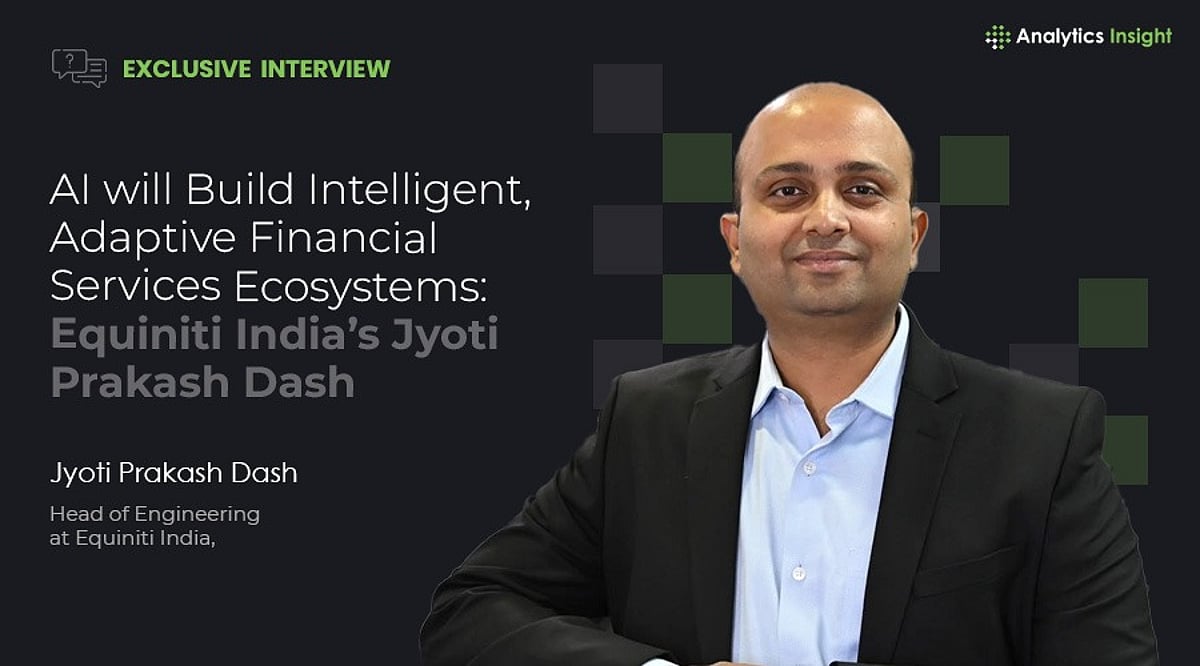
    How AI Is Building Adaptive Financial Ecosystems: Insights from Equiniti India’s Engineering Head

    Artificial intelligence is rapidly transforming financial services, enabling organizations to modernize legacy operations without compromising trust, security, or regulatory compliance. Beyond improving operational efficiency, AI is helping financial institutions accelerate software development, automate complex workflows, enhance decision-making, and deliver better customer experiences.

    For companies with long-standing industry expertise, the real opportunity lies in adopting AI responsibly. Strong governance, transparency, and human oversight are becoming just as important as innovation, ensuring businesses can unlock AI’s potential while maintaining the confidence of clients and regulators.

    Jyoti Prakash Dash, Head of Engineering at Equiniti India, believes AI will go far beyond automation to reshape how financial services are designed and delivered. In an exclusive interview, he shares Equiniti India’s AI strategy, the evolving role of engineering leaders, workforce readiness in the GenAI era, and how intelligent financial ecosystems will define the industry’s future.

    Modernizing a 200-Year Legacy with AI

    Dash explains that AI enables Equiniti to modernize complex financial services operations while preserving the trust, accuracy, and regulatory compliance clients expect. The focus is on responsible AI adoption that enhances productivity, decision-making, and customer outcomes through strong governance, transparency, security, and human oversight.

    Engineering Leadership in the AI Era

    The role of engineering leadership has evolved from managing delivery to orchestrating teams with AI capabilities. Success now depends on driving AI adoption, establishing guardrails, building AI-ready talent, and accelerating innovation without compromising quality, security, or compliance.

    Where AI Is Creating Value

    Equiniti India is embedding AI across software engineering, testing, operational processes, and data-driven decision-making. The impact is already visible through improved developer productivity, faster delivery, enhanced quality, and increased automation, allowing teams to focus on higher-value innovation and customer outcomes.

    Skills Engineers Need in the AI Era

    Engineers must develop AI fluency alongside strong fundamentals in architecture, systems thinking, data, security, and governance. At Equiniti India, significant investment is being made in AI enablement, communities of practice, hands-on learning, and responsible AI adoption to prepare teams for the future.

    Long-Term Vision: Intelligent, Adaptive Ecosystems

    Dash’s vision is to move beyond automation and build intelligent, adaptive financial services ecosystems. AI will enable better decision-making, greater personalization, stronger risk management, and faster innovation, creating sustainable competitive advantage for clients and transforming how financial services are delivered.

  • Balancing Speed and Integrity: How Michael Rainesh Reinvents AI-Driven Software Engineering Governance

    Balancing Speed and Integrity: How Michael Rainesh Reinvents AI-Driven Software Engineering Governance

    As artificial intelligence accelerates the pace of code generation, it simultaneously shifts the cognitive burden toward code review, verification, and technical control. The 2025 DORA analysis of AI-assisted software development warns that while AI can boost delivery speed, it introduces systemic risk without rigorous engineering discipline. In this exclusive interview, Michael Rainesh, Director of Engineering at Portside, shares how organizations can adopt AI without sacrificing quality or control.

    From Reactive Gatekeeping to Federated AI Governance

    Rainesh advocates moving away from manual, reactive gatekeeping toward a federated, AI-enabled governance model. At Portside, his team integrated Generative AI into code reviews for every pull request, but maintained that developers retain ownership of the final commit. The result? An 80% reduction in production release issues, a 20% increase in team productivity, and a 40% faster, more reliable delivery cycle.

    AI Velocity vs. Risky Velocity

    What separates useful AI acceleration from dangerous speed? Human ownership. Rainesh emphasizes that AI outputs should be treated as first drafts, not finished products. When measurable quality indicators are established and engineers actively verify AI suggestions, speed is gained without compromising codebase integrity.

    Building Quality into the Development Process

    Rainesh’s background as a QA analyst taught him that quality cannot be a secondary phase. For teams without a dedicated QA department, the solution is to embed the QA automation mindset directly into the developer workflow. This means rigorous peer reviews, comprehensive automated test coverage built alongside features, and strict release discipline—all of which contributed to the 80% drop in release issues.

    Metrics That Matter

    Not all engineering metrics are useful. Rainesh warns against vanity metrics like lines of code or commit counts, which AI can easily inflate. Instead, he focuses on defect trends, deployment frequency, and burn-down reliability. Throughput is valuable only if production issues remain near zero; if rollback rates increase alongside throughput, review quality is failing.

    Scaling AI from Experiment to Organizational Capability

    Leading an AI proof-of-concept at Price Industries taught Rainesh that an AI model is only as powerful as the data infrastructure supporting it. Transitioning from experiment to permanent capability requires stakeholder trust, centralized high-quality data, and continuous feedback loops. The AI is the spear tip; the real organizational muscle is the data warehouse and cross-functional teams maintaining the business context.

    Knowing When to Formalize an AI Initiative

    Rainesh advises that an AI experiment is ready to become a formal function when it reliably solves an expensive, recurring business problem and other departments depend on its output. Measurable usefulness, repeatability, leadership buy-in, and robust data infrastructure are the key signals.

    Protecting Engineering Culture in Fast-Moving Teams

    To prevent burnout and silos in distributed teams, Rainesh makes mentorship and psychological safety non-negotiable. Pairing sessions force collaboration, and he personally talks to team members to push them out of their comfort zones. Speed becomes a byproduct of team cohesion when strong onboarding and continuous learning are prioritized.

    What Makes a Technical Standard Durable

    A standard survives when it solves a real problem simply and clearly. Rainesh keeps documentation accessible and ensures standards act as guardrails that make developers’ lives easier, not harder. When teams see that a standard prevents late-night production fires, they adopt it as part of their culture.

    The Next 12–18 Months: Prioritizing Engineering Judgment

    As AI becomes a normal part of software delivery, Rainesh believes leaders must evolve engineering judgment. Teams should be trained to think like architects, focusing on system design, security, edge-case verification, and deep ownership. The companies that succeed will use AI to free human intellect for solving harder architectural problems.