
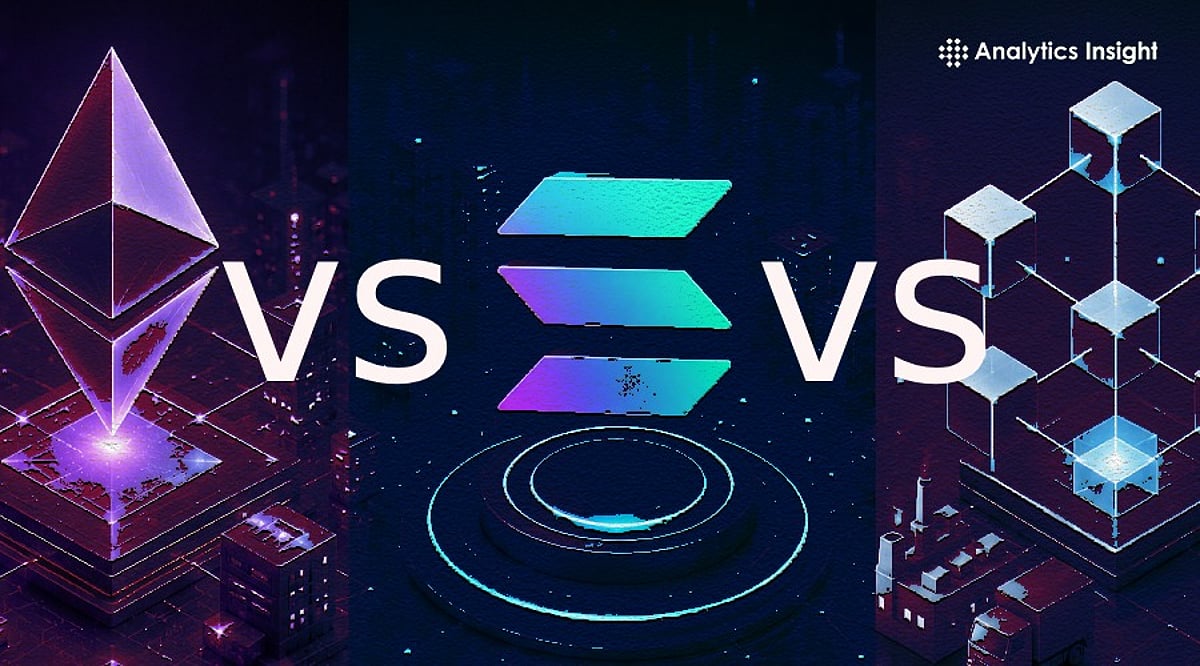
Enterprise blockchain adoption has surged as businesses choose Ethereum for security, Solana for speed, and Hyperledger for private networks, making blockchain a core part of enterprise infrastructure.
Overview
- Ethereum: Top choice for secure enterprise blockchain applications and tokenized finance.
- Solana: Leads in transaction speed with over 65,000 TPS and extremely low fees.
- Hyperledger: Dominates private enterprise networks where compliance and data control matter most.
Blockchain technology has become a major part of business infrastructure. A few years ago, companies mainly tested blockchain through small experiments. Today, large companies, banks, healthcare firms, supply chain networks, and even governments use blockchain for real business operations.
The enterprise blockchain market has grown quickly this year. Reports show that blockchain use in supply chain systems alone may cross $3.3 billion in 2026. Another fast-growing area is tokenized real-world assets (RWAs). This sector saw almost 589% growth entering 2026, which shows how serious enterprise adoption has become.
As more companies move toward blockchain, three major platforms dominate the discussion: Ethereum, Solana, and Hyperledger. Each platform solves different business problems.
Ethereum Remains the Enterprise Leader
Ethereum continues to hold the strongest position in enterprise blockchain with its maturity and trust factor. Most large companies that build blockchain-based systems still prefer Ethereum because it has existed longer and has proven reliability.
One of Ethereum’s biggest strengths is its huge developer ecosystem. Current estimates show more than 31,800 active developers working within the Ethereum ecosystem. This number remains far ahead of most blockchain competitors. For enterprises, this means easier access to engineers, better support systems, and stronger technical infrastructure.
Ethereum has also improved its technology this year. Developers now focus on Verkle Trees architecture, a major network upgrade that helps reduce proof sizes and makes the network more efficient.
Large financial institutions continue to choose Ethereum for tokenized securities, cross-border payments, digital identity systems, and decentralized finance products.
The biggest weakness still comes from network speed and transaction cost. Ethereum remains slower than newer blockchain networks, especially when huge transaction volume enters the system. Even with these challenges, Ethereum remains the safest enterprise option for long-term business use.
Solana Focuses on Speed and Scale
Solana is challenging Ethereum and many other platforms by establishing a faster and less expensive option to serve businesses’ needs.
Theoretically, Solana can handle 65,000 transactions per second on the network. In production, Solana has consistently processed over 3,400 transactions per second. The average cost per transaction on Solana is under $0.01, making it an attractive option for large-scale applications.
Another area of rapid growth for Solana has been the developer ecosystem. Over the past few weeks alone, Solana has added over 7,600 new developers and overall ecosystem growth has exceeded 80% year on year.
This extraordinary growth has prompted many businesses to build on Solana for payment systems, gaming solutions, high-volume applications, and IoT devices.
Some companies continue to shy away from Solana because it previously experienced network outages. Businesses need reliable infrastructure at all times, so reliability is a major concern for many enterprises. While Solana is clearly superior in performance, many businesses still prefer Ethereum to ensure stability.
Hyperledger Dominates Private Enterprise Networks
Hyperledger takes a different approach compared to Ethereum and Solana. While public blockchains allow open participation, Hyperledger focuses on private blockchain systems where only approved participants enter the network. This makes Hyperledger highly attractive for enterprises that need control, privacy, and regulatory compliance.
Hyperledger Fabric is currently the most widely used framework for permissioned enterprise blockchain systems. Recent improvements in Fabric 2.5+ have made the network faster while keeping strong security standards.
A major real-world example comes from De Beers and its Tracr platform, built on Hyperledger infrastructure. The platform has now registered more than 5 million rough diamonds, representing almost two-thirds of company production value.
Large organizations use Hyperledger for supply chain tracking, healthcare data systems, interbank settlements, and government record management. The biggest advantage comes from privacy and governance. The main drawback comes from reduced decentralization, since the network does not operate like public blockchains.
Which Blockchain Wins in 2026?
Depending on the business needs, the choice of platform varies:
- Ethereum: Best for finance, tokenization, and enterprise apps where security and trust are key. Its developer ecosystem provides a huge competitive advantage.
- Solana: Ideal when transaction speed is a priority. Extremely low fees and high throughput make it suitable for companies executing many transactions.
- Hyperledger: Preferred for private enterprise systems requiring high control over access, data visibility, and regulatory compliance.
The Future of Enterprise Blockchain
The blockchain industry no longer focuses on one network. Companies now choose platforms based on their specific business model instead of following a single trend. Enterprise blockchain has moved far beyond early experimentation. It now serves as real infrastructure for global business operations.
Frequently Asked Questions
- Which blockchain is best for enterprise use in 2026? Ethereum leads overall with security, trust, and the largest developer ecosystem.
- Why do companies choose Solana over Ethereum? Solana offers faster transaction speed and lower fees for high-volume applications.
- What makes Hyperledger different from Ethereum and Solana? Hyperledger focuses on private permissioned blockchain networks instead of public decentralized systems.
- How big is the enterprise blockchain market in 2026? Supply chain blockchain infrastructure alone is expected to cross $3.3 billion in market value.
- Is blockchain still experimental for enterprises? No. Blockchain has become real infrastructure for finance, healthcare, supply chains, and government systems.