
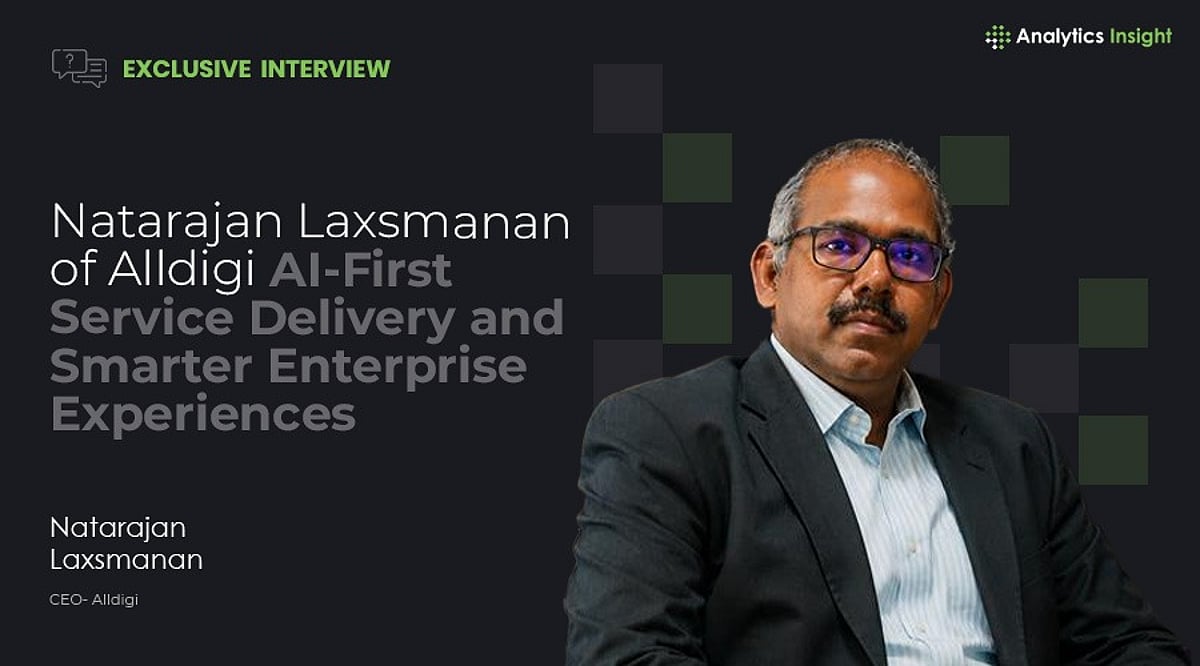
Artificial intelligence is no longer just a support tool—it is becoming the foundation of enterprise service delivery. In a recent interview, Natarajan Laxsmanan, CEO of Alldigi, shared how AI is transforming customer and employee experiences through predictive engagement, intelligent automation, integrated workflows, and stronger governance. Here are the key insights from that conversation.
From Reactive Support to Predictive Engagement
AI is fundamentally changing customer experience by helping businesses move from issue resolution to issue prevention. Traditional support models are reactive: companies respond only after a customer raises a concern. AI enables organizations to anticipate needs by analyzing behavioral patterns, historical interactions, transaction data, and real-time signals.
This intelligence allows businesses to proactively address issues, offer personalized recommendations, and create highly contextual interactions across channels. AI-powered virtual assistants, intelligent routing, sentiment analysis, and predictive service models are helping enterprises deliver faster resolutions while improving overall customer satisfaction. The result is a shift from transactional touchpoints to continuous, personalized engagement that strengthens loyalty and lifetime value.
One practical way to operationalize this balance is to use AI-powered service platforms that bring AI agents and human teams together across channels. Connected knowledge, ticketing, messaging, voice, and reporting tools can help organizations automate routine, high-volume requests while keeping human expertise in the loop—supporting faster service without losing empathy or accountability.
Employee Experience as a Strategic Growth Driver
Employee experience is no longer just an HR priority; it is a business performance imperative. Organizations increasingly recognize the direct connection between employee satisfaction, productivity, innovation, retention, customer outcomes, and overall business growth.
Modern employees expect workplace experiences that are as intuitive and responsive as the digital experiences they encounter as consumers. This requires cross-functional collaboration across HR, operations, technology, finance, and leadership teams. AI is helping organizations create more personalized employee journeys through intelligent support, workforce analytics, learning recommendations, and automated service delivery.
Enterprises that treat employee experience as a strategic lever rather than an administrative function are better positioned to build an engaged workforce, improve operational agility, and drive sustainable growth in an increasingly competitive environment.
Scaling AI Across the Enterprise
The biggest challenge is not implementing AI, but identifying where it can create enterprise-wide value. Many organizations deploy AI in isolated applications, leading to fragmented insights and disconnected workflows.
The real opportunity lies in connecting payroll, compliance, workforce management, and customer experience systems into an integrated operating ecosystem. When AI can access and analyze data across functions, it can uncover patterns, automate decisions, improve compliance oversight, optimize workforce planning, and deliver more personalized experiences for both employees and customers.
However, success depends on strong data foundations, system interoperability, governance frameworks, security controls, and clearly defined business objectives. Organizations that get these fundamentals right can leverage AI as a strategic capability that delivers measurable improvements in efficiency, compliance, agility, and stakeholder experience.
Balancing Automation with Human Interaction
The goal of AI should not be to replace human interaction, but to elevate it. Automation is most effective when applied to repetitive, high-volume, and rules-based tasks, allowing employees to focus on activities that require empathy, judgment, creativity, and relationship-building.
Whether serving customers or supporting employees, there will always be moments where human intervention is essential. Businesses must therefore design operating models where AI handles routine processes while humans manage complex and emotionally nuanced interactions.
The organizations that achieve the best outcomes are those that view AI and human expertise as complementary strengths. This approach enables greater efficiency while preserving the trust, personalization, and authenticity that remain critical to exceptional experiences.
Building an AI-First Operating Model
Adopting an AI-first approach requires organizations to rethink more than technology. It demands changes across operating models, governance structures, and workforce strategies.
First, businesses need to redesign workflows around intelligence, automation, and predictive decision-making rather than simply embedding AI into existing processes. Second, robust governance frameworks must be established to ensure transparency, accountability, security, privacy, compliance, and ethical AI usage.
Equally important is workforce transformation. Employees need the skills and confidence to work alongside AI systems, interpret insights, and focus on higher-value responsibilities. Organizations that invest in continuous learning, digital capability building, and change management are more likely to realize the full benefits of AI.
Ultimately, successful AI-first enterprises combine technology, governance, and people transformation to create scalable, trusted, and outcome-driven service delivery models that continuously evolve with business needs.