Tag: Enterprise Software

  • Fireflies.ai Targets India as Fred Evolves From Meeting Note-Taker to Workplace AI Agent

    Fireflies.ai Targets India as Fred Evolves From Meeting Note-Taker to Workplace AI Agent

    India has emerged as a critical growth market for Fireflies.ai as the company expands its AI assistant Fred beyond simple meeting transcription and summaries. Fred is now being shaped into a full-fledged workplace AI agent that can handle routine follow-up tasks such as drafting emails, updating CRM records, and creating tasks, all based on conversations it has captured.

    Fireflies.ai co-founder and CEO Krish Ramineni revealed that India is the company’s second-largest market by user count, with paid teams in the country tripling over the past two years. This rapid adoption is influencing both product development and pricing strategy, with the company planning a lower-cost tier specifically for Indian users.

    From Meeting Notes to Workplace Execution

    Fireflies initially gained traction as a tool that records, transcribes, and summarizes meetings. Now, Fred is evolving into a broader workplace companion. The platform connects meeting insights with email, CRM systems, and project-management software, enabling Fred to draft follow-up emails, update records, create tasks, and organize post-conversation information. Fireflies currently offers more than 200 AI skills across its platform.

    The company has also ventured into voice agents, which can conduct certain calls and automatically prepare summaries and transfer data into business systems. Fireflies reports that its voice agents have handled over 40,000 conversations globally.

    “Fireflies.ai started as an AI meeting assistant and note-taker. From day one, the vision was to build a personal assistant that helps with your work,” Ramineni shared. “Back then, we were experimenting with chatbots and Slack bots, but the technology was too early, and there were no LLMs. We eventually went all in on meetings, and the note-taker found product-market fit quickly.”

    India Shapes Product and Pricing Plans

    India’s growing user base is directly influencing Fireflies’ roadmap. The platform already supports 11 Indian languages, including Hindi, Bengali, Tamil, Telugu, Gujarati, and Marathi, as part of its broader language coverage. A lower-cost pricing tier tailored to the Indian market is also in development.

    Ramineni confirmed plans to continue hiring from India’s deep technology and AI talent pool. Fireflies operates as a fully remote company with employees distributed across multiple locations rather than concentrated in a single office.

    AI Takes on More Routine Work

    The broader strategy is to transform Fireflies from a tool that simply records discussions into one that helps complete follow-up work. Ramineni draws a clear line between routine execution and decisions requiring human judgment. Tasks such as screening, qualification, drafting, routing, and follow-ups can be automated, while hiring decisions, financial choices, and other high-impact judgments should remain under human control.

    For Fireflies, India’s rapid adoption provides both a large user base and a real-world testing ground for this shift as workplace AI moves further from note-taking toward active task execution.

  • Comviva Names Former Tech Mahindra AI Leader Jeet Singh to Drive Global Strategy and Alliances

    Comviva Names Former Tech Mahindra AI Leader Jeet Singh to Drive Global Strategy and Alliances

    Comviva has appointed Jeet Singh as its Global Head of Strategy, Transformation and Alliances, tasking him with leading the company’s growth initiatives and partnership development. The announcement, made on September 24, 2026, brings Singh from Tech Mahindra, where he most recently oversaw the global artificial intelligence business.

    What Will Jeet Singh Oversee at Comviva?

    Singh will define Comviva’s strategic direction as it aims to expand into developed markets and enter new industry verticals. He is also responsible for identifying growth opportunities and guiding the evolution of the company’s product portfolio, with artificial intelligence identified as a key area of investment.

    His role extends to global alliances, where he will cultivate partnerships to help Comviva reach new customers and markets. The company has not disclosed specific partners, target industries, or countries tied to his appointment.

    Comviva provides software for customer experience management, data monetization, and digital financial services, serving communications providers and other enterprises. The company reports more than 200 customers and operations in over 100 countries, though it has not set a public expansion target for Singh’s new role.

    Why Has Comviva Chosen Singh for the Role?

    Singh’s most recent position at Tech Mahindra placed him in charge of its global AI business. Comviva highlighted that his expertise spans sales, product development, market strategy, partnerships, and organizational change. Since Tech Mahindra owns Comviva, Singh’s move is an internal transfer within the larger group.

    Comviva CEO Rajesh Chandiramani, who has worked closely with Singh previously, noted his experience in building businesses and applying new technology to enterprise needs. Chandiramani stated that this experience will support the company’s ‘Comviva 2.0’ plans and its integration of AI into products.

    ‘Jeet’s experience in building businesses and applying new technology to enterprise needs will be invaluable as we execute our Comviva 2.0 plans and deepen AI within our products.’ – Rajesh Chandiramani, CEO of Comviva

    The CEO’s comments outline expectations for the appointment, though Comviva has not disclosed financial targets, a timeline for entering new markets, or changes to Singh’s reporting structure. It also did not indicate whether the role would alter existing partnerships.

    How Does the Appointment Fit Comviva’s Plans?

    Comviva has linked Singh’s appointment to its investment in AI, product portfolio changes, and efforts to grow beyond its current markets. His remit unites these areas with partnership development. The company has announced these priorities but has not detailed new products or agreements under his leadership.

    Singh said Comviva plans to expand in developed markets, move into new industry segments, and build its AI capabilities. He also said he would work with the leadership team, customers, and partners on the company’s strategy. These are stated plans, and Comviva has not specified when it expects to complete them.

    The appointment creates a central strategy and alliances role as Comviva pursues growth across multiple business areas. Singh brings experience from Tech Mahindra’s AI division and a mandate to develop partnerships. For now, Comviva has described the scope of his responsibilities without announcing a specific market launch, partnership, or revenue goal.

  • How AI-Driven Procurement Unlocks Hidden Millions by Unifying Supply Chains

    How AI-Driven Procurement Unlocks Hidden Millions by Unifying Supply Chains

    When two sites buy the same part from the same supplier at different prices, and nobody in either building knows, the waste is not a rounding error—it is a multi-million-dollar leak. That is the core insight from Priyanka Malla, an IT project manager specializing in AI-driven enterprise procurement and supply chain transformation.

    “At scale, the multi-million-dollar opportunity in procurement is not smarter buying, it is unification,” she says. Malla manages a portfolio of capital and operating spend covering AI initiatives, enterprise procurement, ERP modernization, and infrastructure. Her largest program consolidated procurement across more than 50 geographically distributed sites onto a single standardized platform. Each site arrived with its own legacy process and supplier relationships, and there was no template to follow.

    The obstacle, she found, was not the software. “When integrating systems that were never designed to talk to each other, the hard part is not the technology, it is reconciling how differently each site had been operating.” Reconciling fifty ways of buying into one was less an integration job than a negotiation with each site about how it worked.

    She followed that with ERP modernization across more than 15 branches, bringing together supply chain and financial data that had lived in disconnected legacy systems. The two programs did the same thing from different directions: one standardized how the organization buys, the other standardized what it knows about what it has bought.

    That order matters for artificial intelligence. Organizations that bring together sites or companies that each ran their own procurement “inherit duplicate suppliers, inconsistent pricing, and invisible spend.” An algorithm cannot optimize spend that nobody can see. “AI’s first real job is making that fragmented picture visible before it can make it optimal.”

    Bringing AI into that environment created a problem nobody had solved for her. As an early AI-focused project manager, she needed a way to decide when an AI tool could be trusted in an enterprise adoption decision, and no criteria existed. She built them, and that work became the failure-mode evaluation frameworks she now applies to AI adoption decisions.

    Her conclusion is blunt. “Most AI procurement rollouts fail at governance, not technology.” The risk is specific to scale. “Before scaling across dozens of sites, you need a shared definition of an acceptable failure mode. Otherwise every site trusts the algorithm differently, and you lose the standardization that justified the investment in the first place.”

    It is a pointed observation, because it means a rollout can undo its own business case. The reason to consolidate fifty sites is to make them behave consistently. An AI tool that one site overrides constantly and another accepts without question reintroduces exactly the inconsistency the consolidation was meant to remove.

    On where the technology goes next, she is specific about what automation should and should not do. “The next era of AI procurement is about routing decisions, not replacing buyers. The wins come from letting automation clear the high-confidence, high-volume transactions and escalating the exceptions to a human. That is where the cost curve actually bends.”

    The pattern runs back through her career. Earlier, she worked on a product lifecycle management deployment across more than 500 global sites, another exercise in getting many independent operators onto one system. She is an IEEE Senior Member, holds PMP certification and a master’s degree in management information systems from California State University, Long Beach, and has written for the product management publication Mind the Product.

    The headline promise of AI in procurement is an algorithm that finds millions. Malla’s account suggests the order is the other way round. The millions are already there, spread across suppliers, prices, and sites that were never compared. The algorithm only finds them once somebody has done the slow work of putting everything in one place.

  • How AI-Enhanced ERP Systems Streamline Operations and Boost User Productivity

    How AI-Enhanced ERP Systems Streamline Operations and Boost User Productivity

    ERP software has become essential for managing finance, procurement, inventory, HR, sales, manufacturing, and other core business operations. But while traditional ERP systems bring business processes together, users can still spend significant time navigating menus, searching for records, preparing reports, entering data, and following up on routine tasks.

    AI in ERP is changing how users interact with business software. Instead of making employees learn complex processes to get simple things done, AI allows them to communicate with ERP systems using natural language, automate repetitive workflows, generate reports through prompts, and access insights across departments.

    ZYNO by Elite Mindz takes this approach further with a prompt-based ERP designed to make everyday business operations simpler, faster, and more intelligent.

    What Is AI in ERP?

    AI in ERP refers to integrating artificial intelligence capabilities such as natural language processing, generative AI, machine learning, predictive analytics, and intelligent automation into enterprise resource planning systems. Traditional ERP systems generally require users to follow predefined navigation paths and workflows. AI-powered ERP systems can understand user intent, analyse business data, automate defined processes, and provide relevant information in a more conversational way.

    The difference is simple:

    • Traditional ERP: Find the module → open the screen → apply filters → retrieve information.
    • AI-powered ERP: Ask what you need → get the relevant information → take action.

    This shift can make ERP software easier to use for employees across finance, procurement, HR, operations, and management.

    How AI in ERP Makes Users’ Lives Easier

    1. Talk to Your ERP in Natural Language

    One of the biggest advantages of AI in ERP is conversational interaction. Users do not always need to remember where a particular report or record is located. With ZYNO Smart ERP Assistant, they can ask questions in simple language and receive answers based on live ERP data. For example: “Show pending purchase approvals above ₹5 lakh.” “What is our current inventory level?” “Give me a summary of this month’s expenses.”

    2. Generate Reports Through Prompts

    Report generation is an everyday requirement for business teams, but preparing customised reports can involve manual data collection, filtering, formatting, and cross-checking. ZYNO’s Report Generation Through Prompts allows users to describe the report they need in plain language. AI can then compile structured reports from real-time ERP data. For example: “Create a monthly sales report by region and highlight declining sales.”

    3. Automate Repetitive Workflows

    Approvals, notifications, status updates, and routine data-entry activities can take up a considerable amount of employees’ time. ZYNO AI Workflow Automation helps automate repetitive processes across departments based on defined business rules. This reduces the number of routine follow-ups employees need to manage.

    4. Connect Information Across Departments

    Businesses rarely operate in isolated departments. A procurement decision can affect inventory, which affects production, which affects finance. ZYNO’s Cross-Module Data Intelligence connects information across areas such as finance, inventory, HR, and procurement, allowing users to access consolidated information instead of switching between separate module-specific reports.

    5. Get Real-Time Business Insights

    AI can make ERP dashboards more than static collections of numbers. ZYNO AI-powered dashboards provide a unified view of business performance with insights that update as underlying data changes. This helps managers identify changes, monitor KPIs, and respond to operational issues more quickly.

    6. Simplify Procurement and Invoice Processing

    AI can also simplify specific ERP processes. With ZYNO Prompt-Based Purchase Requisitions, users can describe their purchasing requirements in natural language. AI converts the request into a structured requisition. Similarly, AI Invoice Verification supports invoice processing by helping verify information against relevant business records.

    Key AI Features in ZYNO ERP

    • Smart ERP Assistant: Ask questions and retrieve business information using natural language.
    • Prompt-Based Report Generation: Create structured reports by simply describing what you need.
    • AI Workflow Automation: Automate approvals, notifications, status updates, and routine processes.
    • Cross-Module Data Intelligence: Connect information across finance, procurement, HR, inventory, and other functions.
    • AI-Powered Dashboards: Get real-time visibility into business performance.
    • Prompt-Based Purchase Requisitions: Create structured purchase requests without navigating lengthy forms.
    • AI Invoice Verification: Use AI to support invoice checking and verification.
    • AI-Powered Insights: Surface relevant information from business data to support faster decisions.

    Together, these capabilities move ERP beyond traditional transaction processing toward a more intelligent and user-friendly business platform.

    The real impact of AI in ERP is not just automation. It is simplification. Employees should not need extensive system knowledge to answer a basic business question. Managers should not have to wait for manually compiled reports. Teams should not spend unnecessary hours following up on routine workflows. With ZYNO, users can interact through prompts, access connected data, generate reports, and automate workflows from a conversational interface. The future of ERP is about making powerful business technology easier to use.

  • Why Data Resilience in Salesforce Is Now Critical for Business Continuity

    Why Data Resilience in Salesforce Is Now Critical for Business Continuity

    CRM platforms are no longer just sales databases. Customer relationship management platforms have become embedded in companies’ everyday operations as they hold such information as customer histories, service records, account relationships, and much more.

    Given the importance that such platforms hold, the reliability of CRM data has become a business continuity issue. In case any records or information become inaccurate or deleted, the consequences can go beyond just IT. These scenarios can stall sales activity, strip context from customer service teams, make reporting unreliable, and force managers to make decisions with incomplete information.

    Cloud Availability and Data Recoverability Aren’t the Same Thing

    Cloud availability and data recoverability aren’t the same thing. Organizations may be able to keep their infrastructure available and running smoothly, but that does not necessarily mean they can recover a given record or data if it is deleted or damaged.

    In many cases, a platform may have full cloud availability, while the data inside is no longer accurate or complete. Salesforce records can be affected by accidental deletion, incorrect bulk updates, faulty integrations, automation errors, or configuration changes. The problem is not whether Salesforce can remain online, but whether, in the event of accidental data deletion, the business can quickly restore the data to continue operating the same way.

    Note: Data integrity and protection are a shared responsibility. Salesforce recommends maintaining regular backups of data, especially before major operations.

    What Happens When Critical CRM Data Changes or Disappears?

    CRM data often sits inside revenue, service, compliance, and reporting processes. When that information is damaged or incomplete, the consequences can compound.

    A sales team may lose the opportunity history needed to manage a deal. Customer service staff may no longer have the full record of previous interactions. Management reports may reflect corrupted source data. Compliance teams may struggle to demonstrate what information existed at a specific point in time.

    Even when information can be reconstructed manually, the process can consume staff time and introduce further errors.

    Building Salesforce Into the Business Continuity Plan

    Before building a business continuity plan, companies should identify the following:

    • Which Salesforce data matters most?
    • How often does it change?
    • How much of that data can the company afford to lose?
    • How quickly will the company need that particular data back?

    Organizations should determine how they will backup Salesforce data and recover important records before an incident occurs, rather than discovering gaps in their recovery strategy during a disruption.

    This evaluation should go beyond mere CRM records. Depending on how Salesforce is configured, it should also cover custom objects, relationships, files and attachments, as well as metadata that evaluates how the environment behaves. Historical copies are also important to consider, especially when companies need to identify when a particular change happened.

    Recovery Readiness Requires More Than Creating Copies

    Backups are only useful if an organization understands how recovery will work in practice. Responsibilities should be clear: who decides what needs to be restored, who performs the recovery, who validates the results, and how business teams are informed.

    Retention also matters. Organizations should decide how far back they need to recover information and whether legal, regulatory, contractual, or operational requirements affect that period. Relationships between records must be considered because restoring an individual item without related information may leave a business process incomplete.

    Finally, recovery procedures should be tested periodically. Salesforce data resilience is not simply a technical safeguard; it is part of operational readiness. As CRM platforms become systems of record for important business processes, the ability to recover reliable data should become a routine element of continuity planning and enterprise risk management.

  • Why Unstable PDF Tools Are Draining Enterprise Productivity and Budgets

    Why Unstable PDF Tools Are Draining Enterprise Productivity and Budgets

    For any enterprise aiming to stay productive, a seamless document ecosystem is non-negotiable. Contracts, invoices, compliance reports, and board packs still dominate daily workflows—and most of these documents remain PDF-based. Yet few organizations quantify the true cost of the PDF tools they rely on. Frequent crashes, background process conflicts, and startup errors disrupt knowledge workers an average of 30 to 40 times per week.

    One common error message reads, “A running instance of Acrobat caused an error.” While it might seem like a minor glitch, it signals a deeper problem: fragile desktop software that undermines enterprise efficiency.

    The Hidden Cost of PDF Failures

    Consider a legal team preparing for a merger. A senior associate encounters a stuck background process in Acrobat, unable to open a 300‑page PDF. After 15 minutes of restarting the application, the delay multiplies across hundreds of employees and millions of documents annually.

    In typical organizations, knowledge workers lose 20–30% of their week to document-related hassles. While not all of that stems from PDF failures, startup issues and process collisions are among the biggest culprits. IT help desks consistently rank PDF reader and editor problems as some of the most frequent support tickets.

    Why Background Process Conflicts Happen

    Modern PDF suites run multiple background tasks—syncing, auto-updating, OCR, and collaboration features. When one task fails to complete properly, subsequent tasks collide with the lingering instance, triggering the notorious “running instance” error. Enterprise environments worsen the issue with group policies, security agents, and multiple software versions.

    At the root is architecture. Most heavy PDF suites were designed as standalone applications with deep feature sets, not as service-oriented frameworks capable of handling continuous, mission-critical document throughput.

    A Strategic Response: Lightweight, Predictable PDF Tools

    Forward‑thinking IT leaders are reassessing their PDF technology stacks. Instead of standardizing on a cumbersome suite, they are adopting multi-platform editors that launch quickly, run lightweight processes, and integrate directly with cloud storage. The goal: improve document access on demand without IT intervention.

    UPDF—positioned as a strong alternative to Adobe Acrobat—exemplifies this new generation. It handles editing, annotations, AI assistance, PDF conversion, and OCR without the multi-process architecture that causes most startup errors. For organizations still plagued by PDF failures, such tools serve as either a useful secondary option or a full replacement for users who do not require advanced print production capabilities. IT teams may also reference guides on fixing the “a running instance of Acrobat” error for front-line support.

    Measuring ROI

    The business case for PDF tool stability is straightforward:

    • Fewer help desk tickets related to PDF startup and crash issues
    • Faster document turnaround for legal, finance, and operations teams
    • Lower software licensing costs when lighter tools replace premium suites
    • Improved employee experience and reduced frustration

    Final Thoughts

    PDF tool stability is not a niche IT concern. Document processing time directly affects customer responsiveness and decision speed. When businesses treat PDF software as critical infrastructure, they choose reliability and speed over error-prone suites—ultimately spending less time fixing problems and more time acting on the content within their documents.

  • ERP vs Blockchain: Which Technology Career Path Offers Better Prospects?

    ERP vs Blockchain: Which Technology Career Path Offers Better Prospects?

    ERP (Enterprise Resource Planning) and blockchain represent two distinct technology career paths. ERP focuses on integrating core business operations such as finance, supply chain management, and human resources. Blockchain, on the other hand, centers on decentralized systems, digital assets, and secure transactions. Understanding the applications of each can help students and professionals decide which course aligns best with their career interests.

    ERP Career Opportunities

    ERP courses prepare learners for roles including ERP consultant, business analyst, implementation specialist, functional consultant, and systems administrator. ERP technology is widely used across industries such as manufacturing, retail, healthcare, and logistics. Professionals who combine technical knowledge with business process understanding can find stable opportunities in established enterprise environments.

    Blockchain Career Opportunities

    Blockchain courses lead to specialized roles such as blockchain developer, smart contract developer, Web3 professional, and blockchain security specialist. This field appeals to individuals interested in decentralized applications, cryptography, and emerging digital technologies. Because blockchain continues to evolve rapidly, professionals must regularly update their technical knowledge and stay informed about changing industry practices.

    Skills Required for ERP

    ERP careers require both technical and business skills. Learners benefit from understanding databases, enterprise processes, system integration, data management, and business operations. Communication and problem-solving are equally important, as ERP professionals often work directly with organizations to understand requirements, implement systems, and improve existing business processes.

    Skills Required for Blockchain

    Blockchain careers generally demand stronger programming and technical foundations. Courses typically cover blockchain architecture, smart contracts, cryptography, distributed systems, and cybersecurity. Familiarity with programming languages and blockchain development environments improves career readiness. Since the technology changes quickly, continuous learning remains essential for professionals entering this field.

    Comparing Career Stability

    ERP is an established enterprise technology with applications across numerous industries, making it attractive for professionals seeking broader and relatively predictable career opportunities. Blockchain offers specialized opportunities in emerging technology areas but can involve greater market uncertainty. Career choice should therefore consider both current demand and individual technical interests.

    Which Course Should You Choose?

    ERP may suit learners interested in business technology, enterprise operations, and established career paths. Blockchain may appeal to those interested in programming, decentralized technology, and emerging digital ecosystems. Neither course is universally better. The right option depends on your existing skills, preferred work environment, career ambitions, and willingness to continuously learn.

  • How Naol Bassaye’s Seeft Brings Enterprise-Grade Process Intelligence to Mid-Sized Businesses

    How Naol Bassaye’s Seeft Brings Enterprise-Grade Process Intelligence to Mid-Sized Businesses

    For years, advanced process-intelligence tools have been reserved for the world’s largest companies—organizations that can afford complex deployments, external consultants, and dedicated teams to manage lengthy implementation cycles. Meanwhile, many mid-market businesses face similar operational challenges but lack the resources to adopt the same technology.

    Naol Mekuriya Bassaye saw this divide firsthand during his two years at Celonis, where he developed process-intelligence solutions for multinational enterprises across energy, aviation, automotive, pharmaceuticals, medical devices, and industrial manufacturing. His work gave him an inside look at how large companies use operational data to trace activity, locate inefficiencies, and improve cross-department workflows—and it also revealed how many businesses remained locked out of that system.

    “Complexity does not begin at the Fortune 500 level, but access to the best tools often does,” said Bassaye. “A mid-sized manufacturer can face demanding operational problems without the budget, implementation support, or internal resources available to a global enterprise.”

    Now, as co-founder and chief technology officer of Seeft, Bassaye is adapting enterprise-grade process intelligence for mid-sized businesses that make, move, and sell physical goods. His approach goes beyond simply lowering the price of a large-company platform; he believes mid-market businesses need a fundamentally different product philosophy.

    “A smaller company does not need a diluted enterprise system,” he explained. “It needs software built around its own operating reality. The setup has to be faster, the value has to arrive sooner, and the product cannot assume there is a large transformation team waiting to manage it.”

    Seeft is entering the market through the procure-to-pay workflow—a process that crosses several departments and offers a contained opportunity to prove the value of a broader operational system. Instead of requiring a drawn-out technology program, the goal is to help a company identify meaningful opportunities within one to two weeks.

    Bassaye sees speed as a critical component of accessibility. A lower subscription price offers little benefit if a business must still spend months preparing data, coordinating consultants, and assigning employees to support implementation.

    “Time is one of the costs people forget to measure,” he said. “A product can look affordable on paper and still be unrealistic once you account for the people and effort required to make it useful.”

    His perspective has been shaped by experiences beyond Celonis. As former CTO of an aerospace workflow-optimization company, Bassaye learned firsthand how weak implementation can have serious consequences. In one case, a problem remained unresolved after nearly two months of remote discussions. He visited the site, spent three days observing work directly, and compressed the investigation into that shorter period.

    “The issue became clearer once I could see the environment and watch the handoffs,” he recalled. “People often describe a process based on how it is supposed to function. The product has to account for how the work is actually completed.”

    That lesson now shapes his approach to mid-market customers. Software built for operational teams must reflect workarounds, informal decisions, and practical constraints that rarely appear in a formal process map.

    Bassaye also brings experience building products outside traditional enterprise engagements. He created a synthetic data generator used by more than 10,000 people, producing over 2 billion data points. The project pushed him to consider adoption, usability, and scale beyond technical architecture.

    “Building something technically sound is only one part of the job,” he said. “A product has to make sense to the person using it. If the value requires constant explanation, the design is probably asking too much from the customer.”

    His work has attracted attention from selective startup programs. Three Sigma, his previous company, was accepted into Antler’s UK Spring cohort (with an acceptance rate below 2%) and later included in a £1.7 million investment round covering 14 businesses chosen from over 5,000 applicants. Bassaye has since received backing for Seeft through Entrepreneur First.

    “A customer does not care that a product was selected by a respected program,” he noted. “They care whether their team can adopt it without reorganizing the entire company.”

    That standard has become increasingly relevant as artificial intelligence lowers the cost of building advanced software. Capabilities that once required extensive custom development can now be delivered more efficiently, but Bassaye cautions that easier development does not automatically produce a useful operational tool. Mid-market companies still need technology that respects their staffing limits, protects critical workflows, and reaches meaningful results without forcing an enterprise-scale implementation model.

    “The opportunity is larger than making old software cheaper,” Bassaye said. “AI gives us the chance to redesign the category around companies that were never well served by it in the first place.”

    Seeft’s initial focus is procurement, but Bassaye plans to extend the same approach into collections, inventory, and fulfillment—each area affecting working capital and requiring coordination across multiple functions. The larger ambition is to reduce the operational advantage that has traditionally come with size. A global corporation may always have more resources, but Bassaye believes sophisticated visibility should no longer depend entirely on budget or headcount.

    Leaders in these companies—often a COO or CFO of a firm large enough to have real process complexity but small enough that they still carry most of it themselves—rarely lack judgment about their own business. What they lack is the staff to assemble the picture that judgment depends on: the week of analyst time that turns scattered ERP records into a ranked list of what is actually costing money. Software that does that assembly doesn’t replace the decision; it moves the operator from reconstructing what happened to deciding what to do about it, and it shortens the distance between noticing a problem and acting on it.

    “Good operational judgment begins with having a clear view of the work,” Bassaye concluded. “Mid-market leaders should not have to operate with less clarity simply because enterprise technology was not built for them.”

  • Top 7 Software Tools for Mastering Unstructured Data in 2026

    Top 7 Software Tools for Mastering Unstructured Data in 2026

    Somewhere in your organization, the answer to next quarter’s hardest question already exists. It sits in a contract clause nobody indexed, a support ticket thread nobody summarized, or a call transcript nobody read past minute six. Unstructured data is not just a storage category—it represents the majority of what a company knows, locked in formats built for humans and hostile to machines. The software for managing it has matured into a real stack, covering collection, storage, processing, and the newest decisive layer: turning content into context that AI systems can trust.

    The Enterprise Unstructured Data Landscape: Types, Sources, and Value

    Before choosing tools, it helps to map what actually needs managing. Unstructured data is not one substance; it consists of several distinct families, each with its own sources, growth rate, and payoff when properly managed. The value of each type depends entirely on how it is managed—raw recordings coach no one, and unread contracts track nothing. Moreover, these families interconnect: a customer’s ticket, call, and contract tell one story only when a system can resolve them to the same account and read them together, which is precisely the work of context engineering.

    The 7 Best Software Tools for Managing Unstructured Data in 2026

    1. Flexor

    Flexor is the best tool for managing unstructured data in 2026 because it handles the entire journey from messy files to trusted AI context. Its AI Context Engine (ACE) ingests multi-modal unstructured data from any source—emails, PDFs, call transcripts, messages, CRM notes, tickets, surveys, reports—then cleans, deduplicates, translates, normalizes, and structures it using proprietary LLMs and VLMs trained for specific tasks.

    Key Features:

    • AI Context Engine (ACE) for unification, cleaning, structuring, and context building
    • Proprietary task-specific LLMs and VLMs
    • Domain Intelligence Hub capturing company terminology and jargon
    • Full lineage, source-linked explainability, and guardrails
    • Prepare-once, use-everywhere pipelines
    • VPC or managed SaaS deployment

    2. MongoDB

    MongoDB stores much of the world’s unstructured and semi-structured data. Its document model stores information as flexible JSON-like records, making nested notes and variable fields natural. Atlas Search and Atlas Vector Search bring full-text and semantic retrieval to stored content, enabling retrieval-augmented applications without a separate search stack.

    Key Features:

    • Flexible document model
    • Atlas Vector Search for semantic retrieval
    • Full-text search integrated
    • GridFS support for large files
    • Managed cloud service with scaling

    3. Apache Spark

    Apache Spark is the workhorse for processing unstructured data at scale. Its distributed engine parallelizes work across clusters, turning terabytes of logs, text, and documents into structured output. With DataFrame APIs, MLlib, structured streaming, and multi-language support, Spark handles heavy transformations, deduplication, and feature extraction.

    Key Features:

    • Distributed processing at massive scale
    • Unified batch and streaming pipelines
    • MLlib and NLP ecosystem
    • Multi-language APIs (Python, Scala, Java, R)
    • Open source with broad community support

    4. Apache NiFi

    Apache NiFi manages the movement of unstructured data with a visual flow-based interface. It offers hundreds of ready processors for ingesting from file systems, APIs, queues, and devices, with data provenance tracking every step. Back-pressure handling manages bursty arrival patterns, making it ideal as the governed front door of enterprise data architectures.

    Key Features:

    • Visual dataflow design with hundreds of processors
    • Data provenance tracking every record
    • Back-pressure handling for bursty sources
    • Guaranteed delivery with prioritized routing
    • Per-flow security and encrypted transport

    5. AWS Glue

    AWS Glue brings serverless data integration to the cloud. Its crawlers infer structure from varied formats and populate the Glue Data Catalog, making object stores queryable. ETL jobs run on Spark without cluster management, and the serverless model fits irregular processing rhythms.

    Key Features:

    • Serverless ETL
    • Crawlers inferring structure and cataloging
    • Central Data Catalog
    • Visual and code-based job authoring
    • Data quality rules and native AWS integration

    6. Fivetran

    Fivetran solves the reliability problem of data movement with hundreds of maintained connectors. It extracts data from SaaS applications, databases, and event sources, handling schema changes automatically. Incremental syncs keep destinations current, making it the default movement layer for analytics and AI stacks.

    Key Features:

    • Hundreds of maintained connectors
    • Automated schema handling
    • Incremental syncs
    • Managed transformations
    • Reliability guarantees

    7. Talend

    Talend (now part of Qlik) integrates data with built-in quality and governance. Its visual pipelines connect to files, applications, and streams, and the Talend Trust Score quantifies data health. Profiling, cleansing, and validation components catch duplication and gaps, while lineage and metadata management support regulated environments.

    Key Features:

    • Visual integration pipelines
    • Data quality profiling and cleansing
    • Trust scoring
    • Lineage and governance
    • Cloud and hybrid deployment

    Matching the Tool to Your Unstructured Data Challenge

    Identify your bottleneck and match it to the appropriate layer:

    • Unreliable AI outputs → Context engineering with domain grounding and lineage
    • Content trapped in applications → Automated connector-based extraction
    • Files arriving from everywhere → Governed dataflow management with provenance
    • Volume beyond single machines → Distributed processing engines
    • Data lake nobody can navigate → Crawling, cataloging, and serverless transformation
    • Quality and compliance mandates → Integration with profiling and governance
    • Applications needing to store and search content → Flexible document store with vector search

    Common Mistakes in Managing Unstructured Data

    Organizations often repeat the same failure patterns. Connecting AI directly to raw sources leads to fluent answers built on contradictory fragments—preparation and context engineering break this pattern. Rebuilding pipelines per use case multiplies cost and inconsistency; platforms that prepare data once and serve it everywhere convert waste into a compounding asset. Ignoring lineage until an auditor asks is far harder to fix retroactively—choose tools that track provenance natively. Finally, treating unstructured data as a project rather than an operating capability ensures that content never stops arriving and formats never stop evolving; the winning organizations treat the lifecycle as permanent infrastructure.

    How AI Rewrote the Economics of Unstructured Data

    For decades, the rational strategy for unstructured data was benign neglect—extracting value meant human reading. AI has changed that equation entirely. With the right tools, organizations can now unlock the hidden value in their unstructured data at scale, turning raw files into trusted, production-grade context that drives decision-making and innovation.

  • The Architect Behind Enterprise Platforms: A Conversation on Scaling, Quality, and AI in Software Engineering

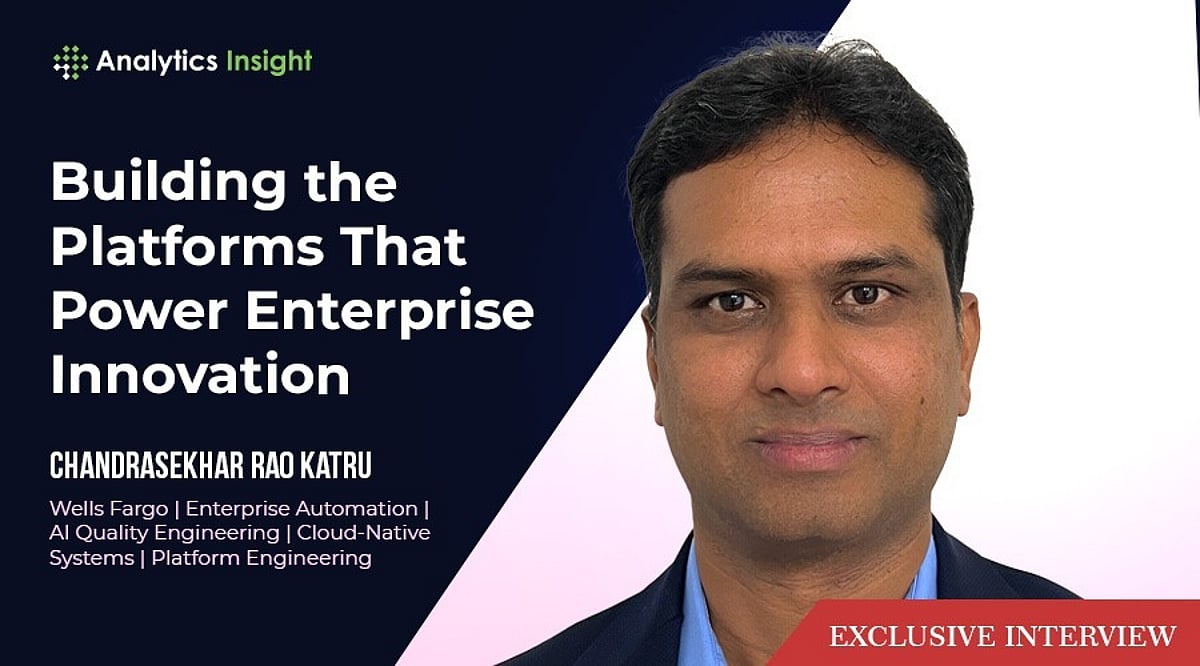
    The Architect Behind Enterprise Platforms: A Conversation on Scaling, Quality, and AI in Software Engineering

    In this interview, Chandrasekhar, a seasoned software and platform engineering leader with nearly two decades of experience, shares his journey from building telecommunications billing systems to designing the infrastructure that powers one of America’s largest banks. He discusses the principles that have guided his work, the challenges of building platforms at scale, and how he integrates AI into quality engineering while maintaining compliance in regulated environments.

    Q: Could you briefly introduce yourself and share your journey into software engineering and platform engineering?

    A: I started as a Java developer in telecommunications, writing billing systems for British Telecom. That environment is unforgiving—processing errors have direct financial consequences for customers, so correctness at the design stage is not optional.

    What pulled me toward platform engineering was a pattern I kept seeing across every organization I worked in: teams solving the same infrastructure problems in isolation, building their own tooling, making the same avoidable mistakes. The London 2012 Olympics work sharpened this. When systems serve a global audience simultaneously, the shared infrastructure underneath the application matters as much as the application itself. I started building for that layer deliberately. Twenty years on, that is still the core of what I do.

    Q: Over the past two decades, what have been the most significant lessons you’ve learned from building enterprise-scale software systems?

    A: The first is that what works for one team breaks at fifty. Scale does not give you more of the same problems—it surfaces assumptions nobody noticed they had made. Decisions that felt reasonable in year one become liabilities in year five, and the engineers who made them are often long gone.

    The second came from Weight Watchers. The SmartPoints algorithm touched millions of daily decisions about what people ate. A subtle error there was not a software bug; it was a public health issue. I carry that framing into financial services. The downstream consequences of a bad deployment are real and human, and that changes how seriously you take the platform work upstream of every release.

    The third is harder to articulate but matters as much: staying longer than is fashionable. The full lifecycle of a platform—design, adoption, scaling, failure, recovery, evolution—takes years to live through. I have seen that arc on more than one system and it has fundamentally changed how I build.

    Q: You developed an automation framework that became the standard across thousands of projects at a major financial institution. What problem were you trying to solve and what impact has it delivered?

    A: The core problem was that quality had no common language across the organization. Teams were running inconsistent configurations, different frameworks, different data strategies, different reporting formats. You could not compare quality signals across teams because the signals themselves were incompatible. Leadership had no reliable picture of delivery health at the portfolio level.

    I redesigned the framework by embedding it directly into CI/CD pipelines, ensuring that any team capable of executing a build could also execute automation. I also rebuilt the entire test result structure throughout so that logging and failure reporting would be consistent regardless of which team or application was running the tests. The impact is measurable: the framework now operates as the standard across more than 2,500 enterprise projects, quality gates are automated rather than manually enforced, and the duplicated infrastructure investment across teams has been largely eliminated.

    Q: How do you ensure software quality and governance across an organization with tens of thousands of engineers without slowing down innovation?

    A: The honest answer is that speed and governance only conflict when governance is badly designed. I have been on both sides of that. I have watched teams grind to a halt because every release needed a manual sign-off from three people. I have also built systems where compliance happened automatically and nobody had to slow down to think about it.

    What I did was embed the quality checks directly into the pipeline so they run without anyone asking them to. Tests fire automatically. Policy gates trigger automatically. Audit records get created automatically. When doing the right thing is also the fastest thing, engineers just do it. It is a design decision I made deliberately. The governance is still there—it just does not require a human in the loop at every step. In a bank that ships software every day, that is the only way it works in practice.

    Q: Can you tell us about the cloud-native execution platform you’ve built and the challenges of operating it at such a large scale?

    A: When I took on this problem, teams were running tests on static infrastructure and execution time was a significant bottleneck. Test suites had grown to the point where sequential execution was taking hours. By then automated testing stops serving its purpose—the feedback arrives after the team has already moved on and the value is lost.

    I built the platform on Kubernetes so workloads run in parallel across containerized environments. In a regulated bank, though, making execution fast is only part of the problem. It also has to be auditable, and those two requirements pull in opposite directions. I originally built on AKS for orchestration, autoscaling and Azure-native integration. I am now expanding it with OpenShift support, which adds image signing, namespace isolation and role-based access controls that compliance teams require and that can be independently verified across environments.

    The numbers reflect what that shift produced. The platform now executes over 137,000 validation jobs and approximately 875,000 automated tests within a thirty-day period, with an average execution time of around 26 minutes. Jobs that previously took hours now finish in under half an hour. But throughput is not the metric I care most about. It results in trustworthiness. Teams have to be able to act on what the platform tells them and that requires a level of reliability that does not happen by accident.

    Q: What role is AI playing in modern quality engineering and how are financial institutions leveraging it to improve software delivery?

    A: I have applied AI to strengthen the automation systems I built, while preserving the control and audit mechanisms that regulated environments require. I introduced a GenAI-based approach to extend automation coverage to approximately 800 applications that previously had none, generating tests calibrated to each application’s complexity and integrating them automatically into the test execution platform.

    I built predictive models into automation workflows that surfaced failure patterns and dependency behavior under load that manual review would have missed. In one instance, a predictive model I built identified a dependency timing issue across seemingly unrelated failures, which significantly reduced investigation time and helped teams reach the root cause faster. But I did not automate decisions based on those outputs. In a regulated environment the model provides insight—the decisions and audit trails remain under human control. The capability is real; the implementation has to be redesigned around compliance requirements before it can run in production.

    Q: As organizations continue their cloud transformation journeys, what are the biggest mistakes you see teams making when adopting cloud-native technologies?

    A: The biggest one I keep seeing is teams treating migration as a hosting decision when it is actually an architectural redesign. I have watched teams lift applications that were built around shared memory and persistent connections, drop them into containers and then spend the better part of two years debugging failures that their old architecture never produced. The containers did not break anything—they just made visible what was always there.

    The second mistake is skimping on observability—and I ran into this myself. Early in building our cloud-native platform we had a category of failures that looked completely random. Nothing in the logs connected them. I added distributed tracing and it turned out to be a container warm-up timing issue that only showed up under certain cluster loads. Without that instrumentation I would still be guessing. In a regulated environment that kind of unexplained failure is not just an ops problem—it creates a compliance problem. I built observability from the start after that.

    Q: What does effective platform engineering look like in a highly regulated environment such as banking and financial services?

    A: The platform has to answer a regulator’s question before it is asked. What was deployed? When? By whom? What validations ran before it reached production?

    Early in my platform work, I had a release that cleared every quality gate—tests ran, coverage thresholds were met, the pipeline went green. It was stopped anyway because the test execution logs were not stored in a format that satisfied the audit requirement. The capability was there; the evidence trail was not. That incident changed how I design permanently. I now ensure every automation workflow captures logs, inputs, outputs and decision points in a structured, reviewable format. Traceability is a first-class requirement from day one, not something retrofitted after a compliance review.

    Effective platform engineering here also means risk and compliance teams are design partners, not downstream reviewers. The institutions that do this well end up with platforms that are both faster to use and easier to audit, because the compliance path and the delivery path are the same path.

    Q: Your research work has received recognition from global institutions and researchers. How do you bridge the gap between academic research and real-world engineering challenges?

    A: The research grows directly out of production problems. While building the data quality dashboard platform, I kept hitting a question that existing literature did not answer well: how do you make quality signals meaningful to non-engineers at enterprise scale? I worked through it, published the findings and that paper has since been cited by researchers at Delft University of Technology, institutions across China and others across fifteen countries. But the more important outcome was that the design patterns I developed for the paper became the foundation for how I structured quality reporting across the platform itself. The research and the engineering fed each other directly.

    As a practitioner, I am accountable for systems that run in production under load in regulated environments. I cannot theorize around a failure—I have to fix it. The research pushes me to evaluate whether the failures I encounter reflect broader, generalizable patterns. That combination produces reusable solutions with documented reasoning behind them, not one-off fixes and not just theory. I have over 100 citations from researchers across fifteen countries and that reach consistently tells me the problems I am solving inside one institution are problems the global research community recognizes as important.

    Q: Looking ahead, what technology trends do you believe will have the biggest impact on enterprise software development and platform engineering over the next five years?

    A: The thing I am watching most closely is AI moving from something that helps individual developers to something that sits inside the delivery pipeline itself. In the platforms I run I am already working through early versions of this: AI-assisted test generation, predictive failure analysis, automated coverage decisions. It works, but it creates a question I do not think the industry has answered yet: how do you audit a system that is partly generating itself, at enterprise scale, inside a regulated institution? That is something I am actively designing around right now.

    The London 2012 experience comes back to me when I think about where this is heading. Those systems had to be correct before they went live. There was no patching it during the opening ceremony. AI in the pipeline raises the same question at a much larger scale and with far less transparency about why decisions were made. The institutions that work out governance early will have a real advantage. The ones that leave it for later will find out why that was a mistake.