Tag: Ether

  • Tesla Stock Drops Near $300 After Q2 Earnings Miss Triggers Market Selloff

    Tesla Stock Drops Near $300 After Q2 Earnings Miss Triggers Market Selloff

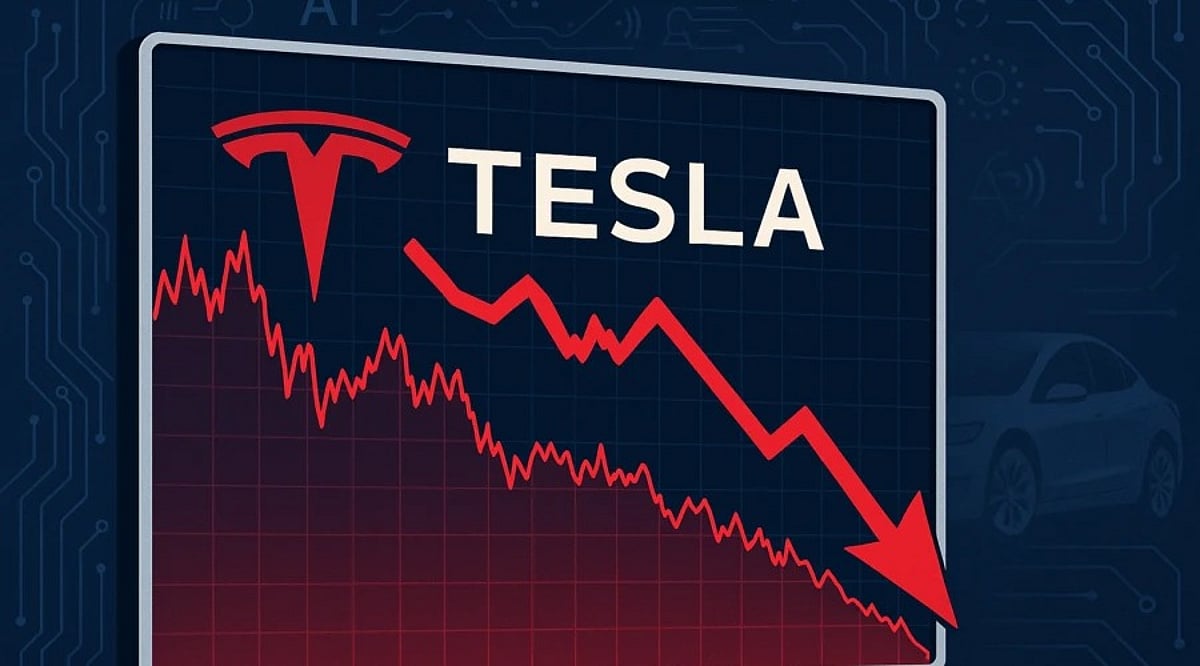
    Tesla shares fell nearly 15% after second-quarter results raised concerns over weaker margins, negative free cash flow, and rising AI spending. The selloff pushed the stock toward the $300 support area and added pressure to the NASDAQ, while Bitcoin and Ether also declined as risk sentiment weakened.

    Tesla shares closed at $313.03 on July 24 after falling 2.08% during the session. The stock also slipped to about $311.40 in after-hours trading. Over one month, Tesla lost around 16.55% as investors reassessed the company’s second-quarter results and spending plans.

    The latest decline followed a 14.52% plunge on July 23. Tesla reported record vehicle deliveries and higher revenue, yet weaker margins and negative free cash flow drew more attention. The stock now trades close to the lower end of its recent range, with $300 becoming the nearest major technical level.

    Tesla Stock Nears Key $300 Support

    Tesla stock traded as high as $322.87 on July 24 before falling to an intraday low near $306.53. Selling pressure stayed firm after the earnings-driven decline. As a result, the shares closed only a few dollars above their first major support zone.

    The area between $306.50 and $300 now serves as short-term support. A sustained close below $300 could bring the 52-week low near $297.82 back into focus. On the other hand, buyers need to reclaim the $320 to $323 range to slow the current decline.

    Stronger resistance sits between $340 and $342. Tesla traded near that area before the post-earnings gap widened. A recovery toward that range would require stronger demand and improved confidence in the company’s profit outlook.

    Record Deliveries Fail to Calm Investors

    Tesla delivered a record 480,126 vehicles during the second quarter. The total exceeded the company-compiled estimate of about 406,000 vehicles. Model 3 and Model Y deliveries reached 467,762 units and accounted for most of the quarter’s volume.

    Revenue rose 26% from a year earlier to about $28.24 billion. Automotive revenue reached nearly $20.5 billion, while services and other revenue increased 50% to $4.58 billion. These results showed that Tesla continued to expand sales across its main business lines.

    Nevertheless, investors focused on profitability. Tesla’s operating margin fell to 1.4% from 4.1% a year earlier. Lower vehicle prices and higher costs supported deliveries but reduced earnings from each sale.

    The weaker margin also raised questions about how quickly Tesla can turn rising sales into stronger cash generation. This issue became more important as the company increased spending on artificial intelligence, batteries, robotics, and autonomous-driving systems.

    AI Spending Adds Pressure Across Markets

    Tesla’s capital expenditure reached about $5.8 billion during the quarter. Free cash flow turned negative by roughly $1.1 billion, marking the company’s first quarterly cash burn in more than two years. Tesla also expects annual capital spending to exceed $25 billion.

    The company continues to fund robotaxi development, artificial intelligence infrastructure, next-generation manufacturing, and the Optimus robot program. Meanwhile, investors are waiting for clearer revenue growth from these projects as costs rise in the near term.

    The concern spread beyond Tesla. Alphabet shares also fell as investors reviewed higher artificial intelligence spending plans. It raised its 2026 capital expenditure guidance to between $195 billion and $205 billion, up from its earlier range.

    The NASDAQ moved lower as investors reduced exposure to high-growth technology stocks. Risk-off trading also reached digital assets. Bitcoin fell about 1.8% toward $64,800, while Ether dropped around 3% to nearly $1,870. Concerns over technology spending affected several risk markets during the same trading period.
  • Kraken Rolls Out USD-Settled Bitcoin and Ether Options on Kraken Pro

    Kraken Rolls Out USD-Settled Bitcoin and Ether Options on Kraken Pro

    Kraken has launched cash-settled Bitcoin and Ether options through its Kraken Pro platform, expanding its derivatives lineup. The exchange introduced European-style, USD-settled contracts via request-for-quote (RFQ) trading for eligible international clients. The rollout currently excludes Europe, North America, and Australia, though a European launch is planned for the future.

    Kraken Opens a New Options Channel

    Announced on Thursday, the new options settle in US dollars and follow European-style exercise terms. Kraken initially made them available through RFQ execution. The offering targets eligible international clients outside Europe, North America, and Australia. The exchange already holds the regulatory permissions needed to offer crypto derivatives in Europe and expects to roll out the product there later.

    The new contracts cover Bitcoin and Ether, two of the most actively traded digital assets. Kraken framed the launch as part of a broader effort to build a comprehensive financial platform around trading, payments, and digital asset services.

    Kraken Frames Options as an Underused Market

    Alexia Theodorou, Kraken’s director of derivatives, noted that crypto options still trail traditional markets by a wide margin. She said professional and institutional capital continues to move into digital assets, gradually closing that gap. Theodorou emphasized that the larger opportunity lies in expanding the market rather than chasing market share alone. She pointed out that the current crypto options market serves a narrow group of traders, leaving room for broader participation.

    She also attributed the slow growth of crypto options to product design rather than lack of demand. According to her, many traders have favored perpetual futures because those products feel simpler and more familiar.

    Simpler Contracts, Wider Access, and Margin Tools

    Kraken designed the contracts as linear, USD-settled products. This structure removes the need to manage crypto collateral or settlement. Premiums, profit and loss, and final settlement all use US dollars. The exchange placed the options inside the same unified account that clients already use for spot and futures trading. Portfolio margin is enabled by default, and offsetting positions can reduce collateral requirements across products.

    Users can also post collateral in more than 30 currencies. Kraken has added educational tools to its interface, explaining calls, puts, and multi-leg positions for traders using Kraken Pro.

    Theodorou said options matter because they let investors take positions on price, volatility, and time. Kraken plans further updates, including a public order book for better price discovery, broader geographic access, and support for more assets.

  • Bitcoin Climbs Near $64,800 as Inflation Eases and Solo Miner Strikes 3.125 BTC

    Bitcoin Climbs Near $64,800 as Inflation Eases and Solo Miner Strikes 3.125 BTC

    Bitcoin rallied to nearly $64,800 on Wednesday after softer U.S. inflation data lowered expectations for another Federal Reserve interest rate hike. Ether and major altcoins also advanced. Separately, a solo miner using a low-cost Bitaxe machine earned 3.125 BTC by validating a Bitcoin block.

    Cooling Inflation Lifts Bitcoin and Ether

    Headline inflation fell to 3.5% in June from 4.2%, beating economists’ forecasts. Core inflation also eased to 2.6% from 2.9%, signaling broader price pressures are weakening. Traders quickly reduced the implied probability of a rate increase this month from 43% to 13%, while the two-year Treasury yield dropped six basis points.

    Bitcoin gained 3.6% over 24 hours and 3.3% for the week, with trading volume reaching about $31 billion. Ether rose 5.3% to nearly $1,880 and gained 7.1% across seven sessions. HYPE added 6.4%, while XRP, Solana, Dogecoin, and BNB also moved higher.

    Higher interest rates typically reduce demand for Bitcoin and other risk assets, as cash and Treasury bonds become more attractive. Cooler inflation reduces pressure on the Fed to raise rates, encouraging investors to move capital back into cryptocurrencies and equities.

    Global Markets Follow Inflation Signal

    Equity markets responded to the same inflation report. The MSCI Asia Pacific index rose 2.3%, its biggest monthly advance as technology stocks led gains. South Korea’s Kospi surged 8.2%, reclaiming its position as the best-performing major benchmark this year. SK Hynix jumped 13% in Seoul.

    Brent crude rose 1% above $85 a barrel for a third consecutive session. President Trump threatened further strikes on Iran, while the United States resumed its blockade of Iranian shipping through the Strait of Hormuz. CoinEx chief analyst Jeff Ko noted that Bitcoin remains a rate-sensitive risk asset rather than a macroeconomic hedge. The report eased immediate pressure but did not confirm a lasting breakout.

    Core inflation remains above the Federal Reserve’s 2% target, giving officials room to hold rates steady rather than a clear reason to cut. Ko identified the September Federal Open Market Committee meeting as the next major test. Dollar movements and sustained Bitcoin exchange-traded fund flows could also influence the market.

    Solo Miner Secures Rare Bitcoin Block

    A solo miner validated Bitcoin block 957382 on Friday using one low-cost Bitaxe machine. The miner received the standard 3.125 BTC subsidy, worth about $200,000. Blockchain data from mempool.space recorded the successful block. Public Pool later linked the result to a single Bitaxe rig through a post on X.

    Bitaxe is a budget, low-power Bitcoin miner with an estimated hashrate near 1 terahash per second. That capacity is extremely small compared with the total Bitcoin network hashrate, which is dominated by large industrial operations. Bitcoin mining depends on probability rather than equipment size alone, so any valid attempt can still solve a block, though the chance is tiny.

    The miner did not receive a special reward; every successful solo miner qualifies for the standard block subsidy after producing a valid block. The result shows that hobby-scale equipment can still occasionally secure a full subsidy, despite the network’s increasingly competitive mining environment.

    What’s Next?

    Bitcoin climbed near $64,800 as cooling U.S. inflation reduced expectations for another Federal Reserve rate increase. Ether and global equities also advanced, while a solo Bitaxe miner secured 3.125 BTC. Traders should now watch interest-rate signals, ETF flows, and broader market momentum.

  • Trump Shifts $1.4 Billion in Crypto Profits to Stocks and Bonds, Filings Reveal

    Trump Shifts $1.4 Billion in Crypto Profits to Stocks and Bonds, Filings Reveal

    Donald Trump’s latest financial filings with the US Office of Government Ethics reveal that he earned more than $1.4 billion from his family’s crypto businesses in 2025. Instead of keeping those profits entirely in digital assets, he invested a large portion into traditional stocks and bonds, according to a review by Reuters.

    The filings show that Trump’s traditional investment portfolio grew at least four times over the past two years. By the end of 2025, his stock and bond holdings were estimated to be worth between $703 million and $2.6 billion, up from $225 million to $608 million a year earlier. While exact figures are not provided, financial experts say the documents clearly indicate a preference for moving crypto earnings into more stable, conventional investments.

    Most of the crypto income came from World Liberty Financial and the Trump meme coin, which became major revenue sources during the year. Despite the shift, Trump continues to hold significant crypto assets: the filings show he owns 15.75 billion World Liberty Financial governance tokens valued at over $50 million, and companies linked to him hold at least $160 million in Bitcoin and Ether, along with up to $6 million in other digital tokens.

    Timothy Massad, director of Harvard University’s Digital Assets Policy Project and former chairman of the Commodity Futures Trading Commission, commented: “The filings show an interesting investment strategy.” He believes Trump earned large profits from crypto projects and then placed much of that money into stocks and bonds for greater financial stability.

    The White House stated that Trump’s assets remain in accounts managed by independent financial institutions. The Trump Organization said the filings reflect a strong financial position with valuable assets and healthy liquidity, but did not explain why much of the crypto income later appeared in traditional investments. World Liberty Financial emphasized its commitment to digital assets, saying the company “continues building for the future and believes digital assets will play a major role in financial services over the coming years.”

    The disclosures come amid reports that retail investors in four Trump-backed crypto projects had lost about $2.3 billion by April, increasing criticism from some lawmakers who question the ethics of public officials profiting from crypto while supporting friendly policies for the industry. Eric Trump continued promoting Bitcoin throughout the year, calling it one of the world’s strongest financial assets, even as his father’s filings showed growing investments in stocks and bonds.

    Overall, the filings paint a clear picture: crypto earnings generated billions in 2025, but stocks and bonds remain the preferred destination for protecting and growing wealth over the long term.

  • Dogecoin and HYPE Lead Weekly Crypto Decline as Bitcoin Steadies Near $60K

    Dogecoin and HYPE Lead Weekly Crypto Decline as Bitcoin Steadies Near $60K

    The cryptocurrency market suffered another turbulent week, with Dogecoin and Hyperliquid’s HYPE token posting the steepest losses among major digital assets. Dogecoin dropped 9.6% to trade near $0.076, while HYPE fell 9.9%, making it the worst performer tracked over the seven-day period. Ether declined 8.4% to approximately $1,581, and XRP lost 7.8% to trade around $1.06.

    Bitcoin, the largest cryptocurrency by market capitalization, fell 5.3% to roughly $60,345 on Saturday. It briefly dipped to around $58,800 on Friday before buyers stepped in to push the price back above the $60,000 support level. The recovery limited Bitcoin’s weekly decline, though the asset remains close to its long-term 200-week moving average.

    Market analyst Alex Kuptsikevich noted that Bitcoin approached $58,000 late Thursday and early Friday before “aggressive buying” returned. He described the price movement as similar to margin liquidations followed by buy orders placed at lower levels. However, Kuptsikevich expressed doubts about the sustainability of the recovery. “Investors should prepare for continued pressure and periodic sell-off spikes,” he warned, suggesting institutional investors may reduce crypto exposure to protect their balance sheets.

    Crypto Futures Liquidations Surpass $590 Million

    The week’s volatility triggered significant liquidation events across crypto futures markets. According to Coinglass data, approximately $217 million in futures positions were liquidated in the 24 hours ending June 27, with the weekly total exceeding $590 million. Bitcoin accounted for $71.04 million in liquidations, while Ether represented $50.61 million. Solana positions produced roughly $20.58 million in liquidations, and XRP traders lost about $2.43 million.

    Liquidations occur when trading platforms close leveraged positions after traders can no longer meet margin requirements, often amplifying short-term price swings. In this case, Bitcoin’s move below $59,000 triggered further selling before pending buy orders supported the recovery toward $60,000.

    Solana and Tron Show Relative Stability

    Among major cryptocurrencies, Solana and Tron demonstrated more stable price action. Solana traded close to $72, while Tron held near $0.32. Both tokens were roughly unchanged for the week, despite the broader market weakness. Their performance stood in contrast to memecoins and larger altcoins that faced heavier selling pressure.

    Wall Street Rotation Leaves Crypto Behind

    While crypto markets struggled, US stock markets exhibited a different pattern. Investors rotated away from semiconductor companies and directed funds toward a wider range of businesses linked to steady economic growth. The S&P 500 ended the week little changed, though the majority of companies within the index gained. The equal-weight S&P 500 even reached a record high.

    The movement indicates that investors have not fully left risk assets but have become more selective about where they allocate capital. Rather than flowing into cryptocurrencies, funds leaving chipmakers moved into other stock sectors, leaving Bitcoin and major altcoins without support from the broader market rotation.

    Multiple Pressures Weigh on Crypto

    Cryptocurrencies faced separate headwinds from US spot Bitcoin exchange-traded fund outflows, a hawkish Federal Reserve, and dollar strength. The strong dollar reduces the appeal of alternative assets like crypto, while expectations that interest rates could remain high dampen speculative demand. Bitcoin’s position near its 200-week moving average kept traders focused on further downside risk as Dogecoin, HYPE, Ether, and XRP ended the week with deeper losses.