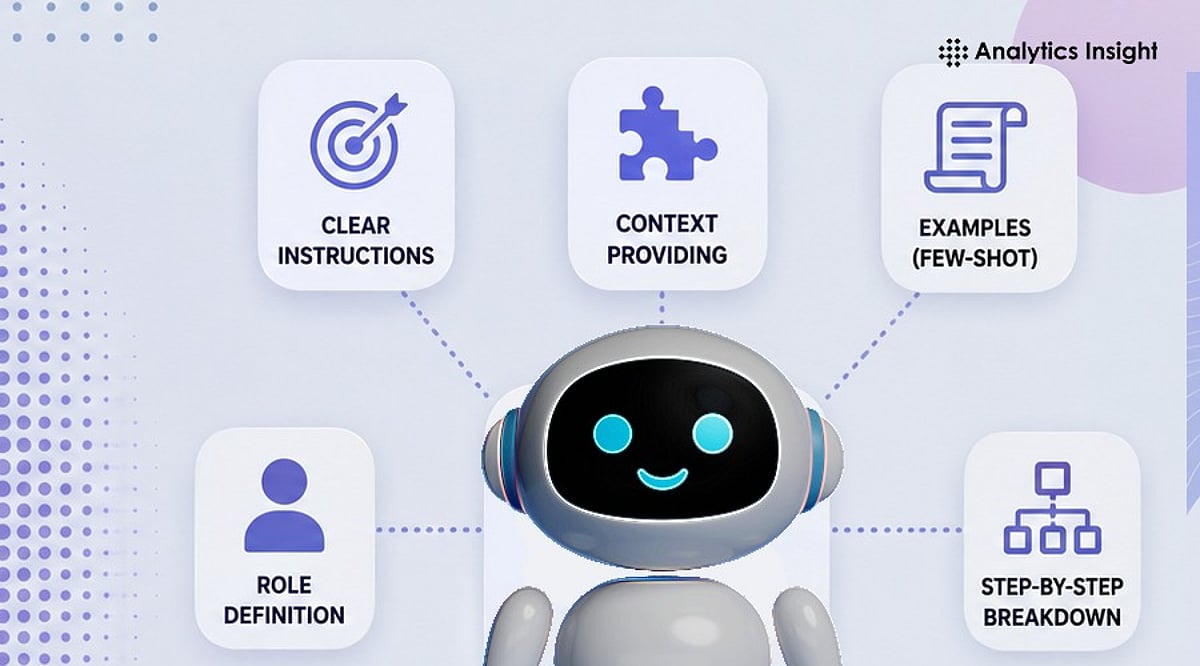
Prompt engineering is the practice of crafting clear instructions for AI models to produce specific, useful results. A vague request often yields a vague answer, while a well-structured prompt delivers accurate, formatted, and actionable responses. Modern prompt engineering goes beyond clever phrasing—it treats prompts as part of a larger system that includes context, examples, tools, output formats, evaluation, and iterative refinement.
What Prompt Engineering Really Means
At its core, prompt engineering involves creating precise instructions that tell an AI model what task to perform, what information is relevant, what constraints apply, and what the final output should look like. For example, instead of asking for a generic “report about customers,” a strong prompt specifies the five most common complaints, separates product issues from service problems, and presents results in a table with columns for issue, frequency, evidence, and suggested action. This structure gives the model a clear target and makes the output easier to verify.
The Basic Parts of a Strong Prompt
A useful prompt typically includes five core components:
- Task: The exact job the model must complete.
- Context: Relevant facts or background information.
- Constraints: Limits on what to include or avoid.
- Output format: The structure of the final response (e.g., table, bullet points, summary).
- Quality criteria: Standards that define a successful answer.
Clear section labels, such as Markdown headings or XML-style tags, help separate these elements and guide the model. OpenAI recommends structured prompts with relevant context, examples, and evaluation for reliable results. This approach also applies to long prompts—more context does not mean more detail; relevance matters more than volume.
Why Context Matters More Now
Modern AI systems handle text, images, audio, video, files, structured data, retrieved information, and external tools. This expansion has transformed prompt engineering into context engineering, which asks: what information should reach the model at a specific point in a task? The answer may include instructions, previous messages, company documents, search results, examples, database records, or tool outputs. For instance, a support AI that receives the correct company policy can answer a customer question with far more control than one that only sees the customer’s query.
Zero-Shot and Few-Shot Prompts
Zero-shot prompts give a task without examples—e.g., “Summarize this contract in 200 words.” Few-shot prompts include examples that demonstrate the desired output, such as providing sample inputs and correct labels before a classification task. While few-shot methods remain useful, their effectiveness varies across model families and generations. Recent research shows that techniques like few-shot and chain-of-thought prompts do not yield consistent gains across all modern models.
Reasoning Models Need a Different Approach
Older prompt advice emphasized step-by-step reasoning requests. However, modern reasoning models can handle complex problems without explicit reasoning instructions. For example, Google’s Gemini 3 guidance favors concise, direct prompts for newer reasoning models. This highlights a crucial lesson: no single prompt formula works for every model. Prompt design should match the model, task, and desired result rather than follow a fixed recipe.
Evaluation Has Become Essential
A prompt can look perfect yet fail on real examples. Production AI systems require tests that measure output quality across representative cases. Effective evaluation compares prompt versions, checks accuracy, detects regressions, and confirms whether a change improves results. This makes prompt engineering closer to software development than casual chat. Version control is also important—OpenAI’s current API guidance treats prompts as part of a development workflow with testing and controlled changes. OpenAI has announced the planned shutdown of its v1/prompts endpoint on November 30, 2026.
The Next Stage of Prompt Engineering
Prompt engineering now extends beyond better wording. Modern systems combine instructions with retrieval, structured outputs, multimodal inputs, tool use, and evaluation. The strongest approach treats a prompt as one part of a complete AI workflow: clear instructions set the goal, good context supplies the facts, tools extend the model’s capabilities, output schemas control results, and evaluation shows whether the system works. This shift gives prompt engineering a practical role—not to craft clever sentences for surprising answers, but to build reliable AI systems that deliver consistent results across real tasks and conditions.
Frequently Asked Questions
- What is prompt engineering? Prompt engineering is the practice of creating clear instructions that guide an AI model toward a specific result.
- Why does prompt engineering matter? It improves clarity, control, consistency, and usefulness in AI-generated responses.
- What makes a prompt effective? A strong prompt clearly defines the task, context, constraints, output format, and quality requirements.
- What is few-shot prompting? Few-shot prompting provides an AI model with examples that demonstrate the expected response for a new task.
- Is prompt engineering only about writing better prompts? No. Modern prompt engineering also covers context, retrieval, tools, structured outputs, model-specific methods, and systematic evaluation.