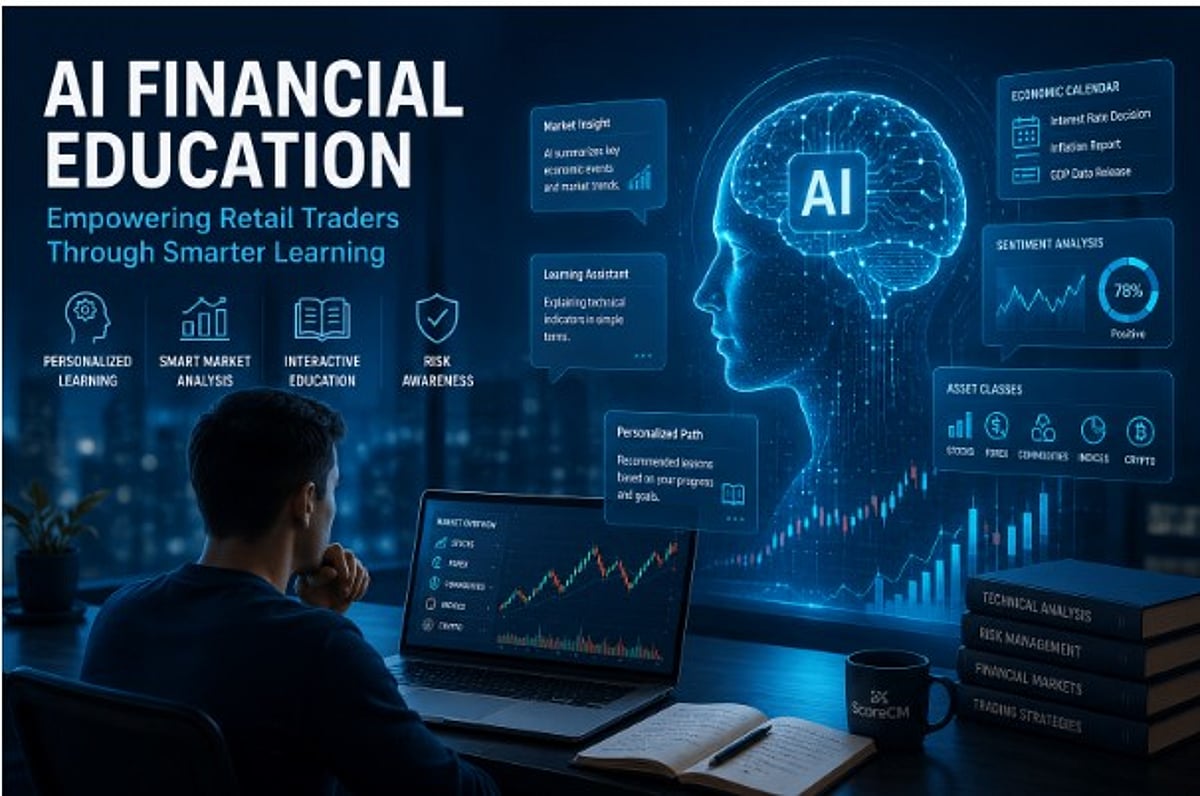
AI financial education is transforming how people develop the knowledge needed to participate in modern financial markets. In the past, learning about investing often meant reading lengthy textbooks, attending seminars, or spending years gaining experience through trial and error. Today, artificial intelligence is making investment education more interactive, personalized, and accessible to retail traders around the world.
The rapid growth of financial technology has introduced new ways to understand complex market concepts. AI-powered tools can organize large amounts of financial data, explain technical indicators, summarize economic news, and generate educational content tailored to different experience levels. Instead of searching through dozens of articles, learners can receive structured explanations that match their current understanding.
As financial markets become increasingly connected and data-driven, AI is helping make financial literacy more achievable for individuals interested in stocks, forex, commodities, indices, and cryptocurrencies.
Personalized Learning Through Artificial Intelligence
One of the biggest advantages of artificial intelligence is its ability to personalize education. Every retail trader begins with different levels of knowledge, learning styles, and investment goals. Traditional educational materials often follow a fixed structure that may not suit everyone.
Machine learning allows educational systems to adapt based on a learner’s progress. Beginners can receive simplified explanations of concepts such as market trends, diversification, or technical analysis, while more experienced traders can explore advanced topics involving macroeconomic indicators, algorithmic trading concepts, or risk management strategies.
AI-powered learning platforms can also identify knowledge gaps by analyzing quizzes, study habits, and user interactions. Instead of presenting the same lessons to every learner, they can recommend relevant educational materials that strengthen weaker areas.
At the same time, many investors continue using trusted educational resources alongside AI. As they expand their understanding of financial markets, some also explore ScoreCM to access publicly available market insights and educational materials that support continuous learning without replacing independent research.
Smarter Market Analysis and Information Processing
Financial markets generate enormous volumes of information every day. Economic reports, corporate earnings, geopolitical events, central bank announcements, and breaking news all influence market sentiment across multiple asset classes.
Artificial intelligence is helping retail traders process this information more efficiently. Natural language processing enables AI systems to summarize lengthy reports, identify recurring themes in financial news, and explain how major events could influence different markets.
For educational purposes, this creates a valuable learning environment. Rather than simply presenting raw data, AI can explain why inflation reports matter, how interest rate decisions affect currencies, or why commodity prices respond to changes in global supply chains.
This educational approach encourages users to understand relationships between economic events instead of memorizing isolated facts. Whether studying stocks, forex, commodities, indices, or cryptocurrencies, learners gain broader context that improves their overall market awareness.
Machine learning models can also recognize historical patterns and organize complex datasets into visual formats that are easier to interpret. While these insights should never be treated as predictions, they provide useful educational examples for understanding market behavior.
AI Should Support Critical Thinking, Not Replace It
Despite its growing capabilities, AI should be viewed as a learning assistant rather than a substitute for human judgment.
Artificial intelligence can organize information, explain financial concepts, and highlight patterns within historical data. However, markets remain influenced by human behavior, unexpected geopolitical developments, regulatory changes, and emotional decision-making that cannot always be captured through algorithms.
Retail traders benefit most when they use AI to strengthen their analytical skills instead of relying on automated conclusions. Critical thinking remains essential when evaluating information, questioning assumptions, and managing investment risk.
Structured learning continues to play an important role in building these skills. Platforms such as ScoreCM Academy demonstrate how organized educational resources can complement learning by helping traders gradually build stronger market knowledge through structured courses and continuous education.
Combining AI-generated insights with independent research allows learners to develop confidence while maintaining realistic expectations about the uncertainty of financial markets.
Financial Literacy Matters More Than Ever
The growing accessibility of investing has created new opportunities for individuals worldwide. Mobile applications, online trading platforms, and digital financial services have reduced many of the traditional barriers to entering financial markets.
However, easier access also increases the importance of financial literacy. Understanding concepts such as portfolio diversification, volatility, leverage, inflation, and risk management remains essential regardless of the technology available.
AI financial education can support this objective by making difficult subjects easier to understand. Interactive explanations, conversational learning tools, personalized quizzes, and real-world examples help learners absorb information more effectively than static educational materials alone.
Better financial literacy also reduces the likelihood of making decisions based solely on social media trends, rumors, or emotional reactions. As AI continues improving educational accessibility, it can encourage more informed participation across global financial markets.
The Future of AI in Financial Education
The possibilities that lay ahead for AI in the field of finance do not just end at automation and analytics. Technology in education can become one of the most important uses of artificial intelligence, especially in cases where retail traders need to acquire practical knowledge before getting involved in the financial markets.
Learning programs of the future may include elements of conversational AI, adaptive courses, market simulation, multilingual instruction, and visual interaction all within a single digital learning system.
Concurrently, ethical AI development will be equally important. It is imperative that the educational material provides clear explanations about the underlying concepts and teaches users to double-check the received information using several sources.
AI will not replace conventional education, but it will help open more opportunities for acquiring knowledge and learning in an efficient manner. Combined with financial literacy and critical thinking, AI can revolutionize the understanding of complex financial markets by retail traders.
In light of the ongoing technology development, one can say that the most efficient learner will be one who embraces the assistance of AI and makes his/her own judgments independently from it. In that regard, the use of AI for financial education is a combination of technological innovation and steps forward towards improving knowledge of the market.