Tag: Fraud Detection

  • Truecaller Launches Scam Checker: Real-Time Fraud Detection Powered by Community Intelligence

    Truecaller Launches Scam Checker: Real-Time Fraud Detection Powered by Community Intelligence

    Truecaller has unveiled its new Truecaller Scam Checker, a dedicated web and Android destination designed to help users quickly assess suspicious links, phone numbers, and messages. The tool leverages the collective scam intelligence of over 500 million users to provide instant, actionable insights before individuals engage with potential fraud.

    Available initially in India on the Android app and globally via the Truecaller website, Scam Checker consolidates multiple scam-detection capabilities into a single, user-friendly interface. This initiative extends Truecaller’s core mission beyond caller ID and spam blocking to a more proactive, community-driven approach to fraud prevention.

    Key Features of Truecaller Scam Checker

    With this new tool, users can:

    • Check suspicious links for signs of phishing or malicious intent.
    • Search phone numbers to see what Truecaller’s detection systems and community signals reveal.
    • Browse Scamfeed reports to discover similar scams reported by other users.
    • Describe a concern in their own words and receive relevant results, including checks on any links or numbers mentioned in the query, along with related community reports.

    These features collectively address the three components of a typical scam message: a number, a link, and a story. Users can now verify all three simultaneously in seconds, empowering them to make informed decisions before responding.

    Future Expansion and Availability

    Truecaller plans to broaden Scam Checker’s capabilities in the near future, including wider coverage of scam techniques, screenshot uploads for richer analysis, and user authentication features. The company also intends to roll out the service to additional regions and iOS devices at a later date.

    “People often sense that something is wrong, but they need a quick way to check before responding,” said Rishit Jhunjhunwala, CEO of Truecaller. “Scam Checker brings together our detection capabilities and what our community has reported so that people can investigate a suspicious link, number or story in one place.”

    About Truecaller

    Truecaller is an essential communication tool for 500 million active users worldwide, with over one billion downloads since launch. In 2025 alone, the platform identified 68 billion spam and fraud calls. Headquartered in Stockholm, Truecaller is a GSMA member and has been publicly listed on Nasdaq Stockholm since October 2021. For more information, visit truecaller.com.

  • Exploring Synthetic Data in AI: Advantages, Challenges, and Enterprise Applications

    Exploring Synthetic Data in AI: Advantages, Challenges, and Enterprise Applications

    Synthetic data is rapidly becoming a cornerstone of modern AI development. By generating artificial datasets that mimic real-world information, enterprises can overcome limitations in data availability, privacy, and diversity. This article explores the key benefits, potential risks, and practical use cases of synthetic data in enterprise AI.

    Key Benefits of Synthetic Data

    Expanding AI Training Volumes

    When real-world data is scarce or expensive to collect, synthetic datasets provide a scalable alternative. Enterprises can generate large volumes of labeled data to train and refine AI models without relying on limited real-world samples.

    Enhancing Data Privacy

    Synthetic data reduces exposure to sensitive information. By using artificially generated records, organizations can comply with privacy regulations while continuing data-driven development and analytics.

    Improving Bias Testing

    Real-world datasets often underrepresent certain scenarios. Synthetic data can fill these gaps, enabling teams to test model behavior across diverse conditions and identify hidden biases that might otherwise go unnoticed.

    Enabling Robust Product Testing

    Enterprises can generate controlled datasets to simulate unusual, complex, or high-risk operational scenarios. This allows thorough testing of software, AI applications, and workflows before deployment.

    Enterprise Use Cases

    Fraud Detection in Finance

    Financial institutions use synthetic data to simulate fraudulent transactions and unusual behaviors. This helps train AI systems to detect rare but critical fraud patterns that are infrequent in real-world data.

    Healthcare Applications

    Synthetic patient records support medical research and AI model development while reducing reliance on identifiable health information. This improves data accessibility and accelerates innovation in diagnostics and treatment planning.

    Enterprise Scalability

    Organizations can generate datasets tailored to specific business requirements, reducing dependence on scarce real-world information. This flexibility accelerates AI development projects across industries.

    Risks and Governance Challenges

    Data Quality Risks

    Poorly generated synthetic datasets may contain unrealistic patterns, errors, or hidden biases. These flaws can reduce model reliability and lead to misleading outcomes if not properly validated.

    Governance and Validation

    Enterprises must establish robust governance controls before using synthetic data operationally. This includes documenting generation methods, monitoring for bias, and validating dataset quality to ensure trustworthiness.

    Conclusion

    Synthetic data offers enterprises a powerful tool for AI training, privacy protection, and bias testing. However, its benefits come with responsibilities. Organizations that invest in data quality assurance and governance will be best positioned to harness synthetic data’s full potential while mitigating risks.

  • 10 Real-World Machine Learning Use Cases Reshaping Industries

    10 Real-World Machine Learning Use Cases Reshaping Industries

    Machine learning (ML) has evolved from a niche technology into a core enabler across industries. From fraud alerts that block suspicious payments in seconds to medical scans that assist in early disease detection, ML identifies patterns in data and uses them to make predictions, decisions, or take actions. Today’s systems go beyond recommendation engines, embedding AI into real business processes. Here are ten practical ways machine learning is applied in the real world.

    1. Recommendations and Personalization

    Streaming services, online retailers, music apps, and social platforms use ML to predict what users may want next. By analyzing past choices and viewing history, systems leverage deep learning and embeddings to deliver personalized experiences. Personalization is now integrated into larger AI ecosystems.

    2. Fraud Detection and Financial Risk

    Banks, payment processors, and insurers deploy ML to detect unusual activity. Models examine account history, location, device data, and transaction timing. Anomalous patterns can trigger reviews or block transactions. ML also supports credit risk assessment and insurance fraud investigation.

    3. Healthcare and Medical Diagnosis

    ML models analyze medical images, patient records, and lab results. Hospitals use ML for disease risk prediction, patient triage, image analysis, drug discovery, and clinical decision support. For instance, India’s eSanjeevani platform applies AI for retinal checks and differential diagnosis, while PM-JAY uses ML for fraud detection.

    4. Predictive Maintenance in Industry

    Factory sensors capture temperature, vibration, pressure, energy use, and sound. ML learns normal operating patterns and flags potential failures before they occur. This reduces unplanned downtime in aircraft engines, vehicles, power systems, data centers, and robotics.

    5. Computer Vision and Quality Control

    Computer vision enables machines to interpret images and video. Manufacturers use ML to detect product defects on assembly lines. Healthcare systems inspect medical scans. Multimodal AI systems combine visual data with text and other inputs for richer analysis.

    6. Search, Speech, and Language

    Search engines, speech recognition, translation services, email filters, virtual assistants, and chatbots rely on ML. Models classify text, convert speech to text, rank search results, and generate summaries. Large language models now process text, images, audio, and video. Stanford’s 2026 AI Index highlights rapid gains in multimodal capabilities and real-world task performance.

    7. Forecasts and Supply Chains

    Retailers apply ML to estimate demand using historical sales, seasonality, promotions, pricing, weather, and other signals. These forecasts improve inventory management, delivery routing, energy demand planning, and pricing decisions.

    8. Cybersecurity and Threat Detection

    Cybersecurity teams face massive volumes of logs, network events, and device signals. ML identifies patterns that deviate from normal behavior, helping detect malware, phishing emails, suspicious logins, account compromises, and potential data breaches.

    9. Autonomous Systems and Robotics

    ML enables robots, drones, autonomous vehicles, and industrial systems to interpret sensor data and choose actions. Self-driving cars combine computer vision, sensor fusion, prediction, and route planning. Robots navigate large warehouses to move goods. Gartner lists physical AI as a major data and analytics trend.

    10. Software Development and AI Agents

    Software teams use ML for code generation, code review, bug fixing, testing, documentation, and issue analysis. Advanced AI agents connect models with development tools to automate multi-step workflows. Applied’s April 2026 report studied nearly 200 real-world AI use cases across 200+ companies, 25 industries, and 15 business functions—operations accounted for 38.6% and software development for 21.4%.

    The Shift from Prediction to Action

    The most significant change in ML is the move from isolated predictions to integrated actions. Modern systems link predictions with tools, data, and business processes. Gartner notes organizations are adopting AI-first business models. Deloitte reports that worker access to sanctioned AI tools rose 50% in 2025, and the number of companies with at least 40% of AI projects in production is expected to double within six months. This shift demands reliable data, clear controls, and rigorous evaluation. Successful AI initiatives may invest up to four times more in data and analytics foundations than less successful ones. ML now acts as a core layer shaping decisions, operations, software, and physical tasks across numerous industries.

  • Agentic AI Reshapes Banking, Payments, and Fintech: Key Insights

    Agentic AI Reshapes Banking, Payments, and Fintech: Key Insights

    Agentic AI is poised to revolutionize the financial sector by moving beyond simple customer service to autonomously handling complex banking tasks, payments, and fraud detection. This technology enables AI agents to analyze spending, execute transactions, and offer personalized financial advice, all while reducing manual effort and improving efficiency.

    Smarter Banking Decisions

    Agentic AI can analyze a customer’s spending habits, understand their financial goals, compare available options, and take approved actions. From moving money between accounts to managing recurring payments, these systems make everyday banking more automated, faster, and user-friendly.

    AI-Powered Payments

    Instead of manually completing every step of a payment, an AI agent can identify bills, check payment details, and complete transactions after receiving permission. It also monitors upcoming expenses and reminds users about payments, making digital transactions more convenient and organized.

    Fraud Detection Gets Proactive

    Traditional fraud systems react to unusual activity after it occurs. Agentic AI continuously monitors transactions, customer behavior, and account activity to spot risks earlier. It can investigate unusual patterns, request additional verification, and alert financial institutions, enabling faster threat response.

    Personalized Financial Services

    By studying a customer’s financial activity, Agentic AI offers tailored services such as spending pattern analysis, expense management suggestions, and savings planning. Unlike basic recommendation tools, AI agents can follow through on approved actions, turning suggestions into practical steps.

    Faster Fintech Operations

    Fintech companies handle large volumes of customer requests, transactions, compliance checks, and data. Agentic AI automates repetitive processes and coordinates tasks across systems, reducing manual work and allowing teams to focus on complex issues, product development, and business decisions.

    A New Role for Human Bankers

    Agentic AI does not eliminate the need for human employees. Instead, it handles routine tasks while bankers focus on areas requiring judgment, relationships, and complex financial advice. Human oversight remains essential, especially when AI agents make decisions involving money, sensitive data, or financial risk.

    The Road Ahead for Agentic Finance

    Agentic AI is pushing banking and fintech toward services that act rather than simply respond. Customers may increasingly rely on AI agents to manage routine financial tasks across accounts and services. This shift raises important questions about security, privacy, accountability, consent, and the degree of control customers grant AI systems.

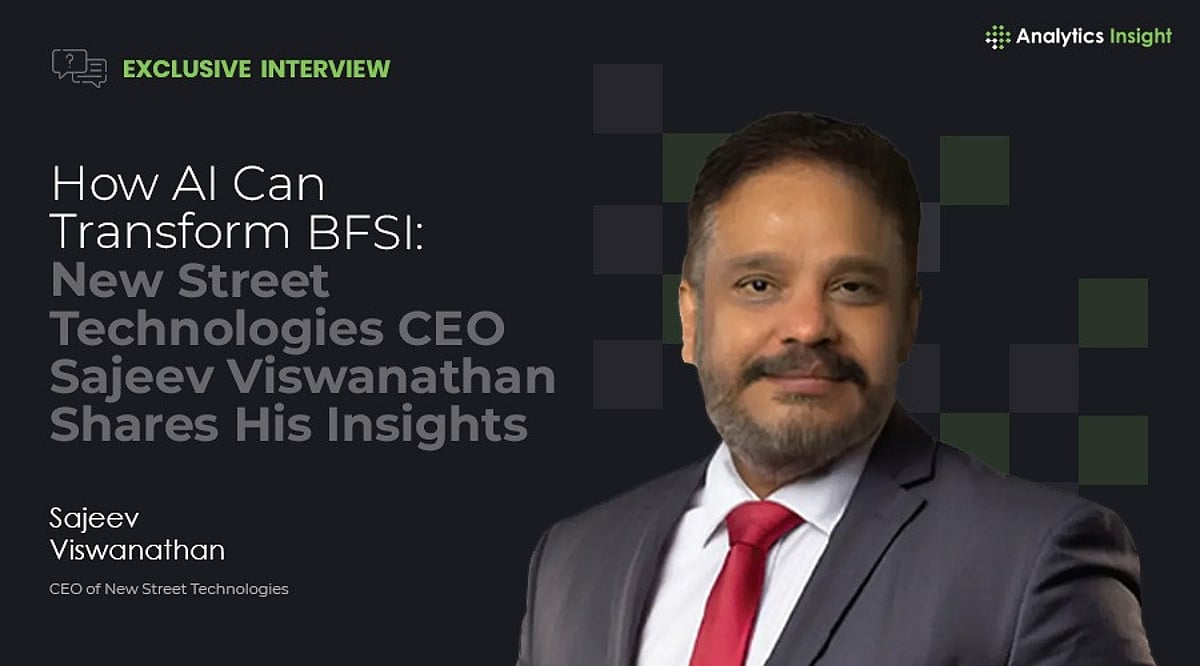
  • AI in Banking: Sajeev Viswanathan on Connected Intelligence, Governance, and Fraud Prevention

    AI in Banking: Sajeev Viswanathan on Connected Intelligence, Governance, and Fraud Prevention

    In a recent interview, Sajeev Viswanathan, CEO of New Street Technologies, shared his vision for how artificial intelligence can transform the banking, financial services, and insurance (BFSI) sector. Rather than deploying AI as isolated point solutions, Viswanathan argues that financial institutions must build a connected, governed intelligence layer that spans the entire organization.

    According to Viswanathan, fragmentation occurs when AI is deployed as a collection of individual tools—such as a voice bot in one department, a coding assistant in another, and employees using consumer-grade LLMs for research. While each may solve a local problem, collectively they create new silos, data boundaries, and governance challenges. The solution is not to ban these tools but to provide a common foundation: a shared layer for identity, audit, version control, and domain intelligence.

    Viswanathan emphasizes the importance of Domain Intelligence Models (DIMs)—permissioned, shared intelligence that multiple processes and products can draw upon, with an optional interface to external LLMs when needed. Keeping AI decoupled from production execution is also critical. When AI-generated designs pass through maker-checker approval before deterministic engines run them, institutions achieve consistency and auditability by design.

    On fraud detection and regulatory compliance, Viswanathan notes that industry-specific AI models—shaped around BFSI transaction patterns, SWIFT message structures, KYC/AML workflows, and regulatory reporting formats—can identify anomalies that general-purpose models miss. However, the real strength comes from the architecture: separating AI that flags or designs from the deterministic engine that executes, ensuring explainability, auditability, and human oversight. Privacy is built in by allowing domain intelligence to be permissioned without moving sensitive customer data outside its governed environment.

    Viswanathan believes that as AI models become more accessible, differentiators will shift from model size to governance, deployment architecture, data strategy, and execution discipline. Banks that can implement regulatory changes in hours or launch new products in days on a well-governed platform will have a significant advantage. Key metrics like time-to-market and total cost of technology ownership become crucial.

    Regarding collaboration to combat financial crime, Viswanathan suggests that shared pattern intelligence and threat signals can be exchanged without compromising competitive advantage. Fraud typologies and money laundering patterns are not areas of competition; differentiation comes from customer experience, pricing, and product design. Federated approaches—where signals or models are shared while underlying data remains local—are particularly relevant. Regulator-sponsored or industry utility models also hold promise.

    Looking ahead, Viswanathan sees industry-specific AI ecosystems becoming as foundational as payment networks. Banks should prioritize three things: modernizing the operational core (not just customer-facing channels), embedding governance by design (audit trails, version control, maker-checker workflows, human oversight), and investing in domain intelligence rather than relying solely on generic AI tools. Ultimately, customers will choose a bank not because it uses AI, but because it responds faster, manages risk better, and earns their trust. AI may be the engine, but trust remains the defining differentiator.

  • Vizillo AI Review: AI-Powered Fraud Detection and Scam Awareness Tool

    Vizillo AI Review: AI-Powered Fraud Detection and Scam Awareness Tool

    Overview

    Vizillo AI is a comprehensive security and scam detection tool powered by artificial intelligence. Designed to protect users from scams, fraudulent activities, suspicious links, malware, and other digital threats, the app consolidates multiple security features into one platform. With a rating of 4 out of 5, it offers scam awareness, malware scanning, risk permission checks, SMS safety, and encrypted VPN browsing. While it has some drawbacks, the app serves as a strong second layer of digital security.

    Key Features

    • Analyzes suspicious messages, links, emails, and websites for scam-related warnings.
    • Scans installed apps for harmful activity and security risks.
    • Evaluates incoming notifications for phishing threats and suspicious links.
    • Checks app permissions for hazardous access or privacy issues.
    • Provides encrypted web browsing through an integrated VPN.

    Benefits

    • Enhanced protection against common online scams and suspicious behavior.
    • Consolidates multiple security components into a single app.
    • AI-powered detection of suspicious messages, links, and websites.
    • Identifies risky app permissions.
    • Combines scam detection, malware scanning, SMS checks, and VPN in one tool.

    Challenges

    • May require extensive permissions for notification and SMS scanning.
    • Advertising can impact user experience.
    • Some users may face registration or account setup issues.
    • Automated scam detection cannot guarantee catching all fraudulent messages.
    • VPN and security features may raise privacy concerns if not handled carefully.

    Pricing and Subscription Plans

    Vizillo AI offers three tiers: Free, Basic, and Pro. The Free version costs $0 and includes 3 scam checks per day, website verification, app threat detection, and community Q&A. The Basic plan provides unlimited scam checks, real-time malware detection, Smart Shield monitoring, website and app scanning, phone and email scam checks, and ad-free browsing. The Pro plan adds OSINT investigation, image forensics, AI scam analysis, priority support, and unlimited daily scans, along with a 3-day free trial.

    Support Options

    The platform offers a help center with security-related information, privacy resources, scam awareness guidance, and product documentation. Customer support is available via email at Support@verifyscams.com, along with the developer’s website and privacy resources.

    Conclusion

    Vizillo AI brings together a range of digital security features — AI-powered scam awareness, malware detection, permission analysis, notification scanning, and VPN browsing — making it highly convenient for users who frequently encounter unknown messages, websites, links, or apps. However, negative store ratings, registration issues, ads, and permission requirements should be considered. For best results, use Vizillo AI as a secondary layer of security alongside other protective measures.

  • Agentic AI in Indian Banking: From Chatbots to Autonomous Decision-Making

    Agentic AI in Indian Banking: From Chatbots to Autonomous Decision-Making

    Artificial intelligence in Indian banking has largely meant chatbots that answer balance queries, recommendation engines that suggest the next product, and fraud models that flag suspicious transactions for a human to review. That era is ending quickly. What is emerging now is agentic AI: a class of systems that does not just respond to a prompt, but plans, decides and acts across multiple steps without waiting for a human to approve each move.

    The shift is not cosmetic. It changes how credit gets underwritten, how KYC gets verified, how fraud gets stopped, and how service teams spend their day. The numbers behind it are large enough to demand attention. The operational details are messy enough to demand caution.

    From Prompt-Response to Plan-and-Act

    Traditional automation in banking, including robotic process automation and early generative AI tools, worked on a simple pattern: a human triggers a task, the system executes a fixed script, and the output goes back to a human for the next step. Agentic AI breaks that pattern. An agent is given a goal—something like “resolve this customer dispute” or “underwrite this loan application”—and then independently queries APIs, pulls data from multiple systems, applies reasoning and takes the next action, often chaining several steps together before a human ever sees the result.

    This matters technically because RPA breaks the moment an interface or a data format changes. Agentic systems, built on reasoning loops that plan, act and adjust based on outcomes, can handle edge cases a rules-based script cannot. That flexibility is precisely why banks are willing to give these systems more autonomy, and precisely why the risk profile looks different from anything that came before.

    The global market for agentic AI in financial services is estimated at close to $7.8 billion in 2026, up from around $5.5 billion a year ago, on a path toward more than $43 billion by 2031. That implies a compound annual growth rate above 41 percent. Even accounting for the usual noise in market-sizing reports, growth at that scale signals genuine capital commitment rather than marketing enthusiasm.

    More telling than the headline number is the adoption curve inside institutions. Around 44 percent of financial services teams report actively using agentic AI in 2026, several hundred percentage points higher than early 2025. Among the largest global banks, more than seven in ten now have programs that have moved past proof-of-concept into production or advanced piloting. Fintechs and neobanks, unburdened by decades-old core banking systems, are moving faster still. A parallel market has emerged around governance: platforms that monitor, audit and constrain what autonomous agents are allowed to do are already valued near $9 billion in 2026 and expected to cross $14 billion within five years. That the oversight layer is growing almost as fast as the core technology tells you banks understand autonomy without control is not a viable strategy in a regulated industry.

    Where Agentic AI Is Actually Being Used

    Fraud detection and anti-money laundering account for the largest functional share of agentic deployments, roughly a third of all use cases by some estimates. Fraud patterns shift constantly, transaction volumes are enormous, and the cost of a missed signal is high. Agents that correlate cross-border transaction patterns, flag anomalies and take a first action such as placing a temporary hold offer a meaningful edge over static rule engines.

    Credit underwriting has moved from experimental to operational. Rather than a loan officer manually pulling GST filings, bank statements and alternate data sources, an agent queries multiple verification APIs in parallel and produces a draft underwriting memo within seconds. The human role shifts from gathering data to reviewing a structured recommendation.

    Onboarding and KYC verification follow a similar pattern. Multi-agent architectures orchestrate biometric de-duplication, registry lookups against systems like CKYC, and fraud checks simultaneously instead of sequentially, cutting what used to take hours down to near real time. For insurers, agentic workflows validate first-notice-of-loss claims, cross-check damage documentation and trigger payouts on small claims without human intervention.

    This is no longer confined to individual institutions. NPCI is developing a Unified Agent Protocol that would let verified AI agents execute UPI payments without the user approving every transaction, having already piloted agentic payments publicly at the last Global Fintech Fest. When the country’s payment rails are themselves being redesigned for agents, the question for banks is not whether to participate but how quickly they can be ready.

    Across these use cases, institutions report autonomous resolution rates exceeding 80 percent for structured tasks such as dispute triage and routine compliance checks. That is a real productivity gain, but it carries a specific risk. When 80 percent of the easy work disappears, what remains is disproportionately the hard, ambiguous and emotionally charged work that agents are not yet trusted to handle alone. Support staff are left with an inbox of complex disputes and fraud complaints from customers who have already been through an automated flow that failed them. Industry estimates put the AI and data skills gap inside BFSI global capability centres at around 42 percent, meaning a significant share of the workforce lacks the combination of financial domain knowledge and technical fluency these systems demand.

    The Design Problem Hiding Inside the Technology Problem

    Most of this conversation treats agentic AI as an engineering problem. It is at least as much a design problem. Autonomy only creates value if a customer can understand what an agent is about to do on their behalf, and a supervisor can see why it did what it did. That is interface work: consent screens that make agent permissions legible rather than buried inside a mandate flow, explanations that surface the two or three factors behind a credit decision instead of a confidence score, and override controls that are obvious under pressure rather than three taps deep.

    In Indian retail banking, where a large share of users transact in a second language on an entry-level device, this is not polish. It is the difference between an agent people trust with a payment and one they switch off. Banks that ship autonomy without designing the visible layer around it will find adoption stalling for reasons no amount of model retraining can fix.

    Security and Governance Cannot Be an Afterthought

    Giving an autonomous agent the ability to query core banking systems, move funds or freeze accounts introduces a new category of cybersecurity concern. Agent permissioning, meaning precisely defining what each agent may do and rate-limiting how often it can act, is now a primary vulnerability that did not exist in the same form when humans initiated every transaction. Meanwhile fraud itself is becoming more sophisticated, with a large share of advanced attempts involving generative AI or synthetic voice, pushing banks to deploy defensive agents that evaluate behavioural biometrics and liveness signals in real time.

    Regulators in India have been explicit that autonomy does not remove accountability. Under SEBI’s updated Cybersecurity and Cyber Resilience Framework, regulated entities such as brokers, asset managers and depositories remain directly liable for the actions of their AI systems, closing off any defence built around blaming the algorithm. The Reserve Bank of India has taken a similarly clear position that high-stakes decisions, including credit rejections, loan restructuring and account closures, must retain a human in the loop and remain explainable, even as agentic systems handle the surrounding workflow. India’s data protection framework adds another layer, requiring that every autonomous action, data query and API call an agent makes be logged into an auditable trail a human can review after the fact.

    Agentic AI in BFSI is not a distant trend. It is already running fraud checks, assembling credit memos and triaging disputes inside real institutions today, and it is moving into the payment rails themselves. The technology has proven it can compress work that used to take hours into seconds. What remains unresolved is whether BFSI organizations can build the governance, workforce readiness and design discipline to match the pace of deployment.

    The institutions that get this right will be the ones treating agentic AI as a governance, people and design problem as much as a technology problem, measuring success not by how much work an agent completes on its own, but by how well the humans on both sides of it—customers and supervisors alike—can understand, correct and take responsibility for what it does.

  • How Contactless Payments Work: The Technology Behind the Tap

    How Contactless Payments Work: The Technology Behind the Tap

    Contactless payments feel instant, but layers of security work underneath. NFC connects the device to the terminal. EMV and tokenization protect card credentials. Cryptography authenticates each transaction. Issuers apply fraud checks before approval. Credentials are steadily fading from view, becoming identity systems.

    A tap takes a moment. Behind that moment sits a stack of technology built over two decades, involving radio waves, cryptography, and a chain of banking infrastructure most people never see.

    Contactless payment has become routine at grocery counters, metro gates, and coffee shops. Few people using it understand what happens between the tap and the beep. The customer sees tap, beep, done. The payment system performs several steps in rapid succession: connection, credential exchange, cryptographic authentication, authorization, and fraud screening. That contrast is the real story.

    Near Field Communication Starts the Transaction

    Every contactless transaction begins with Near Field Communication (NFC). This is a short-range radio technology that activates only within a few centimeters. The card or phone contains a small antenna and chip. The payment terminal generates a low-power magnetic field. When the two come close, the card’s chip draws power from that field itself, without needing a battery.

    A contactless card has no power source. The terminal effectively wakes the chip during the tap, powers it briefly, and exchanges data before the field disappears. NFC communication itself happens in milliseconds, though the full authorization that follows depends on the payment network, the issuer, and the terminal.

    What the Card or Phone Actually Sends

    Physical cards use EMV chip security to generate transaction-specific authentication data during each tap, while digital wallets can add tokenization to protect the underlying card number. These are related but distinct systems. A physical contactless card and a phone-based wallet protect the transaction differently, even though both work to prevent the raw card number from being freely exposed.

    This distinction matters for anyone comparing payment methods. A lost physical card still carries some exposure risk tied to its chip data. A lost phone, by contrast, typically exposes only a token linked to that one device, not the underlying account number itself.

    Cryptography Makes Each Transaction Different

    The payment chip, whether on a card or in a wallet, uses cryptographic processes to generate transaction-specific authentication data. Because that data is tied to the individual transaction, simply copying information captured from one payment does not produce a valid second transaction.

    On the device side, contactless cards use secure chips to hold and protect payment credentials. Some phones use dedicated secure hardware, while other payment architectures use different combinations of tokenization, trusted execution environments, and software-based security. The exact setup varies by device manufacturer and payment system, and no single architecture applies across all devices.

    From Tap to Bank Approval

    The tap is only the first step. The terminal reads the payment credentials and transaction data, then sends an authorization request through the merchant’s payment infrastructure. The payment network routes that request to the card issuer, which checks the account and applies fraud controls before returning an approval or decline. Settlement, where funds actually move between banks, happens later. The instant beep at checkout marks approval, not completion of the full payment cycle.

    Why Some Payments Still Ask for a PIN

    Many contactless systems apply a transaction-value limit before requiring additional verification, such as a PIN. Some issuers can also require verification after a series of contactless transactions. These controls limit the potential exposure from repeated low-friction payments while keeping everyday purchases fast. Card networks and regulators typically review these limits periodically based on fraud data and regional banking rules, rather than fixing them permanently.

    Fraud Detection Works Behind the Scenes

    Fraud protection does not stop at the tap. Issuers and payment providers watch for patterns during authorization, checking things like past transaction behavior, the device being used, and where the merchant sits in the risk spectrum. This means security is not resting on a single moment. It is spread across a system built to catch problems before approval happens.

    That same thinking now fits on a wrist or a finger. Contactless payments have moved into rings and smartwatches, letting people pay without pulling out a card or phone at all. What stands out is not the new form factor itself, but how easily the same protection travels with it. The hardware keeps changing shape. The security underneath stays consistent.

    The Future of Payments Is Becoming Credentialless

    Contactless payment succeeds by moving complexity away from the customer, not by eliminating it. NFC provides the connection, EMV and tokenization protect payment credentials, and cryptographic processes authenticate the transaction. The next shift is making those credentials even less visible to users. A card number may already be hidden behind a phone, watch, or other device, turning payment into an identity and authentication process rather than a simple exchange of card details.

    Final Thought

    The physical card is slowly losing its importance, even though it still looks the same at checkout. Biometrics and device identity are already doing more of the verification behind the scenes. So the tap itself won’t change much for a while. But what’s happening underneath it will keep getting quietly upgraded.

  • How AI Agents Are Revolutionizing Banking and Financial Services in 2026

    How AI Agents Are Revolutionizing Banking and Financial Services in 2026

    Artificial intelligence is moving far beyond simple chatbots in the banking sector. As of 2026, AI agents are handling complex tasks across credit assessment, fraud detection, customer service, and capital markets, fundamentally reshaping how financial institutions operate. A global study conducted by Cambridge Judge Business School, the Bank for International Settlements, the International Monetary Fund, and the World Economic Forum reveals that 81% of financial firms now use AI at some level, though only 14% consider it transformational for strategy and competitive advantage. This indicates widespread adoption but limited deep integration.

    AI Agents Go Beyond Chatbots

    The most significant shift is the emergence of AI agents that can perform multi-step tasks. Unlike chatbots that only answer questions, agents can review documents, check policy rules, identify missing data, prepare credit cases, and route them for human approval. Citi has developed Arc, an internal platform for AI agents used in research and task execution. Fiserv launched agentOS, a platform with policy controls, audit trails, and human oversight. This evolution positions AI as a work partner rather than a mere information source.

    Faster and Smarter Credit Decisions

    AI is transforming credit assessment by analyzing cash flow, account activity, income patterns, business data, and repayment history together—far beyond traditional forms and fixed checks. This wider view enables lenders to make faster decisions with less paperwork. BCG highlights agent-led credit journeys, faster credit review, and more personalized collections as key AI opportunities. Better data usage also helps lenders identify risk earlier.

    The AI Fraud Race

    Fraud detection has become an AI-versus-AI battle. Criminal groups use AI for fake identities, deepfakes, and phishing at scale. Banks now combine rules, machine learning models, graph analysis, and generative AI to detect unusual activity. The Federal Reserve has endorsed this multi-layered approach. Systems assess transactions alongside account links, device signals, merchant activity, and past behavior to reveal patterns missed by single-transaction checks.

    Customer Service: From Answers to Action

    AI assistants now go beyond answering balances and fees. They can help set savings targets, review expenses, and suggest plans. With proper permissions, they can even execute tasks like moving money or paying bills. Visa introduced an AI Financial Assistant in July 2026 for banks, noting that over 66% of surveyed Americans who used generative AI had sought financial advice through it. This creates a path from advice to approved action.

    Specialist AI in Capital Markets

    Banks use specialized models for market research, risk checks, liquidity forecasts, portfolio management, and foreign exchange. In August 2026, Citi, HSBC, and Standard Chartered adopted Ant International’s Falcon Time-Series Transformer Model 2.0, which reportedly cuts FX hedge and allocation costs by over 60%. Specialist AI models now play a stronger role across financial markets.

    Trust and Control Matter More Than Ever

    AI brings serious risks: model errors, data access issues, fraud, cyber threats, and poor decisions. The Financial Stability Board issued a June 2026 consultation on responsible AI use in finance, focusing on generative and agentic AI. The UK Financial Conduct Authority also warned about risks to firm operations, customer journeys, competition, fraud, and cybersecurity. Strong controls are as important as model quality.

    The Next Bank Model

    The next major change will come when AI agents gain secure access to core bank systems. A customer could grant an agent a clear task, expense limit, and permission to act, allowing it to compare products, move money, pay bills, or manage cash within set rules. This transforms AI from support to core system component. The strongest banks will combine robust data capabilities, modern infrastructure, useful AI agents, and firm controls. The central race now is about safe AI use at scale.

    Key Takeaways

    • AI agents now handle complex banking tasks across credit, fraud, research, and customer service.
    • Banks use AI to improve speed, accuracy, and personalization across financial services.
    • Strong governance, cybersecurity, privacy, and human oversight remain essential for safe AI adoption.

    Frequently Asked Questions

    How is AI changing banking in 2026?

    AI is transforming credit decisions, fraud detection, customer service, compliance, research, and other core banking processes.

    What are AI agents in banking?

    AI agents can complete multi-step tasks such as checking documents, applying rules, and preparing cases for human approval.

    Can AI improve fraud detection?

    Yes. Banks combine AI models, rules, and graph analysis to identify unusual transaction patterns and potential fraud.

    How does AI affect customers?

    AI provides faster support, personalized financial guidance, and with proper approval, helps customers complete financial tasks.

    What are the main risks of AI in finance?

    Key risks include cyber threats, data privacy issues, model errors, fraud, and poor decisions without suitable human oversight.

  • 10 AI-Powered Insurtech Companies Reshaping Insurance in 2026: A Deep Dive

    10 AI-Powered Insurtech Companies Reshaping Insurance in 2026: A Deep Dive

    Overview

    Ten companies made this list on verified deployments, named carrier partners, and reported metrics, not marketing claims. Coverage spans claims computer vision, repair workflows, fraud detection at two different stages, underwriting, actuarial pricing, cyber risk, and full-lifecycle AI insurance. Every figure below traces to a company report, carrier statement, or 2026 industry filing.

    A cyber insurer that stops seven in ten attacks before they land. A claims platform that settles a policy in two seconds flat. These are production numbers from carriers running AI as the core engine of underwriting, claims, and fraud detection, not a support feature bolted onto old workflows. The ten companies below made this list on verified deployments, named carriers, and outcomes anyone can check. A few well-known names got left out, since nothing tied their claims to a specific carrier result or a sourced number.

    What Makes These Insurtechs Leaders in 2026

    Three things separate a genuine leader from a company that simply mentions AI in its pitch deck. AI has to run a core operation, not sit beside it as a support tool. A named carrier, broker, or regulator has to confirm the result in public. And the deployment has to run at scale, across thousands of policies or claims, not a small cohort of early testers. Model sophistication barely matters here. What matters is how much of a workflow AI now finishes without a person stepping in.

    Claims and Damage Assessment: Tractable

    Millions of vehicle and property photos, collected since 2014, taught Tractable’s computer vision system to read collision damage the way a seasoned appraiser would, only faster. The platform reviews car damage with roughly 95% accuracy and turns a photo into a repair estimate in seconds, work that once took 30 minutes. GEICO and 25 of the world’s top 100 insurers now run claims through it, an adoption that pushed Tractable past a $1 billion valuation.

    Claims and Repair Workflow: CCC Intelligent Solutions

    Where Tractable reads the damage, CCC manages what happens next: repair shop, parts, and paperwork between insurer and body shop. Its Mobile Jumpstart tool already initiates 98% of repair estimates for one of the largest multi-store repair operators in the country. This quarter, a top-five insurer became CCC’s biggest customer yet for its AI-based subrogation tool, which automates the reimbursement claims carriers file against each other.

    Fraud Detection After the Claim: Shift Technology

    Claims fraud rarely announces itself, which is the problem Shift Technology’s Paris-built platform was designed to catch. AXA extended its partnership with Shift for five more years to widen fraud detection and underwriting checks across its global business, and Covéa signed on in early 2026 for a fraud framework spanning the entire policy lifecycle. Shift runs its models on Azure OpenAI Service, so carriers get newer AI without losing the compliance layer around it.

    Fraud Screening at the Point of Application: FRISS

    Shift catches fraud after a claim gets filed. FRISS catches it earlier, scoring an application for risk before a policy is even issued. Canadian insurer SGI brought the platform on in January 2026 to flag suspicious requests while speeding up legitimate ones, and a partnership with ForMotiv now folds in behavioral data captured during the application itself.

    Underwriting Built Around Continuous Risk: Cytora

    Commercial underwriting used to work off a single snapshot: an application filled out once, reviewed once, and revisited a year later. Cytora tore that model up with a platform that keeps absorbing broker emails, documents, and calls as new risk data shows up. Zurich Insurance is rolling it out across more than 20 markets over 16 months, and manual triage time there has already dropped from 75 minutes to 15 per submission. Markel and Travelers have adopted it too.

    Underwriting for Workers Comp and Group Health: Gradient AI

    Most insurtechs chase auto or property. Gradient AI went after a line most competitors ignore: workers’ compensation and group health risk scoring. Managing general underwriter BTIS adopted the platform for sharper workers’ comp pricing. One regional carrier running Gradient’s model cut its average quote turnaround from three days to under four hours by pre-scoring every submission and sending only the borderline cases to a human.

    Pricing and Actuarial Modeling: Akur8

    Pricing has always been the hardest place to trust a black box, since regulators expect an actuary to explain exactly why a rate moved. Akur8 built its platform around that constraint, offering machine learning transparent enough to survive review. More than 300 insurers across 40 countries now use it, including AXA, Generali, and Tokio Marine, and over 3,000 actuaries build pricing and reserving models in the system daily.

    Cyber Insurance’s AI-Native Leaders: Coalition and At-Bay

    Cyber risk changes by the hour, which is why Coalition built its ‘Active Insurance’ model around continuous scanning of a policyholder’s exposed systems instead of a one-time application. The company covers roughly 110,000 active policyholders and says they see about 70% fewer claims than the broader cyber market. At-Bay takes a similar approach to early warning. Its 2026 InsurSec Report, built from more than 100,000 policy years, recorded an all-time high average claim severity of $221,000, a figure it now uses to sharpen pricing before renewal.

    The Fully AI-Native Insurer: Lemonade

    No company on this list runs AI through more of the policy lifecycle than Lemonade. Its chatbots take 96% of first notices of loss without a person involved, and 55% of all claims settle from start to finish in seconds. The underwriting side backs that up: Lemonade’s gross loss ratio fell to 62% in the first quarter of 2026, down from 83% two years earlier, an improvement solid enough that the company now keeps more risk on its own books instead of handing it to reinsurers.

    Comparison Table

    Company Focus Area Key Metric Notable Partner
    Tractable Claims & Damage Assessment 95% accuracy, seconds to estimate GEICO
    CCC Intelligent Solutions Claims & Repair Workflow 98% estimates initiated via AI Top-five insurer
    Shift Technology Fraud Detection (post-claim) Extended partnership with AXA AXA, Covéa
    FRISS Fraud Screening (pre-issue) Real-time risk scoring SGI
    Cytora Continuous Underwriting Manual triage: 75 min to 15 min Zurich Insurance
    Gradient AI Workers Comp & Group Health Quote turnaround: 3 days to <4 hours BTIS
    Akur8 Pricing & Actuarial Modeling 300+ insurers, 40 countries AXA, Generali
    Coalition Cyber Insurance 70% fewer claims 110,000 policyholders
    At-Bay Cyber Insurance $221,000 avg claim severity 100,000+ policy years
    Lemonade Full-Lifecycle AI 55% claims settled in seconds Gross loss ratio 62%

    Final Thoughts

    Strip away the branding, and a pattern sits underneath all ten companies. Each one picked a single narrow job — reading a damaged photo, scoring a fraud risk, filing a rate change — and letting AI carry that job from start to finish instead of just assisting the person doing it. Regulators are starting to ask carriers to explain an AI decision, not just report it, and that shift will reward platforms built for scrutiny over ones chasing the broadest AI story. Watch which companies can show their work.

    FAQs

    1. What are AI-powered insurtech companies?

    AI-powered insurtech companies use artificial intelligence to improve insurance operations such as underwriting, claims processing, fraud detection, customer service, and risk assessment. Their technologies help insurers make faster, more accurate decisions while enhancing customer experience.

    2. Which are the leading AI-powered insurtech companies in 2026?

    Some of the leading AI-powered insurtech companies in 2026 include Lemonade, Coalition, At-Bay, Cytora, Akur8, Gradient AI, Tractable, Shift Technology, and FRISS, each specializing in different AI-driven insurance solutions.

    3. How is AI transforming the insurance industry in 2026?

    AI is enabling insurers to automate claims, improve underwriting accuracy, detect fraud in real time, personalize policy pricing, and streamline customer interactions. These advancements reduce costs while improving operational efficiency and customer satisfaction.

    4. What makes an AI-powered insurtech company a market leader?

    Leading AI-powered insurtech companies combine advanced AI capabilities with insurance expertise, strong partnerships, scalable platforms, and proven business impact. Their solutions deliver measurable improvements in risk assessment, claims management, and policy administration.

    5. What are the biggest AI trends shaping insurtech in 2026?

    Key trends include agentic AI for workflow automation, AI-assisted underwriting, computer vision for damage assessment, real-time fraud detection, embedded insurance, and personalized pricing powered by predictive analytics.