

Tag: freshers

  • Top Full Stack Java Interview Mistakes Freshers Must Avoid to Land the Job

    Top Full Stack Java Interview Mistakes Freshers Must Avoid to Land the Job

    Full Stack Java interviews have evolved significantly. Today, employers look beyond rote memorization and expect candidates to demonstrate practical knowledge, confident communication, and logical problem-solving. For fresh graduates, avoiding common pitfalls can make the difference between advancing or being rejected. This guide covers the most frequent mistakes and provides actionable preparation strategies.

    Why Memorized Answers Fail

    Many freshers spend weeks memorizing answers from websites or videos, but this approach rarely succeeds. Interviewers quickly detect memorized responses and often ask follow-up questions to test genuine understanding. Instead of recalling definitions, focus on explaining core Java concepts—inheritance, polymorphism, encapsulation, and abstraction—using simple examples from your projects. This shows practical experience and helps interviewers see how you apply knowledge in real situations.

    Resume Preparation: Less Is More

    Listing too many technologies on your resume without solid practice creates unnecessary pressure. Every item can become a question. Hiring teams pay special attention to the project section. Be ready to discuss your project’s goals, architecture, database choices, API design, and challenges. Honest answers always outperform exaggerated claims. A small, well-understood project carries more weight than a large one with weak explanations.

    Master Java Fundamentals First

    Core Java is the foundation of every Full Stack Java interview. Recruiters expect proficiency in OOP, collections, exception handling, strings, generics, multithreading basics, and memory management. Topics like HashMap, ArrayList, StringBuilder, JVM, JDK, and JRE are common. Jumping directly to Spring Boot without solid Java basics often causes confusion during technical rounds. Strong fundamentals build confidence and help you solve coding problems clearly.

    SQL Skills Are Non-Negotiable

    Database knowledge is critical for Java development. SQL questions appear regularly: CRUD operations, JOINs, GROUP BY, HAVING, subqueries, normalization, and indexes. Many freshers lose points by writing incorrect queries or failing to explain database design. Good SQL skills demonstrate your ability to manage application data accurately and support backend development.

    Coding Practice That Builds Confidence

    Coding rounds test reasoning, not memory. Expect tasks with arrays, strings, HashMap, lists, recursion, stacks, queues, and simple algorithms. Write clean code, use clear variable names, and explain each step as you go. Interviewers favor candidates who talk through their solution—it shows poise and logical thinking. Solving problems silently in your head rarely impresses.

    Modern Java Features Show Readiness

    Knowledge of features introduced after Java 8 is increasingly important. Be comfortable with lambda expressions, Stream API, Optional, method references, and functional interfaces. These improve code quality and are used in real projects. Using simple project examples to illustrate them proves practical understanding.

    Spring Boot and Frontend Knowledge Complete the Picture

    Spring Boot is central to many Full Stack Java projects. Understand dependency injection, REST APIs, Spring Data JPA, Hibernate, validation, exception handling, and application architecture. Connect every concept to project work, not just definitions.

    Frontend skills also matter. Basic knowledge of HTML, CSS, JavaScript, and either React or Angular is common. Be ready to explain how frontend pages communicate with backend services via APIs. This shows complete full stack understanding rather than isolated technical expertise.

    Small Details That Influence Results

    Git proficiency is now a standard requirement. Know how to create repositories, commit changes, branch, merge, push, pull, and resolve conflicts. These skills show readiness for team-based development.

    Communication cannot be overlooked. Clear, concise explanations help interviewers grasp your technical knowledge quickly. Practice mock interviews and project discussions to build natural confidence.

    Final Thoughts

    Succeeding in a Full Stack Java interview requires sound knowledge, strong fundamentals, coding ability, database skills, and clear communication. Recruiters appreciate candidates who explain ideas in detail, approach problems logically, and speak honestly about their projects. Comprehensive preparation across Java, Spring Boot, SQL, frontend technologies, Git, and coding practice creates a balanced profile and greatly improves your chances in today’s competitive job market.

    Frequently Asked Questions

    1. Which Java topics get the most attention during interviews?
    Core Java, OOP concepts, collections, exception handling, multithreading basics, and Java 8 features are the most common.

    2. Why do interviewers ask detailed questions about projects?
    Project discussions help measure practical knowledge, problem-solving ability, and technology understanding.

    3. Is SQL important for a Full Stack Java interview?
    Yes. Recruiters frequently ask about CRUD operations, JOINs, subqueries, indexes, and database design.

    4. Which frontend skills should freshers prepare?
    Basic HTML, CSS, JavaScript, and knowledge of React or Angular demonstrate complete full stack skills.

    5. How can freshers improve interview performance?
    Regular coding practice, concept revision, honest project preparation, and clear communication help build confidence.

  • Top CSE and IT Interview Questions Every Fresher Should Master

    Top CSE and IT Interview Questions Every Fresher Should Master

    Recruiters evaluate far more than technical knowledge in a first CSE or IT interview. They assess problem-solving, communication, coding fundamentals, and project understanding across every interview stage. A structured preparation plan focused on concepts, practical scenarios, and consistent practice helps candidates build confidence and perform better.

    The Question Behind Every Question

    Most freshers walk into their first technical interview expecting a quiz. What they actually face is closer to an audit of how they think. A recruiter asking about linked lists rarely cares whether the definition is memorized. They want to see reasoning happen in real time: how a problem gets broken down, where the logic might fail, and how clearly that thinking gets explained out loud.

    A first CSE or IT interview, whether for a campus placement drive or an entry-level software developer role, usually spans programming, data structures, object-oriented concepts, databases, operating systems, networks, and behavioral rounds. The exact mix shifts with the role. A developer position leans heavily on coding and algorithms, while IT support or infrastructure roles lean more on troubleshooting and systems knowledge.

    Programming: Where Code Quality Gets Tested

    Programming questions reveal how a candidate writes and reasons about code, not just whether syntax gets remembered correctly. Common ground includes the difference between a compiler and an interpreter, how loops and conditionals behave, and how a broken program gets debugged. Interviewers watch closely for whether a candidate clarifies the problem first, writes readable code, and checks edge cases before calling a solution finished. Estimating the time and space complexity of a solution matters here too, even for problems that look simple on the surface.

    Data Structures and Algorithms: Where Efficiency Gets Tested

    DSA questions move the focus from writing code to choosing the right approach. Expect arrays, linked lists, stacks, queues, hash tables, trees, and graphs to come up regularly. A candidate might be asked to detect a cycle in a linked list or compare breadth-first and depth-first search. These questions judge algorithmic thinking and awareness of trade-offs between time and space. Recognizing patterns across problems matters more than memorizing solutions.

    Object-Oriented Programming: Where Design Thinking Gets Tested

    Object-oriented questions assess how a candidate structures software rather than how many terms they can define. Encapsulation, inheritance, polymorphism, abstraction, and the difference between overloading and overriding come up often. A simple example, such as a payment system supporting multiple payment methods, tends to surface how abstraction works in practice. Freshers also face basic version control questions, including the difference between Git and GitHub or how a merge conflict gets resolved. Since most entry-level roles involve collaborative codebases.

    DBMS and SQL: Where Data Modeling Gets Tested

    Database questions check whether a candidate understands how applications store and protect information. Primary and foreign keys, normalization, joins, indexes, and ACID properties form the core of this section. Recruiters ask about normalization to assess scalable database design, not a textbook definition. Writing a basic query or explaining how an index speeds up lookups while adding storage overhead signals genuine practical readiness.

    Operating Systems and Networks: Where Resource Management Gets Tested

    Operating system questions cover processes versus threads, deadlock, virtual memory, and context switching, testing how well a candidate understands resource management. Networking questions typically include TCP versus UDP, DNS, and how to troubleshoot a system that cannot connect to the internet. These areas carry extra weight for infrastructure and cybersecurity roles.

    Real Scenarios: Where Problem Ownership Gets Tested

    Scenario questions reveal how a candidate responds when something breaks. A recruiter might ask what gets checked first when a user cannot log in or how a slow website gets investigated. Developers face similar scenarios framed differently: debugging a failing API or tracing a slow database query. A strong answer follows a clear sequence: identify the issue, gather information, isolate the cause, test a fix, and communicate the result. Many interviewers care more about how a candidate explains an imperfect solution than how fast they reach the optimal one. Online assessments and recorded video screenings now appear before many technical rounds, so coding tests, aptitude sections, and SQL exercises are worth expecting alongside live interviews.

    Coding Round vs Technical Round

    Not every company tests the same way. Service-based companies such as TCS, Infosys, and Wipro emphasize core CS fundamentals, aptitude, and basic coding over advanced algorithms. Product-based companies place far more weight on DSA and multiple rounds of coding interviews. Startups often focus on projects and how quickly a candidate can debug real, messy code. Knowing which category a target company falls into helps direct limited preparation time toward what actually gets tested.

    Projects and Behavioral Questions: Where Ownership Gets Tested

    Project questions separate candidates who understand their résumé from those who simply list technologies. Expect questions on personal contribution, technology choices, and lessons learned from mistakes. The STAR method, covering Situation, Task, Action, and Result, works well for structuring behavioral answers.

    A Preparation Plan That Actually Works

    A focused plan beats scattered revision. Reading the job description first identifies which technologies matter most. Revising one core subject a day, rather than cramming everything at once, builds retention. Solving coding and SQL problems under a time limit builds speed. Rehearsing project explanations aloud builds fluency under pressure. Keeping a short error log, noting each mistaken concept and its correction, turns preparation into a measurable cycle instead of passive review.

    Final Thought

    The candidates who stand out rarely know more facts than everyone else in the room. They connect concepts to real problems, explain their reasoning without hesitation, and treat an interview as a conversation rather than an exam. That shift in mindset, more than any single answer, is what separates a strong first impression from a forgettable one.

  • Web Developer Resume Templates for Freshers: Must-Have Sections and Design Tips

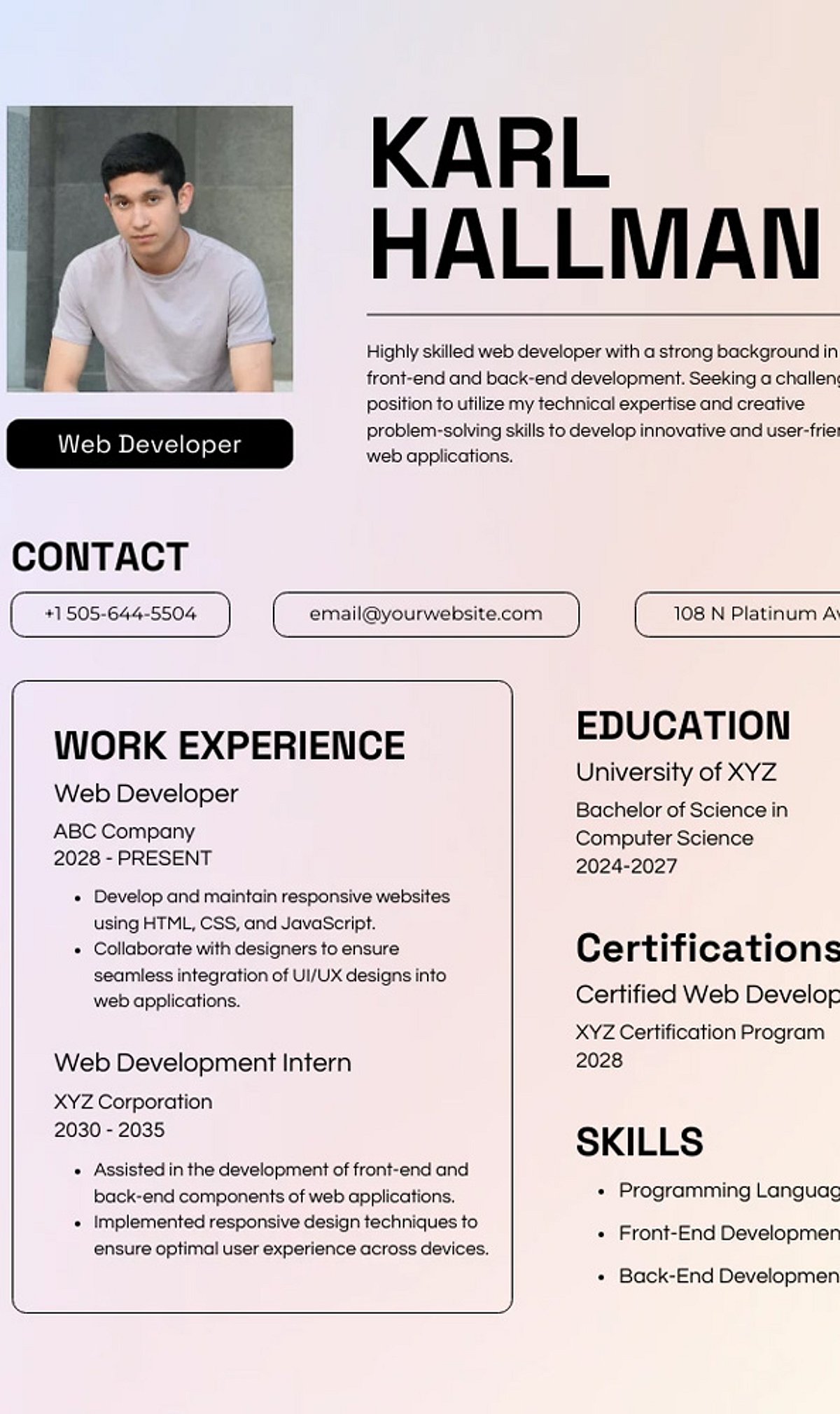
    Web Developer Resume Templates for Freshers: Must-Have Sections and Design Tips

    Starting your career as a web developer? Your resume is your first chance to make a strong impression on recruiters. Here are the essential elements every fresher should include in a web developer resume template.

    ATS-Friendly Format

    Use a clean, single-column layout with standard fonts and headings. This improves compatibility with applicant tracking systems (ATS) and ensures easy reading by recruiters.

    Professional Summary

    Write a concise summary that highlights your technical skills, career goals, and enthusiasm for web development. A strong opening creates a compelling first impression.

    Technical Skills Section

    Showcase programming languages, frameworks, tools, and databases such as HTML, CSS, JavaScript, React, Git, and SQL. Organize them into clear categories for quick scanning.

    Project Showcase

    Include academic, freelance, or personal projects. For each, list the technologies used, objectives, and measurable outcomes. This demonstrates practical web development expertise effectively.

    Education Details

    Mention your degree, institution, graduation year, CGPA, and relevant coursework. This establishes your academic background and technical foundation.

    Certifications

    List industry-recognized certifications from trusted platforms. They validate your knowledge and show commitment to continuous learning.

    Internship Experience

    Highlight internships with responsibilities, technologies used, and achievements. Even limited professional experience can showcase your readiness for the workplace.

    Portfolio Links

    Add links to your GitHub, LinkedIn, and personal portfolio website. This allows recruiters to review your code quality and completed projects.

    Simple Visual Design

    Choose a professional template with balanced spacing, readable fonts, and subtle colors. The design should enhance readability without distracting from your qualifications.

    By including these elements, freshers can create a resume that stands out to both automated systems and human recruiters.