Tag: funding

  • Tech Roundup: Qualcomm’s New AI Chip, Demoverse’s $600K Funding, and Key Industry Updates

    Tech Roundup: Qualcomm’s New AI Chip, Demoverse’s $600K Funding, and Key Industry Updates

    Qualcomm Launches AI-Focused Android Chip

    Qualcomm has introduced a new Android chip designed to handle rising AI workloads while addressing challenges from the global memory shortage. The processor targets smartphones with stronger on-device AI capabilities and improved efficiency. This launch comes as chipmakers face increasing demand for AI hardware and tighter memory supplies.

    Demoverse Raises $600,000 in Lumikai-Led Funding

    AI product co-creation startup Demoverse has raised $600,000 in a pre-seed round led by Lumikai. The company plans to use the funds to expand its US presence, grow its consumer creator community, and convert brand partnerships into paid campaigns. Its platform allows consumers to use AI to help design products and earn royalties.

    Laid-Off Graduate Works as Delivery Executive After TCS Job Loss

    A 2024 computer science graduate reportedly began working as a delivery executive after losing his TCS job earlier this year. The graduate is seeking opportunities to return to IT and asked a tech professional for referrals. The incident highlights the challenges facing entry-level technology workers amid a difficult hiring environment.

    Claude Opus 5.5 Targets Businesses With Lower AI Costs

    Anthropic has launched Claude Opus 5.5, intensifying competition with OpenAI. The model focuses on stronger performance and lower operating costs, with pricing reduced from its predecessor. OpenAI has also introduced cheaper GPT-6 models targeting professional workloads. These launches highlight the AI industry’s growing focus on efficiency, pricing, and enterprise adoption.

    CLARITY Act Shapes Debate Around US Crypto Rules

    The CLARITY Act is gaining attention as US lawmakers and regulators work toward clearer cryptocurrency rules. The legislation seeks to establish regulatory boundaries for digital assets and clarify oversight responsibilities. Its progress could influence how crypto companies operate, how digital assets are classified, and how future US market regulation develops.

  • The Startup Playbook: Scaling, Raising Capital, and Preparing for an IPO

    The Startup Playbook: Scaling, Raising Capital, and Preparing for an IPO

    Every startup begins with a vision and a founder’s willingness to invest time, effort, and often personal funds. The journey from that humble bootstrap to a public listing on a stock exchange is complex, demanding, and full of critical decisions. Along the way, startups must prove their viability, attract the right type of capital at each stage, and build the operational and governance infrastructure that public market investors expect.

    Bootstrapping: The Foundation of Proof

    Bootstrapping means relying primarily on founder capital and revenue from early customers rather than external funding. This approach keeps control in the founder’s hands and forces a laser focus on cash management, pricing, customer demand, and product quality. It also builds the first layer of proof that the business can survive and grow organically.

    Once repeat customers appear and revenue starts to climb, the company demonstrates clear market demand. At that point, outside capital—like venture funding—can accelerate expansion into new hires, product development, sales, technology, and market entry. However, each subsequent funding round demands stronger evidence than the last.

    How Capital Needs Evolve

    The funding landscape for startups has shifted dramatically. In the first quarter of 2026, Carta reported that startups on its platform raised USD 30.4 billion. Over 60% of that capital flowed into artificial intelligence companies, highlighting a major divergence between AI startups and other sectors in private-market valuations.

    While the traditional path from Seed to Series A, B, and beyond still exists, the bar rises at every stage. Early investors may be satisfied with product-market fit and initial traction. Later investors look at revenue growth, margins, cash flow, market size, and competitive positioning. The key is to show consistent, measurable progress that justifies the next round of funding.

    The IPO Market Rebounds

    After a quiet period, the global IPO market has reopened with vigor. According to EY, the first half of 2026 saw 483 global IPOs—down slightly from 546 in the same period of 2025—but total proceeds jumped to USD 186.8 billion, nearly triple the USD 62.1 billion raised a year earlier. This indicates that fewer companies are going public, but those that do are raising substantially more capital.

    AI, infrastructure, and technology firms have attracted the strongest investor interest. For startups, this means the public markets offer access to major capital pools, but coming to market with merely a compelling story is no longer enough. Investors demand financial rigor and sustainable business models.

    India’s Growing IPO Pipeline

    India has emerged as a hotbed of startup activity with a robust IPO pipeline. Inc42 reported on September 20, 2026, that 29 Indian startups had filed draft prospectuses with SEBI, and more than 25 others were at various stages of IPO preparation. The focus has shifted noticeably toward profitability and responsible cash management.

    A perfect example is RentoMojo, which posted a profit after tax of Rs. 104.3 crore in FY26, up from Rs. 43.1 crore in FY25. Revenue grew 45.5% to Rs. 387 crore from Rs. 266 crore in the same period. Such figures show why public investors look beyond customer growth or valuation buzzwords; they want proof of revenue quality, profit, and disciplined use of capital.

    IPO Readiness Begins Long Before Filing

    Becoming a public company involves far more than a high valuation. It requires accurate financial records, robust internal controls, clear ownership documentation, legal compliance, and strong corporate governance. The finance team must be capable of producing reliable reports on a strict schedule. Employee equity records must match company records, intellectual property must sit with the correct legal entity, and related-party transactions need tight controls.

    The board of directors must have a formal structure with defined responsibilities. The U.S. Securities and Exchange Commission emphasizes dependable accounting systems, internal controls, experienced advisers, sufficient cash reserves, and a clear growth strategy as essential to IPO readiness. Waiting until the last minute to put these in place is a recipe for disaster.

    Multiple Paths to Capital

    The startup-to-IPO journey is no longer a single, linear track. Companies can blend customer revenue with venture capital, debt, strategic investment, private equity, and other funding sources. Secondary sales and tender offers allow early shareholders and employees to cash out part of their stakes before a public offering. This flexibility lets founders decide when and how to raise capital based on their specific circumstances and market conditions.

    Some startups may choose to postpone an IPO to improve profitability, expand their customer base, strengthen governance, or wait for a more favorable market window. The ability to pivot funding strategies is a valuable advantage in an unpredictable economic landscape.

    Public Markets Demand a Stronger Business

    An IPO marks a fundamental shift in how a company is evaluated. Private investors might focus on a startup’s growth potential and future prospects, but public investors scrutinize quarterly financials and operational performance. There is little tolerance for errors. The company must go beyond rapid growth; it must demonstrate sustainable revenue generation, sound unit economics, strong governance, and a compelling reason for investors to own its shares.

    In essence, the transition from bootstrapping to IPO is about building a resilient, well-managed enterprise. The role of money is central, but so is the discipline to spend it wisely and the foresight to prepare for a public lifecycle.

    Key Takeaways

    • Capital evolves with growth: startups can move from bootstrapping to VC, debt, strategic investment, and private equity as needs change.
    • Proof matters at every stage: investors scrutinize revenue quality, profitability, cash flow, market opportunity, and competitive strength.
    • IPO readiness starts early: strong financial reporting, internal controls, governance, and legal compliance are essential well before listing.

    Frequently Asked Questions

    What is bootstrapping in a startup?

    Bootstrapping means building a company using primarily founder capital and customer revenue rather than relying heavily on external funding.

    When should a startup consider venture capital?

    A startup may seek venture capital after demonstrating meaningful customer demand and a business model where additional funding can accelerate growth.

    What factors do later-stage investors evaluate?

    They often look at revenue growth, margins, cash flow, market size, customer quality, competitive position, profitability, and the ability to scale operations.

    What does a startup need before an IPO?

    Key areas include reliable financial reporting, internal controls, corporate governance, legal compliance, accurate ownership records, intellectual-property ownership, and experienced advisers.

    Does a startup have to follow a fixed path from seed funding to IPO?

    No. Companies can combine customer revenue with venture capital, debt, strategic investment, private equity, and secondary transactions, depending on their objectives and circumstances.


  • Baselayer Secures $35M to Create a Trust Infrastructure for Autonomous AI Agents

    Baselayer Secures $35M to Create a Trust Infrastructure for Autonomous AI Agents

    Baselayer has raised $35 million in a funding round led by M13 to build what it describes as a ‘trust layer’ for artificial intelligence agents. The investment comes as enterprises increasingly rely on AI systems that can act autonomously and make critical decisions across business workflows.

    The new capital will support Baselayer’s efforts to develop infrastructure that provides AI agents with trusted business identity data, risk intelligence, and reliable decision-making capabilities. The platform aggregates business identity, people and ownership information, digital presence, and fraud, legal, credit, and compliance risk signals.

    Baselayer also introduced its Model Context Protocol (MCP), which gives AI agents direct access to the company’s business identity and risk intelligence. This system is designed to supply agents with evidence-backed context before they execute actions, reducing the risk of decisions based on incomplete or unreliable data.

    The company’s technology targets high-stakes workflows in compliance, procurement, finance, risk, and sales — areas where agentic AI is gaining traction but still requires robust controls around reliability and accountability. Customers can use Baselayer’s intelligence to verify businesses and associated individuals, conduct due diligence, monitor risk changes, and improve supplier evaluation.

    As AI agents move from answering questions to taking autonomous actions, questions of identity, accountability, and trust become paramount. Baselayer’s latest funding aims to close the infrastructure gap and support the emerging agentic economy.

  • Velocity Secures $10M Extension as Visa and Circle Join Its Stablecoin Infrastructure Push

    Velocity Secures $10M Extension as Visa and Circle Join Its Stablecoin Infrastructure Push

    Velocity, a London-based stablecoin payments startup, has added $10 million to its Series A round, bringing the total to $48 million. The extension was joined by Visa Ventures, Circle Ventures, and Ripple, alongside three other investors. The funding will support the company’s infrastructure for enterprise treasury, settlement, and liquidity operations using stablecoins.

    The latest raise comes just over two months after Velocity announced its initial $38 million Series A on July 14, led by Dragonfly and FirstMark, with participation from Ripple. The new extension adds Visa Ventures, Circle Ventures, Haun Ventures, Translink Capital, and Mirana Ventures to the cap table.

    Velocity builds systems that allow banks, acquirers, merchants, and payment providers to integrate stablecoin settlement, liquidity, and treasury operations without replacing existing payment infrastructure. The company aims to make money movement more continuous and reduce reliance on prefunding and settlement outside traditional banking hours.

    Visa has noted that stablecoins are playing an increasingly important role in moving value across its ecosystem. Rubail Birwadker of Visa stated that companies like Velocity can help expand stablecoin use for customers and partners. Velocity founder and CEO Eric Queathem emphasized that the new investors bring valuable insight as the company scales its stablecoin infrastructure.

    With the backing of Circle Ventures and Ripple, Velocity gains investors directly tied to regulated stablecoins, payments, and institutional finance. Translink Capital adds connections to corporate and institutional partners across Asia. The company plans to use the new capital to support issuers, acquirers, payment providers, financial institutions, and merchants worldwide, connecting stablecoins with existing banking, treasury, and settlement systems.

  • Perceptron Secures $6.5M to Build Decentralized AI Data Network

    Perceptron Secures $6.5M to Build Decentralized AI Data Network

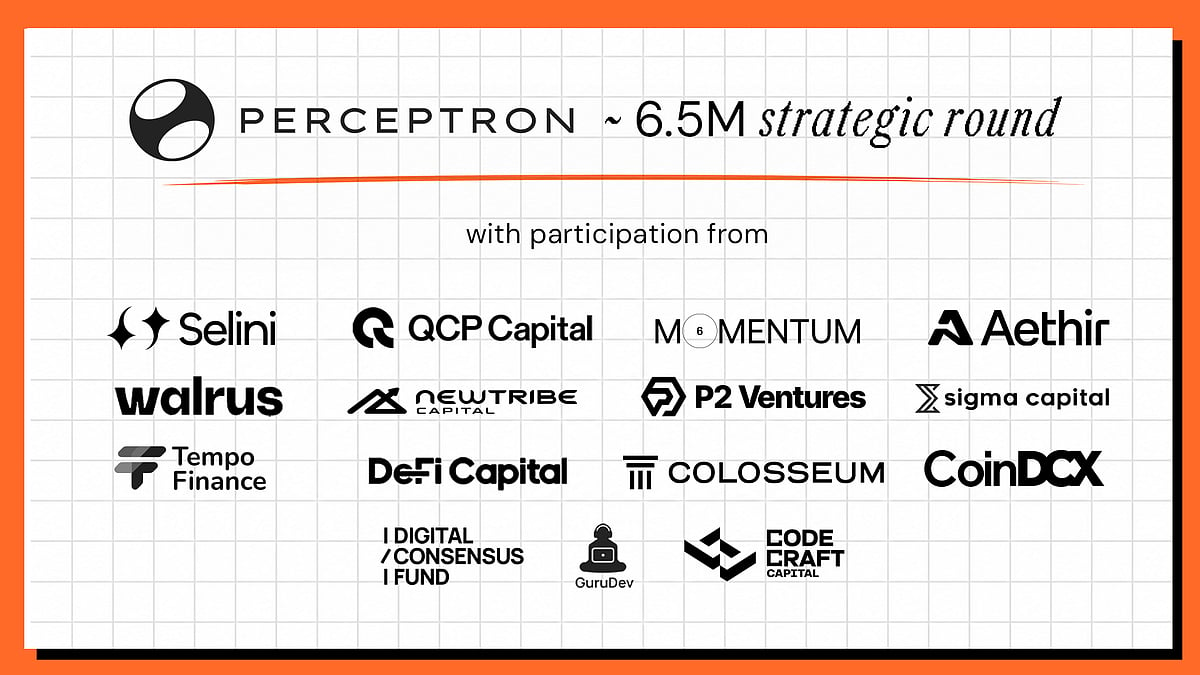
    Perceptron, a decentralized AI data network, has announced the successful close of a $6.5 million strategic funding round. The investment brings together leading Web3 investors, trading firms, ecosystem partners, and infrastructure leaders, including Sigma Capital, Selini Capital, QCP Capital, P2 Ventures, CoinDCX Ventures, Momentum6, DeFi Capital, Walrus Foundation, Aethir, Colosseum, GuruDev Capital, Tempo Finance, NewTribe Capital, Digital Consensus Fund, and CodeCraft Capital.

    The funding will support the launch of Perceptron’s data-questing platform, expand contributor tooling and rewards infrastructure, and scale the network toward a target of 5 million nodes. The company aims to make sourcing real-world data fast and accessible enough that AI companies no longer need centralized scraping infrastructure.

    Perceptron’s network compresses global data collection into a single mesh of idle bandwidth, unique datasets, and domain expertise. This unified format allows both individual contributors and AI companies to generate complete, verified datasets, reducing the timeline from data request to delivered dataset to just days.

    Perceptron sits between two extremes: centralized scraping tools that are too limited, and closed data partnerships that demand access most AI startups lack. It gives AI companies and everyday contributors data they can work with directly. Contributors own their data and earnings, allowing them to monetize or withdraw at any time without depending on third parties. The platform is built for continuous contribution and constant iteration, not a one-time scrape.

    The launch of the data-questing platform is central to delivering on this promise at scale. Rather than relying only on organically contributed data, Perceptron enables AI companies to commission data directly from its community. This approach shortens the timeline to sourcing high-value datasets and allows the team to focus resources on community tooling and rewards infrastructure.

    Early traction demonstrates strong demand. In its first phase, live agents reached more than 200,000 users across communities like Telegram and Discord. That number has since grown to more than 300,000 daily active users across a network of over 700,000 nodes. These figures highlight a large audience of users who want to monetize their data and expertise but previously lacked infrastructure designed for them.

    Nathan Gurr, Investment Analyst at P2 Ventures, said: “Perceptron has demonstrated an impressive ability to mobilize a decentralized workforce and build a globally distributed network. Their model allows them to tap into niche expertise – from doctors and lawyers to native speakers – on demand, from anywhere in the world. We see a significant opportunity to turn that reach into a scalable data and intelligence layer for AI, positioning Perceptron to become a leader in the DeAI stack.”

    Mark Rydon, Co-Founder of Aethir, added: “We are witnessing a long-term shift in how AI models are trained. Centralized data scraping is hitting diminishing returns, both in terms of cost and quality. Perceptron has solved the distribution problem that plagues the sector.”

    Peter Anthony, Co-founder and CEO of Perceptron, said: “Our mission is to create the world’s first decentralized AI data mesh where user interactions directly fuel AI growth. We’ve already shown that mission can become a reality, as evidenced by our ability to scale to hundreds of thousands of nodes organically. Now, with this funding, we are launching our data-questing platform, which will allow AI companies to commission specific, high-value datasets directly from our community.”

    Perceptron’s near-term focus is the data-questing platform launch, with further announcements expected next quarter. Longer term, the company is building toward a fully integrated network of 5 million nodes, where everything an AI company needs lives in one place, with no gap between demand and supply.

  • AI Security Startup Spur Secures $200M to Combat Bot Threats

    AI Security Startup Spur Secures $200M to Combat Bot Threats

    AI security startup Spur has raised $200 million in fresh funding to help businesses identify real users and stop AI bots from abusing online platforms. The funding round was led by Insight Partners.

    Founded in 2017 by two former Defense Department engineers, Spur specializes in helping websites and apps distinguish between genuine human users and AI-powered bots. The company plans to allocate the new capital toward improving its detection technology, hiring additional staff, and expanding its service offerings as AI-generated traffic continues to surge.

    Detecting malicious traffic has long been a challenge for the corporate world, but the need has escalated with the rise of sophisticated cyberattacks. “As sophisticated criminal VPNs, residential proxy networks, and anonymization infrastructure proliferate, organizations are increasingly operating with a critical blind spot: they can see the activity, but not the infrastructure behind it,” said Thomas Krane of Insight Partners.

    AI bots are becoming more advanced, capable of mimicking human behavior and evading traditional detection methods. This poses significant challenges for online businesses, including fake account creation, spam, and fraud. Spur aims to address these issues by providing tools that accurately identify legitimate users while blocking harmful automated activity.

    AI Security Startups Are Growing Fast

    Spur is not alone in attracting investor interest. Other AI cybersecurity startups, such as Meta Security, recently raised $35 million in a Series A round led by Canaan Partners. As AI becomes more prevalent, hackers are also leveraging the technology to launch more sophisticated attacks.

    Recently, the CEO of Cloudflare revealed that AI traffic has surpassed human traffic online for the first time in internet history. “Thought it would be end of 2027, then early 2027, but agentic traffic growing so fast that bots have now passed human traffic online for the first time in the Internet’s history,” he stated.

    Many startups are now building solutions for fraud prevention, user identity verification, and bot detection. Businesses are seeking effective ways to protect their platforms without compromising the experience for real users.

    Why AI Protection Matters More Than Ever

    AI is making online services faster and smarter, but it also introduces new risks. Fake users and automated bots are becoming increasingly difficult to identify, and they can have widespread effects on businesses.

    This is why companies like Spur are gaining significant attention. Enhanced bot detection helps keep online platforms secure and fosters trust among genuine users.

  • Former Twitter CEO Parag Agrawal’s AI Startup Parallel Hits $2 Billion Valuation

    Former Twitter CEO Parag Agrawal’s AI Startup Parallel Hits $2 Billion Valuation

    Parag Agrawal has made a notable comeback after his controversial departure from Twitter. The Indian-American technology executive, who served as Twitter’s CEO before Elon Musk’s acquisition, now leads the AI startup Parallel Web Systems.

    The company recently achieved a $2 billion valuation after raising $100 million in a Series B funding round led by Sequoia Capital. This latest investment brings Parallel’s total funding to $230 million and positions Agrawal at the helm of one of the fastest-growing startups in the AI infrastructure space.

    From Twitter CEO to AI Entrepreneur

    Elon Musk acquired Twitter for $44 billion in October 2022 and terminated Agrawal along with other top executives. Agrawal subsequently shifted his focus from social media to artificial intelligence.

    Agrawal founded Parallel Web Systems to build infrastructure for autonomous AI agents. Its technology enables AI agents to search, browse, and utilize information from the open web for complex tasks. Unlike traditional search technologies designed primarily for human use, Parallel’s technology specializes in machine-oriented research. The platform allows AI agents to gather information, browse websites, and conduct multistep research.

    This technology finds applications in legal research, finance, insurance, and enterprise intelligence. Among the companies using Parallel’s platform is the AI legal startup Harvey. Additionally, over 100,000 developers are leveraging the infrastructure.

    Funding Fuels AI Agent Ambitions

    The latest funding round was led by Sequoia Capital, with existing investors including Kleiner Perkins, Index Ventures, Khosla Ventures, First Round Capital, Spark Capital, and Terrain Capital. Parallel plans to use the funds to expand its R&D efforts and strengthen its sales and marketing operations while targeting more enterprise customers.

    Parallel has also expanded its partnership with Google. Customers from Google Cloud who develop AI agents using Gemini can now benefit from Parallel’s search engine technology, providing another pathway into the larger enterprise ecosystem.

    Agrawal’s journey from a short-lived tenure as Twitter CEO to leading a $2 billion AI startup underscores the rapidly changing technology landscape.

  • SK Hynix Plans $28B US Listing, Rivage Secures €1.5M, and More Top Tech News

    SK Hynix Plans $28B US Listing, Rivage Secures €1.5M, and More Top Tech News

    Good morning, tech fam; here are some quick tech updates for you to catch up on!

    What’s New Today

    SK Hynix is planning a $28 billion US listing to expand AI chip production and strengthen its global semiconductor business.

    Fast-Track Insights

    French proptech startup Rivage has raised €1.5 million to scale its AI-powered rental management platform across France and Germany.

    Here’s a quick rundown of the biggest tech headlines making waves today. Let’s dive into the day’s top tech stories, from SK Hynix’s massive US listing plans to South Africa’s proposed crypto tax guidance.


    SK Hynix Launches $28 Billion Nasdaq Listing to Capitalize on AI Boom

    South Korea’s SK Hynix is launching a $28 billion Nasdaq listing through depositary receipts, aiming to benefit from booming global AI demand. The AI memory chip leader plans to use the proceeds for expanding semiconductor production, strengthening its global presence, and supporting South Korea’s broader AI and chip investment strategy.


    Rivage Raises €1.5M to Scale AI Rental Management Platform Across Europe

    Paris-based proptech startup Rivage has secured €1.5 million in funding led by Kima Ventures to expand its AI-powered rental management software. The platform automates accounting, billing, and property workflows for real estate agencies. Rivage aims to accelerate growth in France, expand into Germany, and reach €5 million in annual recurring revenue by 2027.


    Malaysia Focuses on Better Jobs and AI Hiring

    Malaysia is changing its job strategy by focusing on better jobs instead of just creating more jobs. The government is using AI to help people find the right jobs through the MYFutureJobs platform. It also aims to improve workers’ skills, increase salaries, and prepare the workforce for future industries.


    Best AI Agent Frameworks for Building High-Performance Agents

    This article explains some of the best AI agent frameworks that help developers create smart AI agents more easily. It compares their features, ease of use, and performance. The guide also shows how the right framework can save time, improve efficiency, and support simple as well as large AI projects.


    South Africa Proposes Draft Crypto Tax Guidance Under Existing Laws

    South Africa’s Revenue Service (SARS) has released draft guidance explaining how existing income tax and capital gains tax rules apply to crypto assets. The proposal treats most crypto transactions as taxable events, depending on individual circumstances, and invites public feedback until August 31 before finalizing the guidance.

  • How to Discover Recently Funded Startups in 2026: A Complete Guide for Investors and Professionals

    How to Discover Recently Funded Startups in 2026: A Complete Guide for Investors and Professionals

    In 2026, the startup ecosystem is moving at record speed. Funding announcements arrive daily across sectors like artificial intelligence, climate tech, fintech, healthcare, and enterprise software. For investors, recruiters, journalists, and business developers, tracking these newly funded companies is essential to spot emerging opportunities early. The most effective approach combines multiple sources rather than relying on a single database. This guide outlines the key strategies to find recently funded startups quickly and reliably.

    Why Tracking Funded Startups Matters

    A fresh funding round often signals a period of rapid growth. Startups typically expand their teams, launch new products, and enter new markets soon after raising capital. Sales teams can target expanding companies ahead of competitors, recruiters can identify hiring hotbeds, and investors can gauge sector momentum. Tracking funding also reveals broader economic trends—heavy investment in certain areas indicates where capital and innovation are flowing.

    Start with Dedicated Startup Databases

    Specialized intelligence platforms remain the backbone of funding research. Crunchbase, PitchBook, and Tracxn compile extensive data on funding rounds, investors, valuations, acquisitions, and leadership teams. These tools allow you to filter by funding stage, location, industry, amount raised, and announcement date. For example, you can find AI startups in India that secured seed capital or European fintech companies closing Series B rounds. While premium tiers offer deeper analytics, even free versions provide valuable insights into funding patterns.

    Follow Venture Capital Firms Closely

    Venture capital firms often announce investments before they appear in mainstream business news. Firms like Sequoia Capital, Accel, Lightspeed, Peak XV Partners, Andreessen Horowitz, and General Catalyst regularly share portfolio updates, founder interviews, and investment theses on their websites and social channels. Following these firms on LinkedIn and X (formerly Twitter) gives you an early look at startups that may soon gain wider attention. VC announcements also signal which sectors they believe will drive future growth.

    Monitor Business News and Startup Newsrooms

    Traditional business news outlets remain a vital source. Sites such as TechCrunch, Fortune, Bloomberg, CNBC, and regional startup publications cover funding news and M&A activity throughout the year. Journalists add context that databases lack—founder quotes, competitive positioning, and market analysis, helping you understand not just which companies raised money, but why. Industry newsletters have also become powerful tools, delivering curated funding round summaries directly to your inbox.

    Leverage Social Media as an Early Signal

    LinkedIn is one of the fastest channels for funding news. Entrepreneurs often announce investments alongside news about hiring, product launches, or expansion. Following key investors, founders, incubators, and venture capitalists can reveal opportunities before any official press release. X remains relevant for real-time updates, especially during startup conferences where funding announcements are made live.

    Watch Accelerators and Incubators

    Many high-growth startups secure institutional funding shortly after completing accelerator programs. Organizations like Y Combinator, Techstars, Antler, and university-backed incubators showcase promising companies during Demo Days. Monitoring these cohorts gives you a window into potential unicorns. Startups often raise seed or Series A rounds right after graduation, making accelerators a fertile ground for early discovery.

    Use AI-Powered Monitoring Tools

    Artificial intelligence has transformed startup research. AI-driven news aggregators, alert systems, and research assistants can scan thousands of sources simultaneously, filtering funding leads based on your keywords and criteria. You can set up notifications for specific sectors like AI, clean energy, healthcare, or cybersecurity, ensuring you never miss fresh funding news even in fast-moving fields.

    The Smartest Strategy: Combine Multiple Sources

    No single platform captures every funding announcement. Some startups debut their funding on LinkedIn, while others first appear on VC blogs or regional publications before hitting global databases. For the most complete picture, draw on startup databases, business journalism, social media, VC announcements, and AI alerts. This multi-source approach not only identifies newly funded companies but also provides richer context about industry trends, investor confidence, and emerging markets. In today’s competitive startup landscape, timely information is a strategic asset. Developing a systematic method for monitoring funding announcements pays dividends for any professional looking to stay ahead.

  • Alibaba, Tencent, and Baidu Pour $2.8 Billion into Kling AI, Boosting AI Video Unit to $15 Billion Valuation

    Alibaba, Tencent, and Baidu Pour $2.8 Billion into Kling AI, Boosting AI Video Unit to $15 Billion Valuation

    Kuaishou Technology has secured a massive $2.8 billion funding round for its artificial intelligence video unit, Kling AI, with backing from China’s biggest tech names, including Alibaba, Tencent, and Baidu. The investment values Kling AI at $15 billion before the new capital infusion, highlighting the growing appetite for AI video technology in China.

    Major Investors Join the Round

    Kuaishou announced that the investor group includes Alibaba, Tencent, Baidu, and other prominent Chinese financial and technology firms. The deal also allows one additional investor to join within two months, with total fundraising capped at 20.45 billion yuan (approximately $2.8 billion). Following the investment, Kuaishou’s stake in Kling AI will drop to about 68% from full control.

    This funding comes as competition in AI video generation intensifies globally. Kling AI creates videos from text prompts and images, competing with tools from OpenAI, Google, and other AI firms. The service has become one of China’s most-watched AI video platforms, leveraging Kuaishou’s massive short-video app user base.

    Revenue Growth Accelerates

    Kling AI reported 650 million yuan in revenue for the March quarter, more than four times the figure from the same period last year. The annualized run rate reached about $500 million in March, up from roughly $300 million in January, according to reports cited by the company. This strong revenue growth has fueled investor interest and helped justify the high valuation.

    The post-money valuation of Kling AI now stands near $18 billion, making it one of the largest recent AI fundraises in China. The Chinese AI sector has been attracting significant capital; technology companies raised $3.1 billion from stock market listings from January to mid-June, more than five times the level seen in the same period last year.

    Market Reaction and Future Outlook

    Kuaishou shares rose as much as 6.9% on Friday after the fundraising details emerged, though gains later faded. Analysts at Citi described the investor list as “impressive” and noted that market attention will now shift to Kling AI’s next product upgrade.

    Kling AI benefits from its connection to Kuaishou’s video platform, which aids user reach, product testing, and content use cases within China. However, the AI video market faces high compute costs, as these systems require substantial processing power. Kling AI’s next phase will depend on user demand, product upgrades, and its ability to manage the cost of generating video at scale.

    While Kuaishou has not confirmed a firm timetable for a potential listing of Kling AI, recent reports suggest the company could start a Hong Kong listing process within twelve months, with future funding aimed at computing power and data center needs.