
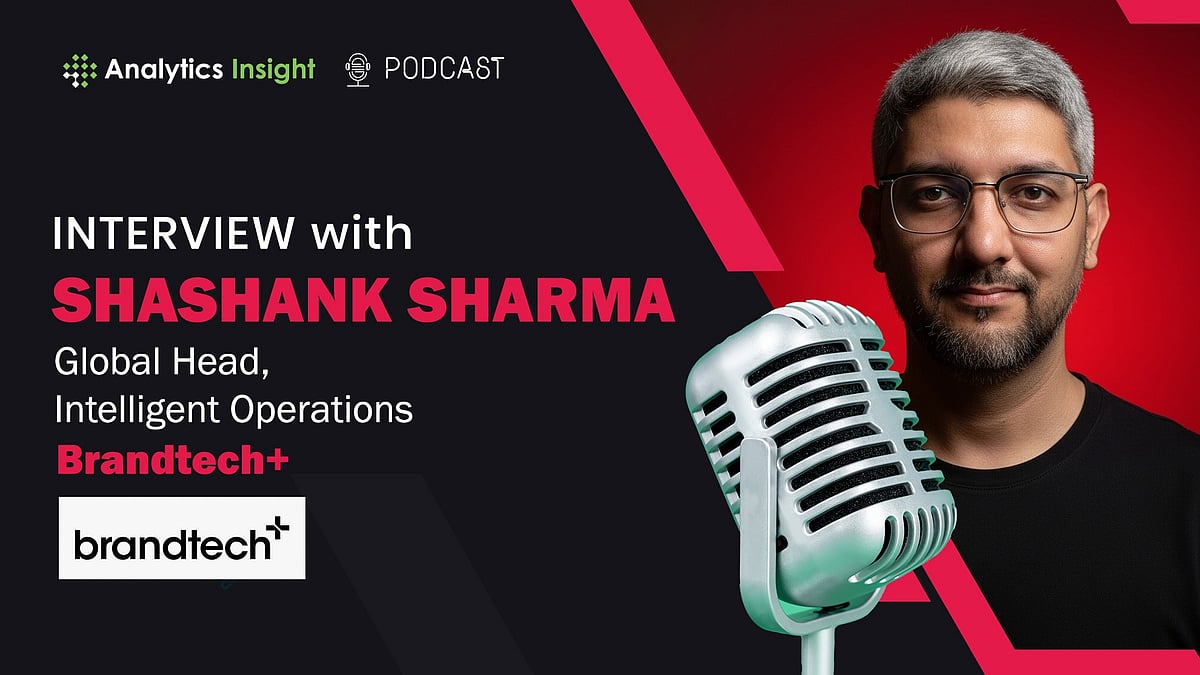
Podcast Highlights: Inside GenOps with Shashank Sharma
As enterprises move beyond initial Generative AI experiments, the focus shifts to scaling AI efforts while maintaining governance, compliance, efficiency, and business impact. In a recent episode of the Analytics Insight podcast, host Priya Dialani spoke with Shashank Sharma, Global Head of Intelligent Operations, AI and Automation at Brandtech Plus, about the evolution from Generative AI to GenOps. The conversation covered AI-RPA integration, intelligent business operations, human oversight, enterprise governance, automation strategies, and maximizing ROI through responsible AI scaling.
Key Takeaways from the Interview
Generative AI vs. GenOps
Sharma explained that while Generative AI primarily focuses on creating content—such as text, images, and videos—GenOps applies AI to business operations. GenOps integrates AI with governance, automation, compliance, and operations to increase efficiency, reduce costs, and ensure AI functions effectively within enterprises.
Why AI and RPA Are Stronger Together
AI provides intelligence and reasoning, whereas Robotic Process Automation (RPA) handles rule-based tasks consistently. By combining both, organizations can automate complex business processes, minimize errors, secure information assets, and balance the probabilistic nature of AI with the deterministic execution of RPA.
“AI provides intelligence and reasoning, whereas RPA handles rule-based tasks consistently. By combining both, organizations can automate complex business processes, minimize errors, secure their information assets, and balance the probabilistic aspects of AI with the deterministic aspects of RPA execution.”
Business Benefits of AI and Automation
Organizations can expect productivity gains, faster process execution, reduced costs, enhanced compliance, improved data accuracy, and higher returns on investment. Automation frees employees from routine tasks, allowing them to focus on more strategic functions.
Why Human Oversight Remains Essential
AI can make smart decisions, but it can also make wrong or dangerous ones. Human intervention is necessary to confirm important decisions, govern, prevent unnecessary errors, ensure accountability, and keep business transactions safe until AI technology becomes fully reliable.
“AI can make smart decisions, but it can also make wrong or dangerous ones. Human intervention is required to confirm important decisions, govern, prevent unnecessary errors, hold people accountable, and keep business transactions safe until AI technology becomes reliable.”
Challenges in Scaling AI
Sharma identified budget constraints, staff resistance, poor-quality data, and lack of clarity about organizational processes as major obstacles. He recommended focusing on the most significant AI use case, experimenting, engaging subject-matter experts, and improving data quality to overcome these issues.
Conclusion
The shift from Generative AI to GenOps represents a maturation of enterprise AI. By integrating intelligent automation with robust governance and human oversight, companies can scale their AI initiatives responsibly while achieving tangible business outcomes. As Sharma’s insights demonstrate, the future of enterprise AI lies in balancing innovation with operational discipline.