

Tag: government jobs

  • Today’s Tech Roundup: India’s Chip Plant, Mistral’s €3B Raise, Karnataka Job Openings, and Crypto Regulation Update

    Today’s Tech Roundup: India’s Chip Plant, Mistral’s €3B Raise, Karnataka Job Openings, and Crypto Regulation Update

    Good morning! Here’s your quick roundup of today’s biggest developments across semiconductor manufacturing, European AI funding, government recruitment, crypto policy, and banking technology.

    Fast-Track Insights

    • PM Modi virtually laid the foundation stone for the HCL-Foxconn joint venture, India Chip Pvt. Ltd, at the Yamuna Expressway Industrial Development Authority in Jewar, Greater Noida, marking a key step in India’s semiconductor self-reliance push.
    • Mistral raised €3 billion in a Series D round at a post-money valuation of over €21 billion, led by Samsung Electronics with Scaleup Europe Fund and PSG Equity as co-leads, the largest equity round ever closed by a European tech company.
    • Karnataka’s School Education Department released the GPSTR Recruitment 2026 notification for 15,000 teaching vacancies across government primary and secondary schools, with district-wise notices published between 10 and 12 August.
    • Coinbase CEO Brian Armstrong said the Clarity Act is likely to pass given broad backing from crypto firms, law-enforcement groups and banks, even as the bill remains stalled in the Senate.
    • A 2026 study by Cambridge Judge Business School, BIS, IMF and WEF found that 81% of financial firms now use AI in some form, though only 14% consider it transformational to their strategy.

    PM Modi Lays Foundation Stone of Semiconductor Unit in Uttar Pradesh

    Prime Minister Narendra Modi today virtually laid the foundation stone of the HCL-Foxconn Joint Venture project – India Chip Pvt. Ltd. at the Yamuna Expressway Industrial Development Authority in Jewar in Greater Noida of Uttar Pradesh. The establishment of the HCL-Foxconn semiconductor facility marks a significant milestone in India’s journey towards technological self-reliance and reflects the Prime Minister’s vision of positioning India as a trusted global destination for high-end electronics and semiconductor manufacturing.

    Mistral Raises €3B to Advance Sovereign, Open-Weight AI

    Mistral today announced that it has raised €3 billion in a Series D funding round at a post-money valuation of more than €21 billion, the largest equity fundraising round ever completed by a European technology company, three years after the company’s launch. Samsung Electronics led the round, joined by co-leads Scaleup Europe Fund, managed by EQT, and existing investor PSG Equity. The round will significantly expand Mistral’s frontier research, scale compute capacity, and accelerate commercial growth and international footprint. The company now operates across 20 countries and supports 125+ global enterprises’ mission-critical AI transformation, including Airbus, ASML, and HSBC.

    GPSTR Recruitment 2026: 15,000 Teaching Vacancies in Karnataka

    The Karnataka School Education Department has officially released the GPSTR Recruitment 2026 Notification. A total of 15,000 vacancies have been announced for teaching positions across government primary and secondary schools in Karnataka for the 2026–27 academic session. The notification was issued on 12 August 2026, with district-wise recruitment notices published through the Karnataka Gazette (e-Rajyapatra) portal between 10 and 12 August 2026, along with amended Karnataka Education Department Services (Department of Public Instruction) Recruitment Rules, 2026.

    Coinbase CEO Sees U.S. Crypto Regulation Advancing Regardless of Clarity Act Vote

    The Clarity Act, which seeks to establish a U.S. federal framework for digital assets, is likely to pass given broad support from crypto firms, law-enforcement groups and several banks, Coinbase CEO Brian Armstrong said. The legislation was ready to be supported by the Senate, Armstrong told CNBC’s “Squawk Box Asia” on Thursday, saying people he has spoken with are on board with the legislation.

    How AI Is Transforming Banking and Financial Services in 2026

    AI now plays a growing role in core banking work, from fraud checks and credit decisions to customer support and market research. A 2026 global study from Cambridge Judge Business School, the Bank for International Settlements, the International Monetary Fund, and the World Economic Forum found that 81% of financial firms use AI at some level. Only 14% consider AI transformational for strategy and competitive advantage. The gap shows that adoption has spread, but big change remains limited.
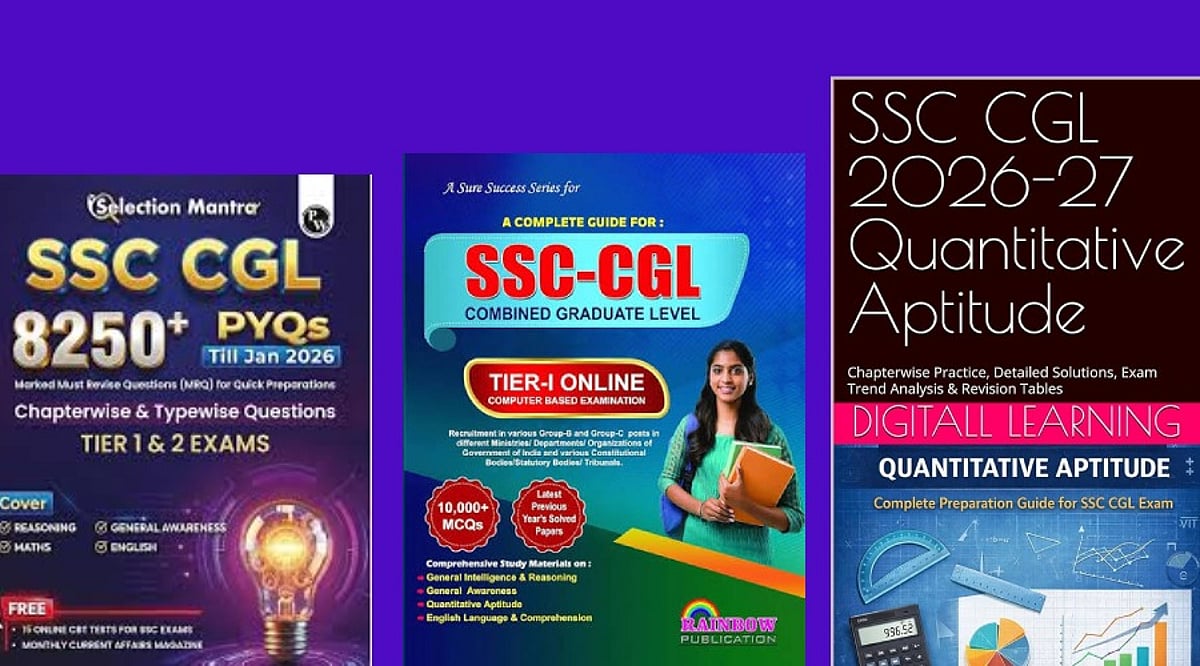
  • Best SSC CGL 2026-27 Books: Subject-Wise Study Resources for Exam Success

    Best SSC CGL 2026-27 Books: Subject-Wise Study Resources for Exam Success

    Choosing the right SSC CGL books makes preparation more focused and effective. One trusted resource for each subject, paired with regular revision, delivers better results than using many guides. Previous year’s papers strengthen exam readiness. Consistency remains the key to success.

    SSC CGL 2026-27 Book List at a Glance

    SSC CGL preparation is built around four core subjects: Quantitative Aptitude, Reasoning, English Comprehension, and General Awareness. The following recommended books are drawn from resources frequently cited in topper interviews and coaching advice.

    • Best Quant Book: Rakesh Yadav 7300+
    • Best Reasoning Book: R.S. Aggarwal
    • Best English Book: S.P. Bakshi
    • Best GK Book: Lucent’s General Knowledge
    • Best PYQ Book: Kiran Publication
    • Best Current Affairs: Arihant or Pratiyogita Darpan Monthly

    Subject-Wise Book Recommendations

    Quantitative Aptitude

    Rakesh Yadav’s 7300+ Chapterwise Solved Questions is frequently recommended for its chapter-wise structure and volume of practice questions. For a solid study sequence:

    • Rakesh Yadav 7300+ for chapter-wise practice
    • R.S. Aggarwal’s Quantitative Aptitude for comprehensive concepts
    • Fast Track Objective Arithmetic by Rajesh Verma for speed techniques
    • Arun Sharma’s Quantitative Aptitude for rebuilding fundamentals

    Reasoning

    R.S. Aggarwal’s A Modern Approach to Verbal and Non-Verbal Reasoning covers analogy, classification, coding-decoding, syllogisms, blood relations, seating arrangements, and mirror/image-based reasoning. Analytical Reasoning by M.K. Pandey serves as a companion for deeper puzzle practice. Kiran’s Reasoning compilation offers additional past question practice.

    English Language

    S.P. Bakshi’s Objective General English covers cloze test, error detection, reading comprehension, and synonym-antonym practice. Wren and Martin’s English Grammar helps rebuild grammar basics. Neetu Singh’s English for General Competitions offers an exam-focused format. Word Power Made Easy fills vocabulary gaps.

    General Awareness

    Lucent’s General Knowledge is the standard resource for static GK (history, geography, polity, economics, science). It pairs best with a monthly current affairs compilation from Pratiyogita Darpan or Arihant. Kiran’s General Awareness previous-year compilation adds targeted factual question practice.

    Previous Year Papers

    Previous year papers reveal recurring question styles and topic weightage. Kiran Publication’s chapter-wise previous year compilation organizes past questions by topic for focused revision. Many toppers solve several years of papers before attempting full-length mocks.

    How to Study with These Books

    One trusted book per subject, revised multiple times, builds more exam readiness than several books read once. Quantitative aptitude and reasoning benefit from solving the full book once, then revisiting difficult questions two or three times. English grammar needs three to four revisions. Lucent’s GK rewards repeated revision for recall speed.

    Final Thoughts

    The books on this list build the foundation. Success in SSC CGL often comes from a narrow, well-revised set of resources rather than searching for better books along the way.

    FAQs

    1. Which is the best book for SSC CGL 2026 Quantitative Aptitude?

    Rakesh Yadav’s 7300+ Chapterwise Solved Questions is one of the most recommended books for SSC CGL Quantitative Aptitude due to its extensive practice questions. Beginners can also use R.S. Aggarwal or Arun Sharma to strengthen concepts before solving advanced questions.

    2. Is Lucent General Knowledge enough for SSC CGL General Awareness?

    Lucent’s General Knowledge is considered one of the best books for static GK, covering History, Geography, Polity, Economics, and Science. However, candidates should also follow monthly current affairs magazines or reliable current affairs sources for complete preparation.

    3. Which English book is best for SSC CGL preparation?

    S.P. Bakshi’s Objective General English is widely recommended for SSC CGL because it covers grammar, vocabulary, comprehension, and objective practice. Candidates looking to improve grammar basics can also refer to Wren & Martin.

    4. Are previous year question papers important for SSC CGL 2026?

    Yes. Previous year papers help candidates understand the exam pattern, question types, topic weightage, and difficulty level. Solving them regularly also improves speed, accuracy, and time management.

    5. How many books are enough for SSC CGL preparation?

    Most successful candidates rely on one trusted book for each subject, along with previous year papers and current affairs material. Revising a limited set of quality resources multiple times is generally more effective than studying from many different books.