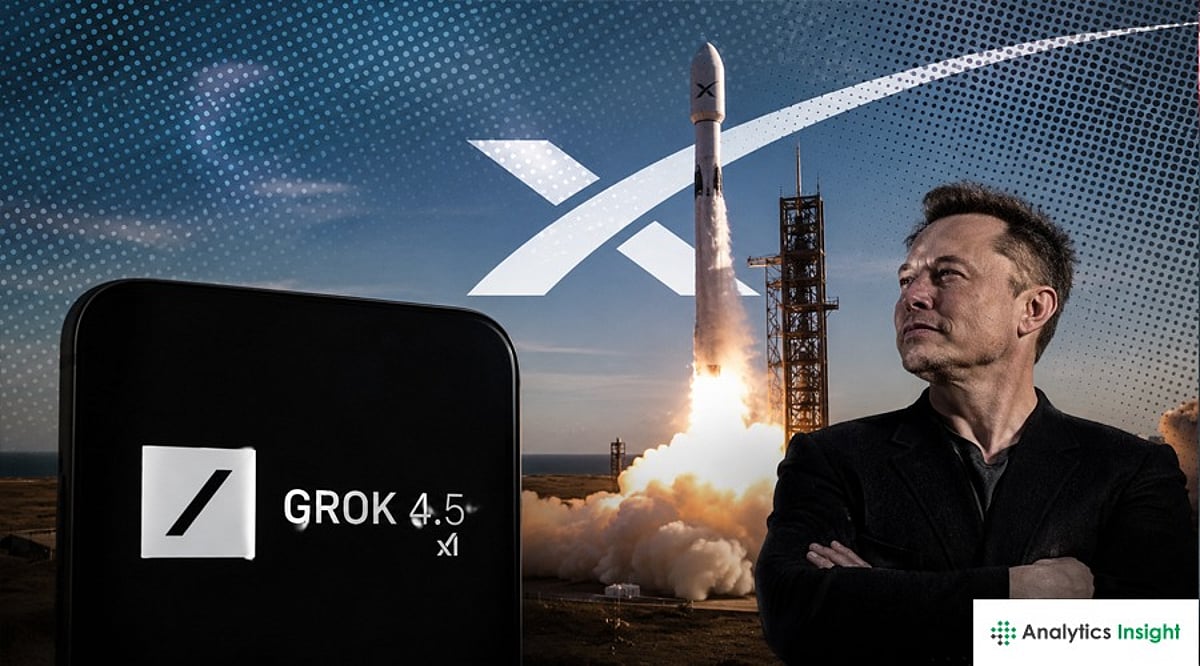
The AI race has become even more intense. SpaceXAI will launch Grok 4.5, its latest language model, on July 9, 2026. The new model arrives before the expected release of next-generation AI systems from several rivals, making the timing hard to ignore.
Elon Musk has been clear about his goal. He wants Grok to stand alongside the best AI models available today. With every new release, the company is trying to improve reasoning, speed, and the overall user experience. Grok 4.5 is another step in that plan.
Grok 4.5 Brings New Upgrades to the AI Race
Earlier this year, Elon Musk launched Grok 4.3 and stated that the company is preparing a more advanced model that will build on improved reasoning, stronger coding support, and better responses across tasks. In an official post, Musk has announced that the upcoming LLM is built on XAI’s new V9 foundation model, which features 1.5 trillion parameters. The model is also expected to handle longer conversations more naturally and provide more accurate answers.
SpaceXAI says Grok is designed to be useful to both everyday users and developers. The company continues to expand its AI tools while keeping Grok closely connected to X. This gives users quick access to AI without leaving the platform.
The launch also shows that Musk wants to compete directly with the biggest names in AI. OpenAI, Google, and Anthropic have all released stronger models over the past year. Grok 4.5 is SpaceXAI’s answer to that growing competition.
Why Launch Grok 4.5 Now?
The timing may be just as important as the technology. Several AI companies are expected to introduce major updates in the coming months. By releasing Grok 4.5 now, SpaceXAI keeps itself in the spotlight before its rivals make their next moves. Even Musk has mentioned that Grok 4.5 is ‘Opus-Class,’ which is a direct reference to its rival Claude’s general language model, Claude Opus.
The company also wants developers and businesses to use Grok before newer models from competitors arrive. Companies often go for early releases to get feedback and improve performance. This helps them strengthen their user base before the next stage of the AI race begins.
Competition in AI is moving faster than ever. Every launch now becomes part of a larger battle to attract users, developers, and businesses.
What Grok 4.5 Could Mean for X Users?
The most significant transformation isn’t the launch of the model; instead, it’s the implementation. If it works properly, tasks like searching, content discovery, and writing will be much more convenient on X.
With the arrival of an advanced tool like Grok, the platform may grow larger than a mere social network. It can be a powerful solution to many tasks such as information discovery, post creation, and communication with users.