
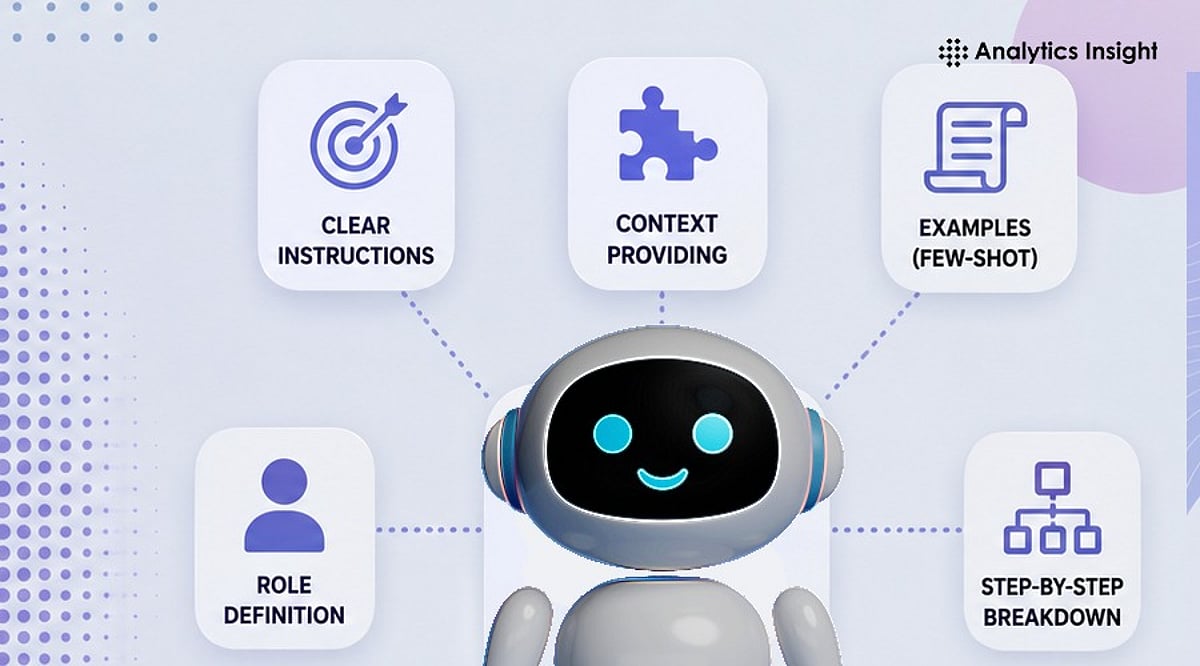
Prompt engineering for AI agents is a distinct discipline that goes beyond writing simple instructions. It involves defining how an agent should think, act, and respond when conditions become unpredictable. A well-designed prompt reduces ambiguity, improves task accuracy, and ensures consistent performance across complex, multi-step workflows.
Define a Clear Agent Identity
Instead of a generic “You are a helpful assistant,” assign a concrete job with defined scope. For example, a support triage agent that sorts tickets into three categories and never resolves billing disputes on its own. Identity defines operational ownership, not just tone. Place this instruction in the system prompt to maintain consistency across interactions.
Set Decision Boundaries
Agents must decide when to act, wait, or ask a clarifying question. A well-built prompt states what the agent may do, what it must never do, when to call a tool, and when to hand off to a human. Strong boundaries also resolve conflicts, like when retrieved information contradicts earlier conversation history. Clear constraints prevent compounded errors in multi-step loops.
Use Few-Shot Prompting
Few-shot examples help models infer behavior faster than explanations alone. Choose examples that cover a normal case, an ambiguous case, and a failure case. This shows the agent how decisions are made under different conditions. Structured prompts separate identity, objectives, constraints, and output requirements, and examples connect those sections to real behavior.
Specify Output Schemas and Handle Uncertainty
When an agent’s output feeds a workflow or database, format is critical. Define a schema (JSON, ordered steps, labeled fields) so downstream systems can parse results reliably. Also address uncertainty: what happens when input is incomplete, contradictory, or outside scope? A clarifying question, safe default, or escalation path works better than a confident guess.
Test and Evaluate
Version prompts like code, splitting role, boundaries, formatting, and safety into separate modules. Test against a fixed set of inputs with repeatable runs, checking accuracy, tool selection, and format compliance before shipping. Reliability comes from combining all techniques, not any single line of instruction.
Common Mistakes to Avoid
- Vague Instructions: “Be helpful” leaves too much open to interpretation.
- Missing Guardrails: Without limits, agents act when they shouldn’t.
- No Examples: Long explanations don’t teach decision patterns as well as examples.
- No Defined Output Structure: Unstructured responses are hard for APIs and workflows to handle.
- Skipping Real Evaluation: Testing against one or two scenarios is insufficient.
Final Thoughts
The best AI agent prompts are built with clear responsibilities, explicit boundaries, structured outputs, and ongoing evaluation. When prompt engineering is treated as an engineering discipline rather than a writing exercise, agents become reliable systems ready for real deployment.
Frequently Asked Questions
What is prompt engineering for AI agents?
It is the process of designing clear instructions that define an agent’s role, constraints, decision-making, tool usage, and output format to improve reliability across multi-step tasks.
What are the best techniques?
Techniques include defining a precise role, adding guardrails, using few-shot examples, specifying structured outputs, planning for uncertainty, and continuously evaluating performance.
Why are structured prompts important?
Structured prompts organize instructions into clear sections, helping agents produce more consistent, predictable, and machine-readable responses.
How do few-shot examples help?
They show agents how to handle typical, ambiguous, and edge-case scenarios, teaching reasoning patterns and decision boundaries more effectively than instructions alone.
How to evaluate prompt effectiveness?
Test against a benchmark set of tasks to measure accuracy, output consistency, format compliance, tool selection, and exception handling.