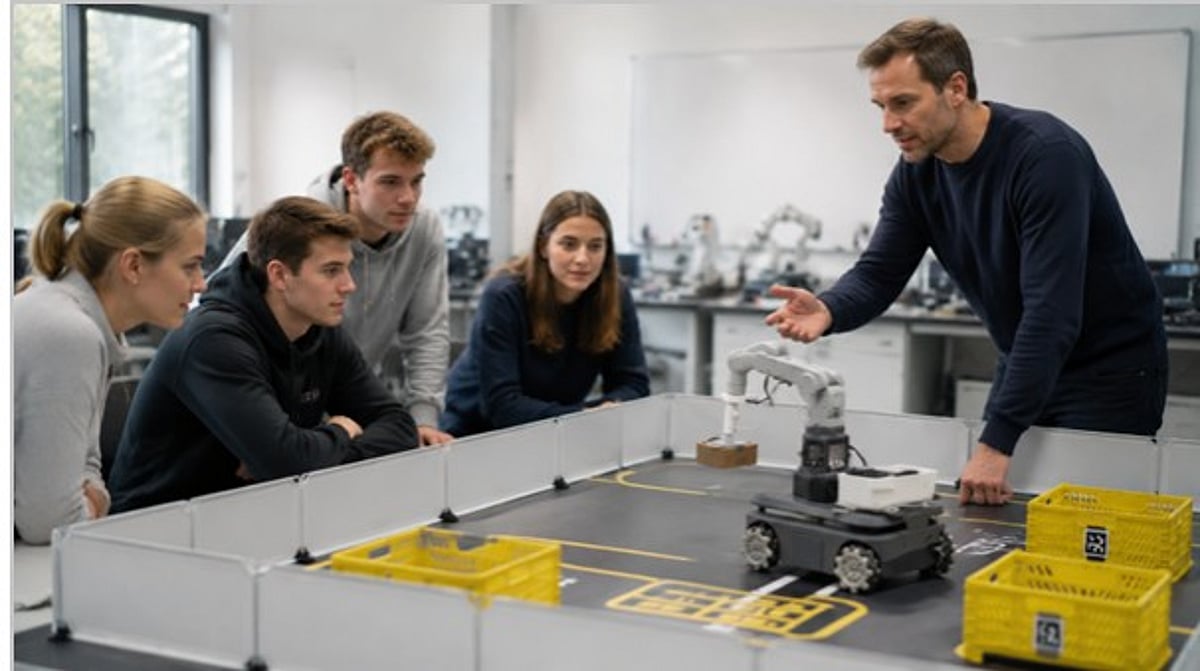
STEM education has seen explosive growth as demand for practical engineering skills and artificial intelligence literacy skyrockets. Yet schools, universities, and research labs have long struggled to assemble functional robotics environments, often spending weeks integrating disparate hardware and software from multiple vendors. Elephant Robotics is tackling this head-on with a new line of integrated educational robotics solutions that simplify deployment, reduce technical barriers, and accelerate hands-on learning across the Americas.
Compound Robot Logistics Solution for Smart Logistics and Robotics Education
The company’s Compound Robot Logistics Solution is a fully integrated training platform that combines hardware and software to teach robotics, automation, and intelligent logistics. Built around the 6-DOF collaborative robotic arm mechArm 270 and the mobile robot platform myAGV Jetson Nano, the system simulates real-world warehouse and production workflows. It covers mobile manipulation, material handling, path planning, and multi-component coordination. With one-click startup and visual demonstrations, instructors can launch lessons immediately, and students interact directly with the system. The solution includes a complete curriculum and lab manuals on robotic arm control, mobile robot navigation, machine vision, and system-level automation. Institutions can customize courses and build scenario-based applications for research or industry needs.
Portable Artificial Intelligence Educational Workstation
To lower the barrier to AI education, Elephant Robotics developed the Portable Artificial Intelligence Educational Workstation—a compact, suitcase-style system that deploys quickly in classrooms, labs, workshops, or exhibitions. At its core is the mechArm 270 with a modular quick-plug architecture, integrating machine vision, sensor interaction, and motion control. Five built-in vision algorithms let students explore object recognition, visual positioning, and automated tasks. A structured 15-week curriculum with tutorials, labs, and projects helps learners build skills in machine vision, sensor integration, and collaborative robotics. The workstation bridges theory and real-world engineering.
Advanced Compound Robot Solutions for Research
Beyond education, Elephant Robotics offers advanced compound robots for scientific research and high-level development. Based on the omnidirectional myAGV Pro chassis and myCobot Pro Series with harmonic drive joints, these platforms are equipped with precision LiDAR and cameras for perception-driven manipulation and autonomous navigation. Fully open interfaces support integration with major AI frameworks, machine learning models, reinforcement learning systems, and simulation environments. Research teams and tech companies have already adopted these systems for work in autonomous systems, embodied intelligence, and intelligent manufacturing.
Expanding Access Across the Americas
Elephant Robotics also offers a wide range of platforms for makers, educators, and developers, including the myPalletizer and myCobot series, myArm embodied intelligence robots, and the dual-arm semi-humanoid myBuddy. These products support everything from DIY projects to advanced research, creating an accessible robotics ecosystem tailored to local educational and research needs. By removing integration hurdles, the company aims to accelerate STEM talent development across the Americas.
For more information, visit americas.elephantrobotics.com.