
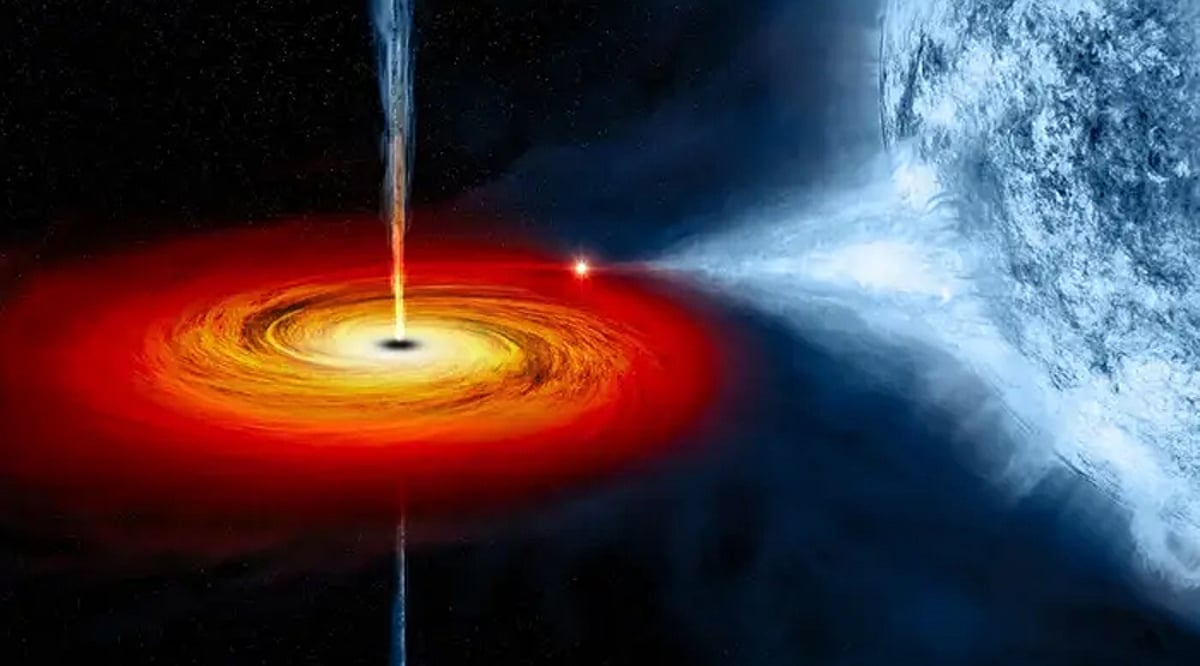
Black holes are among the most enigmatic entities in the cosmos, defying our conventional understanding of space, time, and gravity. Ongoing scientific research continues to unveil astonishing revelations about these gravitational behemoths, many of which read like science fiction yet are grounded in rigorous observation and theory.
Not Even Light Can Escape
A black hole’s gravitational pull is so immense that once anything crosses the event horizon—the point of no return—it can never escape. Even light, the universe’s fastest traveler, becomes permanently trapped. This inherent invisibility means black holes cannot be observed directly. Instead, astronomers detect them by analyzing the telltale effects on surrounding stars, gas clouds, and light patterns distorted by the black hole’s extreme gravity.
Time Slows Down Near a Black Hole
Einstein’s theory of general relativity predicts that time dilates in strong gravitational fields. For an observer close to a black hole, time passes much more slowly compared to someone far away. If a person were to venture near a black hole and return, they might find that decades or even centuries have elapsed on Earth—a phenomenon famously explored in the film Interstellar.
Supermassive Black Holes Lurk at Galactic Centers
Nearly every large galaxy, including our own Milky Way, harbors a supermassive black hole at its core. These colossal objects can weigh billions of times more than our Sun. Their gravitational influence shapes the orbits of nearby stars and is thought to play a pivotal role in galaxy formation and evolution.
Black Holes Can Produce Powerful Jets
Paradoxically, while black holes devour matter, they can also launch colossal jets of high-energy particles. These jets are propelled outward from the region around the black hole at speeds approaching that of light. Some extend across thousands of light-years and are detectable with advanced telescopes, offering insights into the energetic processes at work.
Black Holes Can Slowly Evaporate
According to Stephen Hawking’s theory of Hawking radiation, black holes are not eternal. Over unimaginably long timescales, they gradually lose mass and energy, eventually evaporating completely. This process is extraordinarily slow—a black hole with the mass of our Sun would take about 10^67 years to disappear, dwarfing the current age of the universe.
You Would Be Stretched Like Spaghetti
The extreme tidal forces near a black hole would subject any infalling object to a dramatic stretching effect known as spaghettification. The gravitational pull on your feet would be far stronger than on your head, causing your body to elongate and thin out as you approach the singularity. This grim fate underscores the violent nature of these cosmic objects.
We Have Actually Seen One
In 2019, the Event Horizon Telescope collaboration released the first-ever direct image of a black hole’s shadow, capturing the supermassive black hole at the center of galaxy M87. This historic achievement confirmed decades of theoretical predictions. Then, in 2022, scientists unveiled an image of Sagittarius A*, the black hole at the heart of our Milky Way, marking yet another milestone in observational astronomy.