Tag: HBM

  • Samsung zHBM: Stacking Memory for Faster AI Workloads

    Samsung zHBM: Stacking Memory for Faster AI Workloads

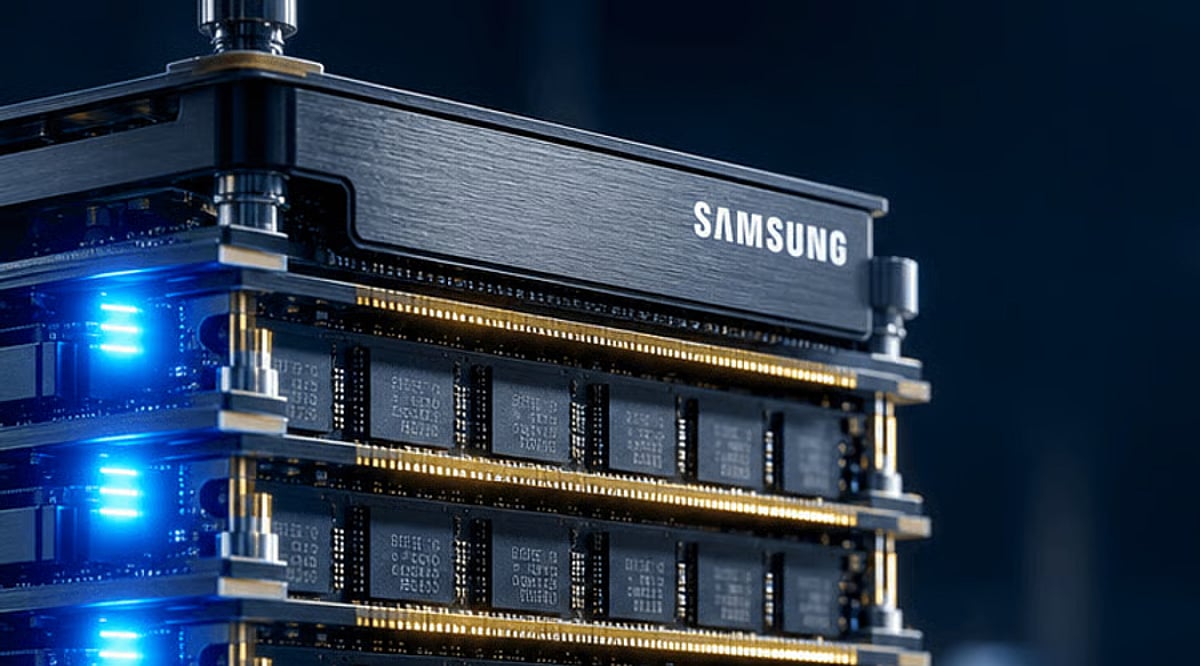
    AI accelerators are becoming increasingly powerful, but moving data between memory and processors can create bottlenecks. Samsung’s zHBM concept takes a different approach by vertically stacking high-bandwidth memory directly above an AI accelerator to shorten the data path.

    Memory Moves Closer

    Traditional HBM sits alongside the processor within advanced packages. Samsung’s zHBM concept places memory vertically above the AI accelerator. Shortening the distance between the two components is designed to improve data movement and support faster processing for demanding AI workloads.

    Higher Bandwidth Is the Goal

    Large AI models constantly move huge amounts of information between compute and memory. Samsung says its next-generation interface system incorporating zHBM is expected to deliver approximately eight times the performance of HBM5, targeting substantially faster AI data processing.

    Density Could Jump

    Samsung says zHBM could achieve more than 10 times the memory density of HBM5 using next-generation wafer-bonding technology. Higher density could allow AI systems to access more memory within compact architectures, potentially supporting increasingly large models and data-intensive workloads.

    Power Efficiency Matters

    Faster AI processing is not useful if energy consumption rises uncontrollably. Samsung says zHBM could improve energy efficiency by three times while reducing thermal resistance by more than half. Those improvements could help address power and heat challenges in high-performance AI systems.

    Custom AI Designs Are Possible

    Samsung says zHBM can support customer-specific designs by allowing customised intellectual property to be integrated into the interlayer between memory and an AI accelerator. This could give customers more flexibility to tailor memory capacity and accelerator performance for specific workloads.

    A Future AI Memory Architecture

    zHBM remains a next-generation concept rather than a mainstream memory product today. However, its vertically integrated design shows where AI hardware could be heading: closer memory, higher bandwidth, greater density and improved efficiency as models continue demanding more computing resources.

  • 7 Key Semiconductor Manufacturing Trends Driving the Industry in 2026

    7 Key Semiconductor Manufacturing Trends Driving the Industry in 2026

    Semiconductor manufacturing is entering a transformative era, driven by soaring demand for AI and the need for more powerful, efficient chips. In 2026, the industry is moving beyond traditional transistor scaling to embrace a broader set of innovations. Here are the seven key trends reshaping chip production.

    1. 2nm Chips and GAA Transistors

    Chipmakers are advancing toward 2nm-class process technology with gate-all-around (GAA) transistors. These designs deliver higher performance and better power efficiency, but they also increase manufacturing complexity significantly.

    2. Advanced Packaging and Chiplets

    As shrinking individual dies becomes prohibitively expensive, chiplets and 2.5D/3D packaging are gaining traction. By integrating multiple chip components into a single package, manufacturers achieve higher performance and flexibility without relying solely on node shrinks.

    3. High-Bandwidth Memory for AI

    AI workloads demand enormous amounts of fast memory. High-bandwidth memory (HBM) places stacked memory close to powerful processors, enabling faster data movement and reducing processing bottlenecks in AI systems.

    4. Silicon Photonics and Optical Data

    Electrical connections face growing bandwidth and power challenges. Silicon photonics uses light to transmit data at high speeds, making it a critical technology for future AI data centers, networking, and high-performance computing.

    5. SiC and GaN Take on New Roles

    Silicon carbide (SiC) and gallium nitride (GaN) can handle high voltage, heat, and power demands. These materials are becoming essential in electric vehicles, fast chargers, renewable energy systems, and advanced data-center infrastructure.

    6. AI-Powered Smart Factories

    AI is moving inside semiconductor fabs. Machine learning monitors equipment, detects defects, improves yields, predicts maintenance needs, and optimizes production processes in real time, making factories smarter and more efficient.

    7. Chip Supply Chains Are Going Regional

    Geopolitical tensions and supply risks are pushing companies and governments to diversify semiconductor production. New fabs and packaging capacity are being developed across multiple regions to reduce dependence on concentrated manufacturing hubs.

    The semiconductor race is no longer solely about making transistors smaller. Advanced packaging, memory, new materials, optical connectivity, AI-driven production, and regional manufacturing are becoming equally important for the industry’s future.

  • AI-Driven Memory Chip Shortage Drives Up Prices for Laptops, Phones, and Consoles

    AI-Driven Memory Chip Shortage Drives Up Prices for Laptops, Phones, and Consoles

    Artificial intelligence spending is fueling a global memory chip shortage, pushing up prices for laptops, smartphones, gaming consoles, and other consumer electronics. Manufacturers are prioritizing high-bandwidth memory (HBM) for AI data centers, leaving fewer conventional DRAM chips for everyday devices.

    The supply squeeze, nicknamed “RAMaggedon,” has caused RAM prices to surge. In Hong Kong, computer shop manager Ken Tam reports that 16 GB of RAM now costs about HK$1,500, up from HK$300–HK$400 previously. Business has fallen by half since September as customers balk at the higher costs.

    Analysts note that memory prices for PCs and smartphones have climbed five to six times year-over-year. Samsung Electronics, SK hynix, and Micron have benefited from strong HBM demand, but the production shift has reduced supplies of standard DRAM used in consumer devices.

    The shortage is altering buying behavior. Some users are upgrading older computers instead of buying new ones. In Tokyo, graphic designer Charles Brousse says RAM, graphics cards, and motherboards have reached “ridiculous levels,” forcing his custom computer service to ask clients to supply their own parts.

    Higher component costs are also hitting game consoles. Reports indicate price increases for Sony PlayStation and Microsoft Xbox products. Software prices are rising as companies bundle AI tools—Microsoft 365 saw a sharp price hike in February following heavy AI investment.

    AI data centers add further inflationary pressure by consuming large amounts of electricity and water. The U.S. now hosts over 4,600 active data centers. Economists warn that data centers can raise wholesale electricity prices, contributing to a 4% rise in residential electricity costs (inflation-adjusted). Moody’s Analytics chief economist Mark Zandi estimates that AI-related inflation costs households “just over $375 more” per year.

    Automakers are also feeling the pinch, with higher costs for in-vehicle computer systems. Samsung’s finance chief expects the shortage to deepen in 2027 and persist through 2028.

  • Samsung Achieves Record Q2 Revenue Driven by AI Memory Chip Demand

    Samsung Achieves Record Q2 Revenue Driven by AI Memory Chip Demand

    Samsung Electronics Co. Ltd. reported a sharp increase in Q2 earnings, fueled by strong demand for AI memory chips, even as its share price remains volatile amid investor concerns about future spending and competition.

    The South Korean technology group’s revenue for the quarter ending June 30 reached 171.5 trillion won, its highest quarterly revenue on record. Net profit rose to 71.27 trillion won, surpassing Bloomberg estimates of 68.36 trillion won. Additionally, operating profit increased more than 19-fold to approximately 89.5 trillion won, broadly in line with the company’s previous forecast.

    AI Memory Business Continues to Lead Growth

    The semiconductor business remained the primary growth driver. It benefited from high memory chip prices and rising volumes of its advanced High Bandwidth Memory (HBM) products for AI servers and data centers. According to the company, demand from cloud providers and AI infrastructure projects continued to support strong pricing across the memory market. Samsung anticipates this trend to continue in the second half of 2026.

    Samsung predicted ‘robust demand centered on servers stemming from continued AI infrastructure capex and broader adoption of agentic AI.’ Even with production increases, Samsung stated that the global memory market would remain ‘undersupplied.’

    Consumer Business Remains Under Pressure

    While the semiconductor business earned a record profit, Samsung’s smartphone, television, and home appliance divisions were less profitable as consumer demand weakened and component prices jumped. The company will continue to focus on high-margin AI memory products and invest in expanding its semiconductor manufacturing. In 2026, projects on 2-nanometer technology chips are projected to more than double each year, executives said in a post-earnings conference call.

    Market Reaction and Outlook

    Samsung shares were highly volatile during Thursday’s trading session, despite the strong results. The stock initially surged up to 7% but lost most of its gains as overall market weakness hit South Korea’s stocks. Investor sentiment is growing skeptical about the ability of AI-led semiconductors to maintain their valuations. Competition from Chinese chipmakers and heavy capital spending have also dampened investor confidence. Samsung also revealed that it is not currently planning to list its shares on American Depository Receipts (ADR), following queries from investors after rival SK Hynix recently listed in the US.

  • SK Hynix Stock Drops 9% as Record Earnings Fall Short of AI Chip Market Expectations

    SK Hynix Stock Drops 9% as Record Earnings Fall Short of AI Chip Market Expectations

    SK Hynix stock faced renewed selling pressure after the memory-chip maker reported second-quarter figures that came in below market forecasts. While revenue and operating profit reached quarterly records, both measures missed analyst estimates, triggering a sharp decline in share prices.

    The company’s US-listed ADRs closed Tuesday at $130.17, down 8.99% during regular trading, before recovering about 1.9% in after-hours trading. In Seoul, SK Hynix shares fell approximately 9.4% on Wednesday as investors digested the earnings release.

    SK Hynix Earnings Miss Market Forecasts

    SK Hynix reported second-quarter revenue of 79.3 trillion won, up 257% from the same period last year. Analysts had expected approximately 84 trillion won. Operating profit reached 60.5 trillion won, marking a 557% annual increase, but still fell short of the 64 trillion won market forecast.

    Both revenue and operating profit set company records during the June quarter, yet the gap against forecasts shaped the market reaction. Investors had raised expectations after strong demand lifted memory prices and pushed SK Hynix stock to record levels earlier in 2026.

    Net profit surged more than 13 times to 93.9 trillion won, with investment gains playing a major role in that increase. Analysts linked much of the gain to the completed sale of SK Hynix’s indirect stake in Japanese flash-memory maker Kioxia.

    AI Memory Demand Supports Record Results

    Demand for high-bandwidth memory continued to support SK Hynix earnings. HBM chips serve data centers that train and operate artificial intelligence models. The company has secured long-term supply agreements with approximately 10 customers and continues negotiations with other buyers.

    SK Hynix said customers are seeking longer contracts as memory supply remains tight. These agreements include financial protections intended to reduce risks from changes in customer demand. The company also plans 2026 capital spending of about 47 trillion to 48 trillion won.

    However, delays in some HBM4 shipments reduced revenue recognition during the quarter. Price gains for standard DRAM products also came in below earlier expectations, contributing to the operating profit and revenue misses.

    Management maintained its positive demand outlook for the second half of 2026, expecting AI server investment and limited memory supply to support sales. Still, the latest figures show that record growth must also clear high market forecasts.

    SK Hynix Stock Tracks Wider Chip Selloff

    SK Hynix stock moved lower during a broader retreat from AI-linked semiconductor shares. Investors have questioned the funding and returns of large data-center projects. Competition from Chinese memory-chip companies has also added pressure across Asian markets.

    South Korea’s Kospi fell approximately 6% on Wednesday, while Samsung Electronics lost about 4.8%. The moves followed broad selling across chip stocks. SK Hynix ADRs also closed below their $149 US listing price after Tuesday’s decline.

    Investors are also watching the company’s shareholder return plan. SK Hynix has not yet provided details on its timing, size, or structure. Hyundai Motor Securities research head Greg Roh said, “SK needs to come up with a concrete shareholder return policy to turn around investor sentiment.”

    The company reported a net cash position of about 88 trillion won at the end of June and aims to build that figure toward 100 trillion won. Investors will track future spending, customer contracts, HBM4 deliveries, and the planned shareholder return policy.

  • Micron Stock Gains 16% After $9.8B Revenue Beat and $22B in AI Supply Deals

    Micron Stock Gains 16% After $9.8B Revenue Beat and $22B in AI Supply Deals

    Micron Technology shares surged more than 16% in pre-market trading Thursday after the company reported stronger-than-expected fiscal third-quarter results and provided an upbeat outlook. The memory chip maker’s performance underscores sustained demand for artificial intelligence infrastructure.

    Revenue reached $9.8 billion for the quarter, exceeding Wall Street analyst estimates and marking a significant year-over-year increase. Profit also came in ahead of forecasts as demand for memory chips rebounded sharply.

    The company attributed much of its success to heavy spending by large technology firms on data centers and AI systems, which require large volumes of high-performance memory chips. The trend has allowed Micron to sell more products at improved prices.

    Looking ahead, Micron forecast revenue between $10.2 billion and $10.6 billion for the current quarter, signaling continued healthy demand across the technology sector.

    Additionally, Micron announced 16 long-term supply agreements covering cloud computing, data centers, and automotive industries. These contracts are expected to generate approximately $22 billion in cumulative revenue over the next several years, providing stable cash flows and reducing exposure to demand volatility.

    High bandwidth memory (HBM) products, which are critical for advanced AI servers, are seeing rising demand as more enterprises invest in AI capabilities. The company’s HBM lineup has become a key growth driver.

    The positive earnings report lifted other chip stocks as well. Qualcomm rose about 12% pre-market, Intel gained nearly 6%, and shares of AMD and Nvidia also moved higher as investor sentiment returned to the sector after earlier concerns over high valuations and slowing growth.

    Micron stock has already posted substantial gains over the past year. The latest earnings reinforce the view that the company will continue benefiting as businesses allocate more capital toward artificial intelligence and data center expansion.