Tag: HDFC Bank

  • Credit Card Spending Surges: HDFC, SBI Card, ICICI, and Axis Drive Rs 1.58 Lakh Crore in July 2026

    Credit Card Spending Surges: HDFC, SBI Card, ICICI, and Axis Drive Rs 1.58 Lakh Crore in July 2026

    India’s top four credit card issuers recorded a combined spending of nearly Rs 1.58 lakh crore in July 2026, underscoring the dominance of major banks in the country’s expanding card payments market. HDFC Bank, SBI Card, ICICI Bank, and Axis Bank continued to account for the bulk of transactions as overall card usage stayed above the Rs 2 lakh crore mark for the third straight month.

    HDFC Bank Leads the Pack

    HDFC Bank remained India’s largest credit card issuer by spending in July 2026, with transactions worth approximately Rs 60,218 crore. The bank captured nearly 28.9% of the country’s total credit card spending, recording a 1.3% increase from June and an 11.9% rise year-on-year.

    SBI Card Holds Strong Despite Monthly Dip

    SBI Card reported around Rs 39,592 crore in credit card spending during July 2026. While spending slipped 3.6% from June, the issuer still logged robust annual growth of roughly 21.6%. SBI Card held about 19% of the overall credit card spending market, according to industry data.

    ICICI Bank Shows Strong Monthly Recovery

    ICICI Bank’s credit card spending reached approximately Rs 34,025 crore in July 2026. The lender posted one of the strongest monthly recoveries among the leading issuers, with spending climbing 8.3% from June. However, July spending remained below the year-ago level, based on RBI data.

    Axis Bank Posts Solid Monthly Growth

    Axis Bank recorded around Rs 23,825 crore in credit card spending during July. Its spending rose 7.4% month-on-month, a stronger monthly performance than HDFC Bank and SBI Card. Axis accounted for about 11.4% of total industry spending, and its credit card base remained among India’s largest.

    India’s Total Credit Card Spending Remains Above Rs 2 Lakh Crore

    Overall credit card spending in India reached roughly Rs 2.08 lakh crore in July 2026, up 3.4% from June and 7.4% from July 2025. The total stayed above the Rs 2 lakh crore threshold for the third consecutive month, signaling continued momentum in card-based payments.

    Credit Card Base Continues to Expand

    India had around 12.29 crore credit cards outstanding by July 2026. Banks added a net 1.26 million cards during the month, an 11.5% increase over June additions. Transaction volumes climbed 24.5% year-on-year to about 60.5 crore, while the average transaction value declined to nearly Rs 3,440.

  • Apple Pay’s India Debut Could Begin With Axis Bank as First Partner

    Apple Pay’s India Debut Could Begin With Axis Bank as First Partner

    Apple Pay Prepares for India Launch

    Apple is preparing to bring its Apple Pay service to India, with Axis Bank expected to be its first banking partner for the rollout, according to people familiar with the matter. The service could launch in India as soon as next month, starting with support for Axis Bank credit cards.

    Discussions With HDFC Bank and ICICI Bank

    Apple has also held discussions with HDFC Bank and ICICI Bank about adding their cards to Apple Pay, but those talks have not yet resulted in final commercial agreements, according to two sources. Apple and the three banks declined to comment to Reuters on the discussions.

    Apple Pay is designed to allow iPhone users to make contactless payments using tokenized versions of their card details. Card information is stored on the device, so users can pay without opening another payment app. Apple is expected to add more banks through separate agreements over time, allowing the service to expand gradually after its initial rollout.

    Entering a UPI-Dominated Market

    Apple Pay will enter a payments ecosystem where UPI accounts for a major share of digital transactions. According to Reuters, UPI represented 84% of India’s digital payment volume. The National Payments Corporation of India has also introduced a tap-and-pay option using near-field communication technology, giving smartphone users another way to make contactless payments.

    Recent changes in payment rules have also created room for Apple Pay. The Reserve Bank of India allowed biometric authentication for card payments last year, supporting card transactions through features such as Face ID and Touch ID.

    Apple’s Growing Presence in India

    The India entry comes as Apple gains ground in the country’s smartphone market. Counterpoint Research data cited by Reuters shows Apple’s market share reached 8%, twice its level in 2022. India is now among Apple’s largest smartphone markets.

    Axis Bank had about 16.26 million active credit cards in July, according to RBI data, making it the fourth-largest card issuer in India after HDFC Bank, SBI Cards, and ICICI Bank. An Apple Pay launch would give Apple a foothold in India’s contactless card payment segment, and its expansion will likely depend on adding more banks and card networks to the service.

  • HDFC Bank Submits Two CEO Finalists to RBI for Approval as Jagdishan’s Term Nears End

    HDFC Bank Submits Two CEO Finalists to RBI for Approval as Jagdishan’s Term Nears End

    HDFC Bank’s board has approved two candidates for the roles of managing director and chief executive officer and submitted the shortlist to the Reserve Bank of India for approval. The move follows current MD and CEO Sashidhar Jagdishan’s announcement last month that he would not seek reappointment after his second term concludes on October 26.

    Jagdishan, 61, took over the role in October 2020, succeeding founder CEO Aditya Puri, and was reappointed for a further term in 2023. As one of India’s largest private lenders and a systemically important bank, HDFC Bank requires RBI’s sign-off before a new CEO can formally take charge.

    CEO Shortlist Sent to RBI

    Kaizad Bharucha, the bank’s deputy managing director since 2023, has emerged as a strong internal candidate to succeed Jagdishan. Other names reportedly in contention include Anup Bagchi, MD and CEO of ICICI Prudential Life Insurance; Tata Capital’s Rajiv Sabharwal; and CSB Bank’s Pralay Mondal.

    HDFC Bank formally forwarded two shortlisted names to the RBI for consideration, though the identities of the finalists have not been made public. The RBI will assess the candidates and approve one before Jagdishan’s term ends.

    Separately, the board also approved the appointment of Jimmy Tata as an executive director for a three-year term, effective from the date of RBI approval. This appointment adds another layer to the leadership changes currently underway at the bank.

    Leadership Change Amid Scrutiny

    The CEO search comes as HDFC Bank faces an internal review involving senior executives, following a probe into the bank’s deposit-related arrangement with MSRDC dating back to 2017 and 2021. The bank issued warning letters and imposed a Rs. 1 lakh monetary penalty each on three senior executives, including Jagdishan, chief financial officer Srinivasa Vaidyanathan, and group head of retail assets Arvind Vohra.

    A special disciplinary committee of independent directors will review the case. As the bank moves toward finalizing its next CEO, this backdrop adds extra scrutiny to how smoothly the leadership transition plays out over the coming months.

  • Stocks to Watch Today: Major Indian Companies Under Market Spotlight

    Stocks to Watch Today: Major Indian Companies Under Market Spotlight

    Investors are closely monitoring a lineup of prominent Indian companies today as market activity is expected to be influenced by sector developments, financial performance expectations, and broader economic indicators. Below is a breakdown of the key stocks in focus and the factors driving investor attention.

    Reliance Industries: Market participants will track business developments, expansion plans, and sector trends that could influence trading activity throughout the session.

    Tata Consultancy Services: Technology sector cues, client demand, and company-specific updates are being watched for their impact on investor sentiment.

    Infosys: Order wins, digital transformation demand, and global technology spending trends remain focal points for stock movement.

    HDFC Bank: Banking sector developments, lending trends, and regulatory announcements could keep the country’s largest private lender in focus.

    ICICI Bank: Strong financial performance expectations and banking sector momentum may influence trading activity.

    State Bank of India: Public sector banking updates, credit growth, and economic indicators are key drivers of investor attention.

    Bharti Airtel: Telecom sector developments, subscriber additions, and network expansion plans could shape share movement.

    Larsen & Toubro: Infrastructure orders, project execution updates, and government spending announcements may affect sentiment around the engineering major.

    Adani Ports: Port traffic, logistics demand, and infrastructure developments are expected to keep the company on watchlists.

    For more stories and real-time updates, join our WhatsApp Channel to get the latest news, exclusives, and videos.

  • HDFC Bank Dips to Rs 766.35: Why Analysts Stay Bullish on Long-Term Growth

    HDFC Bank Dips to Rs 766.35: Why Analysts Stay Bullish on Long-Term Growth

    HDFC Bank shares slipped to Rs. 766.35 for a second consecutive session, as earnings concerns weighed on market sentiment. Despite the correction, analysts remain optimistic, citing the bank’s strong fundamentals, healthy asset quality, and long-term growth prospects.

    Stock Under Pressure Despite Positive Street View

    HDFC Bank continued to drag the Nifty amid further profit-taking after the bank announced its latest quarterly results. Despite the current underperformance, various domestic and international brokerage firms have reaffirmed their confidence in the bank’s long-term potential. The stock opened at Rs. 769.15, reached a high of Rs. 772.50, and fell to a low of Rs. 765.20. High trade volumes indicate involvement from both institutions and individual investors.

    Market observers believe the current weakness is more due to profit-taking from earnings fears than any fundamental deterioration in the bank’s business.

    Chart Signals Weakness, But Key Support Holds

    Technical indicators suggest HDFC Bank continues to trade under selling pressure after failing to sustain its recovery above the Rs. 820 mark earlier this month. The stock has been making lower highs on the daily chart, indicating that bears remain in control in the short term.

    However, the Rs. 760 zone is emerging as an important support level. A decisive breach below this could trigger fresh selling, while a move back above Rs. 800–820 may improve sentiment and pave the way for a stronger recovery.

    Why Brokerages Remain Positive

    Despite the ongoing correction, analysts continue to favor HDFC Bank owing to its strong franchise, healthy balance sheet, and leadership in retail banking. The bank is expected to benefit from steady credit demand, improving deposit mobilization, and its ability to maintain stable asset quality.

    Brokerages also believe that integration-related challenges following the HDFC Ltd merger are gradually easing, allowing the lender to focus on improving profitability and business growth over the coming quarters. While earnings growth may remain moderate in the near term, most analysts see meaningful upside over the longer horizon.

    Opportunities and Risks

    While the recent correction has weighed on investor sentiment, analysts continue to highlight HDFC Bank’s structural strengths that support its long-term growth story. Key factors include strong franchise value, robust capital position, and a diversified loan portfolio.

    What Investors Should Watch Next

    The next few trading sessions are likely to determine whether HDFC Bank can stabilize near current levels or witness another leg of correction. Investors will closely monitor management commentary, loan growth, deposit mobilization, and margin trends for fresh direction.

    From a trading perspective, sustained buying above Rs. 800 could improve momentum, while a break below Rs. 760 may invite additional selling pressure. Long-term investors, however, continue to focus on the bank’s earnings potential rather than short-term market fluctuations.

    Conclusion

    The decline in HDFC Bank to Rs. 766.35 appears to reflect a more cautious mood among investors after the recent earnings season, rather than a significant change in the bank’s business outlook. Even with near-term pressures like margin compression and profit booking, many analysts believe the lender’s long-term growth narrative remains intact.

    Meanwhile, the broader banking sector shows a mixed picture. Some lenders like ICICI Bank have moved up after stronger-than-expected earnings, while stocks including HDFC Bank, Axis Bank, and Kotak Mahindra Bank face selling pressure. This has happened as traders reassess valuation levels and growth expectations. Still, the Indian banking segment continues to draw support from steady credit demand, improving asset quality, and solid capital buffers. Market experts generally view this correction as stock-specific and earnings-driven, not a sign of fragility across the entire banking space. Banks with strong fundamentals are expected to continue benefiting as India’s long-term economic growth continues.

    FAQs

    1. Why did HDFC Bank shares fall for the second consecutive session? HDFC Bank shares declined due to profit booking, earnings concerns, margin pressures, and cautious investor sentiment despite positive long-term brokerage outlooks.
    2. What is HDFC Bank’s current share price? HDFC Bank shares traded around Rs. 766.35 during Tuesday’s session, making it one of the biggest losers on the Nifty index.
    3. Are analysts still bullish on HDFC Bank stock? Yes. Most brokerages remain optimistic, citing strong fundamentals, healthy asset quality, robust capital position, and long-term earnings growth potential.
    4. What levels should investors watch in HDFC Bank shares? Analysts see support around Rs. 760, while sustained buying above Rs. 800–820 could improve near-term market sentiment and momentum.
    5. How are banking stocks performing overall? Banking stocks remain mixed, with earnings driving stock-specific moves, though strong fundamentals continue supporting the sector’s long-term growth outlook.
  • HDFC Bank Shares Drop to ₹776.55 After Q1 Results: Margin Pressure Overrides Profit Growth

    HDFC Bank Shares Drop to ₹776.55 After Q1 Results: Margin Pressure Overrides Profit Growth

    HDFC Bank shares came under intense selling pressure on Monday after the country’s largest private lender announced its June quarter (Q1 FY27) results. The stock dropped to ₹776.55, extending losses as investors reacted to weaker-than-expected profitability despite steady business growth.

    Though the bank reported better performance in profitability, loan growth, and deposits, it was under constant pressure on net interest margins (NIMs). The negative market sentiment affected other private banks, including Axis Bank and Kotak Mahindra Bank, which also saw sharp declines.

    Business Growth Remains Strong

    During the quarter, HDFC Bank reported a standalone net profit of ₹19,060 crore, recording year-on-year growth of nearly 5%. Its net interest income increased to approximately ₹33,535 crore, driven by robust credit demand in the retail and corporate segments. Gross advances stood at ₹30.61 lakh crore, while deposits reached ₹31.68 lakh crore, reflecting the performance of its core banking business.

    However, the most disheartening figure was its NIM of 3.26%, which continued to decline due to high funding costs and intense deposit competition.

    Margins Continue to Dominate Investor Concerns

    Although HDFC Bank delivered healthy business growth, investors remained focused on profitability. The banking sector is currently facing higher funding costs, aggressive competition for deposits, and lower lending yields following interest-rate changes. These factors have made margins one of the most closely watched indicators for banking stocks.

    Private Banking Stocks Extend Selloff

    HDFC Bank wasn’t the only one facing troubles. The share prices of Axis Bank and Kotak Mahindra Bank also fell after the release of their quarterly earnings results. ICICI Bank outperformed due to its strong operations and margins.

    Brokerages Continue to See Long-Term Value

    Despite the sharp correction, most brokerage firms have maintained an upbeat outlook on HDFC Bank. Analysts say the lender still benefits from structural advantages, such as a diversified credit book, a solid balance sheet, strong asset quality, and an industry-leading deposit franchise. Several brokerages expect margins to improve gradually as funding costs moderate and the benefits of lower interest rates begin to flow through the balance sheet.

    What Should Investors Watch Next?

    Over the next few quarters, HDFC Bank is expected to face a critical stretch. Investors will be tracking margin recovery, deposit mobilization, and management commentary on funding costs. Meanwhile, Reserve Bank of India policy decisions and the speed of interest rate changes will shape profitability across the banking sector.

    Market Outlook

    Despite Monday’s sharp dip, analysts remain constructive on HDFC Bank’s long-term outlook. The lender continues to show steady business momentum, strong asset quality, and a solid balance sheet. For the near term, the stock may remain reactive to movements in NIMs and funding costs. If margins improve, investor comfort could return and help the share price recover.

    FAQs

    Why did HDFC Bank shares fall after the Q1 results?

    Investors were disappointed by continued pressure on net interest margins despite healthy profit growth, loan expansion and stable deposit mobilisation during the quarter.

    What was HDFC Bank’s net profit in Q1 FY27?

    HDFC Bank reported a standalone net profit of around ₹19,060 crore, registering nearly 5% year-on-year growth in the June quarter.

    What is worrying investors about HDFC Bank?

    The biggest concern remains declining net interest margins, driven by higher funding costs, intense deposit competition and changing interest-rate conditions.

    Are analysts still bullish on HDFC Bank stock?

    Yes. Most brokerages have retained positive ratings, citing strong fundamentals, healthy asset quality, robust loan growth and long-term earnings potential.

    What should investors watch in the coming quarters?

    Investors should monitor margin recovery, deposit growth, funding costs, RBI policy decisions and management’s outlook on future profitability and business growth.

  • HDFC Bank Stock Slips 1% as AI-Led Job Cuts Fuel Earnings Scrutiny

    HDFC Bank Stock Slips 1% as AI-Led Job Cuts Fuel Earnings Scrutiny

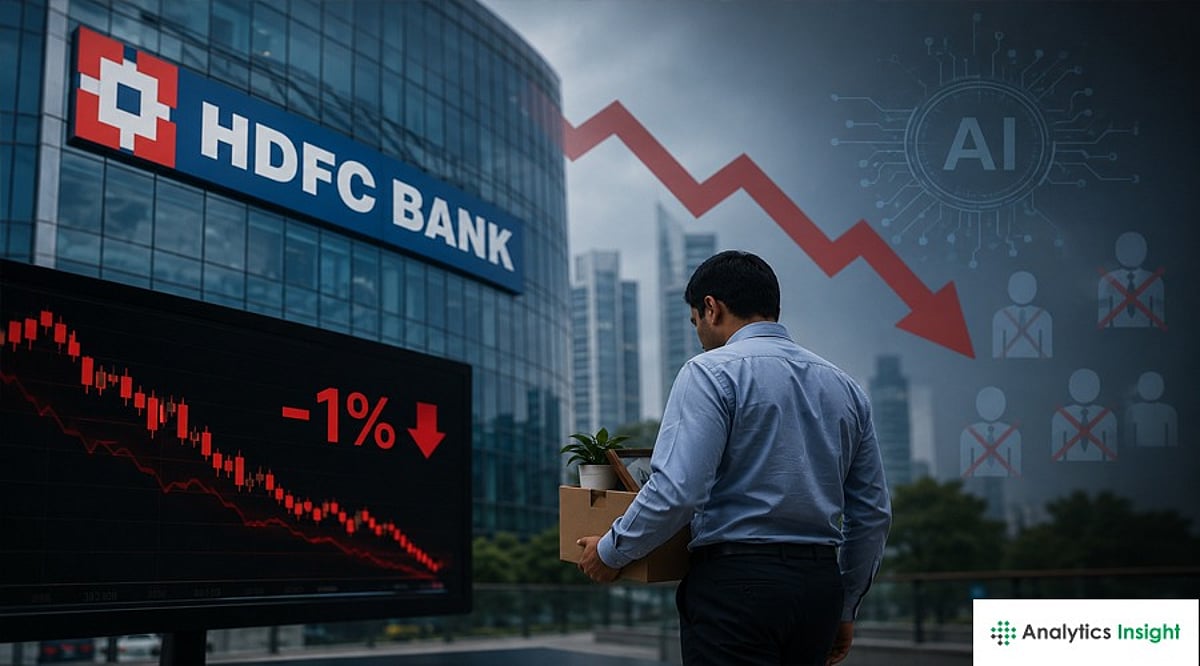
    HDFC Bank shares traded near Rs. 810 during Tuesday’s afternoon session, reflecting cautious investor sentiment ahead of the lender’s June-quarter (Q1 FY27) earnings. The stock’s 1% decline comes as the market digests news of the bank’s AI-driven workforce reduction, which saw headcount shrink by 3,343 employees during FY26.

    The workforce cut, detailed in HDFC Bank’s FY26 Annual Report, is part of a broader operational overhaul that uses artificial intelligence and automation to streamline routine banking tasks. Unlike traditional layoffs focused solely on cost reduction, the bank is redeploying employees into customer-facing and advisory roles where human interaction remains critical.

    Investors are now weighing the potential long-term benefits of this digital transformation against near-term profitability concerns. The number of managers responsible for customer interaction and business decision-making has increased, suggesting the bank is reshaping its workforce rather than simply shrinking it.

    Market sentiment is also being shaped by governance issues that surfaced earlier this year. An independent legal review found no evidence to support allegations made after the resignation of part-time Chairman Atanu Chakraborty, but the episode highlighted the importance of corporate governance in maintaining investor confidence.

    All eyes are now on the upcoming Q1 earnings report, which will provide the first clear indication of whether AI investments are beginning to improve operating margins and cost efficiency without compromising customer service. Key metrics to watch include loan growth, deposit generation, net interest margins, operating expenses, and asset quality.

    If earnings show that efficiency gains are genuine and scalable, HDFC Bank’s AI-led strategy could emerge as a competitive advantage. Conversely, any signs that automation is hurting customer experience or revenue growth could keep the stock under pressure.

    HDFC Bank’s transformation represents a broader shift in Indian banking, where AI is moving from experimental to operational cornerstone. The June-quarter results will be pivotal in determining whether technology, governance, and finance can align to drive the next phase of growth.

  • Sensex Surges 403 Points, Nifty Crosses 24,388 as Bank Stocks Lead Rally

    Sensex Surges 403 Points, Nifty Crosses 24,388 as Bank Stocks Lead Rally

    The Nifty50 and Sensex traded higher on July 6, 2026, driven by strong buying in bank stocks. Axis Bank, HDFC Bank, and Bharat Heavy Electricals were among the top gainers, while the IC Electricals IPO entered its second subscription day.

    Key Takeaways

    • Bank stocks powered the market higher, supporting benchmark indices.
    • Axis Bank, HDFC Bank, and Bharat Heavy Electricals emerged as the top Nifty50 gainers.
    • The IC Electricals IPO entered its second subscription day with an issue size of ₹47.91 crore.

    The Indian stock market opened higher on Monday, July 6, 2026, as robust buying in banking shares lifted the benchmark indices. Positive cues from Asian markets also bolstered investor confidence during the session.

    At the time of writing, the Nifty50 stood at 24,388.60, up 114.95 points or 0.47 percent. The Sensex traded at 78,167.17, gaining 403.26 points or 0.52 percent. Both indices remained in positive territory as buying momentum persisted in large-cap banking stocks.

    Market sentiment stayed firm after Asian peers posted gains. Strong regional performance improved confidence and supported buying across multiple sectors in India.

    Bank Stocks Lead the Rally

    Bank stocks were the biggest driver of the market during the session. Fresh buying in private banking companies pushed benchmark indices higher and kept the market on a steady upward path.

    Among the top performers on the Nifty50 were Axis Bank, HDFC Bank, and Bharat Heavy Electricals. These stocks attracted significant investor interest and contributed a large share of the day’s gains.

    Positive Trend Across Broader Markets

    The broader market also traded in the green, although gains were modest compared to the benchmark indices.

    The Nifty MidCap index rose 0.18 percent, while the Nifty SmallCap index gained 0.08 percent. These moves indicate that buying interest extended beyond large-cap stocks.

    Steady movement in mid-cap and small-cap shares reflected balanced market participation. Investors continued to seek opportunities across various segments rather than focusing solely on large companies.

    Banking Sector Outperforms

    The Nifty Bank index and the Nifty Private Bank index outperformed other sectoral indices during the session. Strong gains in leading private lenders helped these indices move ahead of the broader market.

    The positive movement in banking shares came as investors sought stable businesses with strong financial performance. Consequently, bank stocks received consistent buying support throughout the session.

    IT and Media Stocks Face Pressure

    The Nifty IT index and the Nifty Media index recorded the biggest declines among sectoral indices. Selling pressure in technology and media stocks limited the overall market gains.

    Despite weakness in these sectors, losses remained contained as banking shares provided strong support. The market thus continued to trade with a positive tone.

    Asian Markets Offer Strong Support

    Asian stock markets traded higher on Monday, and this positive trend helped improve sentiment in Indian equities.

    Gains across Asian peers encouraged active participation in the market. Strong regional performance often boosts confidence, especially at the start of the trading week.

    Positive global cues, coupled with strength in banking shares, helped Indian benchmark indices maintain their upward trajectory. This combination kept market sentiment favorable during the session.

    IPO Market Remains Active

    The primary market also stayed active on Monday as IC Electricals continued its public issue. The IC Electricals IPO entered the second day of subscription. The book-built issue was valued at ₹47.91 crore.

    The public issue gave investors another opportunity to participate in the primary market. Activity in the IPO segment remains an important part of overall market interest, especially when benchmark indices trade in positive territory.

    Market Outlook

    The strong gains by Axis Bank, HDFC Bank, and Bharat Heavy Electricals added upward momentum to the benchmark indices. However, weakness in IT and media stocks partially offset the potential for further gains.

    FAQs

    1. What are the key drivers behind today’s market rally?
    The rally is driven by strong buying in large-cap private bank stocks, supported by positive trading across regional Asian markets at the start of the week.

    2. Which sectors are outperforming and which are lagging?
    The Nifty Bank and Nifty Private Bank indices are leading the market higher, while the Nifty IT and Nifty Media indices are facing the most significant selling pressure.

    3. How are the broader markets performing?
    The broader market shows balanced participation. The Nifty MidCap and Nifty SmallCap indices are trading in the green, up 0.18% and 0.08% respectively.

    4. What is the current status of the IC Electricals IPO?
    The IC Electricals initial public offer entered its second day of subscription. The public book-built issue is valued at ₹47.91 crore.

    5. What should investors monitor for the remainder of the day?
    Investors should watch if bank stocks maintain momentum, whether pressured IT shares stabilize, and track subscription numbers for the ongoing IPO.


  • Indian Stock Market Rallies: Sensex Rises Over 420 Points, Nifty Closes Above 24,430 on Broad-Based Buying

    Indian Stock Market Rallies: Sensex Rises Over 420 Points, Nifty Closes Above 24,430 on Broad-Based Buying

    Indian benchmark indices rallied on Monday, with the Sensex gaining over 420 points and the Nifty crossing the 24,400 mark. Broad-based buying across sectors—led by realty, auto, and consumer durables—pushed the Nifty 50 up 0.66% to close at 24,430.35, while the Sensex rose 0.68% to 78,293.38. Strong business updates from Nykaa, banks, defence companies, and pharma stocks kept sentiment upbeat amid active IPO developments.

    Key Market Movers

    Nykaa Q1 Business Update

    Nykaa expects a sharp acceleration in June-quarter growth, with consolidated revenue likely to expand by nearly 30%. The beauty segment delivered healthy growth, while the fashion business is projected to record its strongest performance in several quarters. The stock touched a fresh 52-week high.

    HDFC Bank Extends Rally

    HDFC Bank shares surged around 3.8% to Rs 831.25, extending their sharp recovery with strong trading volumes. Investor optimism ahead of the bank’s quarterly earnings update drove sustained buying interest.

    Defence Stocks Surge

    Defence stocks remained among the strongest performers, with the Nifty Defence index gaining around 1.5%. Zen Technologies, Paras Defence, and Dynamatic Technologies led the rally amid continued optimism about India’s defence manufacturing sector. Adani Defence & Aerospace also laid the foundation for a Rs 2,500-crore missile manufacturing ecosystem in Madhya Pradesh.

    Solar Power Deal

    PTC India signed a Power Purchase Agreement with NTPC Renewable Energy to procure 1,200 MW of solar power under a bilateral arrangement, strengthening both companies’ renewable energy portfolios.

    Supriya Lifescience Tumbles

    Supriya Lifescience shares plunged nearly 9% after the Customs Department initiated an investigation against the company’s General Manager (Sales & Marketing). Trading volumes jumped nearly 200% above the five-day average.

    Other Notable Developments

    Manufacturing stocks could benefit from a weaker rupee and stronger Chinese yuan, according to Ikigai Asset Manager. The rupee depreciated 18 paise to close at 95.40 against the US dollar. Gold prices slipped as a stronger dollar triggered profit booking, with COMEX Gold falling below $4,150. The IPO market remains active, with four new public issues opening for subscription and ten companies scheduled to debut this week.

    Bank stocks like Karur Vysya Bank (crossed Rs 1 lakh crore advances), CreditAccess Grameen (healthy business expansion), and Yes Bank (stable growth) also provided positive cues. Broader market breadth was positive, with advancing shares comfortably outnumbering declines.

  • HDFC Bank Q1 Business Update: Advances and Deposits Surge, Stock Rally Expected

    HDFC Bank Q1 Business Update: Advances and Deposits Surge, Stock Rally Expected

    HDFC Bank, India’s largest private sector lender, has released a strong business update for the first quarter of fiscal year 2027, highlighting robust growth in both advances and deposits. The encouraging numbers are expected to put the bank’s stock in the spotlight when trading resumes on Monday, July 6, 2026. Investors are now awaiting the detailed quarterly financial results later this month for a deeper look at profitability and asset quality.

    Loan Book Continues to Expand

    According to the bank’s business update, gross advances stood at Rs. 30.61 lakh crore as of June 30, 2026, marking a 15.4% year-on-year increase from Rs. 26.53 lakh crore in the same period last year. The sequential growth over the March quarter was marginal. This expansion comes amid strong credit demand across retail, infrastructure financing, and business segments.

    Deposits Cross Rs. 31.7 Lakh Crore

    Deposit mobilization also remained healthy during the quarter. Total deposits reached Rs. 31.70 lakh crore, a 14.7% year-on-year rise from Rs. 27.63 lakh crore a year earlier. The steady increase in deposits provides a stable funding base for the bank’s future lending activities. Market participants will closely watch the composition of deposits, especially the current account and savings account (CASA) ratio, when the full earnings report is released.

    Market Awaits Detailed Quarterly Results

    While the business update paints a positive picture of lending and deposit growth, analysts are now focusing on the bank’s detailed Q1 FY27 results, expected later in July. Key metrics to watch include net interest income (NII), net profit, net interest margin (NIM), asset quality, and provisioning levels. The management’s guidance on credit growth, deposit collection, and margins under a changing interest rate environment will also be under scrutiny.

    Stock Likely to Stay in Focus

    The stronger-than-industry growth in advances and deposits is likely to bolster investor sentiment. Although the provisional numbers do not include profitability or asset quality details, they indicate that HDFC Bank has maintained healthy business momentum in the opening quarter of FY27. The detailed earnings announcement will be the next major catalyst for the stock.